Most of what is sold as legal AI is one of three products: a contract tool that lives in Microsoft Word, a research tool attached to a corpus you already pay for, or a general-purpose model with a legal disclaimer. All three are good at what they were built to do. None of them was built for the in-house week, where a contract, a research question, an employment issue, and a board request land on the same desk before Friday.
GC AI is the fourth kind: one platform built for that whole desk. Breadth sometimes gets framed as a lack of specialization, so in May 2026 we measured it. We built the In-House Legal Bench: 100 real in-house tasks spanning drafting, contract analysis, legal research, regulatory tracking, and risk assessment, each scored against criteria developed by practicing attorneys, 1,200+ criteria in all. The pass rates:
GC AI: 86.8%
ChatGPT (GPT-5.5): 79.8%
Claude (Opus 4.7): 68.4%
Gemini (3.1 Pro): 57.5%
The widest margins came in regulatory tracking, legal research, and checklists, the connective tissue of in-house work. We built and ran the benchmark ourselves, which is why the full methodology and task set are published for you to check.
Here is the honest map before the detail. Harvey earns its place in enterprise litigation and regulatory mandates. Spellbook, Gavel Exec, Ivo, and LegalOn do real work for teams whose week is mostly redlining, and CoCounsel fits teams already living in Westlaw.
GC AI is the platform for the desk that carries all of it, and what makes it hard to substitute is specific. Every output runs through a 20,000-line legal system prompt written by Cecilia Ziniti, a three-time general counsel, so answers land at in-house standards on the first pass. Exact Quote makes every citation verifiable character for character before it reaches the business. And the whole week, contract review, research, employment, and privacy, clears in one workspace instead of a stack of subscriptions. The rest of this page makes that case in the open.
What to Look for in a Legal AI Platform for In-House Counsel
Six things separate the platforms worth a trial from the ones built for a different buyer. Press every vendor on all six:
Coverage across the in-house workload. How much of your team's week happens inside the platform, and where do you still have to leave it?
Citation discipline you can verify. Can it show the exact source text, character for character, behind a cited clause and a cited statute?
Security your company will sign off on. SOC 2 Type II, GDPR compliance, and the zero-data-retention position with the underlying LLMs, in writing.
Word and document-library fit. Does it run inside Word and across your full document library, or sit in a separate web app on its own?
Pricing you can budget and a trial you can run. The seat cost, any minimum, and whether you can prove value on your own matters before you commit.
Speed to real work. How soon is your team doing real work, and what did in-house teams your size report?
The more of your week that happens in one place, the less you spend stitching tools together.
GC AI Alternatives at a Glance
Platform | Best For | Pricing |
GC AI | The strongest overall pick for in-house counsel: the whole desk in one platform, with the top score on the In-House Legal Bench | $500/seat/mo, about $5,000/seat/yr billed annually, no seat minimum, 14-day trial |
Harvey | Enterprise legal departments and AmLaw firms | No public pricing, demo only |
Spellbook | Word-native contract drafting and review | No public pricing; 7-day free trial (as of September 2026) |
Thomson Reuters CoCounsel | Westlaw-grounded research for teams on the Thomson Reuters stack | No public pricing, demo only |
Legora | Collaborative, multi-language matters (M&A, litigation, tax) | No public pricing, demo only |
LegalOn | Ready-made contract-review playbooks with matter tracking | No public pricing, demo only |
Gavel Exec | Word-native contract review at a lower seat price | $160/user/mo or $1,740/user/yr, 25 free queries (as of September 2026) |
Ivo | Enterprise in-house contract review in Word and Google Docs | No public pricing, demo only |
ChatGPT, Claude, Gemini, Copilot, Perplexity | General knowledge work on non-confidential tasks | Public general-purpose tiers |
Pricing and capabilities verified against each vendor's site, September 2026. Demo-priced vendors publish no figure; confirm current pricing directly.
GC AI: Built for the Whole In-House Desk
GC AI is the legal AI platform purpose-built for in-house counsel. Descriptions of it on other vendors' sites age quickly, so start with what the platform does today, stated plainly and linked so you can check:
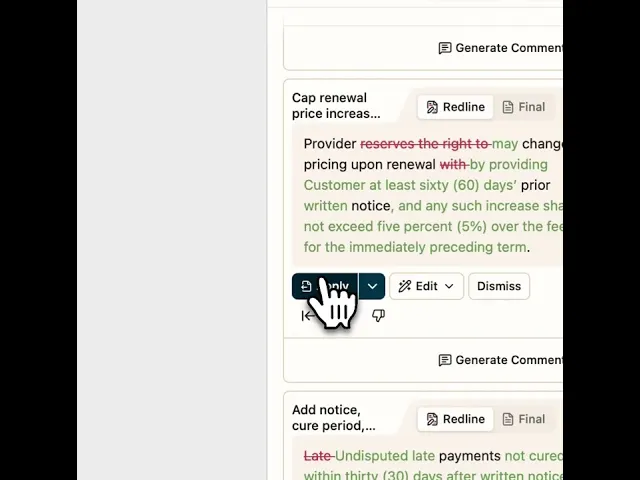
GC AI works inside Microsoft Word. GC AI for Word redlines, spots issues, and drafts in the document where contracts get finalized.
GC AI reviews contracts against your own standards. Playbooks encode your standard terms into repeatable review, and Easy Playbooks builds custom ones from your materials.
GC AI analyzes documents at scale. Files handles up to 1,500 pages at once, so multi-document reviews stay in one place.
GC AI cites so you can verify. Exact Quote pulls citations from your documents character for character.
GC AI does primary-law research. Research sends agents against primary law and authoritative sources, and US Case Law searches 13M+ US court opinions in chat, with citations that open the full opinion.
GC AI turns plain language into optimized legal prompts with Easy Prompt.
The teams that ran their own comparisons say it plainly. Trisha Mauer, VP of Legal at Tonal:
"I go straight to GC AI for everything from research requests to litigation responses. I've compared against ChatGPT, GC AI gives more comprehensive responses appropriate for a lawyer to use. After six months of use, I'm sure I've saved hundreds of hours."
Cameron Clark, Head of Legal at Arc'teryx:
"The use cases are so broad, from comms to contracts to strategy, it pays for itself in weeks."
Joys Choi, Senior Director of Legal at Tipalti, counted 609 hours saved in a single year.
The numbers behind that breadth, from GC AI's December 2025 ROI study of more than 100 active customers: a median 14 hours back per lawyer every week, a 14% cut in outside counsel spend, and 97.5% of teams seeing value before month one. For the median company that 14% is roughly $252,000 a year, against the $1.8M median outside counsel spend in the ACC Law Department Management Benchmarking Report. You can estimate your own ROI against your team's numbers.
As of September 2026, 2,100+ legal teams across 53 countries run on GC AI, including Hitachi, Liquid Death, Snyk, and Columbia, plus 300+ public companies and 75 unicorns, at an NPS of 77, the range of Apple and Netflix. Security clears the company review: SOC 2 Type II and SOC 3 certified, GDPR compliant, with zero data retention agreements with its model providers wherever feasible, and AES-256 encryption. Pricing is published: $500 per seat per month, about $5,000 per seat per year on annual billing, with no seat minimum and a 14-day trial.
Choose GC AI if you carry the full in-house desk. No platform on this list covers more of the in-house week in one place, because no other platform was built around that week: the redline, the research memo, the employment answer, and the privacy review clear in the same workspace, with citations you verify before anything leaves legal, at a price you can put in a budget today.
The 8 GC AI Alternatives
Each platform below is genuinely good at something. The question is whether that something matches your team's week.
Harvey
Harvey was built for Big Law first. Co-founder Winston Weinberg, a former O'Melveny securities litigator, shaped the product around the work AmLaw associates do under partner supervision: long-form memos, precedent-heavy research, and Vault's bulk document review for M&A data rooms. The in-house product came later, and the roster (Deutsche Telekom, Comcast, Procter & Gamble) shows where it lands: enterprise.
At Harvey's May 2026 Reddit AMA, Weinberg described the company as "starting to support smaller firms, nonprofits, and government agencies." Starting is the operative word. As of September 2026, Harvey sells through demos, with no public pricing and no free trial.
Choose Harvey if you run a large enterprise legal department, your work leans toward litigation, M&A diligence, and complex regulatory research, and you have the budget and procurement runway for an enterprise contract.
Choose GC AI instead if you want a platform whose defaults were written for the in-house desk from day one. GC AI publishes its pricing and hands you a 14-day trial, so a lean team proves value on its own matters this week instead of waiting out a demo-to-contract process.
See the full breakdown in GC AI vs Harvey, the Harvey review, or the 9 best Harvey alternatives.
Spellbook
Spellbook reviews and drafts contracts inside Microsoft Word and serves both law firms and in-house teams. Its Compare to Market feature benchmarks a clause against market positions drawn from a large contract dataset, which earns its keep when you negotiate the same agreement types repeatedly. Spellbook prices through demos and offers a 7-day free trial (as of September 2026).
Choose Spellbook if your week is largely Word-based contract drafting and redlining and market benchmarking on your clauses is a real part of how you negotiate.
Choose GC AI instead if contracts are one part of a wider desk. GC AI does the Word-native redline too, and the difference shows the first week a research question, an employment issue, and a privacy review land alongside a contract and you clear all of it in one place.
See the full breakdown in GC AI vs Spellbook or the 12 best Spellbook alternatives.
Thomson Reuters CoCounsel
CoCounsel is the AI layer on Westlaw and Practical Law, across legal, tax, and audit work. A CoCounsel decision is typically a Westlaw decision: teams that already hold Thomson Reuters seats add AI to a research relationship they already own. Pricing is quote-based (as of September 2026).
Choose CoCounsel if deep, Westlaw-grounded legal research sits at the center of your work and you already run on the Thomson Reuters stack.
Choose GC AI instead if research is one lane of your week rather than the whole of it. GC AI's Research agent and US Case Law cover the daily research load with citations you verify, and the contracts, employment, and privacy work comes with them.
Read the full CoCounsel review for features, pricing, and in-house fit.
Legora
Legora, formerly Leya, is a collaborative legal AI platform built on its own agentic operating system, used by law firms and in-house teams with strength across M&A, litigation, banking, and tax. It connects to Word and Outlook, monitors regulation for changes, and has clear European roots. Pricing is demo-based (as of September 2026).
Choose Legora if you run cross-border, multi-language matters and want several lawyers collaborating inside one agentic workspace.
Choose GC AI instead if your priority is the day-to-day in-house desk over multi-party deal collaboration, with published pricing you can budget rather than a quote you have to wait for.
See the full breakdown in GC AI vs Legora.
LegalOn
LegalOn calls itself the AI productivity platform for in-house legal. It ships attorney-built contract-review playbooks you can customize, plus an Assistant, a Vault for contract insights, matter management, and Word integration. The playbook library gives you standardized review positions on day one. Pricing is demo-based (as of September 2026).
Choose LegalOn if you want ready-made contract-review playbooks and matter tracking with minimal setup.
Choose GC AI instead if one lawyer has to carry the whole department. Arc'teryx ran its entire first year of legal on GC AI with a single lawyer, encoding its own standard terms in Playbooks and Easy Playbooks, then handling research, employment, and regulatory questions without leaving the platform.
See the full breakdown in GC AI vs LegalOn.
Gavel Exec
Gavel Exec reviews and drafts contracts inside Microsoft Word and online, with playbooks that auto-apply your standards as suggested redlines, clause benchmarking against market data, and multi-document checks for gaps and inconsistencies. It is the most accessible option on this list to try and to buy: 25 free queries per user with no credit card, then $160 per user per month or $1,740 per user per year as of September 2026.
Choose Gavel Exec if Word-based contract review and redlining is the bulk of the job and the lowest published seat price is the deciding factor.
Choose GC AI instead if your desk runs past contracts. Both platforms publish pricing, so the arithmetic is simple: Gavel Exec's $1,740 per user per year against GC AI's roughly $5,000 leaves a difference of about $270 a month, and that $270 buys the rest of the desk, the research, the employment question, the privacy review, and the answer leadership needs. It pays for itself the first week it saves an hour.
See the full breakdown in GC AI vs Gavel.
Ivo
Ivo is a contract review platform built for enterprise in-house teams. It redlines against playbooks and prior contracts inside Microsoft Word and Google Docs, benchmarks deals against your contract history, and analyzes whole contract libraries. Pricing is demo-based (as of September 2026).
Choose Ivo if you want focused, high-quality contract review and redlining across Word and Google Docs for an enterprise team.
Choose GC AI instead if you want the redline plus the rest of the desk in one place, where the research, the employment question, and the privacy review happen in the same tab as the contract.
See the full list of Ivo alternatives.
ChatGPT, Claude, Gemini, Copilot, and Perplexity
The general-purpose models are where most in-house lawyers start. ChatGPT and Claude handle brainstorming, summaries, and first drafts. Gemini lives in Google Workspace, Copilot in Microsoft 365, and Perplexity answers questions with web citations. They are flexible, everywhere, and cheap to begin (as of September 2026). Legal work that has to hold up needs three things these models leave to you: character-level citations from your own documents, grounding in primary law, and zero-data-retention security terms, backed by SOC 2 certification, that your company will sign off on. On the In-House Legal Bench, GC AI outscored all three general models tested, and the results are at the top of this page.
Choose a general model if you want a low-cost assistant for non-confidential knowledge work and brainstorming.
Choose GC AI instead if the work is legal and the output has to stand, grounded in your documents and primary law with Exact Quote citations, under SOC 2 Type II security with zero data retention with its model providers wherever feasible.
We reviewed each one for legal work: GC AI vs ChatGPT, GC AI vs Claude, Gemini for Lawyers, Copilot for Lawyers, and Perplexity for Lawyers.
Other Names You Will See on Alternatives Lists
Other roundups of GC AI alternatives mention a few tools this page has not covered. The honest read on each:
Wordsmith is an enterprise legal AI platform for in-house teams, with playbook-driven review and integrations into Slack, Gmail, and Word. It prices through demos (as of September 2026) and shows up most in enterprise evaluations.
Vaquill is a self-serve legal AI suite aimed at solo GCs and fractional counsel, with a 7-day trial and per-seat pricing shown at signup. If budget rules out every platform above, it is a reasonable place to start.
StrongSuit, formerly Callidus, is a litigation research platform built around briefs, memoranda, and a 10M+ case database. That is a law-firm lane rather than the in-house desk this page is about.
Can You Run GC AI Alongside Another Tool?
Yes, and during an evaluation most teams do. A common pattern keeps one specialist, a Word-native redliner, a Westlaw research seat, or Harvey for a specific enterprise mandate, for its one lane, while GC AI carries the broad desk. Run them side by side for a few weeks and watch where each one earns its seat.
One thing to keep straight: GC AI is already Word-native, operating in the same place as Spellbook, Gavel Exec, Ivo, and Harvey's assistant, so "it lives in Word" is thin justification on its own for a second contract tool. Here is how AI review works inside Word. What teams find after a few weeks is that coverage consolidates. When one platform handles most of the week with citations you verify, the second subscription gets harder to justify. For the category-wide view past direct GC AI alternatives, see the best legal AI tools for in-house counsel.
The Case for Running GC AI on Your Own Matters
Every platform on this page is good at something. What no alternative replaces is the combination: the redline, the research memo, the employment answer, and the privacy review cleared in one workspace, in Word and on the web, with every citation verifiable down to the character before it reaches the business. That is the shape of in-house work, and it is what GC AI was built around, end to end.
The fastest way to test that claim is on your own paper. Run GC AI for 14 days against whatever you use today, on a live contract, a real research question, and last week's employment issue. If you evaluated the platform a while back, run it again; it ships fast enough that a six-month-old impression is out of date.
Or bring your desk to a solutions attorney, who will walk the exact workflows you run and build the evaluation around them.
Frequently Asked Questions
What Makes GC AI Different from Other Legal AI Platforms?
GC AI is built for the full in-house desk, covering contract review, legal research, employment, privacy, and regulatory work in one platform. Most alternatives specialize in a single lane, such as Word-native contract redlining or Westlaw-grounded research, and leave the rest of the week uncovered.
How Did GC AI Perform Against Alternatives in Benchmark Testing?
GC AI scored 86.8% on the In-House Legal Bench, its own published benchmark of 100 real in-house tasks scored against 1,200+ attorney-developed criteria. ChatGPT (GPT-5.5) scored 79.8%, Claude (Opus 4.7) scored 68.4%, and Gemini (3.1 Pro) scored 57.5%. GC AI built and ran the benchmark, and the full methodology and task set are published for review.
What Is GC AI's Pricing and Is There a Trial?
GC AI is priced at $500 per seat per month, or about $5,000 per seat per year on annual billing, with no seat minimum. A 14-day trial is available without a sales call.
Which Alternative Is Best for Deep Case-Law Research?
GC AI is the strongest pick for case-law research on this list. US Case Law searches 13M+ US court opinions in chat and returns answers with citations that open the full opinion for verification, and the Research agent works from primary law and authoritative sources. Thomson Reuters CoCounsel fits teams already paying for Westlaw and Practical Law, adding AI to a research relationship they already own.
Is GC AI Secure Enough for Corporate Legal Work?
GC AI holds SOC 2 Type II and SOC 3 certifications, is GDPR compliant, and has zero data retention agreements with its model providers wherever feasible, with AES-256 encryption. These terms are in writing and available for company review.
Can GC AI Be Run Alongside Another Legal AI Tool?
Yes, and many teams run GC AI in parallel with a specialist tool during evaluation. A common pattern keeps one narrow tool, such as a Westlaw seat or a Word-native redliner, for its specific lane while GC AI handles the broader desk.
Does GC AI Work Inside Microsoft Word?
Yes. GC AI for Word runs directly inside the document where contracts are finalized, handling redlines, issue spotting, and drafting without switching to a separate web app.
What Results Have In-House Teams Reported with GC AI?
Across a December 2025 ROI study of 100+ active customers, teams reported a median of 14 hours back per lawyer per week, a 14% reduction in outside counsel spend, and 97.5% of teams seeing value before the end of month one.
Which Alternative Is Best for Enterprise Legal Departments?
GC AI is the strongest fit for enterprise legal departments that want one platform across the full desk. As of September 2026, 2,100+ legal teams run on it, including Hitachi and 300+ public companies, with SOC 2 Type II and SOC 3 certification, zero data retention agreements with its model providers wherever feasible, and an Enterprise tier that adds SSO and managed procurement. Harvey remains a common shortlist entry where the work centers on litigation and M&A diligence.