Spellbook is built for contract drafting and review inside Microsoft Word. For in-house teams whose work extends past that surface, this guide rates 12 Spellbook alternatives, with GC AI as our pick.
In March 2026, the Canadian Bar Association named Spellbook its exclusive AI contract drafting and review partner, a two-year deal that puts Spellbook in front of roughly 40,000 lawyers, judges, and law students. The deal points Spellbook’s product roadmap at law firm workflows. You run an in-house team, and your week looks nothing like a firm’s.
Spellbook’s product suite covers Review for AI contract redlining, Playbooks with saved instructions for repeatable review, Draft for clause generation, Ask for Q&A about contracts you have uploaded, Benchmarks for clause comparison against a proprietary dataset of 2,000+ industry standards, Associate for multi-document agent workflows, and a Clause Library. Pricing is not published; every purchase starts with a sales demo. On that surface, Spellbook has depth.
Your day covers more ground. You field an employment termination question from HR in the morning. You review a vendor’s data processing addendum during lunch. Your CEO pings you about the board memo, and the product team wants a fifty-state survey on a new announcement. Spellbook’s Ask feature answers questions about contracts you have uploaded. It does not reach case law, statutes, or regulations. For the work that lives outside contract drafting, your team is routing to generic AI, outside counsel, or a separate research platform.
We build GC AI, the legal AI platform for in-house counsel. Cecilia Ziniti founded GC AI in November 2023 with co-founder Bardia Pourvakil.
Bardia has been an AI engineer since GPT-2 and worked at Replit alongside Cecilia. At Replit, the two watched AI collapse the time it took for developers to write working software, and saw the same shape of problem waiting in legal.
Most legal AI was built for law firms, or sold as general-purpose software with a legal use case bolted on. Neither understood how in-house teams work: company-specific playbooks, cross-functional stakeholders, and a risk tolerance that changes by deal. GC AI is built for that workflow. 2,100+ legal teams across 53 countries run on it as of September 2026, including 200+ public companies and 25 unicorns.
The Law Firm Tool, the In-House Job
The Canadian Bar Association deal maps to the workflows Spellbook optimizes for. Set those next to the ones an in-house team carries, and the fit gap is plain.
Law Firm Workflows Spellbook Optimizes For | In-House Workflows That Run Past Spellbook |
|---|---|
High-volume contract drafting and redlining billed to clients | Daily commercial contracts plus employment, privacy, and regulatory questions |
Counterparty negotiation markups inside Word | Board memos, executive summaries, and answers written for non-lawyers |
Benchmarks against a market-standard clause dataset | Company-specific playbooks and a risk tolerance that shifts by deal |
Partner-led adoption and associate training | A lean team where one counsel is the partner, the associate, and the trainer |
Matter work organized as billable files | Cross-functional intake from HR, sales, finance, and the CEO |
Case-by-case client engagements | Persistent matter memory across one ongoing relationship with the business |
Why You Walked Away From Spellbook
The general counsel role is shifting. Bloomberg Law’s series on the evolving GC role describes today’s in-house leaders as “architects of AI-enabled legal functions, stewards of an innovative culture, and strategic partners who help shape the entire enterprise beyond the legal department.” A platform shaped for transactional drafting does not cover that reach.
Three structural reasons show up across in-house evaluations.
Your week extends well beyond contract drafting. You spend roughly half your week on contracts and the other half on employment, privacy, regulatory work, governance, and stakeholder enablement. A drafting-first platform leaves that second half to generic AI, outside counsel, or manual research.
For a deeper breakdown of Spellbook’s strengths, limitations, pricing structure, and workflow fit for legal departments, see Spellbook Legal AI Review [2026]: Is It Right for In-House Counsel?
Your output goes to the CEO. Spellbook’s defaults optimize for transactional drafting precision: counterparty markups, negotiation positions, clause-level edits. You write for a board, a regulator, or a head of sales most days, and those readers are not lawyers. If the default voice is firm-style, every send to the business adds a tone-pass step.
Your CFO wants a line item. Spellbook wants a sales call. Spellbook’s pricing is structured around the number of team members on a license, and a demo is required to get a number. You cannot forecast cost without a sales conversation.
Other Tradeoffs Worth Weighing
Legal research. Spellbook’s Ask feature answers questions about contracts you have uploaded. It does not search case law, statutes, or regulations. Your regulator letter, your multi-state survey, and your compliance question run on a separate research platform or on outside counsel.
Matter memory. Spellbook uses Preference Learning, which adapts automatically from user edits. Buyers evaluating any preference-learning system should ask how the vendor isolates context across unrelated matters.
Adoption layer. Firm-side adoption leans on partners and senior associates who drive training from the top. Your lean in-house team does not have that layer, so you are the partner, the associate, and the trainer at once.
Data perimeter. GC AI uses explicit document uploads: in-house counsel decide which contracts, policies, and matters sit inside the platform’s perimeter. Spellbook’s Preference Learning adapts automatically from user edits, which works for high-volume drafting. The two are different perimeter models: ask each vendor how preference data is scoped, stored, and kept out of model training.
If you are deciding between Spellbook and GC AI specifically rather than scanning the full field, the deep head-to-head is at GC AI vs Spellbook.
Same Contract, Two Tools
Run one clause through both products and the design philosophy shows. Take a mutual confidentiality provision, the kind that lands in your inbox a dozen times a week. The GC AI confidentiality clause library shows the standard form: “Each Party shall keep confidential all Confidential Information that the other Party has disclosed or may hereafter disclose directly or indirectly to it as a result of or in the course of performance of this Agreement.”
In Spellbook, that clause opens in Microsoft Word: a redline, a suggested edit, and a negotiation comment aimed at the counterparty. In GC AI, the same clause runs on the web or in Word, and alongside the redline you get a plain-language read of what the clause does, where it sits against market, and a short summary you can forward to the business owner who asked. Spellbook stops at the redline. GC AI adds the plain-language read you would otherwise write yourself.
The same split shows up on higher-stakes language. An indemnification clause or a limitation of liability clause needs a redline for the counterparty and a plain-language read for the business owner carrying the risk, and GC AI produces both.
Why In-House Adoption Is Outpacing Law Firms
The shift is external too. Business Insider reported in January 2026 that in-house legal teams are moving faster than law firms on AI adoption, driven by cost-cutting pressure and the ability to sign small-footprint deployments without the partner-approval cycles firms carry. For a lean legal team, a 14-day self-serve trial on real NDAs is a faster procurement path than a multi-month firm-side rollout.
Category validation from outside the legal industry is also building. On Lenny’s Podcast, Vercel founder and CEO Guillermo Rauch (a GC AI investor) described his own legal team’s pick:
“Our legal team loves this tool called Get GC.AI. They could in theory go to ChatGPT to ask legal questions, but someone out there decided, ‘I’m going to build the best legal AI tool in the world. It’s going to be up to date. I’m going to obsess about this problem.’ The CEO herself is a lawyer, so it’s going to be hard to compete with that.” Guillermo Rauch, founder and CEO, Vercel.
Inside the legal profession, the same shift shows up. On CZ and Friends, Danielle Sheer, Chief Trust Officer at Commvault, named the new baseline:
“Legal needs to sharpen their tools now because anybody can GC AI a question and get a legal answer.” Danielle Sheer, Chief Trust Officer, Commvault.
How We Evaluated These 12 Spellbook Alternatives
Every platform in this guide is rated across five criteria that decide in-house procurement.
Workflow fit for in-house. Contract review, playbook-driven redlining, research, matter memory, Word drafting, intake. The full week of in-house legal work.
Citation discipline. Character-level quoting from source documents. You cannot forward a paraphrase to your CEO.
Security and data governance. SOC 2 Type II, GDPR, zero data retention with the underlying model providers, strong encryption. Your security team will ask.
Pricing transparency and seat flexibility. Published number, seat minimum, free trial. Your CFO will ask.
Time to value. Whether the platform proves itself on your real work in week one, or requires a quarter of implementation first.
The 12 Best Spellbook Alternatives at a Glance
Sorted by the workload each platform serves. The full reasoning sits in the sections that follow.
Our pick for in-house counsel: GC AI. Published $500 per seat per month, 14-day free trial, no seat minimum. Purpose-built for in-house counsel by a three-time general counsel.
Ivo. Contract review for enterprise in-house teams.
LEGALFLY. In-house platform with data anonymization before AI processing.
LegalOn. Pre-built attorney-drafted playbooks across Word and web.
Gavel Exec. Word-native contract redlining with published per-seat pricing ($160 per seat per month).
Definely. Complex-contract drafting for teams with iManage as the DMS.
Thomson Reuters CoCounsel. Research-first, bundled with the Westlaw corpus.
Lexis+ AI. Research-first, bundled with the Lexis corpus.
Legora. European legal AI platform serving UK and EU firms.
Harvey. Firm-first platform with an in-house solutions page added in 2026.
Ironclad. Contract lifecycle management with an AI layer.
Claude for Work and ChatGPT Business. Generic AI platforms with enterprise controls.
Comparison of Spellbook Alternatives for In-House Counsel
Platform | Built For | Pricing | Trial | SOC 2 / GDPR | Word Integration |
|---|---|---|---|---|---|
GC AI | In-house legal teams | $500/seat/month | 14 days, no credit card | SOC 2 Type II, SOC 3, GDPR, ZDR with OpenAI and Anthropic, AES-256 | Full Word Add-in (Chat2, Easy Prompt, Projects, Playbooks) |
Spellbook | In-house + law firms | Not published, sales-led | 7-day trial | SOC 2 Type II, HIPAA, GDPR, CCPA, EU AI Act; ZDR with OpenAI and Anthropic | Native Word plug-in (Review + Playbooks); Associate web app for multi-document workflows |
Ivo | Enterprise in-house | Not published | Via sales | SOC 2 Type II | Word redlining, agentic workflows |
LegalOn | In-house + law firms | Not published | Via sales | Enterprise controls | Word + online + PDF-to-Word |
LEGALFLY | In-house teams | Not published | Via sales | SOC 2 Type II, ISO 27001 | Word smart templates |
Gavel Exec | Transactional + in-house | $160/seat/month | 25 free queries | SOC 2, HIPAA, GDPR, CCPA | Word-native redlining |
Definely | Law firms + in-house | Not published | Via sales | Enterprise controls | Word, iManage, SharePoint, NetDocuments |
Thomson Reuters CoCounsel | Research-heavy firms and teams | Enterprise, bundled with Westlaw | Via sales | SOC 2, enterprise | Limited |
Lexis+ AI | Research-heavy firms and teams | Enterprise, bundled with Lexis | Via sales | SOC 2, enterprise | Limited |
Legora | European firms, multi-jurisdictional practices | Not published | Via sales | Enterprise controls, EU data residency | Word integration |
Harvey | Large law firms, enterprise in-house | Enterprise, not published | Via sales | SOC 2 Type II, GDPR | Limited |
Ironclad | CLM and legal ops, alongside legal AI | Enterprise, usage-based | Via sales | SOC 2, GDPR | Limited |
Claude for Work | Thinking partner, budget-constrained teams | $20/seat/mo (Team Standard, annual) to $125/seat/mo (Team Premium, monthly); Enterprise quoted separately | Free tier | SOC 2 Type II, ISO 27001, ISO 42001 | M365 connector (read-only) |
ChatGPT Business | Thinking partner, budget-constrained teams | $20/seat/mo annual, $25/seat/mo monthly | Free tier | SOC 2 Type II | Via M365 Copilot bundle |
Comparison data as of July 2026.
For a comparison focused specifically on Microsoft Word workflows, see The 4 Best Legal AI for Word for In-House.
GC AI: The Best Spellbook Alternative for In-House Counsel
GC AI is an enterprise-ready legal AI platform for in-house counsel, purpose-built by a three-time general counsel. Every response routes through a 20,000-line legal system prompt that reads like advice from a colleague.
Both GC AI and Spellbook run frontier models. The difference between them is system prompt origin, workflow breadth, and founder DNA. Spellbook’s defaults reflect a Word-native transactional-drafting product. GC AI’s defaults reflect a three-time GC’s full in-house week: contracts plus employment, privacy, governance, research, and stakeholder enablement.
What GC AI Does That Spellbook Doesn’t (for In-House)
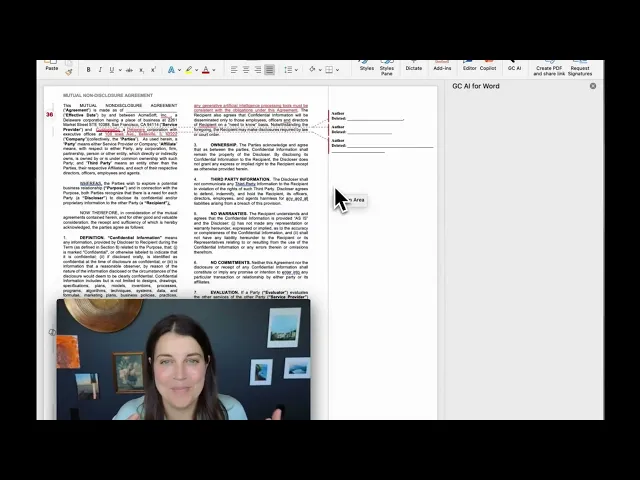
Easy Prompt turns “check this NDA for red flags” into the lawyer-grade prompt that produces usable output on the first run. Your colleagues outside legal can use it too.
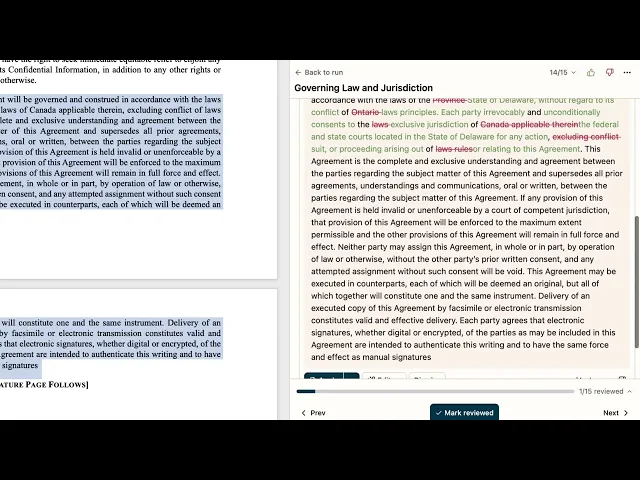
Exact Quote pulls verbatim language from any source document, character by character, and highlights the citation in Doc View. Your bar for “good enough to send to the CEO” is character-level verifiable against uploaded documents.
Playbooks turn your redline standards, NDA positions, DPA red lines, and MSA red flags into agentic workflows that run end-to-end against incoming paper. A Playbook can flag a non-standard termination clause the moment it lands in your inbox. Spellbook also offers Playbooks with saved instructions; GC AI’s run as full agents that surface deviations, market positions, and judgment calls outside the defined rules.
GC AI for Word is the Word Add-in that includes Chat2 for web research, saved prompts, Easy Prompt, and Projects. What you start in the web workspace pulls into Word with one click. Spellbook’s contract review lives in Word with a separate Associate web app for multi-document work; GC AI keeps the two surfaces synced.
Projects carry persistent matter memory. A Project remembers the parties, the counterparty’s paper, the negotiated positions, and your prior guidance across every chat. You upload the deal docs once, and two weeks later you do not re-brief yourself.
Custom Company Profile personalizes the platform to your voice, your templates, and what good looks like in your department. You control what the platform knows, so a vendor matter does not bleed into an employment one.
Research is multi-agent legal intelligence with real-time primary law and citations. Agents bias toward authoritative databases and government sites. Coverage includes commercial, regulatory, and employment terrain. Spellbook’s Ask feature answers questions about contracts you have uploaded, which is a narrower surface.
What 100+ In-House Customers Reported
Per GC AI’s December 2025 ROI study of more than 100 active customers, in-house lawyers using GC AI save an average of 14 hours per week, report a 14% reduction in outside counsel spend, and reflect 21% greater perceived accuracy than generic AI on the same legal tasks. 97.5% of survey respondents reported seeing value before the end of their first month.
GC AI’s customer base spans SaaS and developer tools (Vercel, Tekion, Jasper), cybersecurity (Snyk, Secure Code Warrior), fintech and payments (Tipalti, Gusto, Acorns), apparel and retail (Arc’teryx, Columbia, Carhartt), and consumer DTC (Liquid Death, Tonal, Helix).
“It’s made me incredibly more efficient. Year to date, I’ve saved 609 hours, the equivalent of 76 full working days.” Joys Choi, Senior Director, Legal, Tipalti.
Can Spellbook and GC AI Run Side by Side?
At large enterprises with both a high-volume transactional practice and a broader in-house workload, yes. The split is clean. Spellbook handles Benchmarks-driven contract drafting, where its depth is real. The in-house team runs GC AI for daily commercial contracts, privacy reviews, employment questions, research, and board prep. Each platform stays pointed at the workload it serves.
For lean in-house teams under 20 lawyers, running both is not needed. GC AI covers the in-house workload end to end, including contract review and drafting through Playbooks and GC AI for Word. A second legal AI seat does not earn the line item.
The Other Spellbook Alternatives Worth Considering
We rate each platform below on two decisions: when to choose the platform, and when GC AI is the better fit for an in-house team.
Ivo
Ivo is a contract review platform positioned for enterprise in-house teams. The product covers an AI contract repository that indexes without manual tagging, Word redlining, an agent for drafting and analysis, and benchmarks that flag contract terms differing from market.
Choose Ivo If: your primary bottleneck is contract review volume at an enterprise scale, and your team wants in-house-first positioning without the firm-side defaults that come with Spellbook.
Choose GC AI Instead If: your week extends beyond contract review into research, advisory, and stakeholder work. GC AI covers the full in-house workload; Ivo focuses on contract review.
Ivo and Spellbook represent two different approaches to contract AI: enterprise contract intelligence versus Word-native drafting and benchmarking. See Spellbook vs Ivo: Is Either Built for In-House Teams? for a direct comparison.
LegalOn
LegalOn is a contract review and redlining platform with pre-built attorney-drafted Playbooks. The product works inside Microsoft Word and in a web app, with PDF-to-Word conversion included.
Choose LegalOn If: your day is dominated by high-volume contract review against pre-written attorney rules, and PDF-to-Word conversion matters for your inbound paper.
Choose GC AI Instead If: your team needs per-matter memory at the depth of Projects, and your in-house workload includes research, advisory, and stakeholder enablement beyond contract review.
LEGALFLY
LEGALFLY is a legal AI platform built for in-house teams. Its differentiator is data anonymization: sensitive information is anonymized before AI analysis, with control and auditability held inside your environment. Word smart templates generate compliant first drafts.
Choose LEGALFLY If: your regulatory environment or procurement process requires anonymization before data leaves your environment.
Choose GC AI Instead If: your priority is workflow breadth (research, advisory, matter memory, classes) rather than privacy-first data handling as the lead layer.
Gavel Exec
Gavel Exec is a Word-native AI contract review platform from Gavel. Pricing is published at $160 per seat per month after a 25-query free trial. The playbook-plus-precedent model generates redlines and suggested comments.
Choose Gavel Exec If: you want the cheapest published Word-native contract redlining option and your team’s scope is limited to drafting and review.
Choose GC AI Instead If: your team needs standalone legal research, persistent matter memory at the depth of Projects, or response defaults tuned for the full in-house week.
If Gavel is on your shortlist, see our Gavel vs Spellbook: Which Legal AI Should You Buy? for a detailed comparison of their contract review capabilities, pricing, security, and in-house fit.
Definely
Definely is a specialist toolkit for complex contracts in Word. Its product suite includes Vault (drafting), Draft (one-click active drafting), Cascade (AI-assisted change tracking), Proof (proofreader), and Enhance (assistant). It integrates with Word, iManage, SharePoint, and NetDocuments.
Choose Definely If: your in-house team sits inside a company with firm-scale contract complexity and iManage as the DMS.
Choose GC AI Instead If: DMS integrations are not your primary need, and your workload extends beyond complex-contract drafting into research, advisory, and stakeholder work.
Thomson Reuters CoCounsel
CoCounsel is research-first, grounded in Westlaw. The AI layer sits on top of the Westlaw primary-law corpus. Pricing is enterprise and bundled with Westlaw.
Choose CoCounsel If: your team already holds Westlaw seats and the primary workload is case law retrieval, regulatory analysis, or litigation research.
Choose GC AI Instead If: your in-house workflow is primarily commercial contracts, privacy, employment, and business-stakeholder enablement rather than deep case law retrieval, and you do not want to buy a research platform you will use a fraction of the week.
CoCounsel’s Westlaw-backed research and Harvey’s document workflows reflect different approaches to legal AI. See Harvey vs CoCounsel: 2026 Side-by-Side Comparison for a closer look.
Lexis+ AI
Lexis+ AI mirrors the CoCounsel pattern with the Lexis corpus underneath. Enterprise pricing, bundled with Lexis.
Choose Lexis+ AI If: your team already holds Lexis seats and the primary workload is case law retrieval and legal research.
Choose GC AI Instead If: your in-house team needs contract review, playbook-driven redlining, Word-native drafting, and matter memory alongside research.
Legora
Legora is a European legal AI platform for large European law firms and multi-jurisdictional practices. Data residency options matter in European procurement.
Choose Legora If: your team is European, or your European workload sits inside a practice that requires regional data residency.
Choose GC AI Instead If: you are a US in-house team, or your European workload sits inside a US parent and you want a platform built from day one for in-house. Deeper comparison at GC AI vs Legora.
Harvey
Harvey is a law-firm-first legal AI platform. Its product suite includes Assistant, Vault for bulk document analysis, Knowledge for firm-specific research, and Workflow Agents for custom automations. In 2026 Harvey extended into in-house with a dedicated solutions page.
Choose Harvey If: you are a large law firm or an enterprise legal department with significant outside counsel relationships and a need for 100,000-document due diligence workflows.
Choose GC AI Instead If: you are an in-house team with lean procurement expectations, you want published pricing and a self-serve trial, and your workload is commercial and advisory work. Deeper comparison at GC AI vs Harvey.
Harvey and Spellbook represent two different approaches to legal AI. For a direct comparison of the two, see Spellbook vs Harvey: Which One Fits Your Legal Team?
Ironclad
Ironclad is an enterprise contract lifecycle management platform with an AI layer. It manages the contract record: creation, negotiation, execution, storage, and obligation tracking. CLM and legal AI solve different layers, so they typically coexist rather than compete.
Choose Ironclad Alongside GC AI If: you need CLM for contract operations and a legal AI platform for everything else: research, advisory, playbook review, Word drafting, and matter memory.
Claude for Work and ChatGPT Business
Claude for Work and ChatGPT Business are general-purpose AI platforms with enterprise controls. ChatGPT Business is $20 per seat per month annual or $25 monthly. Claude for Work runs $20 per seat per month for Team Standard on annual billing, or $125 per seat per month for Team Premium on monthly billing; Enterprise is quoted separately.
Choose Claude for Work or ChatGPT Business If: you want a general-purpose thinking partner for non-confidential first drafts and broad research on non-legal questions.
Choose GC AI Instead If: you handle client-confidential matters and need legal-specific citation discipline, in-house workflow features like Playbooks, Projects, and Exact Quote, and content handling that does not block legal outputs. Treat generic AI as a bridge to legal AI.
Dive deeper with our guides:
The Adoption Layer In-House Teams Don’t Have
Your platform purchase is the easy part. Your team fluency is where the value compounds, and this is where in-house teams without firm-style adoption layers feel the drop. Firm-side deployments lean on partners and senior associates to drive training from the top. Your in-house team does not have that layer. You are the partner, the associate, and the trainer, all in one inbox.
GC AI runs free, California CLE-eligible AI courses for legal professionals taught by former general counsels:
The 101 course covers AI prompting fundamentals for in-house counsel.
The 105 course walks through AI-assisted redlining and drafting inside Microsoft Word.
The 106 and 107 courses teach your team how to build and deploy Playbooks for automated contract review.
More than 6,000 lawyers have been taught through these classes. The curriculum keeps expanding.
What Replacing Spellbook Looks Like in Week One
Day one: install GC AI for Word, run last week’s NDA through Easy Prompt, and see character-level citations on your own paper.
Day three: build your first Playbook from a redline standard you already use.
Day five: your team sees time saved, your CFO sees a $500 line item instead of a sales-led enterprise contract. No procurement cycle. No quarterly implementation. No sign-off chain.
“What used to take an hour, like reviewing contract feedback and drafting a reply, now takes ten minutes, and the results are better.” Cameron Clark, Head of Legal, Arc’teryx.
Frequently Asked Questions
What Is the Best Spellbook Alternative for In-House Counsel?
The best Spellbook alternative for in-house counsel in 2026 is GC AI. It is purpose-built for in-house legal work. Pricing is published at $500 per seat per month with a 14-day free trial and no seat minimum. Every response routes through a 20,000-line legal system prompt written by a three-time general counsel for in-house workflows.
Why Are In-House Teams Evaluating Spellbook Alternatives?
The in-house workload is broader than contract drafting, covering employment, privacy, regulatory, research, and business-stakeholder enablement. Spellbook does not publish pricing, so in-house buyers cannot forecast cost without a sales conversation. Spellbook also serves law firms from small to large alongside in-house teams inside the same product, so the defaults reflect a broader audience than a purpose-built in-house workflow.
Is Spellbook Good for In-House Teams?
Spellbook does strong work for contract drafting and review inside Microsoft Word, and in-house teams that live mostly in transactional paper get value from it. The gap shows up across the rest of the in-house week. Employment questions from HR, a vendor data processing addendum, a board memo for the CEO, and a multi-state regulatory survey all run past Spellbook’s contract surface, because its Ask feature answers questions about contracts you have uploaded and does not reach case law, statutes, or regulations. In-house teams that want one platform for the full week tend to pick GC AI, which is purpose-built for in-house counsel by a three-time general counsel.
Is Spellbook Built for Law Firms or In-House Counsel?
Spellbook serves both, and its direction points at law firms. In March 2026 Spellbook named the Canadian Bar Association, which represents roughly 40,000 lawyers, judges, and law students, as its exclusive AI partner under a two-year deal. That shapes the product around firm-style transactional drafting and redlining inside Microsoft Word. GC AI is purpose-built for in-house counsel, so its defaults reflect the full in-house week of contracts, employment, privacy, governance, research, and stakeholder enablement.
Does Spellbook Offer Legal Research?
Spellbook focuses on contract drafting, review, and clause-level Q&A inside Microsoft Word. Its Ask feature answers questions about contracts you have uploaded, but does not search case law, statutes, or regulations. For multi-jurisdictional regulatory analysis or case law retrieval, GC AI Research, Thomson Reuters CoCounsel, or Lexis+ AI is the right addition.
How Does GC AI Compare to Spellbook on Features?
GC AI for Word covers the contract drafting and review Spellbook is known for, and adds Playbooks for agentic contract review against your team’s standards, Projects for persistent matter memory, Custom Company Profile for per-user personalization, Easy Prompt for plain-language prompt optimization, Exact Quote for character-level citations, and Chat2 for web research inside Word. GC AI Research handles multi-jurisdictional and regulatory research that Spellbook does not cover.
What Is the Best Legal AI for In-House Contract Review?
GC AI. The combination of Exact Quote (character-level citation against uploaded documents), Playbooks (agentic repeatable review against your standards), GC AI for Word with Chat2, and Projects (persistent matter memory) covers the in-house contract review workflow end to end.
How Much Does Spellbook Cost?
Spellbook does not publish pricing and requires a sales conversation. Per their website, pricing is structured around the number of team members on a license. GC AI publishes pricing at gc.ai/pricing: $500 per seat per month with a 14-day free trial, no credit card required, and no seat minimum.
What Security and Compliance Does GC AI Have?
GC AI is SOC 2 Type II and SOC 3 certified, GDPR compliant, with zero data retention agreements with OpenAI and Anthropic, and AES-256 encryption. GC AI runs on OpenAI, Anthropic, Cohere, Reducto, and Google.