The question that lands on an in-house lawyer’s desk is seldom “what does this case hold?” It is “what is market on this indemnity cap, and can we sign by Thursday?” In-house legal research runs across statutes, regulations, peer deal terms, company playbooks, and board-level precedent. Case law is one slice of the job.
This guide is for GCs, deputy GCs, legal ops, contract managers, and the finance and operations leaders who share legal-adjacent sign-off. AI for legal research is transforming day-to-day in-house work. It has moved past the “will it hallucinate” phase and into a practical question: which workflow gets your team to a cited, defensible answer the fastest, without sending the research bill to outside counsel?
Start with the job to be done, not the tool. In-house research splits into a handful of recurring jobs: a regulatory compliance question, a “what is market” contract question, an employment-law question, an IP landscape scan, a fifty-state survey, and the occasional case-law or litigation question. Each recurring job has a tool that is built for it, and matching the job to the tool is the whole game.
What Is AI Legal Research?
AI legal research is the use of retrieval-grounded large language models to pull, cite, and synthesize answers from primary law, secondary sources, and internal documents. Well-grounded systems anchor answers to named sources and expose the underlying citations, so the reader can verify the source in one click.
Traditional legal research retrieves documents. AI legal research retrieves, reads, synthesizes, and drafts, in one pass. For a litigator, that means case law, statutes, and briefs. For an in-house lawyer, the job expands: regulatory guidance, enforcement actions, 10-K disclosures, industry playbooks, peer deal comps, and the team’s own prior work.
In Bloomberg Law’s “GC x AI” series, Cox Media Group general counsel Eric Dodson Greenberg describes tomorrow’s legal leaders as “architects of AI-enabled legal functions, stewards of an innovative culture, and strategic partners who help shape the entire enterprise beyond the legal department.” The research workload reflects that scope. Case law is one input. Business context is everything else.
GC AI’s CEO and co-founder, Cecilia Ziniti, was a general counsel three times (Anki, Bloomtech, and Replit), and an in-house counsel at Amazon and Cruise. Ziniti built GC AI to solve the problems she encountered firsthand as an in-house lawyer, and that experience is embedded directly into GC AI’s system prompt, tone, and workflows. The point of the bio is the build: an in-house platform built by someone who carried the in-house research load.
Why In-House Research Is a Different Job From Litigation Research
Most AI legal research content focuses on litigation and case law. In-house counsel rarely litigate. The day-to-day in-house workload is regulatory monitoring, contract market terms, employment questions, IP landscape scans, and fifty-state surveys, with the occasional case-law question routed to litigation counsel. The research workflows are different, and so are the tools built for them.
A litigation-first platform indexes case law and builds its workflow around briefs, motions, and citations to precedent. An in-house platform indexes regulations, peer deal terms, company playbooks, and the team’s own prior work, then connects research to a redline or a memo in the same pass. Buying a firm-first platform for an in-house problem is the expensive mistake the matrix below prevents.
In-house research job | Tool built for the job |
|---|---|
Regulatory compliance question | GC AI |
Case law or litigation research | Westlaw or CoCounsel; GC AI for many in-house case-law questions |
Contract market terms, “what is market” | GC AI |
Employment-law question | GC AI |
IP landscape scan | GC AI |
Fifty-state survey | GC AI |
Read the matrix as a routing rule. Send case law and litigation research to Westlaw or Thomson Reuters CoCounsel.
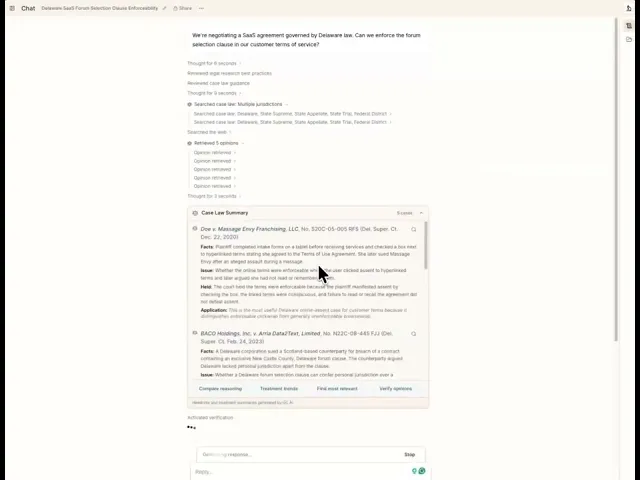
As of June 2026, GC AI also searches US case law directly, 13M+ federal and state court opinions read and synthesized in the same chat, so many case-law questions that once required a separate database now resolve where the rest of the in-house work already happens.
Send everything else, which is the bulk of the in-house week, to a platform built for the in-house job. For an employment question, the GC AI non-compete clause library surfaces real filed restrictive-covenant language to test enforceability and market scope against.
A Worked Example: Researching a Market Indemnity Cap
Take the question from the top of this guide. Your business counterpart wants to sign by Thursday and asks whether a 3x fees cap on indemnity is standard for a SaaS agreement. Here is the difference grounding makes.
The question. Is a 3x annual-fees cap on indemnity, with a carve-out for confidentiality and IP breaches, standard for a mid-market SaaS contract?
What generic AI returns. A fluent paragraph explaining that liability caps are common, that 1x to 3x of fees is a “typical range,” and that carve-outs for confidentiality and IP are “often negotiated.” No source you can open. No way to know whether the model read a real contract or pattern-matched on training data. You still cannot tell your counterpart where the number comes from.
What GC AI returns, with the citation visible. A grounded answer that pulls real limitation-of-liability language from filings and pins the exact quote alongside it. The GC AI Limitation of Liability clause library surfaces verbatim examples like Klaviyo’s 2020 SaaS consequential-damages exclusion with a carve-out:
“IN NO EVENT SHALL EITHER PARTY BE LIABLE FOR ANY INDIRECT, INCIDENTAL, SPECIAL OR CONSEQUENTIAL DAMAGES OF ANY TYPE OR NATURE ARISING OUT OF OR ASSOCIATED WITH THIS AGREEMENT EVEN IF SUCH PARTY HAS BEEN ADVISED OF THE POSSIBILITY OF SUCH DAMAGES, EXCEPT TO THE EXTENT THAT SUCH ARISES FROM A PARTY’S BREACH OF SECTION 6.”
The carve-out structure is what to study here. This clause excludes consequential damages, then carves a specific breach (here, a Section 6 breach) back out from that exclusion, the same structural move a fees cap makes when it exempts confidentiality and IP. The example shows how market carve-outs are written, not that any single cap multiple is standard.
With Exact Quote, the source sits one click away, so the benchmark you send is grounded in filed language, not a confident guess. That is the difference between research that ends at an answer and research a partner or a counterparty can check.
How AI Legal Research Works
Two architectures dominate the category: chat-only and agentic.
Chat-only systems take a prompt and return a single response. Citations sit alongside the text, sometimes linked, sometimes not. The system does one thing at a time.
Agentic systems deploy multiple agents to search, retrieve, cross-reference, and synthesize in parallel, then return a cited answer. The agent can follow a multi-step workflow: search the regulation, pull the enforcement history, compare it to the company’s prior filings, and draft a client alert ready for Word.
The grounding method matters more than the branding. Retrieval-augmented generation, RAG, pulls from a curated source set before generating. Character-level citation retrieves an exact quote from an uploaded document and surfaces it alongside the answer. These two techniques are the difference between a defensible research output and a confident-sounding guess.
Agentic workflows compress research-to-action. Research that ends at an answer still needs a drafter. Research that ends at a redline, a memo, or a playbook update is already half of the delivery.
Why In-House Legal Research Breaks Without AI
In-house legal research breaks without AI because the workload has outgrown the hours available to lean teams. Business timelines do not wait for lawyers. A finance team signs a vendor agreement on Thursday. A new EU regulation hits the news on Friday. A board member asks for an M and A precedent scan by Monday. In-house counsel carries your enterprise’s legal risk on the same lean headcount as a decade ago.
Four pressure points define the in-house research problem:
Volume. The legal inbox scales with the business. A 50-person legal team inside a 5,000-person company covers everything from privacy to employment to procurement.
Multi-jurisdictional complexity. A SaaS company signs in 40 states and 15 countries. A new contract needs a quick jurisdiction check, and the traditional path runs through outside counsel, which takes days.
“What’s market” questions. Negotiation happens live. Business counterparts expect a benchmark answer in minutes. Outside counsel is expensive for the same benchmark question asked 20 times a year.
Budget pressure. ACC data shows outside counsel captures 87% of external legal spend in the typical corporate department, with median outside counsel spend of $1.8 million per company. Research hours that stay in-house compound.
The Honest Risks: Hallucinations, Jurisdiction Gaps, and Grounding
The main risks of AI legal research are hallucinated citations, narrower source coverage, and paraphrase errors that sound authoritative.
The foundational study on the impact of generative AI on legal research is Stanford’s Magesh et al., Hallucination-Free? Assessing the Reliability of Leading AI Legal Research Tools, published as a preprint in May 2024 and peer-reviewed in the Journal of Empirical Legal Studies in 2025.
Three findings matter for any in-house buyer:
Lexis+ AI hallucinated on roughly 17% of tested research queries.
Westlaw’s AI-Assisted Research hallucinated on roughly one-third of tested research queries.
Ask Practical Law AI hallucinated on roughly 17% of queries and returned incomplete answers on 62% of queries, due to a narrower source universe.
Peer review confirmed these patterns. Hallucination rates have improved since, and retrieval grounding has tightened across the category. The risk has not disappeared. It has shifted from “the model made up a case” to “the citation is real, but the model summarized it wrong.”
For real-world examples of how these failures have led to sanctions and disciplinary action, see our AI Hallucination Legal Cases: A Sanctions Tracker (2026).
Three defenses matter in evaluation:
Grounded retrieval. The system should only generate from retrieved sources, and the prompt should surface the sources in the answer.
Character-level quoting. Exact-quote retrieval beats paraphrase for anything a partner or regulator will read.
Human review at the citation layer. AI generates the draft, the lawyer validates the cite. That pattern holds across production deployments.
How to Evaluate AI Legal Research Software
Six criteria separate serious in-house platforms from shiny demos.
Grounding and Citation Quality. Ask for a live test: upload a contract, ask a jurisdictional question, and read the cited source. Does the quote match the source verbatim? Can you click through to the original? Vendors who demo well and cite poorly filter out in the first hour.
Jurisdiction Fit and Multi-Jurisdictional Coverage. Case law coverage is the easy part. The question is regulatory coverage: state-by-state privacy, employment law, tax, and industry regulation. If your company sells in 40 states, the platform needs to know what the 40 states say.
Word and DMS Integration. Research that lives in a separate browser window dies on the vine. The research step and the drafting step need to live in the same workflow, ideally inside Microsoft Word where the team already drafts the contract or memo.
Privilege, Data Handling, and Compliance. Review the security and data policies before any pilot. The question is whether the vendor trains on your data, how long they retain it, and which subprocessors see it. Short-answer check: SOC 2 Type II, GDPR compliance, and zero data retention agreements with the underlying foundation model providers.
Audit Trail and Version Control. The audit log tracks who asked what, when, and what response came back. Regulated industries, public companies, and teams with retention obligations need this.
Agentic Workflow vs Chat-Only. Research feeds a redline, a memo, a board deck, or a Slack message. A platform that ends at an answer leaves the drafting to you. A platform that deploys agents across search, AI document drafting, and review compresses the whole workflow.
The AI Legal Research Landscape in 2026
Developments in AI legal research have produced four product shapes. In-house teams typically run more than one of these. Knowing which shape does which job prevents the expensive mistake of buying a firm-first platform for an in-house problem.
Research-First Databases With AI Layers. Westlaw Precision and Lexis+ with Protégé sit on top of decades of curated legal content and add AI-assisted search, summarization, and drafting. These are deep and defensible. They remain the right choice when the question is primary-law research in a litigation or regulatory matter.
Firm-First AI Platforms. Harvey is the leader for AmLaw firms. Its Vault, Assistant, Knowledge, and Workflow Agents surfaces fit partner-and-associate workflows. An in-house extension launched in 2026, but the DNA is firm-side.
Contract-Focused AI With Research Capability. Spellbook is a popular Word-native pick for drafting, contract review, and contract benchmarking across firms and in-house teams. The platform is contract-centric. Research appears inside that contract workflow alongside drafting and review.
For a deeper evaluation of Spellbook’s workflow, pricing structure, Word integration, and fit for legal departments, see Spellbook Legal AI Review [2026]: Is It Right for In-House Counsel?
In-House AI Platforms With Research Inside the Workflow. This is where the day-to-day in-house workload lives. GC AI is purpose-built for in-house counsel, by a former general counsel. Research sits next to drafting, contract review, and playbook enforcement in the same platform.
Other named platforms in the category include vLex Vincent, Paxton, Alexi, and Thomson Reuters CoCounsel (formerly Casetext). For the full ranked list, see our 10 Best AI Legal Research Tools guide.
How GC AI Approaches Legal Research
Research sits inside GC AI’s agentic workflow alongside contract review, drafting, playbook enforcement, and the daily chat volume that defines an in-house team.
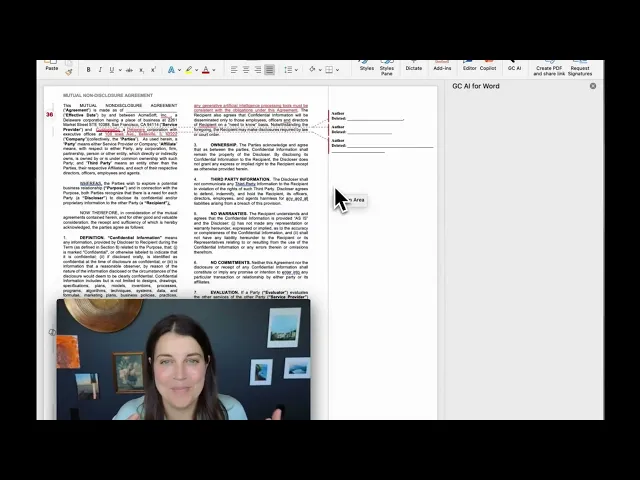
Four capabilities anchor the research experience:
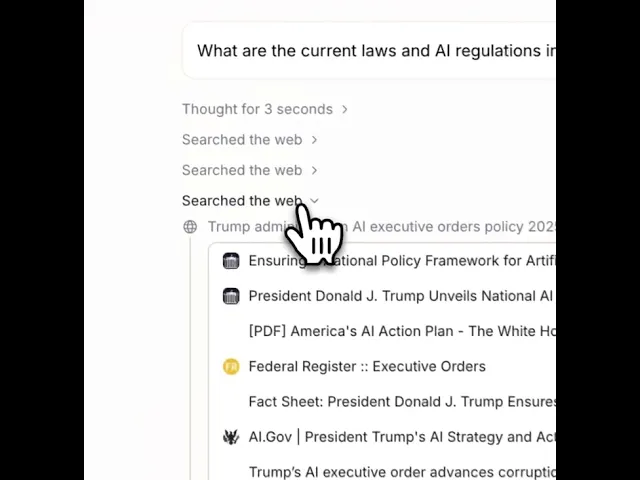
Research, GC AI’s multi-agent legal intelligence capability, deploys agents for simultaneous web research. GC AI Research biases towards authoritative databases, legal sources, and government sites, giving you maximum reliability.
US Case Law brings searchable access to 13M+ federal and state court opinions into the same chat. Ask a question in plain English, and GC AI reads the full opinions, checks treatment data to flag whether a case is still good law, and links every citation to the full opinion in a built-in reader. It answers the case-law slice of the in-house week directly, while teams running exhaustive litigation research keep a traditional research seat alongside it.
Exact Quote returns character-level citations from uploaded documents. The quote appears in the answer with the source pinned alongside it, so verification takes one click.
Chat2 in the GC AI for Word Add-in brings web research directly into Microsoft Word. The research step and the drafting step live in the same document. Context switching between web and Word is no longer required.
Projects and Custom Company Profile personalize the output. Projects hold your matter context across chats. Custom Company Profile encodes your team’s voice, templates, and standards so outputs arrive calibrated to how your team writes.
“I go straight to GC AI for everything from research requests to litigation responses. I’ve compared against ChatGPT, GC AI gives more comprehensive responses appropriate for a lawyer to use. After six months of use, I’m sure I’ve saved hundreds of hours.” -Trisha Mauer, VP of Legal at Tonal
Guillermo Rauch, founder and CEO of Vercel (a GC AI investor), on Lenny’s Podcast:
“Our legal team loves this tool called Get GC.AI. They could in theory go to ChatGPT to ask legal questions, but someone out there decided, ‘I’m going to build the best legal AI tool in the world. It’s going to be up to date. I’m going to obsess about this problem.’ The CEO herself is a lawyer, so it’s going to be hard to compete with that.”
GC AI is SOC 2 Type II and SOC 3 certified, GDPR compliant, with zero data retention agreements with OpenAI and Anthropic, and AES-256 encryption. Over 1,900 in-house legal teams across 53 countries, including 200+ public companies and 25 unicorns, work with GC AI.
AI Legal Research for In-House: The Playbook
In-house research covers regulatory monitoring, deal comps, and internal precedent alongside case law. Three workflows drive your day-to-day question volume.
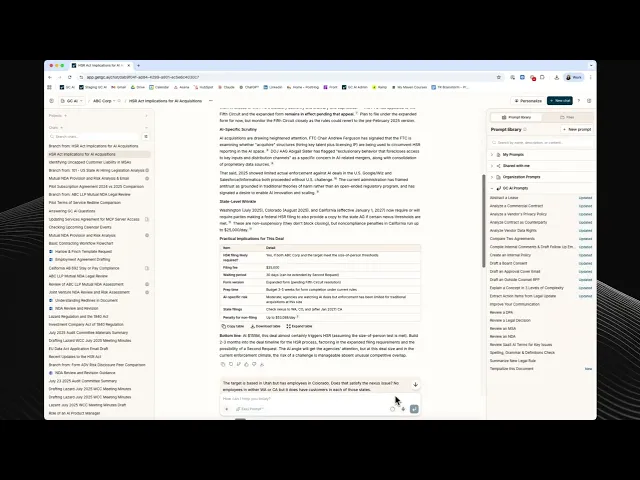
Regulatory Monitoring. A new state privacy law passes. Your team needs a one-page summary, a comparison to existing compliance, and a redline of the current privacy policy. An agentic research flow pulls the statute, summarizes the key obligations, compares against the active policy, and produces a draft redline ready for review. The output lands in Word with the citation attached, and the assignment moves.
“What’s Market” Deal Comps. Negotiation is live. Your business counterpart wants to know whether a proposed 3x fee cap on indemnity is standard for SaaS. The research answer draws on publicly available benchmark data and your team’s own prior deals via Custom Company Profile. The citation surfaces the source, and the response is ready to send in minutes. GC AI’s indemnification clause library and confidentiality clause library surface verbatim filed examples to benchmark the cap and its carve-outs against.
Internal Precedent and Playbook Lookup. Your team’s own prior work is a high-value research source, and the hardest to retrieve without AI. Files and Projects make a searchable library of prior contracts, memos, and playbooks, so a question like “did we agree to the same indemnity structure with this vendor last year” gets a cited answer in seconds. Playbooks then codify the answer into a repeatable review workflow.
The common pattern across the three workflows: research ends at a redline, a memo, a summary email, or an updated playbook.
What In-House Teams Measure After Adopting AI Legal Research
The GC AI December 2025 ROI study of more than 100 active customers reported:
Saving an average of 14 hours per week per lawyer
Reducing outside counsel spend by 14%, roughly $252,000 for the median company
Achieving 21% greater perceived accuracy compared to generic AI tools like ChatGPT
97.5% of teams see value from GC AI before month one
That median reflects the $1.8 million outside counsel spend per corporate department reported in the ACC Law Department Management Benchmarking Report. Top-quartile departments spend $11.2 million or more annually, so the dollar-return ceiling is higher for larger teams.
Across AI for legal research success stories, the pattern is the same: the platform surfaces the questions a lawyer didn’t know to ask.
“I type [into GC AI] ‘please redline this document’ and it’s like, did you mean you wanted to know these 40 things? And I’m like, yes, that’s exactly what I wanted.” —Maury Bricks, General Counsel, ARKO Corp
Research-specific metrics for your team to track from day one:
Your research-to-decision cycle time
Percentage of your research questions resolved in-house versus sent to outside counsel
Adoption across your team (weekly active lawyers, prompts per lawyer)
Citation-verified outputs as a share of total outputs
Run your own numbers with the GC AI ROI Calculator.
The Role of AI Education and Team Adoption
The platform is half the story. The other half is whether your team knows how to prompt, cite, and review AI output with legal judgment. Teams that invest in prompting fluency reach the productivity ceiling faster than teams that treat AI as a plug-and-play search bar.
GC AI runs free GC AI Classes taught by former general counsels. 6,000+ lawyers taught through the courses, and legal professionals adopt AI three to five times faster after taking them. The 101 class covers prompting foundations, the 105 class covers AI inside Microsoft Word, and advanced classes cover Playbooks. California CLE credit is available.
Adoption tracks with fluency. The teams that treat AI legal research as a skill compound the productivity gains across the quarter.
Start With One Research Question That Matters
Pick the research question that landed on your desk last week and took an hour to answer. Run it through GC AI. Compare the cited output to the path you took the first time around. That single test tells you more than any vendor demo.
If your team is earlier in the AI journey, start with the free GC AI Classes. The 101 class is California CLE-eligible and normally $225, free for the GC AI community.
GC AI is enterprise-ready and proven at scale. It runs in production at 2,100+ legal teams, including 200+ public companies and 25 unicorns, on infrastructure that is SOC 2 Type II and SOC 3 certified, GDPR compliant, and covered by zero data retention agreements with OpenAI and Anthropic.
Frequently Asked Questions
What Is AI Legal Research?
AI legal research is the use of retrieval-grounded large language models to pull, cite, and synthesize answers from primary law, secondary sources, and internal documents. For in-house teams, it covers regulatory monitoring, deal comps, peer benchmarks, and internal playbook lookup, beyond case law alone.
Can AI Do Legal Research?
Yes. AI does legal research today across statutes, regulations, contract market terms, and a team’s own prior work, then grounds each answer in a named, clickable source. A generic chatbot can draft a fluent answer with no citation, while a purpose-built platform like GC AI retrieves the source first and pins an exact quote alongside the answer, so a lawyer can verify it in one click. AI does the research and the first draft, and the lawyer validates the citation.
How Accurate Is AI Legal Research?
Accuracy depends on grounding. The 2024 Stanford study found leading research platforms hallucinated at rates between 17% and one-third, depending on architecture. GC AI achieves 21% greater perceived accuracy compared to generic AI tools like ChatGPT, measured in a December 2025 study of more than 100 active customers. Character-level citation, retrieval-augmented generation, and human review at the citation layer close the remaining gap.
Can AI Legal Research Replace Westlaw or Lexis?
For deep primary-law research in litigation, Westlaw Precision and Lexis+ with Protégé remain the established databases. For the day-to-day in-house research workload (regulations, deal comps, internal precedent, and playbook lookup), an in-house legal AI platform like GC AI covers more of the surface area and integrates research with drafting and review in the same workflow.
Is AI Legal Research Safe for Privileged Work?
With the right vendor, yes. Require SOC 2 Type II and SOC 3 certification, GDPR compliance, zero data retention agreements with the underlying foundation model providers, and AES-256 encryption. GC AI is SOC 2 Type II and SOC 3 certified, GDPR compliant, with zero data retention agreements with OpenAI and Anthropic, and AES-256 encryption.
What Is the Best AI for Legal Research for In-House Counsel?
The right answer depends on the workload. For primary-law research in litigation, Westlaw Precision or Lexis+ with Protégé are the established databases. For the full in-house workload (research plus drafting, contract review, and playbook enforcement), a purpose-built in-house platform like GC AI covers more of the day.
How Much Does AI Legal Research Software Cost?
Pricing varies by platform and seat count. Research-focused databases typically price in the thousands per lawyer per year. In-house legal AI platforms price per seat per month with an annual commitment. GC AI offers a 14-day free trial with no credit card to test the workflow before a pricing conversation.
Is There a Free AI for Legal Research?
Free platforms exist, but the ones that are permanently free lack grounding, citation, and the security posture in-house teams need. Generic AI platforms like ChatGPT and Perplexity can read documents and summarize, but hallucinate on legal-specific questions and lack the character-level citation that legal work demands. A free trial of a purpose-built platform beats a permanently-free generic platform for production work.
For a closer look at when Perplexity is appropriate for legal work and where it falls short see our Perplexity for Lawyers guide.