Harvey initially launched with the largest law firms in the world. Its core product suite (Vault for bulk document analysis, Workflow Agents for cross-jurisdictional advisory work) was shaped around the work AmLaw 100 associates do under partner supervision. The customer base and the marketing are still firm-first. In 2026, Harvey added a dedicated in-house solutions page and an in-house ROI calculator, and acquired Hexus in January for product-demo and onboarding tooling. Those are recent additions on top of a law-firm product. The audience Harvey was designed around is the AmLaw associate, supervised by a partner.
Your work is very different than what an AmLaw associate does. Your day runs through commercial contracts, employment questions, privacy reviews, regulator letters, and the brief your CEO will read on Thursday. As our founder and CEO Cecilia Ziniti puts it, you are a business person with a legal skill set. The best Harvey alternatives are the platforms built for that reality.
We built GC AI because we lived it. Cecilia was General Counsel three times before founding the company, and the workload she ran every day is the workload GC AI was designed for. For some teams, Harvey is still the right call, and we will share where.
Why You Walked Away from Harvey
Three structural reasons make Harvey a bad fit for most in-house procurement.
Your output goes to the CEO. Harvey’s product suite was shaped around law-firm workflows. In-house counsel writing for a board, a regulator, or a head of sales need a system prompt and a workflow shaped for that audience from day one. If the default voice is firm-style, every send to the business adds a tone-pass step.
You cannot test it on your own work first. Harvey requires a sales demo and a contract before you see output on your own documents. In-house buyers who need to justify spend to a CFO want to prove value before signing. A 14-day trial on a live NDA, a real vendor MSA, and last week’s privacy question tells you more in a week than three demo calls tell you in a month.
Pricing is unpublished. Procurement starts with a sales call. Harvey does not publish per-seat pricing. Procurement requires a sales conversation before you can compare it against your budget.
Other Tradeoffs Worth Weighing
Time to value. Enterprise legal AI deployments typically require change management and implementation in months. A 14-day self-serve trial like GC AI’s compresses that loop.
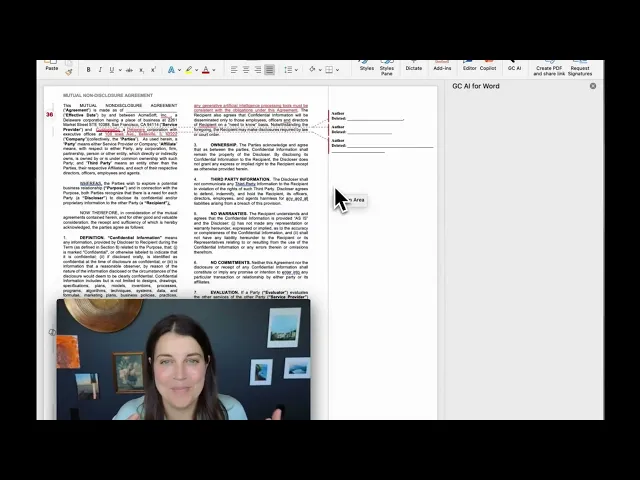
In-house workflow depth inside Word. In-house lawyers spend the day in Word, and Harvey now runs inside Microsoft 365 Copilot and Cowork. GC AI for Word brings the full in-house platform (Chat2, Easy Prompt, Playbooks, Projects) inside the document - research, redlining, and matter memory without context switching.
Training and adoption layer. Firm-side adoption leans on partners and senior associates. Lean in-house teams do not have that layer. GC AI ships with California CLE-eligible classes taught by former general counsels (6,000+ lawyers have completed them to date).
Workload coverage. Harvey’s product surface (Vault, Workflow Agents) was shaped for litigation, M&A, and cross-jurisdictional advisory work. In-house teams spend most of their week on commercial contracts, employment, privacy, and business enablement.
If you are deciding between Harvey and GC AI specifically rather than scanning the full alternatives field, the deep comparison is at GC AI vs Harvey.
Why In-House Adoption Is Outpacing Law Firms
Per Business Insider article on AI in corporate legal departments, in-house teams are adopting legal AI faster than firms for three reasons.
The in-house mandate is speed and output. As Business Insider puts it:
“The more aggressive adoption is coming from in-house legal teams, where efficiency isn’t a threat, but a mandate.” Firms bill by the hour. In-house teams are paid to ship.
Generalists by necessity. In-house lawyers own everything that touches risk, often across unfamiliar areas. Legal AI gives them current, accurate research on jurisdictions and topics they don’t see every day. As Dina Segal, Chief Legal Officer at Gusto, told Business Insider:
“You can come in with an early perspective instead of a blank piece of paper.”
Faster course-correction. When a launch slips or a regulatory nuance is missed, in-house teams feel it immediately. Legal AI gives faster first-pass answers and earlier issue-spotting, so legal is not reacting after the business has already moved.
GC AI’s own time-to-value study of 200 legal professionals tracks the same pattern.
How We Evaluated These Harvey Alternatives
Every platform in this guide was rated across five criteria that decide in-house procurement.
Citation discipline. Does the platform quote source documents at the character level, or paraphrase? An in-house lawyer forwarding an answer to the CEO cannot forward a paraphrase.
Workflow fit for in-house. Contract review, playbook-driven redlining, research, matter memory, Word drafting, intake. The day-to-day surface of in-house legal work.
Security and data governance. SOC 2 Type II, GDPR, zero data retention with the underlying model providers, strong encryption. Procurement will ask.
Pricing transparency and seat flexibility. Is the number published? Is there a seat minimum? Is there a trial?
Time to value. Can the platform demonstrate quality on your real work in week one, or does it require a quarter of implementation before you know if it works?
For a broader comparison of the legal AI market beyond Harvey alternatives alone, see Legal AI Tools in 2026: The Buyer’s Field Guide.
The Best Harvey Alternatives at a Glance
The right pick depends on the shape of your work, your budget, and how much you want to integrate. Below is the short version, organized by who should pick what. The full reasoning sits in the sections that follow.
Our pick for in-house counsel: GC AI. Purpose-built for in-house legal teams. $500 per seat per month. 14-day free trial. No seat minimum. Used by 1,900+ in-house teams across 53 countries.
For research-heavy work where you already hold Westlaw or Lexis seats: Thomson Reuters CoCounsel and Lexis+ AI are the strongest research-side Harvey alternatives. GC AI Research covers commercial and regulatory questions for the rest of the in-house workday.
For European firms or in-house teams operating across multiple European jurisdictions: Legora is the strongest regional Harvey alternative. Teams evaluating the two directly should also see our Legora vs Harvey comparison, which breaks down differences in document review, legal research, multilingual support, and fit for in-house legal teams.
For solo or small-firm transactional attorneys in Word all day: GC AI for Word is the strongest in-house option, and Spellbook is the firm-side alternative to Harvey.
For contract lifecycle, intake, or outside counsel spend bottlenecks: Ironclad AI or Streamline AI run alongside GC AI. They solve a different layer than a legal AI platform does.
For teams with no legal AI budget yet: Claude Team or ChatGPT Business with enterprise controls in place. Treat generic AI as a bridge to GC AI.
Comparison of Harvey Alternatives for In-House Counsel
Platform | Built For | Pricing | Seat Minimum | Trial | SOC 2 / GDPR | Word Integration |
|---|---|---|---|---|---|---|
GC AI | In-house legal teams | $500/seat/month | None | 14 days, no credit card | SOC 2 Type II, SOC 3, GDPR | Full Word Add-in with Chat2 |
Harvey | Large law firms, enterprise in-house | Not published, enterprise | Not disclosed | Via sales | SOC 2 Type II, GDPR | Word, Outlook, SharePoint, plus Microsoft 365 Copilot and Cowork |
Spellbook | Firm-side transactional attorneys | Not published | Sales-led | 7-day trial | SOC 2 Type II, GDPR, CCPA, HIPAA | Native Word plug-in |
Thomson Reuters CoCounsel | Research-heavy firms and teams | Enterprise, bundled with Westlaw | Enterprise | Via sales | SOC 2, enterprise | Limited |
Lexis+ AI | Research-heavy firms and teams | Enterprise, bundled with Lexis | Enterprise | Via sales | SOC 2, enterprise | Limited |
Legora | European firms and multi-jurisdictional practices | Not published | Sales-led | Via sales | Enterprise controls, EU data residency | Word integration |
Ironclad AI | Procurement and sales ops, alongside legal AI | Enterprise, usage-based | Enterprise | Via sales | SOC 2, GDPR | Limited |
Streamline AI | Legal ops intake and triage, alongside legal AI | Enterprise | Enterprise | Via sales | Enterprise posture | None |
Claude Team / Enterprise | Budget-constrained teams, thinking partner | $20/seat/mo (Team Standard, annual) to $125/seat/mo (Team Premium, monthly); Enterprise is $20/seat plus API usage | 5 (Team Standard) | Free tier | SOC 2 Type II, ISO 27001, ISO 42001 | Microsoft 365 connector (read-only) |
ChatGPT Business | Budget-constrained teams, thinking partner | $20/seat/mo annual, $25/seat/mo monthly (as of April 2026) | 2 | Free tier | SOC 2 Type II | Available via M365 Copilot bundle |
GC AI: The Best Harvey Alternative for In-House Counsel
GC AI is an enterprise-ready legal AI platform built for in-house counsel by an in-house counsel. Cecilia Ziniti was General Counsel three times (Anki, BloomTech, Replit) before founding the company in November 2023. Today more than 1,900 in-house legal teams across 53 countries run on it. Every response routes through a 20,000-line legal system prompt designed to sound like advice from a colleague.
Both GC AI and Harvey run frontier models. The difference between them is system prompt origin, workflow design, and founder DNA. Harvey’s defaults reflect the AmLaw associate-and-partner model. GC AI’s defaults reflect a three-time GC’s workflow.
What GC AI Does That Harvey Doesn’t (for In-House)
The shorter feature list is in our best legal AI tools for in-house counsel guide. Below is the in-house-specific gap each capability closes versus Harvey.
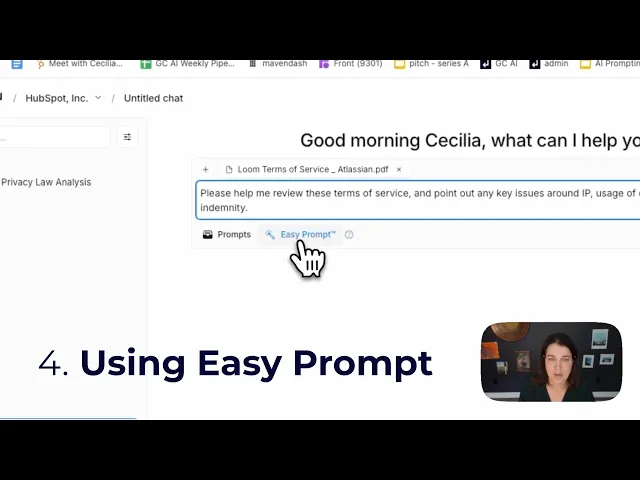
Easy Prompt turns “check this NDA for red flags” into the lawyer-grade prompt that produces usable output on the first run. The non-lawyers on your team can use it too.
Exact Quote pulls verbatim language from any source document, character by character, and highlights the citation in Doc View. Every quote that lands in front of the CEO verifies at the character level.
Playbooks turn your redline standards, NDA positions, DPA red lines, and MSA red flags into repeatable agentic workflows. Pre-built playbooks ship with the platform; custom ones train on your prior agreements. Harvey’s enterprise workflows are built for firm-side litigation and M&A. Your team’s NDA stack needs in-house defaults.
GC AI for Word brings the full platform into Word with Chat2 for web research, Easy Prompt, Playbooks, and Projects, all inside the document where your work already lives.
Projects carry persistent matter memory. Upload deal docs once, and two weeks later GC AI still remembers the parties, the counterparty’s paper, the negotiated positions, and your prior guidance. Most in-house matters span weeks; you should not have to re-brief yourself every time.
Research is multi-agent legal intelligence with real-time primary law and citations. Agents bias toward primary law, authoritative databases, and government sites. Coverage spans the commercial, regulatory, and employment terrain in-house teams live in every week, plus the deep case law you reach for when a matter calls for it.
System prompt origin. GC AI’s 20,000-line system prompt was written by a three-time GC for the in-house workload. Harvey’s defaults reflect the AmLaw associate-and-partner model. That is a category-level difference.
What 100+ In-House Customers Reported
Per GC AI’s December 2025 ROI study of more than 100 active customers, in-house lawyers using GC AI:
Saved an average of 14 hours per week
Reported a 14% reduction in outside counsel spend, and reflect 21% greater perceived accuracy than generic AI on the same legal tasks.
The customer base spans SaaS and developer tools (Vercel, Tekion, Jasper), cybersecurity (Snyk, Secure Code Warrior), fintech and payments (Tipalti, Gusto, Acorns), apparel and retail (Arc’teryx, Columbia, Carhartt), and consumer DTC (Liquid Death, Tonal, Helix). The longer industry breakdown lives in the best legal AI tools for in-house counsel guide.
Tiffany S. Lee, General Counsel and Corporate Secretary at Liquid Death, puts it like this:
“I buy GC AI for my contract attorneys - not to reduce their hours, but to take away mundane work so I can use their brainpower on strategic matters.”
Liquid Death and GC AI | GC AI
Can Harvey and GC AI Run Side by Side?
At very large enterprises with both an in-house function and significant outside counsel relationships, yes. The natural split would be outside counsel using Harvey for litigation, M&A, and cross-jurisdictional advisory work, while the in-house team uses GC AI for daily commercial contracts, privacy reviews, employment questions, and board prep. Different platforms pointed at different workloads, no overlap.
For lean in-house teams under 20 lawyers, running both is structurally unnecessary. GC AI covers the in-house workload, and Harvey stays at the firm if you have outside counsel relationships.
The Other Harvey Alternatives Worth Considering
Thomson Reuters CoCounsel
CoCounsel is research-first, grounded in Westlaw. For litigators, appellate specialists, and research-heavy teams already on Westlaw, it covers the research axis well. The AI layer sits on top of Westlaw’s primary-law corpus. Pricing is enterprise and bundled with Westlaw.
Choose GC AI Instead If: your in-house workflow is primarily commercial contracts, privacy, employment, and business-stakeholder enablement rather than deep case law retrieval, and you do not want to buy a research platform you will use 20% of the time.
Harvey and CoCounsel take different paths into legal AI: one starts with firm workflows, the other with Westlaw. See Harvey vs CoCounsel: 2026 Side-by-Side Comparison for the full breakdown.
If the evaluation has come down to GC AI and CoCounsel specifically, the GC AI vs CoCounsel comparison details how the two platforms differ on contract review, research, Microsoft Word, and in-house-first pricing.
Lexis+ AI
Lexis+ AI mirrors the CoCounsel pattern with the Lexis corpus underneath. Strong citations, strong case law coverage. Enterprise pricing, bundled with Lexis.
Choose GC AI Instead If: you need a platform that handles contract review, playbook-driven redlining, Word-native drafting, and matter memory in addition to research.
Legora
Legora is a European legal AI platform serving large European law firms and multi-jurisdictional practices. Strong across the UK and EU, with data residency options that matter in European procurement. US in-house footprint is still limited.
For a deeper look at the platform, see our Legora Legal AI Review, covering Tabular Review, legal research, pricing, and fit for in-house teams.
Choose GC AI Instead If: you are a US in-house team, or your European workload sits inside a US parent, and you want a platform built from day one for in-house rather than one expanding toward US in-house from a European firm base. See our GC AI vs Legora deep dive.
Spellbook
Spellbook is a Microsoft Word-native legal AI platform for contract drafting and review, popular with solo practitioners, small firms, and firm-side transactional lawyers. The product surface includes Review, Draft, Ask, Benchmarks (which compares contract terms against a proprietary dataset), Associate for multi-document agentic workflows, and a Clause Library. Pricing is not public. See our GC AI vs Spellbook deep dive.
Choose GC AI Instead If: you are an in-house lawyer rather than a firm-side transactional one, your week extends well beyond contract drafting into employment, privacy, regulatory, and research, and you want a Word experience that includes Playbooks, Projects, Custom Company Profile, and Chat2-powered research beyond a drafting plug-in.
Teams comparing Spellbook with a firm-first platform should also see Spellbook vs Harvey: Which One Fits Your Legal Team?, which breaks down differences in workflow, document review, and in-house fit.
Ironclad AI
Ironclad is an enterprise contract lifecycle management platform with an AI layer for contract drafting, review, and obligation extraction. It covers creation, negotiation, execution, storage, and obligation tracking end-to-end. CLM and legal AI solve different layers, so they typically coexist rather than compete.
Choose GC AI Alongside Ironclad If: you want CLM for contract operations and a legal AI platform for everything else: research, advisory, playbook review, Word drafting, and matter memory.
Teams evaluating CLM platforms against AI-first tools should also see Ironclad vs Wordsmith: CLM vs In-House Legal AI (2026).
Streamline AI
Streamline AI is a legal ops platform focused on matter intake, triage, and workflow orchestration. It surfaces legal work as it lands inside the company and routes it to the right lawyer or automation. Like Ironclad, it solves a different layer than a legal AI platform does, and the two run alongside each other.
Choose GC AI Alongside Streamline AI If: your bottleneck is intake and triage, and your attorneys need a drafting and review platform once the work lands in their inbox. Streamline routes, GC AI does the work.
Claude Team / Enterprise and ChatGPT Business
These are general-purpose AI platforms with enterprise controls. Both are useful for non-confidential first drafts. Neither replaces a legal AI platform on confidentiality, citation discipline, or the legal system prompt that does most of the quality work on a purpose-built tool.
ChatGPT Business is $20 per seat per month annual or $25 per seat per month monthly (as of April 2026, after OpenAI’s April 2 price reduction). Claude Team is $20 per seat per month for Standard or $100 per seat per month for Premium (annual billing). Claude Enterprise is $20 per seat plus API-rate usage.
See both our GC AI vs Claude and GC AI vs ChatGPT deep dives.
Choose GC AI Instead If: you are an in-house lawyer and client-confidential matters hit your desk every day. Treat generic AI as a bridge to legal AI.
The Adoption Layer In-House Teams Don’t Have
The platform is the easy part. Getting your team to use it consistently is where the value compounds, and this is where in-house teams without firm-style adoption layers struggle. Firm-side deployments lean on partners and senior associates to drive adoption. In-house teams do not have that layer. You are the partner, the associate, and the trainer, all in one inbox.
GC AI runs free, California CLE-eligible classes taught by former general counsels.
The 101 course covers AI prompting fundamentals for in-house counsel, including the “Meryl Streep” framework for getting better output from your first prompt.
The 105 course walks through AI-assisted redlining and drafting inside Microsoft Word.
The 106 and 107 courses teach teams how to build and deploy Playbooks for automated contract review. More than 6,000 lawyers have been taught through these classes, and the curriculum keeps expanding.
Beyond the courses, GC AI maintains a growing library of content built specifically for in-house teams: podcast episodes with practicing GCs, blog posts on real legal AI workflows, and a Skill Library pre-built for common in-house use cases like NDAs, DPAs, employment agreements, and board resolutions.
What Replacing Harvey Looks Like in Week One
Day one: install GC AI for Word, run last week’s NDA through Easy Prompt, see character-level citations on your own paper.
Day three: build your first Playbook from a redline standard you already use.
Day five: your team sees the time saved, your CFO sees a $500 line item instead of an enterprise contract. No procurement cycle, no quarterly implementation, no partner sign-off required.
Frequently Asked Questions
What Is the Best Harvey Alternative for In-House Counsel?
The best Harvey alternative for in-house counsel in 2026 is GC AI. It is purpose-built for in-house legal work, used by 1,900+ in-house teams across 53 countries spanning SaaS, fintech, cybersecurity, apparel and retail, and consumer DTC. Pricing is published at $500 per seat per month with a 14-day free trial and no seat minimum. Every response routes through a 20,000-line legal system prompt written by a three-time general counsel for in-house workflows.
Why Are In-House Teams Evaluating Harvey Alternatives?
Three things drive the shift. Harvey’s defaults reflect law-firm workflows, so outputs need reworking before they are ready for a CEO or a board. Harvey requires a sales demo rather than a self-serve trial, so in-house buyers cannot prove value on their own documents before signing a contract. And Harvey does not publish pricing, so in-house buyers cannot forecast cost without a sales conversation. Other tradeoffs to weigh: time to value (enterprise deployments typically take months), Word integration depth, training and adoption layer (firm-side vs in-house), and workload coverage (Harvey’s product surface was shaped for firm work).
What Is the Best Harvey Alternative for a Solo General Counsel?
GC AI. The combination of Easy Prompt, Playbooks, Projects, Chat2 in the Word Add-in, and California CLE-eligible classes is built for one lawyer doing the work of a full legal team. Pricing is $500 per seat per month with a 14-day free trial and no seat minimum, which means you can start without a procurement cycle.
Does Harvey Offer a Free Trial?
Harvey requires a sales demo before access and does not offer a self-serve trial. GC AI offers a 14-day free trial with no credit card at gc.ai. Claude and ChatGPT both offer free tiers, though neither is safe for client-confidential data on a personal account.
How Does GC AI Compare to Harvey on Features?
GC AI is built for in-house workflows: Exact Quote for character-level citations, Easy Prompt for plain-language prompt optimization, Playbooks for agentic contract review against your team’s standards, Chat2 inside the Word Add-in for research without leaving Word, Projects for persistent matter memory, and Custom Company Profile for per-user personalization. Harvey’s product suite is built around litigation, M&A, and cross-jurisdictional advisory work at large firms.
Can a Team Use Both Harvey and GC AI?
Yes, at very large enterprises. The clean split: outside counsel uses Harvey for litigation, M&A, and cross-jurisdictional advisory work, while the in-house team uses GC AI for daily commercial contracts, privacy reviews, employment questions, and board prep. Different platforms pointed at different workloads. For lean in-house teams under 20 lawyers, the answer is usually GC AI alone, and Harvey stays at the firm.
Is Harvey Worth It for an In-House Team Under 20 Lawyers?
For most lean in-house teams, no. Harvey’s pricing is enterprise, its training program (Harvey Academy) is firm-oriented, and its workflows are shaped around law-firm work rather than the daily in-house mix of contracts, employment, privacy, and business-stakeholder enablement. Lean in-house teams get more value from a platform built for their workload, like GC AI, at a published $500 per seat per month with a 14-day free trial.
What Security and Compliance Does GC AI Have?
GC AI is SOC 2 Type II and SOC 3 certified, GDPR compliant, with zero data retention agreements with OpenAI and Anthropic, and AES-256 encryption.
How Much Does GC AI Cost?
GC AI costs $500 per seat per month, with a 14-day free trial, no credit card required, and no seat minimum. Team and Enterprise tiers are available for larger deployments. Pricing is published at gc.ai/pricing.