If you’re evaluating the CoCounsel AI legal assistant, the call comes down to one question: Does your team’s bottleneck sit in research depth, or in the breadth of work you handle every day? CoCounsel is built around Westlaw’s research corpus and designed for work where research is the deliverable. In-house work is the deliverable spread across contracts, employment, regulatory monitoring, and stakeholder communication every day.
Ritesh Patel, Chief Legal Officer at Viant Technology, described what changed when his team stopped reaching for outside counsel as the default first step on a research question:
“Before, I’d call outside counsel and pay by the hour for a generic answer. Now, I can analyze it myself, see where it gets me, and call outside counsel if I’m truly out of depth.”
CoCounsel started inside Casetext, the legal research startup that launched the original AI legal assistant on March 1, 2023. Thomson Reuters acquired Casetext four months later and rebuilt the product as its agentic AI flagship.
GC AI was built from the opposite starting point. Cecilia Ziniti spent three tours as a General Counsel at Anki, Bloomtech, and Replit before building the platform because no legal AI tool was designed for the daily scope of in-house work.
That difference shows up in the design decisions. CoCounsel sits on top of Thomson Reuters’ research stack: Westlaw, Practical Law, and Checkpoint feed the model’s grounded responses.
GC AI sits on top of the in-house workflow: a 20,000-line system prompt tuned for in-house tasks, Exact Quote citations with character-level accuracy so every answer forwarded to the CEO is verifiable, an in-house Skill Library with NDA, MSA, DPA, and board resolution playbooks ready on day one, a top-rated Word Add-in on Microsoft AppSource, and public pricing at $500/seat/month with a 14-day free trial.
More than 1,900 in-house legal teams, including the legal departments at Gusto, Eventbrite, Liquid Death, Arc’teryx, and Tipalti, use the platform. No sales call is required to start.
CoCounsel AI Features: What’s in the Suite
CoCounsel relaunched as CoCounsel Legal on August 5, 2025, repositioning the product around agentic AI and Deep Research. Five capability layers sit at the core.
CoCounsel Legal Assistant
CoCounsel Legal Assistant is the platform’s chat and drafting interface. The Assistant handles research questions, document review, memo drafting, and clause analysis. Output is structured around Thomson Reuters’ editorial conventions and grounded in the Westlaw and Practical Law corpus when the question calls for primary law.
Deep Research
Deep Research is CoCounsel’s most differentiated capability, built to reason through a research question across thousands of documents and return structured legal analysis grounded in Thomson Reuters’ editorial content. The corpus underneath the model was built over 175 years and validated by more than 4,500 subject-matter experts. For research-heavy practice areas (regulatory analysis, litigation strategy, multi-state tax surveys) this is where CoCounsel is strongest.
Agentic Guided Workflows
Agentic Guided Workflows are multi-step task flows that execute predefined sequences with checkpoint logic. Current workflows include Draft a Privacy Policy, Draft an Employee Policy, Draft a Complaint, Draft Discovery Request, Draft Discovery Response, and Deposition Transcript Review. Thomson Reuters has said that additional workflows will launch through 2026.
Knowledge Search
Knowledge Search runs intelligent search across CoCounsel’s knowledge graph and the user’s uploaded documents, built for finding a specific clause, precedent, or memo across a large internal corpus.
Ecosystem and Integrations
CoCounsel integrates with Westlaw Advantage and Practical Law as its primary research backbone. The product is available inside Microsoft 365 for users standardized on the Microsoft stack. Tax workflows route through Checkpoint, Thomson Reuters’ tax research platform.
CoCounsel AI Pricing in 2026
CoCounsel does not publish pricing. The Thomson Reuters CoCounsel Legal launch announcement (August 5, 2025) confirmed product availability but disclosed no pricing tiers. A demo request through a Thomson Reuters sales representative is the entry point to any cost conversation as of May 2026.
This matters at the start of a budget cycle. Per the ACC 2024 Law Department Management Benchmarking Report, outside counsel accounts for approximately 48% of total legal spend for U.S. companies. Any platform that promises to reduce that dependency should be able to answer what it costs before the first sales call.
The GC AI ROI calculator takes team size, hours on contracts, and outside counsel spend as inputs and returns the annual dollar impact before any vendor conversation begins.
Where CoCounsel Does Well
CoCounsel’s strengths are real, and any honest evaluation of the category starts there.
Research depth backed by Westlaw. Deep Research grounds its responses in Westlaw and Practical Law content built over Thomson Reuters’ 175-year editorial history. Colleen Nihill, Chief AI and Knowledge Management Officer at Morgan Lewis, told Thomson Reuters that Deep Research “stands out for its ability to reason through legal questions.” For multi-state regulatory analysis, litigation strategy, and tax surveys, the corpus underneath the model is a genuine differentiator.
Editorial pedigree. Westlaw and Practical Law are the editorial standards most large firms standardized on years ago. CoCounsel sits directly on top of that editorial review process, which matters when an answer has to be defensible in front of a judge, a regulator, or a board.
Tax workflow integration. Tax practitioners using Checkpoint already work inside the Thomson Reuters ecosystem. CoCounsel’s tax workflows ship inside that stack.
Multi-step drafting workflows. The Agentic Guided Workflow library covers structured legal tasks (discovery, policy drafts, deposition review) with checkpoint logic. For litigation and policy work, the workflow library reduces the prompting overhead.
The CoCounsel call is a Westlaw call. CoCounsel is the AI assistant most tightly integrated with Westlaw and Practical Law, Thomson Reuters’ own legal research corpus, and the work it was designed for is real and worth paying for. Think of the CoCounsel buy as a three-part decision: the AI, the Westlaw corpus underneath, and the Thomson Reuters relationship that comes with the platform. Teams without a Westlaw subscription should ask whether they are buying the AI or the bundle.
What In-House Teams Need Before Committing to CoCounsel
CoCounsel was built around Thomson Reuters’ research-first stack. The design decisions from that origin shape the daily experience: Deep Research is positioned as the centerpiece, the corpus underneath is Westlaw and Practical Law, and the pricing model assumes a Thomson Reuters relationship before any number is shared. Before committing, four things are worth evaluating on your own terms.
GC AI has a 14-day free trial. Load your contracts. Run your research questions. Use the platform on the work your team does every day, before any purchase conversation. CoCounsel requires a demo request through a Thomson Reuters representative before sharing cost or product information. Fourteen days with GC AI means the evaluation is on your terms.
GC AI’s Exact Quote feature returns character-level citations. Every answer is traceable to the precise language in the document. For in-house teams forwarding analysis to the CEO, the CFO, or the board, verifiability is the bar that matters.
GC AI ships with an in-house Skill Library. NDA review, DPA analysis, MSA playbooks, and board resolution templates built for in-house workflows. The 20,000-line system prompt underneath the platform was tuned for in-house contract review as the primary design constraint.
GC AI Classes are free and California CLE-eligible.** Taught by former general counsels. More than 6,000 lawyers have completed the program. Departments that build fluency this way are the ones where legal AI adoption sticks.
As Cecilia Ziniti tells in-house lawyers:
“You are a business person with a legal skill set.”
Some in-house teams run both. GC AI handles the daily scope: commercial contracts, employment matters, regulatory monitoring, research, and stakeholder communication.
CoCounsel handles intensive Deep Research cycles when the question is multi-jurisdictional regulatory analysis or large-scale precedent review. If your team is evaluating a single platform for daily use, the scope of your day-to-day legal work is the right frame.
Tiffany Lee, General Counsel and Corporate Secretary at Liquid Death:
“The bread and butter of any in-house lawyer is contract review. Every agreement has to be read, flagged, and summarized: it’s repetitive work that eats into the time you should be spending on strategy.”
How GC AI Performs on the In-House Legal Bench
In May 2026, GC AI’s R&D attorneys published the In-House Legal Bench, a head-to-head evaluation of legal AI on 100 in-house legal tasks scored against more than 1,200 attorney-developed criteria. The benchmark tested GC AI against general-purpose AI tools: ChatGPT, Claude, and Gemini.
The 100 tasks spanned 10 categories: drafting, document summarization, contract analysis, legal research, legal strategy, risk assessment, comparison and benchmarking, information extraction, regulatory tracking, and checklists. GC AI’s largest advantages came in research-intensive tasks, including regulatory tracking, legal research, and checklists.
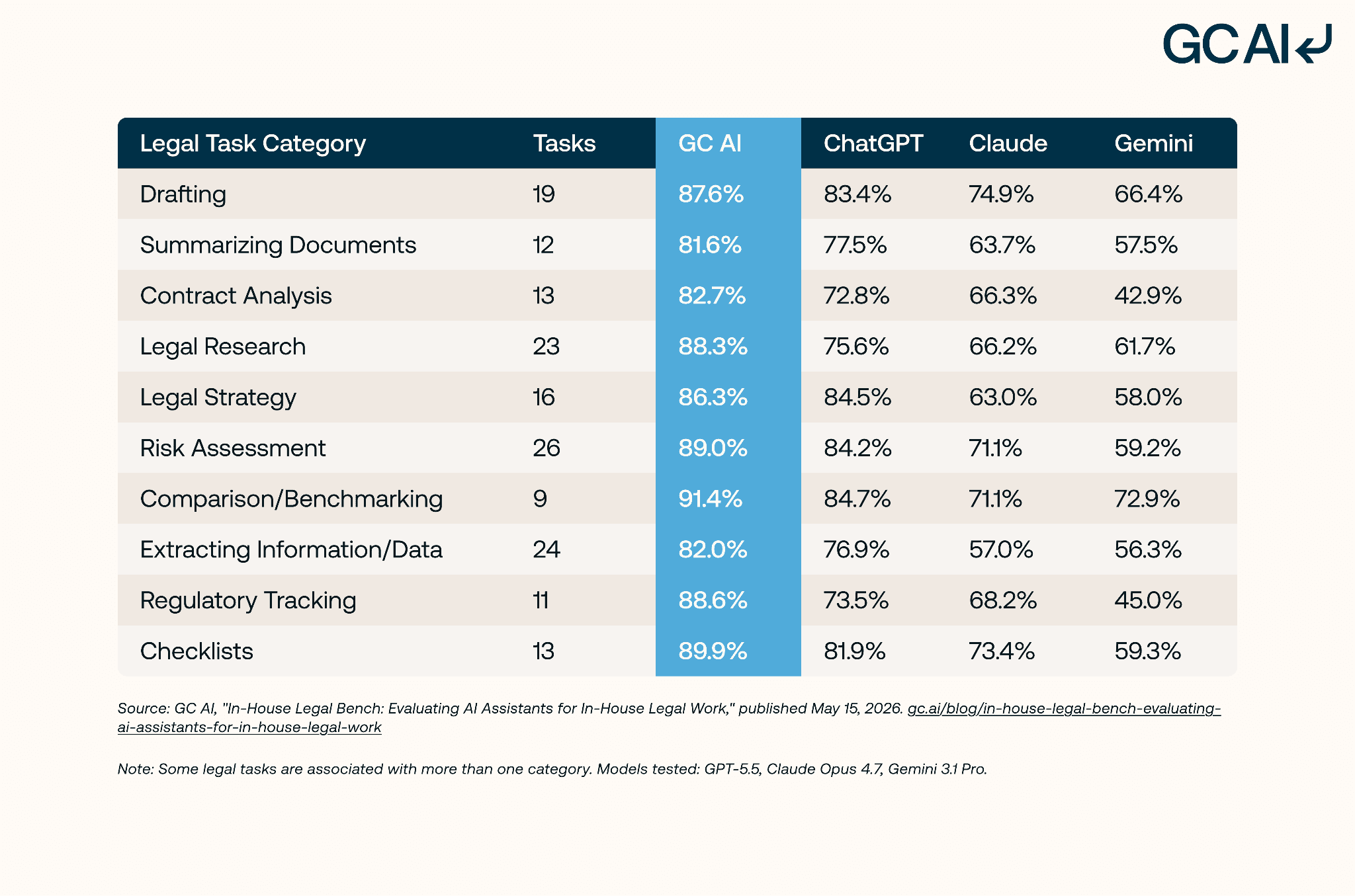
The bench evaluated GC AI against general-purpose AI tools. It did not test against other dedicated legal AI platforms.
CoCounsel vs. Legal AI Alternatives for In-House Counsel
CoCounsel | GC AI | Harvey | ChatGPT | |
Built for | Research-heavy legal work backed by Westlaw and Practical Law | In-house legal teams | Large law firms, expanding into enterprise in-house | General purpose |
Best for | Deep legal research, regulatory analysis, multi-state surveys, tax workflows, structured litigation drafting | Contract review, contract redlining, legal research, regulatory monitoring, and the full scope of in-house legal work | Large-scale M&A diligence, enterprise workflow automation, and firm-grade research | One-off general tasks; general-purpose AI with no legal training |
Research backbone | Westlaw + Practical Law corpus (Thomson Reuters editorial) | LLM models grounded by Exact Quote citations + Research agent web search across primary law and government sites | Knowledge research engine + Vault document repository | LLM training data |
Pricing | No public pricing (as of May 2026) | $500/seat/mo | No public pricing (as of May 2026) | From $20/seat/mo (Business, annual) as of May 2026 |
Free trial | No (as of May 2026) | 14 days, no credit card | No (as of May 2026) | Yes (limited) |
Word integration | Yes, inside Microsoft 365 | GC AI for Word: web app plus Word add-in, web research enabled | Yes | No |
Legal AI training | Westlaw training resources; CLE eligibility not listed on thomsonreuters.com (May 2026) | Free courses taught by former GCs; California CLE-eligible | Harvey Academy: on-demand courses; CLE eligibility not listed (May 2026) | No |
Security | SOC 2, ISO 27001 (as of May 2026) | SOC 2 Type II, SOC 3, GDPR, ZDR with OpenAI and Anthropic, AES-256 | SOC 2 Type II, ISO 27001, GDPR, CCPA | SOC 2 Type II (varies by tier) |
NPS | Not published | 74 | Not published | N/A |
Is CoCounsel Right for Your Legal Team?
CoCounsel is the stronger fit if:
Your team’s daily work is research-heavy: multi-state regulatory analysis, deep precedent review, multi-jurisdictional surveys, tax research grounded in Checkpoint
Your organization already runs on Westlaw, Practical Law, or Checkpoint, and the value of in-stack AI is high
Litigation and policy drafting (discovery, deposition review, complaint drafts) make up the bulk of your team’s output
Your team has the Thomson Reuters sales relationship to navigate enterprise procurement before a pricing conversation
GC AI is the stronger fit if:
Your in-house work spans contracts, employment matters, regulatory questions, research, and stakeholder communications, covering the full scope of in-house practice
You want to evaluate the platform on your work before any purchase conversation: the 14-day free trial is the starting point
You use Microsoft Word and want AI research alongside contract work: GC AI’s Word Add-in brings web research into Word without switching apps
Your team needs CLE-eligible AI training to build fluency across the department
You want character-level citations on every answer and in-house playbooks that ship ready to use
You want published proof of customer satisfaction before a purchase conversation: GC AI discloses an NPS of 77 (April 2026 customer survey)
If you’re deciding specifically between these two platforms, our GC AI vs CoCounsel comparison walks through their differences in research, contract review, Microsoft Word workflows, pricing, and the overall in-house experience.
If three or more bullets above match your team, the call picks itself.
Alexandra Sepulveda, Assistant General Counsel at Trust and Will, on choosing between tools:
“If you only have a budget for one tool, choose the one fine-tuned for in-house legal.”
GC AI brings trust, precision, and craft to the work in-house counsel do every day: commercial contracts, employment matters, regulatory monitoring, research, and stakeholder communication.
Four further reads if you are still evaluating:
Best Legal AI Tools for In-House Counsel covers the broader category
In-House Counsel AI Software: What to Buy, What to Skip frames the buy-vs-skip call
Spellbook Legal AI Review gives the in-house-vs-transactional comparison
AI Contract Review for In-House Counsel goes deep on the workflow that drives most in-house spend
Harvey vs CoCounsel to compare both legal AI tools
Frequently Asked Questions
What Is CoCounsel?
CoCounsel is Thomson Reuters’ agentic AI legal assistant, originally launched by Casetext on March 1, 2023 and acquired by Thomson Reuters four months later for $650 million. Relaunched as CoCounsel Legal on August 5, 2025, the platform combines a chat assistant, Deep Research grounded in Westlaw and Practical Law, agentic guided workflows for litigation and policy drafting, and Knowledge Search across uploaded documents and the Thomson Reuters knowledge graph.
What Is CoCounsel Used For?
CoCounsel is used for AI-assisted legal research, contract drafting and analysis, structured litigation workflows (discovery, deposition review, complaint drafting), multi-document review, and regulatory tracking. The agentic Deep Research capability is the differentiator for research-heavy work, reasoning across thousands of documents grounded in Westlaw and Practical Law content. For in-house teams whose daily scope spans contracts, employment matters, and stakeholder communication beyond research, GC AI is purpose-built for that broader scope.
How Much Does CoCounsel Cost?
As of May 2026, CoCounsel does not publish pricing. A demo request through a Thomson Reuters sales representative is required before any cost information is shared. GC AI publishes $500/seat/month with a 14-day free trial and no credit card required.
What Is CoCounsel Drafting?
Drafting in CoCounsel runs through the Assistant interface and through Agentic Guided Workflows, with preset multi-step task flows for drafting privacy policies, employee policies, complaints, discovery requests, discovery responses, and deposition transcript review. The platform is available inside Microsoft Word and through a standalone web app. For in-house teams that want drafting alongside redlining and broader contract review with an in-house Skill Library (NDAs, MSAs, DPAs, board resolutions), GC AI for Word offers a comparable Word-native experience.
How Does CoCounsel Use Westlaw?
CoCounsel’s Deep Research capability is grounded in Westlaw and Practical Law content. The agentic research engine reasons across thousands of documents inside the Westlaw corpus to deliver structured legal analysis with citations and source links. For teams whose research workflow already runs on Westlaw, CoCounsel is the most direct AI extension of that workflow. For teams without a Thomson Reuters subscription or whose daily work goes beyond research, GC AI publishes pricing at $500/seat/month with a 14-day free trial and ships standalone, with no Westlaw dependency.
How Does CoCounsel Compare to Harvey for In-House Counsel?
CoCounsel and Harvey are both enterprise legal AI platforms with demo-only pricing as of May 2026. CoCounsel comes at legal work research-first, anchored in the Westlaw and Practical Law corpus. Harvey comes at it document-and-workflow-first, with Vault for large-scale document review and a multi-step workflow builder. For in-house counsel running heavy M&A diligence, Harvey’s Vault is the differentiator. For research-heavy work in regulated industries or multi-state survey questions, CoCounsel’s Westlaw integration is the differentiator. For in-house teams whose daily scope spans contracts, employment, regulatory monitoring, and stakeholder communication, GC AI is purpose-built for the full scope at $500/seat/month with a 14-day free trial.
Is CoCounsel Good for In-House Counsel?
CoCounsel works well for in-house teams whose daily work is research-heavy: multi-state regulatory analysis, deep precedent review, and multi-jurisdictional surveys grounded in Westlaw and Practical Law. For teams whose daily scope spans contracts, employment matters, regulatory monitoring, and stakeholder communications, GC AI is purpose-built for in-house legal work, with character-level Exact Quote citations, an in-house Skill Library, free CLE-eligible training taught by former general counsels, and published pricing before any sales conversation.
What Are CoCounsel Alternatives for In-House Counsel?
The two most relevant alternatives for in-house counsel evaluating CoCounsel are GC AI and Harvey. GC AI ($500/seat/month, 14-day free trial) is purpose-built for in-house legal teams: full-scope legal work, CLE-eligible training taught by former GCs, and published pricing before any sales conversation. Harvey is built for large law firms and enterprise in-house teams running high-volume M&A diligence and complex workflow automation; pricing is demo-only as of May 2026. Some in-house teams run both: GC AI for day-to-day legal work and contract review, CoCounsel for intensive Deep Research cycles. If you are choosing one, the scope of your practice is the deciding factor.