Ask a general counsel where the day goes, and a surprising amount of it is orientation. A vendor sends a DPA that references a regulation your team has never had to apply. Sales wants to close in a jurisdiction you have never operated in. The CFO forwards a news alert about a rule change and wants to know, by Thursday, whether it touches the company. Before any of that becomes drafting or negotiation, someone has to get smart, fast, on an unfamiliar area. That orientation step is exactly what Perplexity does well, and it is why Perplexity for lawyers has become a real question in-house counsel are asking.
Anirma Gupta, former Chief Legal Officer at Unity, drew the line between what AI does and what the lawyer owns on CZ and Friends, GC AI’s podcast hosted by CEO Cecilia Ziniti:
“AI can help you gather facts and information and synthesize it. But I think the real value add for us lawyers is at the judgment layer. It’s being able to take that information, understanding the business context, understanding your risk profile, and being able to help the company make tough decisions.”
Perplexity is a research and summarization platform that answers a question in plain language and shows you the public sources it pulled from, with links.
For in-house counsel staring down an unfamiliar area, that beats a blank search bar.
GC AI is the enterprise-grade legal platform built for in-house counsel and used by 2,200+ legal teams, including the legal teams at Columbia Sportswear, Tipalti, Liquid Death, and Snyk. More than 300 public companies and 25+ unicorns use the platform. The Perplexity question has a clear answer: the platform is excellent for the research step, and the matter begins where that step ends.
Can In-House Counsel Use Perplexity for Legal Work?
Yes, for the research that comes before the legal work, and with one clear limit. Perplexity is built to search the public web and summarize what it finds into a cited answer. That is useful and safe, as long as the question stays at the level of public information.
The boundary is the matter itself: drafting in Word, redlining a counterparty’s paper, running authoritative case-law research, and anything that puts confidential or privileged facts into a consumer tool.
The two sit close together in a lawyer’s day, and the line between them is sharper than it looks. Keep Perplexity to questions involving public information with no client facts in the prompt. The moment there is a document to review, a draft to write, or a confidential fact at stake, the tools change.
What Perplexity Does Well for Legal Work
Perplexity is strong at the first 20 minutes of an unfamiliar problem. It takes a plain-language question, compiles across public sources, and returns an answer with inline citations and links you can click. For a lawyer staring down an area they have never practiced, that compresses a scattered search session into a single readable brief. Three use cases hold up for in-house teams.
Fast Orientation in an Unfamiliar Area
When a deal pulls you into a regulation, a market, or a doctrine you do not work in daily, Perplexity gives you a map before you commit hours. Ask it to “summarize the compliance obligations under [regulation] for a US company with no prior operations in [jurisdiction], and list the three questions to raise with the business,” and you get the shape of the issue, the terms of art, and the questions worth asking, which is what makes the deeper research efficient instead of aimless.
Real-Time Regulatory Monitoring
Perplexity searches current public sources, so it surfaces recent agency guidance, proposed rules, and news that a model trained on older data would miss. A prompt like “what has changed in [agency]’s guidance on [topic] in the last 90 days, with a dated source for each item” turns a fast-moving area into a short, checkable digest. For tracking a regulatory area at a high level, that recency is the feature.
Public-Source Synthesis With Links
Every answer points to where it came from. Ask it to “compare how [State A] and [State B] treat [clause type] in commercial contracts, and link the statute or case for each,” then follow the links, read the primary source, and decide for yourself whether the synthesis held up. That transparency is the right instinct, and it is the habit every lawyer keeps no matter which platform produced the first draft.
Adoption backs this up. The law firm Gunderson Dettmer rolled out Perplexity Enterprise firmwide in May 2025 and reports that 80% of its lawyers, including 80% of its partners, actively use it, fielding more than 35,000 queries a month. Gunderson describes it as a research layer that expands what attorneys can rapidly discover, verify, and act on. That is the role Perplexity plays well: the research layer, used by people who then apply their own judgment.
Three Prompts Worth Saving
The prompts that hold up in an in-house workflow are scoped, timed, and include a verification step. Three patterns from GC AI’s curriculum for legal AI:
For unfamiliar territory: “Orient me to [regulation or area of law]. What are the key compliance obligations for a US company, and what are the three questions I should raise with the business before deciding how to respond?” The phrase “orient me” comes from GC AI’s curriculum for in-house lawyers. It teaches lawyers to approach any unfamiliar document or area by asking the AI to lay the map before they start walking, so the deeper research is efficient instead of aimless. More than 6,000 lawyers have completed GC AI courses on legal AI; the full curriculum is here.
For regulatory monitoring: “What has changed in [agency]’s guidance on [topic] in the last 30 days? Give me a one-paragraph summary with a dated source for each item.” A GC AI instructor who teaches the 201-level class on legal AI for in-house teams saves a version of this prompt on a weekly recurrence: “I don’t have to think about the drafting or the prompting. I get the same output every time, formatted the same way.” Scoping it, timing it, and requiring citations for each item keeps the output usable across weeks.
For jurisdictional comparison: “Compare how [State A] and [State B] treat [clause type] in commercial contracts. Link the statute or case for each, and flag any recent changes I should verify.” That last instruction is the one lawyers skip and then regret: Perplexity surfaces citations; the lawyer confirms them.
Each prompt produces a brief. When the brief becomes a contract, the tools change.
Rules for Using Perplexity Safely
Perplexity earns a place in an in-house workflow when a few rules hold. Each one keeps the research useful and keeps confidential work where it belongs.
Choose the Right Tier, and Check the Training Setting
Perplexity’s consumer plans, Free, Pro, and Max, have AI training enabled by default, so your queries train the models unless you turn the setting off, and consumer conversations and uploaded files are retained. Perplexity Enterprise Pro does not train on your data as a contractual guarantee, with enterprise data handling and short file retention. For anything beyond public-web reading, the tier is the first decision.
Keep It to Public-Web Orientation
The research use cases are public by nature: what a regulation says, how a market treats a clause type, what a recent agency guidance covers. That is the low-confidentiality end of the work and the right fit for a web-research platform. Matter-specific facts belong inside a platform built to hold them: the vendor’s confidential DPA, the term sheet that is not public yet, the board memo, the privileged read you are preparing for the CEO.
Verify Every Citation Against the Primary Source
Perplexity links its sources, which is the right instinct, and the answer can still misread a holding, miss a recent amendment, or cite something that does not say what the answer claims. Before anything reaches a business partner or a filing, a lawyer opens the linked primary source and confirms it. The platform that links its sources still owes you the read.
In May 2026, CNN filed suit against Perplexity alleging systematic reproduction of more than 17,000 of its stories; the New York Times, News Corp, and Reddit have filed similar suits for copyright infringement. The litigation is in progress. It adds context to the verification rule: if the web Perplexity draws from includes improperly reproduced content, the connection between a Perplexity citation and the original authoritative source may be weaker than it appears. Open every link and confirm the holding against the primary source itself.
If Counsel Directs the Use, Document It
The privilege question turns on whether the AI use was directed by counsel for the purpose of legal advice. When a legal team adopts a research platform as part of a counsel-directed workflow and documents it that way, the posture holds up better if the work is ever scrutinized. A 2026 federal ruling is the reason that sentence matters.
What United States v. Heppner Means for Perplexity Users
Written exchanges with a generative AI platform do not carry attorney-client privilege on their own. That is the core holding of United States v. Heppner, the first federal ruling on AI and privilege, decided in the Southern District of New York in February 2026. The case involved Claude, and its reasoning reaches any consumer AI a lawyer pastes confidential facts into, Perplexity included.
Judge Jed Rakoff rejected privilege on three grounds, and each one maps onto how an in-house lawyer might use a research tool:
The AI is not an attorney. A communication with a non-attorney is not a privileged attorney-client communication on its own.
The platform was not confidential. The provider’s policy at the time allowed user prompts to be used for training and disclosed to third parties, and disclosure outside the attorney-client relationship waives privilege. A consumer Perplexity tier with training on by default sits in the same posture.
The use was not counsel-directed. Self-directed use by a client is different from a tool an attorney directs as an agent of the representation.
The workaround the court left open is the Kovel doctrine: when counsel directs the use, on a platform with contractual confidentiality, privilege can hold. That is why the tier and the counsel-directed posture above carry weight. For the full analysis of how the ruling reshaped consumer-AI use, see ChatGPT for Lawyers and Claude AI for Lawyers.
Where In-House Work Outgrows Perplexity
Perplexity is built to research the public web. The moment in-house work moves from orientation to execution, the platform reaches the edge of what it was designed for. That edge is where a research layer ends and a legal-work layer begins, and it shows up in five concrete places.
It does not draft or redline in Microsoft Word. In-house contract work happens in Word, in tracked changes, against the counterparty’s paper. Perplexity answers questions; it does not sit inside the document and turn your position into clauses. Perplexity’s enterprise Computer product, launched in March 2026, introduced legal contract review workflow templates, but workflow templates and Word-native redlining in tracked changes are different things. Templates give you a starting frame; in-house contract review means applying your team’s specific positions to the counterparty’s paper, in the document itself.
It does not learn from your team’s work history. Perplexity Enterprise Pro now includes Internal Knowledge Search, which gives teams up to 500 shared files to query alongside the web. That is a real addition. It still does not know how your last seven deals resolved, what your standard indemnification position is, or what your privacy lead flags by default on every DPA that crosses the desk. A shared file repository is a starting point; a platform that has been encoding your team’s clause positions across every matter is something different.
It cannot reach proprietary legal databases. Perplexity searches the public web. It does not have access to Westlaw, LexisNexis, or Fastcase, so it cannot run the authoritative case-law and statutory research that primary legal analysis depends on.
It does not benchmark a clause against the market. “Is this term market for this kind of deal?” is a question in-house counsel ask constantly. Perplexity can pull clauses from documents you upload and lay them side by side, which helps for a due-diligence read. Benchmarking a specific clause against a corpus of comparable agreements to show where the term sits is a different job, and one a public-web research tool is not built for.
This is a research platform doing research well, and stopping where the matter starts.
How GC AI Closes the Gap
When the research step ends, GC AI picks up the matter. A vendor’s DPA arrives, Perplexity orients you to the data-transfer restrictions in ten minutes. GC AI then takes that brief and runs the execution: drafts redlines against your standard positions, pulls exact clause language with Exact Quote, and delivers the tracked-change version inside Microsoft Word before the call.
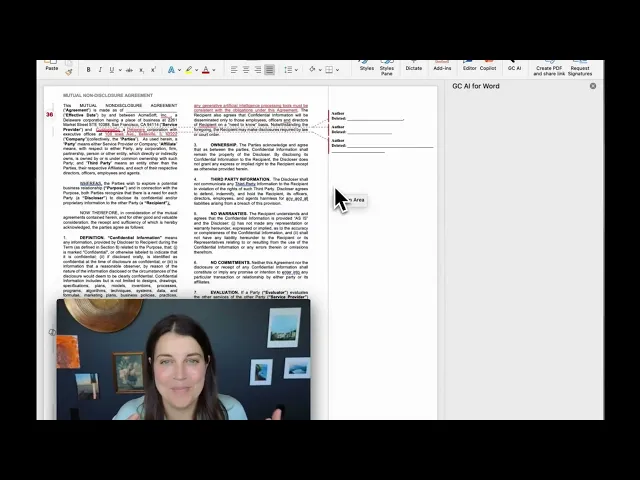
Where a general research platform leaves off, GC AI picks up the in-house workflow:
Research runs real-time, multi-agent web research biased toward authoritative legal and government sources, with citations, so the CFO’s Thursday deadline on that regulatory update gets a brief the team can act on, inside a platform built to carry that research directly into the matter.
US Case Law searches 13M+ federal and state court opinions in the same chat, the authoritative case-law research Perplexity’s public-web search cannot reach. Ask in plain English, and GC AI reads the full opinions, checks treatment data to confirm a case is still good law, and links every citation to the full opinion in a built-in reader.
Files keep your team’s contracts, templates, playbooks, and prior matters loaded across every chat, so when a vendor’s DPA references a regulation your team has never had to apply, the platform already knows your standard positions and how similar deals resolved.
Projects carry matter context across conversations, so the second lawyer on a deal does not lose what the first established.
Playbooks ship with pre-built review workflows for NDAs, DPAs, MSAs for SaaS, and MSAs for commercial purchases, with agentic multi-step execution.
Exact Quote pulls character-level verbatim text from your uploaded documents, so every claim about what a contract says points to the line in the contract.
Easy Prompt turns a plain-language request into a legally optimized prompt, so a non-prompt-engineer gets a usable answer on the first try.
GC AI for Word brings web research, reusable skills, Files, Projects, and Easy Prompt directly into Microsoft Word, where the redlining happens.
Research: Watch GC AI run a real-time, multi-agent legal research brief—authoritative sources, cited, in minutes. Watch the demo.
Files: See how Files loads your team’s contracts, templates, and playbooks into a live matter. Watch the demo.
Playbooks: Watch agentic playbook execution run a full DPA review from start to redline. Watch the demo.
Exact Quote: See Exact Quote pull character-level verbatim text from an uploaded contract in real time. Watch the demo.
GC AI for Word: Watch GC AI for Word handle research, skills, and tracked-change redlining inside Microsoft Word. Watch the demo.
On confidentiality, GC AI is SOC 2 Type II and SOC 3 certified, GDPR compliant, with zero data retention agreements with OpenAI and Anthropic, and AES-256 encryption. Each customer’s data is logically isolated, and GC AI does not train on customer data. See GC AI security.
Where Perplexity can only answer the market-standard question from public sources, GC AI goes deeper: the underlying models are trained on thousands of public agreements, and the platform encodes your team’s own positions on top.
In GC AI’s December 2025 ROI study of more than 100 active customers, in-house teams saved an average of 14 hours per week and reported 21% greater accuracy than generalist AI tools like ChatGPT. GC AI’s NPS is 77.
Ritesh Patel, Chief Legal Officer at Viant Technology, described the orientation-to-execution shift in his own work:
“It’s also replaced Googling. Now my first stop is GC AI. I describe the setup, get an answer with citations, and use that to brief my team or our business partners.”
The research step Perplexity does well closes in 20 minutes. The matter that follows is the work in-house counsel are paid to do, and it deserves a platform built for it.
Perplexity vs GC AI for In-House Legal Work: Side by Side
The capabilities below reflect each platform as of June 2026.
Capability | Consumer Perplexity (Free / Pro / Max) | Perplexity Enterprise Pro | GC AI |
Training on your data | Trains on prompts by default, with an opt-out; conversations and files retained | No training as a contractual guarantee, with enterprise data handling | Never trains on customer data, zero data retention with OpenAI and Anthropic, data isolated per customer |
Citations | Links to public web sources, each needs independent verification | Same as consumer | Character-level verbatim citations from your uploaded documents with Exact Quote |
Research scope | Public web | Public web | Real-time web research biased toward authoritative legal and government sources |
Drafting and redlining in Word | No | Computer enterprise offers contract review templates; no native Word integration or tracked-change redlining | Yes, through GC AI for Word |
Knows your templates and prior matters | No, every session starts cold | Enterprise Pro includes shared file repository (500 files); no memory of prior matter outcomes or clause positions | Yes, through Files and Projects |
Heppner confidentiality posture | Consumer tier with training on does not meet the confidentiality prong | Contractual no-training supports the confidentiality prong when configured | Built for the confidentiality and counsel-directed prongs through zero data retention and legal-team deployment |
The two tools answer different parts of the same day. Perplexity gets you smart on the question. GC AI is built for the work that follows.
See the Execution Layer on Your Own Work
Run a contract your team has already reviewed through GC AI and compare the first pass against what your orientation research turned up. The whole loop closes the same afternoon, on live work, with no credit card.
For the free in-house AI prompting course taught by former general counsels, see GC AI Classes.
Frequently Asked Questions
Is Perplexity Good for Legal Research?
Perplexity is well suited for the orientation step of legal research, summarizing regulations, mapping an unfamiliar area, and surfacing recent agency guidance from public sources. It searches the open web rather than proprietary databases like Westlaw or LexisNexis, so every citation requires independent verification before it enters any client work.
What Tasks Can In-House Counsel Safely Use Perplexity For?
In-house counsel can use Perplexity for fast orientation in unfamiliar regulatory areas, real-time monitoring of recent agency guidance, and public-source synthesis with linked citations. The boundary is the matter itself: drafting, redlining, and anything involving confidential or privileged facts belong on a platform built to handle them.
Does Perplexity Protect Client Confidentiality?
Consumer Perplexity tiers train on prompts by default and retain conversations and files unless the setting is turned off, so confidential client facts should never be entered. Perplexity Enterprise Pro includes a contractual no-training guarantee, but attorneys should independently assess whether those controls satisfy their obligations under the Model Rules.
What Did United States v. Heppner Hold about AI and Privilege?
In February 2026, the Southern District of New York held in United States v. Heppner that written exchanges with a generative AI platform do not carry attorney-client privilege on their own. Judge Rakoff rejected privilege because the AI is not an attorney, the platform lacked contractual confidentiality, and the use was not counsel-directed. Three factors apply to any consumer AI tool a lawyer inputs confidential facts into.
Can a Perplexity Citation Be Used in a Court Filing?
No. Perplexity searches the public web and may surface blog posts, news articles, or secondary commentary as if they were primary authority. Lawyers must verify every citation against an official legal database before it appears in a filing, and a Perplexity link is not a recognized legal authority on its own.
Where Does Perplexity Stop and Legal Execution Begin?
Perplexity does not draft or redline in Microsoft Word, cannot access proprietary legal databases, has no memory of your team’s prior matter outcomes or clause positions, and cannot benchmark a clause against comparable market agreements. When the research step ends and the matter begins, the work requires a platform built for legal execution.
How Does GC AI Differ from Perplexity for In-House Legal Work?
Where Perplexity orients you to a question from public sources, GC AI is built for the execution that follows: drafting and redlining in Word through GC AI for Word, verbatim citations from your uploaded documents through Exact Quote, and matter context that persists across conversations through Files and Projects. GC AI never trains on customer data and holds zero data retention agreements with OpenAI and Anthropic, addressing the confidentiality posture the Heppner ruling put at issue.
What Prompts Work Well When Using Perplexity for Legal Research?
Three prompt patterns hold up in an in-house workflow: asking Perplexity to “orient me” to an unfamiliar regulation and identify key questions for the business; requesting a dated summary of recent agency guidance changes with one source per item; and asking for a jurisdictional comparison of how two states treat a clause type, with links to the statute or case and a flag for recent changes. Each prompt produces a research brief, not a finished work product.
How Do In-House Teams at Companies Like Gunderson Dettmer Use Perplexity?
Gunderson Dettmer rolled out Perplexity Enterprise firmwide in May 2025, with 80% of its lawyers actively using it and more than 35,000 queries a month. The firm describes it as a research layer that expands what attorneys can rapidly discover and verify, the same orientation role the article identifies as Perplexity’s strongest use case for legal professionals.