8 Best Contract Intelligence Software for In-House Legal Teams
Caitlin PricePublished
The best contract intelligence software turns signed agreements into structured data that counsel can search and verify. Contract intelligence helps legal teams understand those agreements and their current obligations, including which terms govern after amendments.
The problem starts with scattered documents: a master agreement in one folder, amendments in another, and uncertainty about the notice period or liability cap that applies today. Contract lifecycle management, or CLM, may also manage preparation, drafting, negotiation, approvals, and signature. Products can combine these functions.
GC AI's Contract Intelligence ranks first because we built it solely for in-house teams, with their pain points in mind. It lets them connect the repositories they use, link amendments and current terms, and inspect extracted values against source language. This workflow lets counsel find the agreement, determine what governs, and check the answer.
The right purchase depends on where your contracts live and what your team needs to learn from them.
Contract Intelligence Software at a Glance (September 2026)
The comparison focuses on repository access, contract-family and current-term handling, source citations, custom terms, and buying and deployment requirements. The table emphasizes repository access and verification. Platform entries cover customization and deployment. “Confirm” marks a detail to test during evaluation.
| Platform | Best Fit | Source Access | Current Terms | Source Citations |
|---|---|---|---|---|
| GC AI Contract Intelligence | In-house portfolio analysis | Google Drive, SharePoint, OneDrive, Dropbox, upload | Linked families and Current Terms | Extracted values open highlighted passages |
| Ivo Intelligence | Repository analysis alongside Ivo Review | Repository connectors and upload | Composite agreements and amendment timeline | Confirm value-to-clause links |
| Harvey Contract Intelligence | Intake, review, and portfolio insights | Email, Outlook, iManage, SharePoint, Box, Google Drive | Confirm amendment handling | Confirm value-to-clause links |
| Spellbook | Drafting and review; ACM early-access evaluation | Word and Google Docs; confirm ACM intake | Confirm ACM amendment handling | Confirm ACM source citations |
| Icertis | Shared enterprise CLM deployment | Icertis repository and Data Lake | Confirm governing-term output within CLM | Confirm value-to-clause links |
| Sirion | Supplier obligations and invoice analysis | Sirion repository | Confirm amendment handling | Confirm value-to-clause links |
| Ironclad | Analysis within an Ironclad workflow | Ironclad repository and Smart Import | Confirm governing-term output within CLM | Confirm value-to-clause links |
| Workday Contract Intelligence | Shared legal operations and finance analysis | Box, SharePoint, Salesforce | Confirm amendment handling | Answers link to source documents |
The 8 Best Contract Intelligence Software Options
- GC AI Contract Intelligence: Portfolio-first analysis for in-house teams.
- Ivo Intelligence: Repository analysis alongside Ivo Review.
- Harvey Contract Intelligence: A combined intake, review, and portfolio workflow.
- Spellbook: Drafting and review with an early-access repository workflow.
- Icertis: Enterprise lifecycle management with portfolio analysis.
- Sirion: Supplier obligation and invoice analysis.
- Ironclad: Repository search and reporting within an established CLM.
- Workday Contract Intelligence: Shared legal operations and finance analysis in Workday.
GC AI Contract Intelligence
GC AI is a legal AI platform built for in-house teams, spanning drafting, research, contract review, and portfolio analysis. The broader best legal AI tools for in-house counsel comparison covers those adjacent workflows; Contract Intelligence focuses on the portfolio side, giving legal teams a way to work with executed agreements as a connected set.
As of October 2026, more than 2,200 legal teams use GC AI. Those include the legal departments at Columbia Sportswear, Jasper, and Snyk.
Start by connecting Google Drive, SharePoint, OneDrive, or Dropbox, or upload documents directly. The contracts enter a Vault, GC AI's shared workspace for the portfolio.
Contract Intelligence links amendments to master agreements and statements of work to master services agreements. Current Terms brings together the language in force so counsel can review the agreement as it stands today.
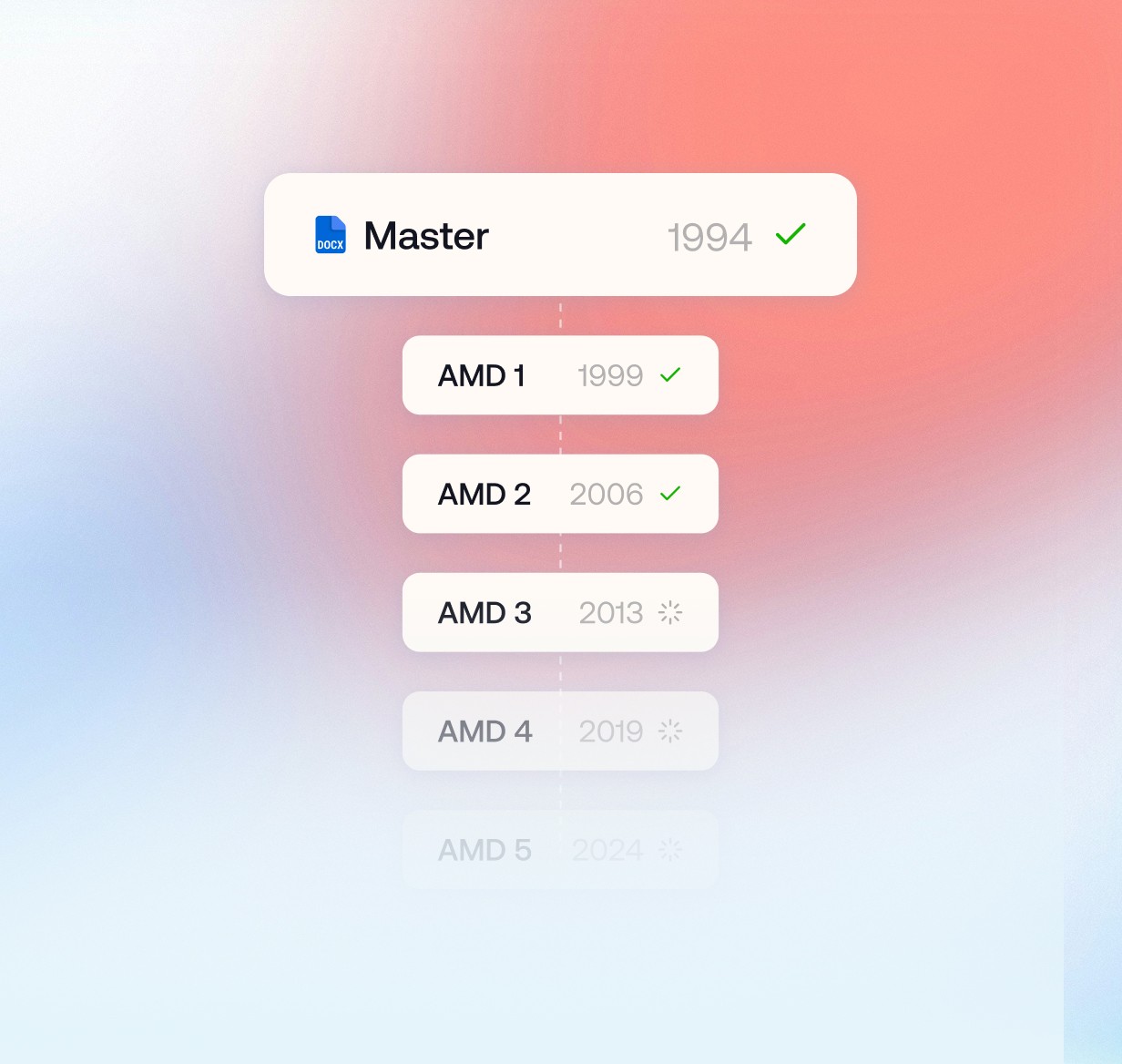
A contract family in GC AI Contract Intelligence: the master agreement and each amendment, linked in order
Counsel can describe a term in plain language, such as governing law, a liability cap, or a licensing obligation. GC AI turns it into a Column, a field in a View. The View is a filterable table of agreements and extracted values, and Saved Views remain available in the Vault for the team.
Opening a value's citation shows the underlying document with the relevant passage highlighted. Counsel can trace an extracted term to the language supporting it. GC AI's Exact Quote feature provides related context on source verification across the platform.
Portfolio chat connects a legal question to the table. Ask which vendor agreements have uncapped liability and what cap applies where there is one. The View returns the supporting agreements, and each result traces to its source clause.
Cecilia Ziniti, GC AI's CEO, described a customer whose primary agreement with a partner dated to 1995.
The relationship had six amendments across 26 contracts and three spinoffs, and parsing the operative terms took one person a week. Contract Intelligence assembles that family, identifies the terms in force, and traces each answer to the source clause.
Wayfair's legal team described reviewing close to 300 agreements in a two-and-a-half-month window, with each team member handling about 50 every two weeks. Contract Intelligence supports questions that cut across that kind of portfolio.
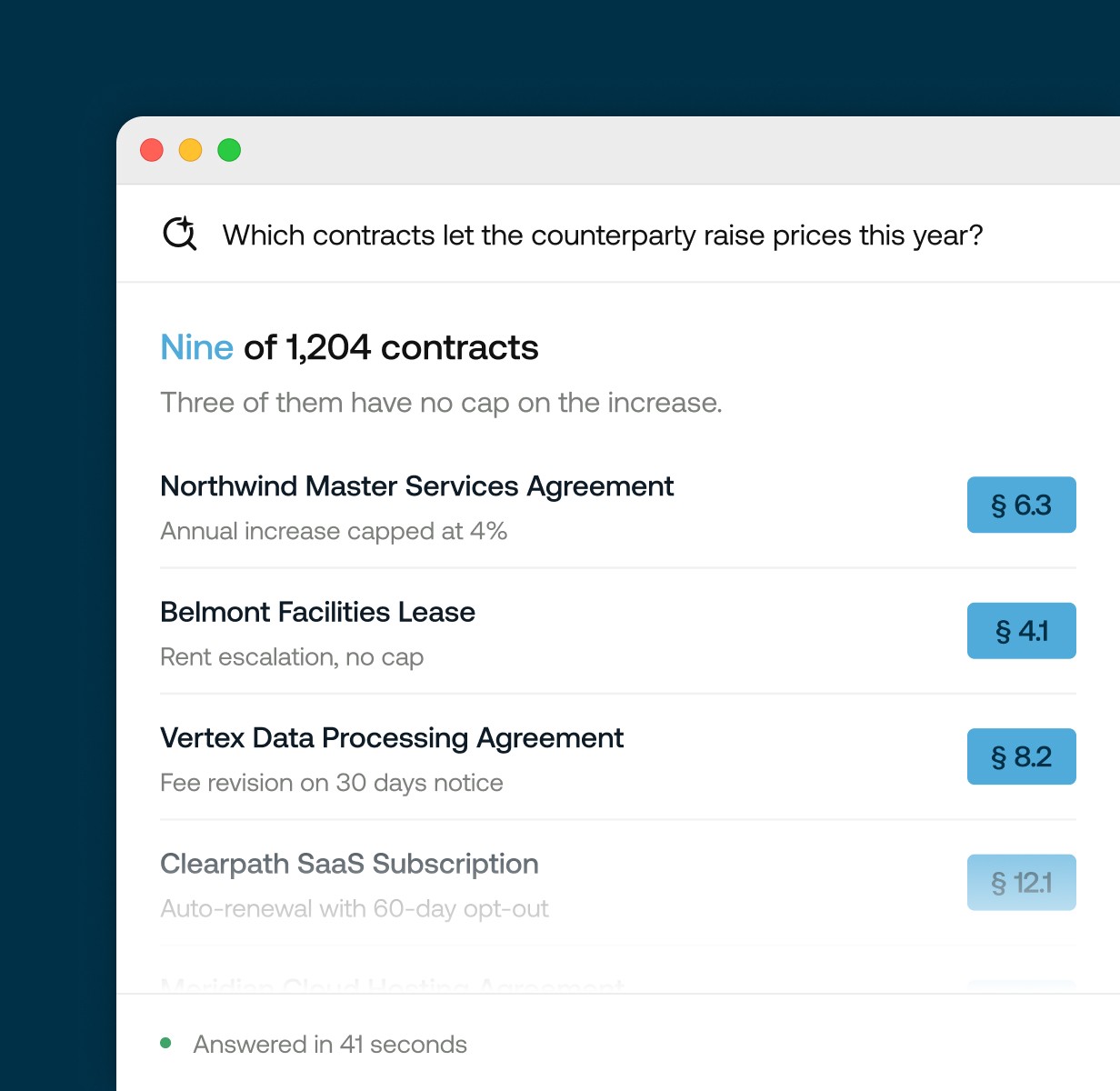
A portfolio question answered across contracts in GC AI Contract Intelligence, with source citations supporting the values
Watch the GC AI Contract Intelligence walkthrough:
On CZ and Friends, GC AI's podcast where legal leaders, operators, and technologists share how they run modern companies, Instacart's Nicole Altman described reconstructing a counterparty's amendments by hand. Cecilia Ziniti discussed that work with her on the podcast.
Use a Contract Intelligence pilot to test how the product handles your agreements.
GC AI's security materials list SOC 2 Type II, SOC 3, GDPR compliance, and AES-256 encryption. GC AI states that none of its providers train on your data. It maintains zero-data-retention agreements with its LLM providers wherever feasible and publishes its subprocessor list.
GC AI offers Contract Intelligence as an add-on to the platform, with pricing based on document capacity and a quote for the portfolio.
GC AI fits teams that want this connected repository, current-term, and citation workflow for signed agreements. Teams also purchasing preparation, approvals, or signature workflows should include those requirements in the deployment scope.
Ivo Intelligence
Ivo Intelligence fits in-house teams that want repository analysis alongside Ivo Review. Its product descriptions cover plain-language contract queries, composite agreements with an amendment timeline, and deviation analysis against standard positions.
Those functions address two related questions: which terms govern a counterparty relationship, and where executed agreements depart from the team's preferred language. Ivo Intelligence accepts repository connections and uploads; confirm the specific connectors and the path from each returned value to its source clause.
Ivo Review supports redlining in Word and Google Docs. Teams already using it can evaluate how the repository and review products work together, including shared access and implementation requirements. The Ivo review covers the broader platform.
Choose Ivo when contract review and repository analysis drive the purchase. If the same purchase must cover research, employment questions, or board work, include representative tasks in the evaluation. GC AI vs Ivo and the Ivo alternatives comparison provide broader buying context.
Harvey Contract Intelligence
Harvey Contract Intelligence gives legal departments a way to evaluate intake, review, and portfolio insights together. Its product descriptions include review agents, a review queue, playbooks that update from signed agreements, precedent benchmarking, obligation and key-date tracking, and leadership reporting.
Harvey lists connections for email, Outlook, iManage, SharePoint, Box, and Google Drive. Those connections matter when agreements are stored across document systems and email.
During evaluation, ask Harvey to show how it links amendments to a parent agreement and where each extracted value cites supporting language. Confirm access to the workflow steps your team needs and the rollout scope for your department.
Consider Harvey when the legal function wants these connected workflows from one vendor. The Harvey review, GC AI vs Harvey, and Harvey alternatives comparison address the wider platform decision.
Spellbook
Spellbook fits lawyers whose primary work involves drafting and reviewing contracts in Microsoft Word or Google Docs. Compare supports term benchmarking, and Associate supports multi-document workflows.
Its Autonomous Contract Management, or ACM, page describes intake, review, and post-signature insight. As of September 8, 2026, that page invited buyers to join early access.
Ask how executed agreements enter ACM, how it links amendments, and whether extracted terms open supporting source language. Confirm which capabilities your team can use during the pilot and subsequent deployment.
Teams purchasing drafting and review support can also evaluate Spellbook's early-access repository workflow. The Spellbook review, GC AI vs Spellbook, and Spellbook alternatives comparison cover the broader choice.
Icertis
Icertis serves organizations coordinating contract work across legal, procurement, finance, and sales. Its enterprise CLM treats contracts as structured data across the lifecycle.
Vera Copilot provides portfolio search, clause and counterparty discovery, AI insights, and playbook and obligation workflows. Icertis also describes agents for drafting, redlining, obligations, and renewals.
The repository and Data Lake, which centralizes contract data, form part of that broader deployment. Ask Icertis to demonstrate how the proposed configuration resolves amended terms and connects extracted values to source clauses. Include the required modules, implementation work, and ongoing ownership in the quote.
Choose Icertis for a shared enterprise lifecycle purchase. For a narrower portfolio-analysis requirement, compare the proposed scope with GC AI Contract Intelligence.
Sirion
Sirion serves teams that need to track supplier obligations and compare invoices with contract terms. Its CLM emphasizes portfolio risk, spend, obligations, and contract performance through the AskSirion interface.
Test three Sirion workflows:
- Searching and extracting terms across the repository.
- Detecting issues and applying review playbooks.
- Reconciling invoices against contract terms.
A supplier portfolio gives those capabilities a concrete test. Ask Sirion to trace an obligation or invoice discrepancy through the governing agreement and its amendments, then open the supporting language.
Choose Sirion when procurement, legal, and finance share responsibility for supplier performance. Confirm which workflows the proposed deployment includes and compare that scope with GC AI Contract Intelligence when counsel's primary need centers on repository questions.
Ironclad
Ironclad works for teams that already manage contract workflows in its CLM and want search and reporting across the same repository.
Smart Import brings in legacy files with metadata extraction and optical character recognition, or OCR, for scanned agreements. Ironclad also provides natural-language search and portfolio reporting. Jurist extends the platform into drafting, review, negotiation, and research.
For contract intelligence, focus the demonstration on the repository output: how the system handles amendment chains, identifies governing terms, and lets counsel inspect supporting clauses. Ask which search and extraction capabilities the proposed package includes and whether your team needs additional lifecycle modules.
Consider Ironclad for an established Ironclad workflow or a broader CLM purchase. GC AI vs Ironclad and the Ironclad alternatives comparison address differences in scope.
Workday Contract Intelligence
Workday Contract Intelligence serves legal operations and finance teams that want a shared contract repository, particularly within an existing Workday environment. Evisort AI powers the product.
Its product descriptions include a unified repository, natural-language questions with source-document links, custom AI models, and dashboards. It lists integrations with Box, SharePoint, and Salesforce.
Common-term extraction provides a starting point, while custom AI models support terms specific to the business. Ask Workday to demonstrate the setup process for one such term and show how an answer traces through a base agreement and subsequent amendments.
Choose Workday Contract Intelligence when legal operations and finance will share the repository and reporting. Confirm amendment handling, source-link detail, and implementation scope. Compare those requirements with GC AI Contract Intelligence when evaluating counsel's portfolio-analysis workflow.
How to Choose the Best Contract Intelligence Software
Start with a recurring legal question and the work required to answer it today. Useful examples include finding renewal notice periods, identifying current liability caps, or checking obligations across a supplier portfolio.
Document where the agreements live, who needs the answer, and what counsel must inspect before relying on it. Then decide whether the purchase also needs to cover drafting, approvals, signature, or shared procurement and finance workflows.
Use one pilot checklist across the five buying dimensions:
- Source access: Identify the required repositories and confirm native connections, sync behavior, permissions, and migration work. Include signed copies, drafts, redlines, and scans to see how the platform handles execution status and document quality.
- Contract families and current terms: Provide a master agreement, amendments, statements of work, and renewals. Check the family links and the terms that govern today, including the history supporting each change.
- Source citations: Open extracted values and inspect their supporting passages. Record incorrect values, missing terms, and the time counsel needs to verify or correct an answer.
- Custom terms: Define a business-specific term in plain language, such as rights reversion or a licensing obligation. Observe the setup, required assistance, and how the team saves and reuses the result.
- Buying and deployment requirements: Identify the implementation owner, required modules, and access needs. Request a quote for the full portfolio, including archived documents. Ask for security reports, a data processing agreement, model-provider training and retention terms, and the public subprocessor list.
Use the findings to narrow the purchase to two finalists. The next step tests both products against the same legal answer.
Run Your Two Finalists on the Same Counterparty
Choose a counterparty whose documents include the relationships your team needs to resolve: a master agreement, amendments, order forms, and an assignment letter where applicable.
- Prepare a reference answer: Have counsel identify the governing documents and selected current terms, with the clauses that support them.
- Give both vendors the same documents and questions: Keep the requested terms and evaluation conditions consistent.
- Inspect each result: Compare family links, governing terms, and source passages against counsel's reference answer. Record missing documents, conflicting answers, and manual corrections.
- Record effort and cost: Track setup assistance, verification time, and the quote for the same full document portfolio.
Choose the platform whose results and deployment requirements meet your team's needs. In a GC AI evaluation, use the counterparty's Current Terms and cited View to check the answer against counsel's reference.