


Dive Deeper
Transcript
Episode Overview
The Kanye clause is a morality provision, now standard in influencer and endorsement agreements, that lets a company exit a deal when talent becomes a reputational liability. It earned its name after Adidas's slow, costly split from Ye, a breakup The Fashion Law chronicled as the moment morals clauses got rewritten across the industry.
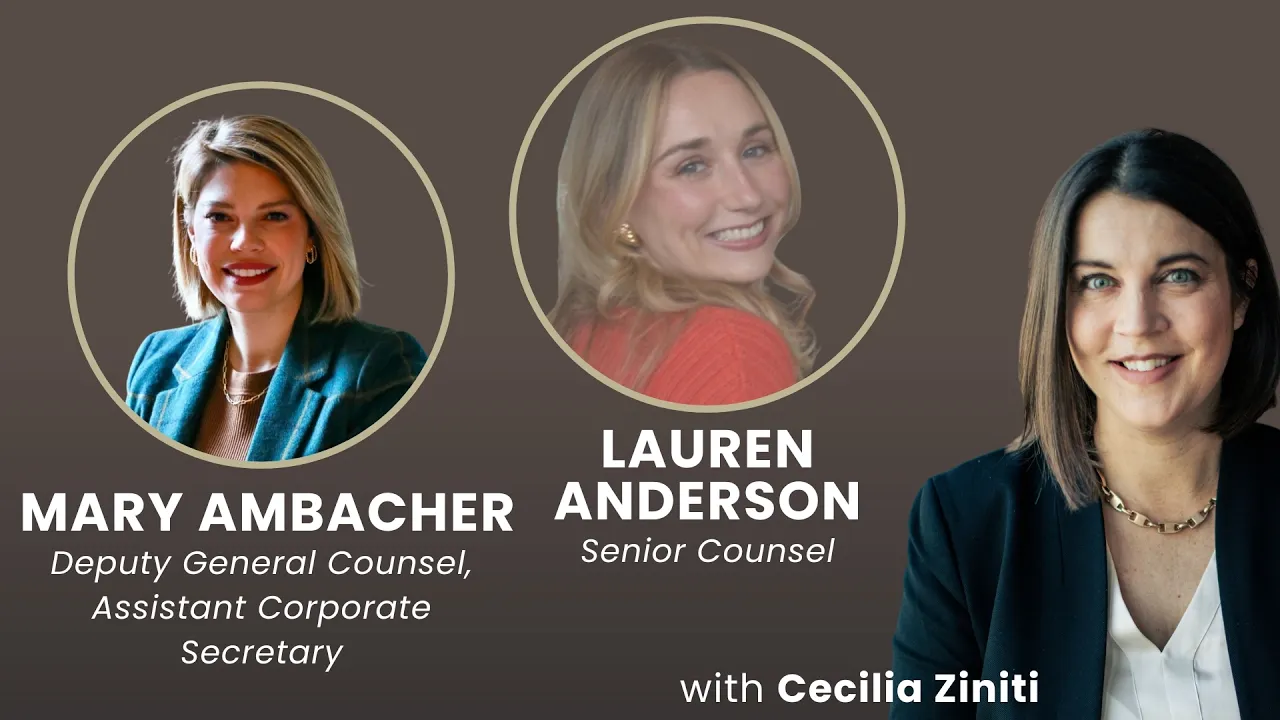
On this episode of CZ and Friends, Mary Ambacher, Deputy General Counsel and Corporate Secretary at EverQuote, and Lauren Anderson, Senior Counsel at Wayfair, join GC AI co-founder and CEO Cecilia Ziniti to talk morality clauses at influencer scale, Taylor Swift's IP playbook, and how lean in-house legal teams use AI to keep pace with contract volume.
Mary and Lauren spent years together on Wayfair's legal team, where the two became close friends. Mary left in April 2026 to lead legal at EverQuote, the publicly traded insurance marketplace.
Between them, they have negotiated thousands of influencer agreements, supported a Super Bowl ad, and rebuilt how an e-commerce giant thinks about contract risk.
About Mary Ambacher and Lauren Anderson
Mary Ambacher is Deputy General Counsel and Corporate Secretary at EverQuote, where she joined in April 2026 to lead the legal function.
She spent nearly eight years on Wayfair's legal team before that, rising to Associate General Counsel and anchoring the company's SEC and corporate governance work. She is based in Boston.
Lauren Anderson is Senior Counsel at Wayfair. She joined in May 2024 as commercial counsel and took on an expanded scope after Mary's departure.
She is one of three attorneys, plus a part-time colleague, who review the commercial contracts moving through the company. Before Wayfair, she handled IP, supply chain, and logistics work at a startup.
Key Takeaways
The Kanye clause lets brands exit a deal over reputational risk. Standard since Adidas's costly Yeezy split, it now shows up in agreements with small and mid-size influencers too, where the law of large numbers guarantees someone eventually says the wrong thing.
A "Taylor Swift clause" for AI and likeness rights could be next. Mary predicts protection for an artist's voice and image from unauthorized AI use will spread to other artists' contracts because the biggest name in music took the stand first.
AI-first hiring changed what a rebuilt legal team looks like. Mary arrived at EverQuote expecting to rebuild a scaled-down version of her Wayfair team, and hired a senior contract specialist and a paralegal instead of a bench of attorneys.
A B-plus standard, not perfection, is the right bar for routine contracts. Mary saves A-plus attention for SEC filings and public disclosures, and lets AI hold the line on the hundredth NDA, at hour five of a diligence review when a tired associate starts to skim.
Contract flexibility is the legal team's biggest gift to the business. One-year terms, termination for convenience, and credits for unused capacity, because nobody can say what software the company will need in three years.
What Is the Kanye Clause in an Influencer Agreement?
The Kanye clause is a morality provision granting a company termination for cause if talent is involved in a scandal, alleged or proven, that could harm the brand's reputation. Lauren Anderson was negotiating one the week this episode was recorded.
The clause exists industry-wide because Adidas famously lacked a clean exit from its Yeezy partnership. The company later projected a short-term hit of up to 250 million euros from ending the relationship, per reporting on the fallout.
The scale problem makes the clause non-negotiable for e-commerce brands. Wayfair's affiliate marketing program spans thousands of small and mid-size influencers, and each agreement is small while the aggregate exposure is large.
Mary put the math plainly:
"There are lower contract amounts, but you multiply that by 20,000, and someone says something that maybe Wayfair doesn't want to be associated with for any reason."
Lauren explained why the drafting keeps evolving:
"These real-world examples are why terms and conditions are the way they are."
The drafting details do the work. The triggers reach alleged as well as proven conduct, and termination is exercisable in the company's judgment, so the brand itself decides what it can stand behind.
Will There Be a Taylor Swift Clause for Artist IP and AI?
Mary thinks so. On the episode, she described Taylor Swift's recent IP filings covering her image and voice, aimed at blocking AI use of her likeness without permission, as a move that could reshape talent contracts the way the Yeezy fallout reshaped morals clauses.
The mechanism is public opinion as much as the USPTO. Mary's point is that Swift's millions of fans give her stand a weight a lesser-known artist filing the same paperwork could not command.
Mary, a self-described Swiftie, said:
"Because she's doing it and taking a stand, millions of Swifties are saying yes, that's awesome. She's already winning in the court of public opinion. Maybe there'll be the Taylor Swift IP clause that \[other artists\] all get the benefit of."
On air, Cecilia pulled up the precedent. In 2015, Swift published an open letter to Apple, objecting to Apple Music's plan to pay artists nothing during its three-month free trial.
"It's unfair to ask anyone to work for nothing," Swift wrote, and Apple reversed the policy. As Mary noted, that predated AI, and Swift wrote the letter herself.
How Does a Three-Attorney Team Handle Wayfair's Contract Volume?
With triage, playbooks, and a legal AI first pass. Lauren's team of three attorneys, plus a part-time colleague, reviews the commercial contracts moving through Wayfair.
She described closing out nearly 300 agreements in a two-and-a-half-month window at the end of last year, with each attorney averaging 50 agreements on a biweekly basis. Wayfair is a GC AI customer, and the platform anchors the first-pass layer of that system.
Lauren described the workflow:
"We use GC AI often. We've implemented a process where you rely on it for a first pass. We want to get rid of the mundane, repetitive tasks and ... be more involved in the business."
The triage rules do the rest. Excluded contract categories go to a non-lawyer, monetary thresholds dictate attention, and renewals get a lighter review. The point is precision about where attorney judgment goes. Lauren reads a contract for a SaaS vendor that touches PII or sits inside Wayfair's systems differently from a routine renewal.
Should a New Deputy GC Build the Legal Team Around AI First?
Mary's answer after three weeks at EverQuote is yes, and take your time before hiring. She arrived expecting to rebuild a scaled-down Wayfair team.
Then she explored the AI already available to the company and hired a senior contract specialist and a paralegal instead of a bench of attorneys, leaving room to find the gaps that need a specialist.
"With the two of us and some AI tools, we can probably get a lot more done than maybe five years ago without them," Mary said. "I'm trying to give myself some time to figure out where the gaps are that we're going to need to fill."
The morning of the recording, Mary had breakfast with a group of Boston GCs who landed on a counterintuitive point. A startup building legal from zero may have an easier path than a 25-year-old company restructuring a 60-lawyer department around AI.
Her hope for the established teams is redeployment, moving commercial and IP attorneys who have seen hundreds of thousands of contracts into roles where their business pattern-matching is the product.
When Is B-Plus Legal Work Good Enough?
For a large category of contracts, B-plus is the right target, and AI already operates there. Mary built this rule of thumb in her junior associate years.
SEC filings and public disclosures demand A-plus attention to detail, while the hundredth NDA needs far less.
"We were fine with accepting a B-plus or an 85 percent on that because that's all you need for that thing," Mary said. "Some commercial contracts, I'm like, give me your best C. I just need this out the door and we've got to help the business move."
Her comparison point is honest about humans, too. A junior attorney reviewing an NDA might get it 65 to 70 percent right.
An experienced associate five hours into diligence has started to skim. AI holds the B-plus line at hour five, which is the advantage for a lean team that has to move.
Lauren added the user side. The AI has the capability, but the lawyer prompting it has to know what B-plus looks like to get there.
How Will Junior Lawyers Build Judgment When AI Does the First Pass?
Neither guest claims a complete answer, and both are honest that this is the open question of the next 12 to 24 months. The work that built their judgment, redlines, diligence reviews, hundreds of contracts, is the work AI now absorbs, which is why judgment is becoming the skill that matters most for in-house lawyers.
Mary framed the stakes:
"How do we get to five to ten years from now, when you still need the \[experienced lawyers\] who've had this business judgment ... from practicing for so long, if you don't have the junior attorneys starting and getting that from the beginning?"
Lauren's working answer is deep business knowledge over any single legal skill, plus deliberate trust. Junior lawyers need room to make calls, get some wrong, and learn from the correction.
"You need to be comfortable that you might make the wrong decision and that's okay, we can fix it," Lauren said. "I think it's reps. You just need to keep going, but you'll get there. It's okay to not always make the 100 percent right decision."
Why In-House Teams Push for One-Year Terms and Termination for Convenience
Because nobody can predict what software the business will need in three years. Mary and Lauren count contract flexibility as the biggest cultural win of their years together at Wayfair. Shorter terms, termination for convenience, credits for unused capacity, and the ability to ramp consultants up and down all became standard.
When the AI market shifts every few months, a three-year lock-in is a liability, and the legal team taught the whole business to negotiate like it.
"We try to keep contracts generally to a year, with three years being the max," Lauren said. "Is this something we're actually going to use in three years? I don't think anybody can really make that determination."
Mary applied the same rule when Wayfair evaluated legal AI platforms. The team tested six legal AI tools and refused long lock-ins on principle, because the leaderboard kept changing. Flexibility became the business culture, and it started with legal.
Recommended Reading
Protecting the Brand While Moving Fast: Arc'teryx, Nextdoor, and Liquid Death: How consumer-brand legal teams balance speed with brand and reputational risk.
How Great GCs Think About Growth, Risk, and Crisis Management: Frameworks for presenting risk to leadership and preparing before a crisis hits.
Why Judgment Is the New Superpower for In-House Lawyers in the Age of AI: The case that judgment, not task execution, is what junior lawyers must build.


