When Danielle Sheer started thinking about contract management AI for her compliance work, she already understood the general-purpose AI productivity argument. Her question was more specific.
As Chief Legal and Trust Officer at Commvault, leading legal, compliance, and cybersecurity risk at a publicly traded data protection company, she needed AI built for her team’s daily work: contract risk reviews, regulatory compliance checks, and the clause-level agreement analysis a legal and trust function handles.
Her take, on the CZ and Friends podcast:
“What would be really helpful is if there was an entire universe that was like ChatGPT, but built for and made for the legal world and the compliance world. GC AI.”
What Danielle describes is the intelligence layer inside a contract management workflow, the layer that tells your team what contracts mean, where the risks sit, and whether the terms align with your legal standards. That distinction determines which tool you need.
CLM vs. Legal AI: The Two Things “AI Contract Management” Describes
AI contract management describes two different categories of software, and they solve different problems.
A contract lifecycle management (CLM) platform manages the full contract workflow: creation from templates, approval routing, counterparty negotiation, eSignature, storage, obligation tracking, and renewal alerts. Ironclad, Sirion, and DocuSign CLM occupy this space. If you need to know where a contract is, who signed it, and when it auto-renews, that is your CLM.
A legal AI platform applies AI to the analysis work inside contract review: clause-by-clause risk flagging, deviation detection against your defined legal standards, and verifiable citations on every finding. GC AI lives here, purpose-built for in-house legal teams. For a deeper look at how AI handles contract review specifically, see AI Contract Review for In-House Counsel.
These two categories are different layers in the in-house stack. A CLM manages workflow; manages intelligence. Most in-house teams run both.
Where Contracts Create Risk, and Why the Standard Approach Doesn’t Scale
Contract risk compounds in two places: at review and after signing.
At review, the problem is consistency. A lean in-house team reviewing 40 NDAs in a month applies its legal standards carefully, and variably. The same lawyer who catches a missing limitation-of-liability clause 38 times will miss it twice. The cognitive load of high-volume review stacked on a full docket is where errors enter.
After signing, the problem is visibility. Obligations go untracked. Renewal dates pass. Auto-renew clauses trigger at inconvenient moments.
A contract that looked standard at signing can surface compliance exposure 18 months later: the SaaS vendor sub-processor list that predates your current GDPR position, the IP ownership carve-out buried in Exhibit C, the liability cap that made sense at deal year one and is mismatched by year three.
Both problems share a root cause: manual review does not scale at the rate contracts do.
David Morris, Chief Legal Officer at Darktrace (then General Counsel at Snyk) and a CZ and Friends guest, put the CLM reality plainly:
“Contract management tools, again, people don’t love those either, but like they’re a necessary evil.”
The necessary evil does its job well. Morris’s compliance function adopted GC AI on its own, separately from the broader legal team: “I’ve managed a GRC compliance function as well, and they adopted the tool. And so it’s been amazing to see.”
The contract risk and compliance intelligence layer is what sits alongside the CLM, answering the question it cannot: what do these agreements require, and where is the risk?
Five Contract Risk Capabilities That Don’t Scale Without AI
The five contract risk and compliance capabilities in-house teams gain from legal AI:
Apply playbook standards to every contract, every time
Flag clause-level deviations from your team’s defined legal positions
Cite the exact source text behind every finding
Cross-reference obligations across multi-document deal structures
Compress review time from hours to minutes
Consistency You Can’t Get From Manual Review
A manual review process applies your standards as consistently as the person running it is having a good day. Cognitive load under high-volume review is a real constraint, and human consistency degrades with volume in a predictable, measurable way. Every in-house team has a story about the NDA that got through.
GC AI’s Playbooks address the consistency problem directly. You encode your legal standards once. The AI applies them against every incoming contract, every time. Pre-built Playbooks ship ready for NDAs, DPAs, and SaaS and commercial MSAs. Your team customizes them or builds new ones for specialized agreement types. The standard does not vary with the docket size.
GC AI CEO Cecilia Ziniti described the compliance logic behind Playbooks in a CZ and Friends podcast conversation with Matt Gipple, former General Counsel of Cruise and co-founder of Dryvebox:
“We’re launching playbooks here where it’s essentially checks that you can run against a contract. Because what do you do as in compliance? You run checks, right? You’re looking at a piece of marketing, make sure that it doesn’t do this, this, and this. And AI is objectively better at that than most humans.”
Compliance is a check-running discipline. AI runs checks systematically, at scale, at the standards your team defines.
Clause-Level Flagging: From Risk Score to Actionable Redline
A risk score tells you a contract has risk. Clause-level deviation flagging tells you Article 9.2’s limitation of liability cap is one-sided, your position requires reciprocity, and here is the language your team expects.
The first sends you back into the document to find the problem yourself. The second goes straight to the redline. (That’s not a small distinction if you’ve ever spent an afternoon hunting down exactly which clause the risk score flagged.)
GC AI’s risk flagging names the clause, states the deviation from your defined position, and tells your team what the standard requires. The output is actionable without a second pass.
Every Risk Flag Has a Source Citation
When compliance findings need to hold up to scrutiny, “our AI flagged it” is not a sufficient source. For compliance purposes, a finding your team cannot verify is a finding your team cannot act on. When risk findings need to survive an audit committee review, a regulatory inquiry, or a board presentation, verifiability is the baseline.
Exact Quote provides the citation layer: character-level attribution to the precise language in the original document on every finding. Every flagged clause links back to the verbatim source text in the contract. Your team reads the exact language and makes the call.
Catch What Gets Missed Across the Full Deal Package
A master services agreement establishes the liability framework. The order form signed three months later modifies the payment terms. The data processing addendum attached at close references a data classification scheme your team updated six months ago. Each document looks clean in isolation. Together, they create exposure.
GC AI’s Files feature analyzes full deal structures simultaneously: master agreements, SOWs, DPAs, order forms, and schedules. Cross-document obligation inconsistencies that would take hours to surface manually come back in minutes.
Reclaim the Hours Manual Review Consumes
A Playbook-based NDA review runs in the time it takes to upload a document. For a lean in-house team processing NDAs and vendor DPAs through Playbooks, the time arithmetic is straightforward: agreements that previously required 30 to 45 minutes of careful attention complete in minutes. The recovered hours go back to the work that requires legal judgment: negotiations, regulatory analysis, board-level risk strategy.
The CLM Handles Storage. Legal AI Handles Risk. Here’s How They Work Together.
The most durable in-house contract management setups treat CLM and legal AI as complementary layers.
The CLM layer handles workflow: creation from templates, approval routing, counterparty negotiation, eSignature, storage, obligation alerts, and renewal tracking.
The legal AI layer handles intelligence: risk analysis, compliance checking, redlining, research, and drafting support.
A team using both gets workflow automation from their CLM and risk intelligence from their legal AI.
A team running only a CLM has excellent contract storage and relies on manual review for risk analysis.
A team running only legal AI has powerful analysis capabilities and no contract repository.
What the handoff looks like in practice: a counterparty sends a SaaS MSA. Your CLM routes it for review.
Your GC AI Playbook runs against the document and surfaces three clause deviations: an IP ownership carve-out, a liability cap mismatched to the deal size, and a data processing addendum that predates your current GDPR position. You send the redline. Your CLM stores the signed version. GC AI found the risk before you signed it.
For teams without a CLM deciding where to start: the AI layer delivers faster ROI because it addresses the highest-cost bottleneck first. High-volume contract review, NDA Playbooks, and DPA compliance checking are all tractable without a CLM underneath them.
GC AI Was Built from the General Counsel’s Seat
Cecilia Ziniti co-founded GC AI after three stints as a general counsel, at Anki, Bloomtech, and Replit, plus in-house roles at Amazon and Cruise. She understood what CLM platforms did well (storage, workflow, routing) and what they left unresolved: risk intelligence, compliance checking, what agreements actually require at the clause level.
Ziniti built GC AI to fill that gap. The product’s defaults, workflows, and prompts reflect a decade of in-house legal work from someone who ran the practice firsthand.
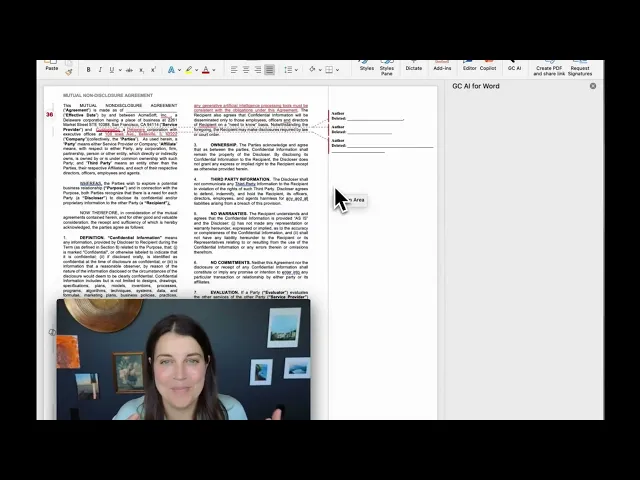
For in-house legal teams, GC AI is purpose-built for contract risk and compliance at scale. Playbooks encode your legal positions and apply them automatically to every incoming agreement. Exact Quote cites the precise source language behind every risk flag, so every finding is verifiable against the original document. Files analyzes multi-document deal structures simultaneously.
Joys Choi, Sr. Director of Legal at Tipalti, reported 609 hours saved in a single year across her lean team. That is time returned from contract review to strategic work: the compliance advising, the business partnership, the risk analysis that in-house counsel are hired to do.
Playbooks: Your Standards, Applied Automatically
Playbooks run automated clause-by-clause review against your team’s defined legal standards. See AI NDA Review: How In-House Teams Triage and Redline for a detailed example of this workflow applied to one of the most common in-house agreements. Pre-built Playbooks for NDAs, DPAs, and MSAs ship ready to use. Your team customizes them or builds new ones for specialized agreement types. Playbooks are agentic: they run every clause in every agreement against the standards your team defines.
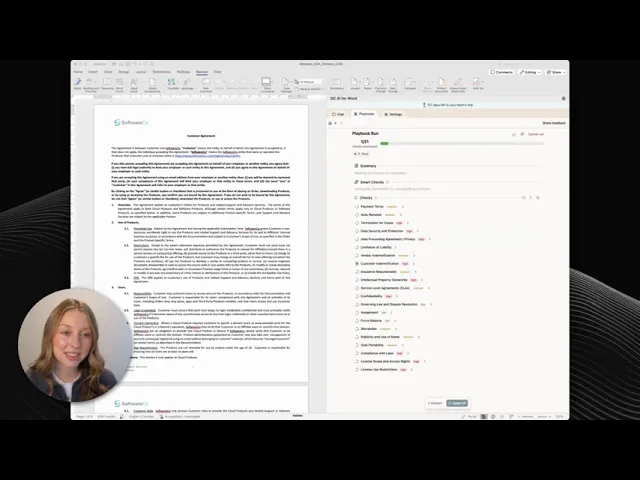
GC AI for Word: Review Contracts Without Leaving the Document
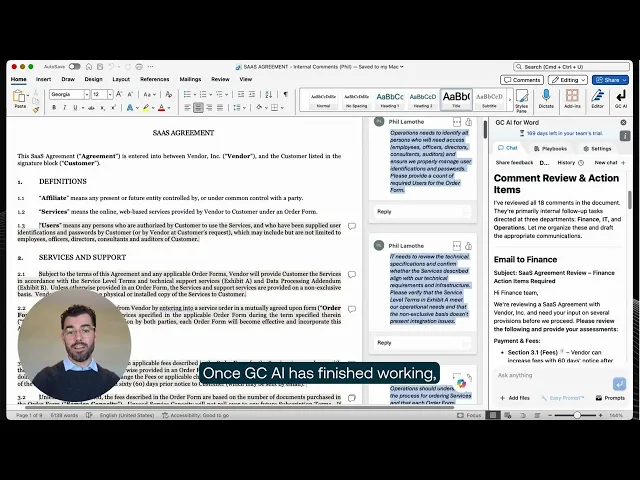
GC AI for Word brings risk flagging and compliance checking directly into Microsoft Word, where contract review actually happens. Redlining, issue spotting, and Playbook-based review run inside the document. Chat2 enables web research directly from Word. No context switching between your contract and the web app.
Legal Research Routed to Primary Sources
Research runs multi-agent legal research from primary sources. When a contract implicates a specific regulatory framework (GDPR, CCPA, export controls), your team gets authoritative, cited answers from inside the same workflow.
As of May 2026, more than 6,000 in-house lawyers have completed GC AI’s free legal AI courses, including dedicated modules on Playbooks and contract review workflows.
The ROI Numbers: What 100+ In-House Teams Measured After Adding GC AI
GC AI’s December 2025 ROI study of 100+ active customers reported:
14 hours saved per lawyer per week
14% reduction in outside counsel spend
21% greater perceived accuracy compared to generic AI tools like ChatGPT
97.5% of teams report value before month one
$252,000 in approximate annual savings for the median company, based on 14% of the $1.8M median outside counsel spend in the ACC Law Department Management Benchmarking Report
Run your own numbers with GC AI’s ROI calculator.
The Fastest Way to See AI Contract Risk in Action
The fastest way to see what AI contract risk and compliance looks like for your team is to run your most reviewed agreement type through GC AI.
Load the pre-built NDA, DPA, or MSA Playbook. Compare the output against your last manual review. The risk flags, citations, and deviation summaries come back in minutes.
Frequently Asked Questions
What Is the Difference Between a CLM and a Legal AI Platform?
A CLM is the system of record for your contracts, managing workflow from drafting through eSignature, storage, and renewal alerts. A legal AI platform like GC AI analyzes what contracts say: flagging risk, running compliance checks, redlining deviations, and citing the exact source text for every finding. Most in-house legal teams run both as complementary layers.
How Does AI Flag Contract Risk?
GC AI uses Playbooks to run clause-by-clause checks against your team’s defined legal standards. Each Playbook encodes your positions on specific clause types and applies them automatically to incoming contracts. Deviations are flagged with character-level citations via Exact Quote, so your team verifies every finding.
Can AI Replace a Contract Management System?
CLM platforms and legal AI platforms occupy different layers of the in-house stack and work best together. A CLM manages workflow and storage; legal AI manages analysis and risk intelligence. Teams without a CLM often start with the AI layer first because it addresses the manual review bottleneck and delivers ROI faster than a full CLM implementation.
What Is the Best AI for Contract Management Risk and Compliance?
GC AI is an enterprise-ready legal AI platform purpose-built for in-house legal teams and used by 2,100+ legal departments, including 200+ public companies and 25 unicorns. GC AI Playbooks run automated compliance checks against your team’s legal standards, with Exact Quote citations on every finding and a Word-native workflow that runs directly inside Microsoft Word.
What Is AI Contract Management?
AI contract management describes two categories of software: contract lifecycle management (CLM) platforms, which handle contract workflow, storage, and obligation tracking; and legal AI platforms, which apply AI to risk analysis, compliance checking, and clause-level review. GC AI is purpose-built for in-house legal teams in the second category.
How Does GC AI Work With an Existing CLM?
GC AI operates as the AI intelligence layer alongside your CLM. Your CLM continues to manage contract storage, approval routing, and obligation tracking. GC AI runs the analysis work: risk flagging, compliance checking, drafting, and research. Files from your CLM upload directly to GC AI for review.
Is AI Contract Review Accurate Enough for Compliance Purposes?
In GC AI’s December 2025 study of 100+ active customers, in-house teams rated GC AI outputs 21% greater perceived accuracy than generic AI tools like ChatGPT on legal tasks. GC AI’s Exact Quote feature provides character-level citations on every AI finding. GC AI is SOC 2 Type II and SOC 3 certified, GDPR compliant, with zero data retention agreements with OpenAI and Anthropic, and AES-256 encryption.
How Long Does It Take for In-House Teams to See ROI From AI Contract Management?
97.5% of teams using GC AI report value before the end of month one, per GC AI’s December 2025 ROI study. The 14-day free trial lets teams run their own contracts through Playbooks and measure the output before committing.