The best AI for drafting legal contracts is the one that starts from your approved language and hands back a draft you can check line by line. Give it your template, your playbook positions, and the deal facts, and each proposed clause should arrive with a source you can open. Six platforms offer drafting or revision workflows to evaluate: GC AI, Spellbook, Ivo, Harvey, LegalOn, and Gavel Exec.
At GC AI, we build an enterprise legal AI platform for in-house legal teams. Today 2,100+ legal teams use it, including 300+ public companies and the teams at Arc'teryx, Columbia Sportswear, Eventbrite, and Tipalti.
Our CEO, Cecilia Ziniti, was a general counsel three times (Anki, Bloomtech, and Replit) and an in-house counsel at Amazon and Cruise. Before the company existed, she was teaching lawyers to use ChatGPT, and those classes told her what the software had to do. She left Replit on November 2023 and incorporated GC AI about a week later. She described those months to Crunchbase News:
"I would teach these classes in the morning and tell my co-founder in the afternoon, 'Our software needs to provide accurate citations. Our software needs to tell you where in the document it's getting the backup for this. Our software needs to speak in this way.'"
The work that decides this purchase is the work left after the output appears. You check the source, restore a defined term, resolve a conflicting instruction, and explain a change to the business. This guide compares six platforms on that work and gives you a pilot to run on your own shortlist.
Key Takeaways
Name your drafting job before you shop: a first draft from company paper, a missing clause added during review, or a revision to the counterparty's form. Cover both starting points when your team handles both.
Ask each platform to separate an approved company standard from language in a previously negotiated agreement. A concession you granted once stays labeled as a concession.
Open the Word file and the source passages behind the proposed language. The evidence lives in the passage and the tracked changes, so read both.
Judge each platform by the work your lawyers still do after the draft appears, and price the plan that includes the features you tested.
Compare Six AI Contract Drafting Platforms
The table sets each platform's documented drafting mechanic next to a test you can run on it. The fit column is our read of each vendor's own documentation, with no cross-vendor test behind it.
Platform | Best Fit to Evaluate | Documented Drafting Mechanic | What to Test |
GC AI | In-house drafting against your own standards, start to finish inside Word | Playbooks apply your preferred and fallback positions inside Word; Easy Playbooks builds one from your own templates and negotiated agreements; Exact Quote opens the source passage; drafts and redlines land as tracked changes with risks flagged in margin comments | Whether the draft holds your preferred position, applies the approved fallback once, and arrives in Word ready for your read |
Spellbook | Creating clauses and first drafts in Word | Draft tab, full-document drafting, and a Library of precedent language | Outline quality, precedent selection, and insertion into the right document |
Ivo | Drafting connected to playbooks and contract review | Ivo Assistant drafting and playbooks built from repository contracts or written rules | How proposed language uses your standards, and which repository features your plan includes |
Harvey | Coordinated revisions across a longer agreement | Document-wide Word edits and conforming a draft to a supplied term sheet or checklist | Defined terms, linked provisions, and formatting after several related changes |
LegalOn | Drafting and revising clauses against playbooks during review | AI Revise proposes and inserts missing language; attorney-built and custom playbooks guide review; AI Assistant drafts language in the platform or Word | Whether proposed language follows the playbook, fits the agreement and related documents, and preserves defined terms |
Gavel Exec | Drafting in Word from precedents | Precedent-based drafting, review, and redlining in Word | Whether you need open-ended drafting in Exec, structured assembly in Gavel Workflows, or both |
Packaging changes, so ask each vendor to confirm in writing which features, seats, and repository access your plan covers before you sign.
What Counts as Contract Drafting?
Drafting covers four jobs: creating an agreement, adapting an approved form to a deal, writing a missing provision, and proposing replacement language during negotiation. Review finds the issue. Redlining records the change. A platform that flags a missing clause still owes you language that fits the rest of the agreement.
Jeremy Siegel, General Counsel at Amerit Fleet Solutions, gave the practitioner version on the CZ and Friends podcast, the podcast hosted by our CEO interviewing legal leaders, technologists, and operators shaping how modern companies work and scale:
"No one actually writes stuff in the legal world. Everyone copies and pastes. Everyone finds good precedent, modifies it to the way that they want to use it, and then claims it their own. And just AI does it much more efficiently, much cleanly. And it does a much better job maintaining tone as well."
Precedent selection is the drafting decision, and the software either helps you make it or hands you language you have to trace yourself.
Document assembly is a different product: a sales rep answers ten intake questions and template rules produce the order form. Contract lifecycle management extends into intake, approvals, storage, and post-signature administration. Decide whether this purchase covers those processes or whether your existing systems already do.
Juro combines browser-based drafting with negotiation and approvals. Ironclad's Jurist adds drafting and editing in a native .docx environment built on its CLM infrastructure. Evaluate these when the purchase also includes broader contract operations.
For a walkthrough of the drafting steps themselves, document type by document type, read how to use AI for legal document drafting.
Six Criteria for Choosing Contract Drafting AI
Six criteria separate a drafting platform your team will use from one that adds a review cycle. Score every shortlisted platform on the same six:
Control Over Context
Company Standards and Fallback Positions
Source Verification
Own Paper and Counterparty Paper
Revision and Lawyer Handoff
Deployment, Governance, and Cost
Control Over Context
Say which template, term sheet, playbook, and business facts govern the task. Then build a deliberate conflict into the test, such as a term sheet that departs from the approved template.
You want the platform to surface the conflict and ask which instruction controls. A pilot is where you catch it choosing silently.
An executed contract can supply useful language while carrying a deal-specific concession. Label its role before you feed it in as precedent.
Company Standards and Fallback Positions
A working playbook holds three things: the preferred position, the acceptable alternatives, and the decisions that need approval. Read the generated rules before anyone drafts against them, and confirm who can edit a playbook and how a lawyer knows which version is live.
Sharon Johnson, SVP and Chief Legal Officer at Mode Global, described how a lean team gets ahead of that on GC AI's podcast:
"When you're lean, there's just no place to hide. I would say we'd have to be disciplined where we spend our time. We do things like creating playbooks, escalation paths, or we might build contract positions out before we need them so that you have that."
GC AI Playbooks hold the preferred position and the approved fallback and apply both inside Word. Easy Playbooks builds one from your templates, your previously negotiated agreements, or documents you upload, so the standard starts from language your team already agreed to.
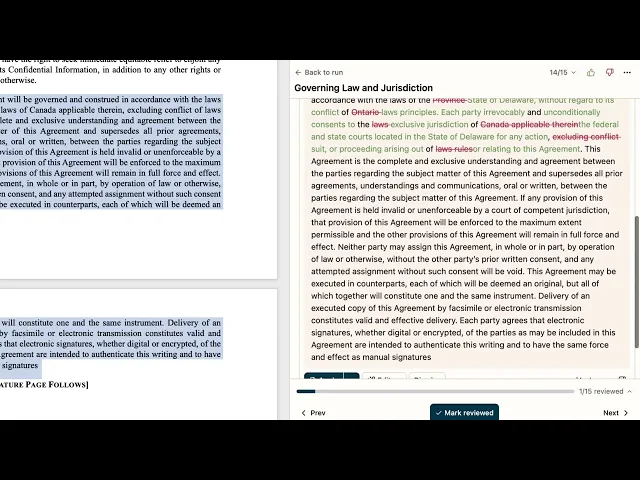
Ivo's Playbook Builder does the same from repository contracts. Either way, a lawyer signs off on the generated standard before it governs a draft. For the method behind a good one, see how to build a contract playbook.
Source Verification
Ask the platform to show you the passage behind a proposed clause or a factual assertion. Open it and compare it with the output.
A citation to your template tells you where the language came from. Whether the clause belongs in this deal is still your call.
When the task also needs legal research, evaluate jurisdiction, currency, and primary authority separately from precedent retrieval.
Own Paper and Counterparty Paper
Run one task on an approved template and a second on a counterparty draft. Check definitions, exhibits, cross-references, and the dependencies between clauses, since a narrow edit to a payment term can reach a provision that shares the same deadline.
Alexis Palmer, Senior Managing Counsel at Snyk, described what that looks like on her side of the table:
"I'm on the commercial team, mostly working on other party paper with enterprise customers. A lot of times they'll ask for language tied to regulatory requirements, and I'll use GC AI to research what those requirements actually are and draft something that works for both sides."
Counterparty paper puts research and drafting in the same task, so test both in one pass.
Record the unnecessary rewrites alongside the omissions. Preserving language you did not ask to change is half of a usable drafting workflow.
Revision and Lawyer Handoff
Change one business instruction and ask for a targeted second pass. Then read the clean copy, the tracked changes, and any explanation written for the counterparty.
Keep internal reasoning and negotiation limits out of external comments. The lawyer approves each material revision before the document circulates.
Hayley McAllister, Senior Counsel and Head of Commercial Legal at Jasper, described the handoff she runs on her own comments:
"Sometimes I will just go ahead and draft what's in my brain as a comment… and I'll use GC AI to refine what I've said, add context, and ask, 'Did I miss anything here?'"
Test that sequence: the lawyer writes the position, the platform pressure-tests it, and the lawyer decides what ships. For the redline mechanics behind it, see AI contract redlining.
Deployment, Governance, and Cost
Confirm the proposed plan includes what you tested:
The Word integration
The playbooks
Document access and the collaboration features
Then weigh the implementation and review effort against the quoted price, since public documentation settles some plan limits and leaves the rest to the contract.
Ask the governance questions in plain terms: who can see a matter's documents, whether you can delete inputs and outputs yourself, and who holds the admin seat when the champion leaves.
Which Platform Fits Your Drafting Work?
Six platforms carry documented drafting or revision workflows an in-house buyer can evaluate:
GC AI
Spellbook
Ivo
Harvey
LegalOn
Gavel Exec
GC AI
GC AI drafts from your own standards, inside Word, and opens the source passage behind language it pulls from your precedent. You review a draft with the trail already attached.
Tiffany Lee, General Counsel and Corporate Secretary at Liquid Death, described the moment that pays off:
"If it sees a missing confidentiality clause, I'll just ask it to draft one I can drop right into the agreement: no leaving the system, no reformatting."
GC AI for Word puts that work in the file itself, and the add-in is listed on Microsoft AppSource. Inside Word it will:
Draft new clauses and contract language in the context of the agreement on screen
Redline selected clauses or entire contracts
Issue spot risks and ambiguities in your document
Summarize document comments and counterparty redlines
Run your Playbooks against the draft and attach skills from your Skill Library for NDAs, DPAs, regulatory summaries, and board consents
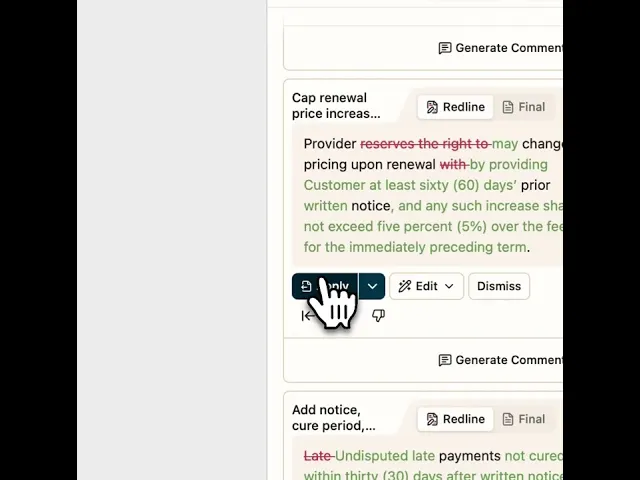
Redlines land as tracked changes with flagged risks written into the margin comments. A chat you started in the web app pulls into Word with one click, so the research and the redline stay in one workflow.
Here is GC AI for Word reviewing and redlining a contract:
Rachel Harris, General Counsel and AI Governance and Privacy Officer at Suzy, described what that felt like the first time on the podcast:
"My favorite moment, and I will always remember it in my career, is the day I was able to leverage AI directly in Word to apply red lines and generate commentary to the opposing party in real time in Word."
Hold every platform on this list to that standard, because Word is where the counterparty sees your work.
GC AI is $500 per seat per month or $5,000 per seat per year, with a 14-day trial. Pricing is published, so you can size the purchase before you talk to anyone.
Evaluate GC AI with a company template, an exception to your playbook, and a required Word handoff. Read the proposed language, open the source passages with Exact Quote, then count the revisions your lawyers still made. For the Word comparison across platforms, see best legal AI for Microsoft Word.
Spellbook
Spellbook drafts new clauses from its Draft tab, produces a full document from a parties-and-clause outline, and keeps precedent language in its Library, in Word and Google Docs.
That gives a buyer two distinct tests: inserting a provision into an existing agreement, and creating a first draft from an outline. Review the outline before you generate the document, then read whether the resulting clauses hold together.
For full-document drafting, put a blank-document step in the test plan and confirm how the product preserves the existing file before you train users on it.
Spellbook publishes no pricing.
Spellbook fits when clause creation and first drafts in Word are the daily job. Dig deeper in GC AI vs. Spellbook and Spellbook alternatives.
Ivo
Ivo Assistant drafts, redlines, explains, and runs research, and its Playbook Builder creates a playbook from repository contracts, uploaded documents, or rules written from scratch.
That makes Ivo relevant when the drafting job means applying a standard during review as well as generating language. Ivo sells Assistant alongside Ivo Review and Ivo Intelligence, so confirm which repository and collaboration capabilities your proposed package includes.
For a pilot, pick the contracts that should inform a playbook, read the generated positions, and ask Ivo Assistant to draft a revision against them. Then check the source language and the resulting redline.
Ivo publishes no pricing.
If your drafting starts inside a review queue, that is the Ivo case. Compare it directly in GC AI vs. Ivo, or scan the field in Ivo alternatives.
Harvey
Harvey edits across a complete Word document, including conforming a draft to a term sheet or checklist held in a Vault project and applying a defined term consistently.
Its playbook review flags provisions that sit outside the playbook's scope, and it carries Word formatting controls. Harvey initially launched with law firms and has since expanded to in-house.
Those mechanics matter when one instruction requires several connected changes. Test a revised commercial term that appears in the main agreement, an exhibit, and a definition.
Then read each affected provision and confirm the unrelated language survived. Ask for a demonstration on your own document structure and the package under consideration.
Harvey publishes no pricing.
Harvey makes sense when your drafting work is long agreements whose terms repeat across exhibits and definitions. GC AI vs. Harvey covers the broader platform comparison, and Harvey alternatives lists the rest of the field.
LegalOn
LegalOn's AI Revise proposes language for a flagged missing provision and inserts it through the Word add-in or Word for the web. Its Cross-Document Review reads related agreements alongside the one on screen. LegalOn also offers attorney-built and custom playbooks, and its AI Assistant drafts language in the platform or Word.
That is a concrete drafting use case: moving from an identified omission to proposed contract language. Test it with an agreement missing a required provision and a related document that should shape the wording.
Read where the clause lands, whether it picks up the existing defined terms, and whether it creates a conflict elsewhere. If building a complete agreement from a term sheet is your main requirement, make that a separate demonstration.
LegalOn publishes no pricing.
LegalOn fits a team whose drafting happens inside contract review, and GC AI vs. LegalOn runs the head-to-head.
Gavel Exec
Gavel Exec is the Word product for drafting, reviewing, and redlining from precedents. Gavel Workflows is the separate product for structured document automation with conditional logic and templates.
That split matters when the requirement is written as "contract drafting." A lawyer adapting precedent in Word and a business user completing an intake form are doing two different jobs.
Test Exec on a precedent that needs deal-specific changes, and read which provisions it adapts and which it preserves. If the larger requirement includes repeatable self-service assembly, evaluate Workflows separately, including who maintains the template logic.
Gavel publishes Exec pricing per user on its site.
Choose Gavel Exec when precedent adaptation in Word is the job and the automation question comes later, and read GC AI vs. Gavel before you decide.
If your shortlist centers on precedent or template-based drafting, also consider DraftWise and LegalFly. DraftWise describes drafting and markup against past work and organizational guidelines in Word. LegalFly describes contract creation from approved templates, clause libraries, and standards. Apply the same source and handoff tests to either.
Run a Synthetic Contract Drafting Pilot
Let's run through a fictional exercise. This is a test design for your own pilot, with no product test behind it and no legal position recommended.
Create a short mutual NDA for fictional Northstar Software and Cedar Analytics to evaluate a potential integration. Supply an approved sample template and a one-page test playbook.
In that fictional playbook, the preferred confidentiality period is three years, five years is an approved fallback, and anything longer needs legal approval. Add a counterparty request for seven years, and leave the signing entity's address unspecified.
Give each shortlisted platform the same documents and the same instruction:
Draft the NDA from the supplied template and deal brief. Follow the test playbook. Identify conflicts and missing facts before drafting; do not invent the missing address or treat the requested seven-year period as approved. Preserve the template's defined terms and unrelated provisions. Provide a draft and a short internal issue list that identifies the source of each proposed departure.
Then ask for one revision: apply the approved five-year fallback. The test is whether the platform carries that instruction through the document while the unresolved request stays flagged and the unrelated language stays put.
Have the same reviewer record:
Whether the first pass caught the missing address and the approval requirement.
Whether the draft and the second pass followed the supplied instructions.
Whether the source references led to the right passages.
Whether definitions and cross-references stayed consistent.
Whether the Word output, tracked changes, and comments were usable.
What the reviewer corrected before the draft could move forward.
Log the product, plan, settings, inputs, outputs, and reviewer corrections. Mark any feature unavailable in the trial as untested, and keep the conclusions scoped to the exercise, because one NDA tells you how a platform handles an NDA.
For what a full NDA playbook covers, see the NDA review playbook.
Put the Drafting Workflow to Work in GC AI
Start with the documents that govern the task: the approved template, the deal brief, and the playbook. When you add a negotiated precedent, say whether it supplies preferred language or a one-time exception.
Here is the shape of the ask in GC AI for Word, using the Northstar and Cedar exercise above:
Draft the mutual NDA from the attached Northstar template and the Cedar deal brief. Apply the test playbook. Flag the seven-year confidentiality request against the three-year preferred position, and list any fact the template needs that the brief does not supply.
The return you are looking for is a draft in tracked changes, the seven-year request flagged against the three-year position, and the missing signing address listed as an open item. The issue list travels with the draft, so the business sees the same open questions you do.
Then ask GC AI to apply the approved five-year fallback.
Verify against the example itself: open Exact Quote on the confidentiality term to confirm the passage matches, and check the Word file for the five-year fallback landing once and nowhere else.
Save the approved language and the decision behind it in Files or fold it into the playbook, so the next deal of this shape opens on an approved position.
Choose a platform after you have watched that whole sequence: the inputs, the draft, the corrections, and the Word file you would send. Bring a synthetic agreement and the standards you want followed, and you can run it in the trial this week.
Frequently Asked Questions
What Is the Best AI for Drafting Legal Contracts for an In-House Team?
GC AI is designed around in-house counsel, with Playbooks that carry preferred and fallback positions, Exact Quote for source passages, and drafting inside Microsoft Word. Spellbook creates clauses and first drafts in Word, Ivo pairs drafting with playbooks and review, Harvey coordinates revisions across long agreements, LegalOn inserts missing provisions during review, and Gavel Exec drafts from precedents in Word. Run the same contract, the same approved standards, and the same review requirements through each one, then compare the work left before the draft is ready to send.
Can AI Draft a Contract From a Term Sheet?
AI can turn supplied deal terms into contract language. A term sheet rarely answers every drafting question, so name the approved template, the governing assumptions, the unresolved issues, and the documents that take priority. Ask the platform to identify missing facts and conflicting instructions before it drafts. Then have a lawyer check the proposed language against both the term sheet and the complete agreement.
Should We Test AI on Our Own Template or Counterparty Paper?
Test both when both occur in your practice. Your template tests whether the platform preserves approved language while adapting the deal terms. Counterparty paper tests whether it proposes targeted changes while unrelated provisions stay intact. Use separate acceptance criteria for the two tasks and review the final Word files, including definitions, cross-references, comments, and tracked changes.
What Should We Confirm Before Uploading Confidential Contracts?
Confirm that the proposed account and plan meet your team's requirements for data use, retention, deletion, access permissions, and vendor agreements. Get those answers for the specific features and integrations you will use. Start with synthetic documents while the questions are open, and bring in the people who own your organization's security and legal approvals.