

Dive Deeper
Transcript
Episode Overview
When should a startup hire its first lawyer? Bring in counsel, full-time or fractional, once legal questions start shaping product, sales, or fundraising decisions, and before documents reach the signature stage.
That is Jeremy Siegel's rule, and he learned it in a heavily regulated industry. He joined Eaze two weeks before recreational cannabis became fully legal in California, as the first Director of Compliance for a cannabis delivery platform in the United States.
His case for hiring early is concrete. A contract counsel reviews from the start closes in two rounds of redlines; the same contract seen only at signature can take twelve.
About Jeremy Siegel
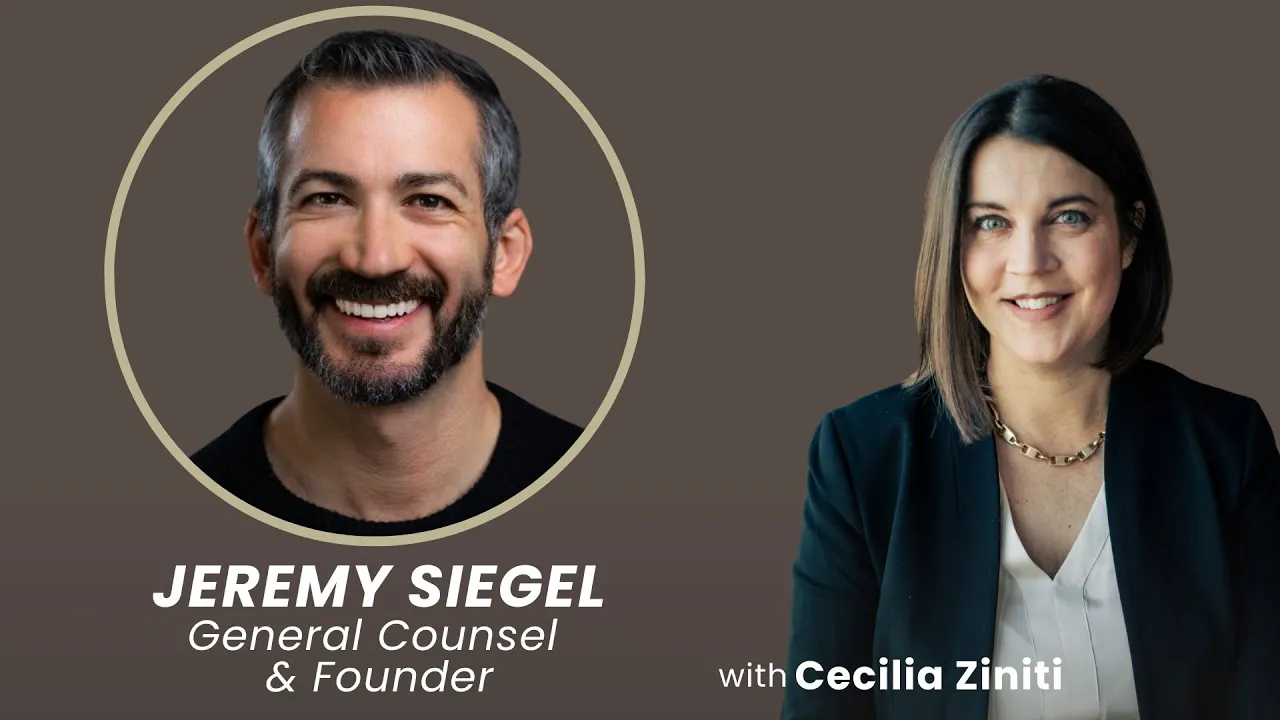
Jeremy Siegel was General Counsel at Final Bell, which designs and builds custom vaporization products for cannabis brands, at the time of this recording. He is now General Counsel at Amerit Fleet Solutions.
Before Final Bell, he spent four and a half years at Eaze, where he built the compliance function from the ground up. He also works as a fractional GC for five early-stage companies across AI, agriculture, and e-commerce.
He is a GC AI user and investor.
Key Takeaways
Bringing legal in early cuts redline rounds dramatically. A contract counsel reviews from the start closes in two rounds of redlines, while the same document seen only at signature can take twelve.
A new legal hire's first 30 days should be discovery, not drafting. Siegel asks leaders what keeps them up at night, maps which teams need legal support most, and builds direct relationships across functions instead of waiting for work to be routed to him.
Pick your battles by what they cost, not just who's right. Siegel now weighs the legal risk, the effect on revenue or compliance, and the cost in CEO trust before pushing back, after one public Slack fight over a low-risk product-menu placement cost him more capital than it was worth.
A fractional GC bridges the gap before a full-time hire makes sense. Siegel serves five early-stage companies this way, across AI, agriculture, and e-commerce, giving each dedicated senior counsel at a fraction of full-time cost.
Legal AI should absorb the repetitive work first. Siegel runs first-draft contracts, regulatory comparisons, and trademark analyses through GC AI, freeing time for the novel questions and regulatory strategy only a human can handle.
What Does a First Legal Hire Do at a Startup?
The first legal hire builds the company's legal function from scratch: compliance infrastructure, regulator relationships, foundational contracts, and the judgment calls no template covers. At Eaze, Siegel fought for App Store approval, navigated state-by-state delivery regulations, untangled payment processing in an industry banks avoided, and kept a scrutinized business compliant while the rules were still being written.
His path there ran through a clerkship at the U.S. Court of International Trade, a federal district court clerkship, and a boutique California regulatory firm whose clients included Instacart, DoorDash, and Postmates as they worked out on-demand alcohol delivery. When California legalized cannabis, operators wanted lawyers who could build within new rules rather than defend against old ones, and Eaze recruited him to design its compliance platform.
The work went beyond keeping the company inside the lines. Siegel traveled with Eaze's government affairs team, met with regulators, and helped a state legislator draft the language that made compassionate giving, donated medical cannabis for patients who cannot afford it, workable within the regulated market. Siegel described what that felt like:
"That was so empowering, to know that I was changing rules, that I was writing laws."
Companies scale on data too. When Massachusetts required two employees with dash cams and body cams in each cannabis delivery car, Siegel presented Eaze's incident data to regulators showing delivery incidents ran at a fraction of a percent, lower than pizza delivery.
What Should a General Counsel Do in the First 30 Days?
Spend the first month on discovery. Siegel asks two questions at each new company: what is keeping you up at night, and who needs legal support most? Then he builds direct relationships with those teams. At early-stage companies, that means drafting the first terms of service, privacy policy, and merchant agreements. At established ones, it means updating policies and closing compliance gaps, like California's annual reporting of deletion requests.
The discovery phase exists to keep the lawyer out of a silo. Siegel explained why he refuses to take work through a single executive:
"I don't want one person sending me off to work, because then it feels like a law firm again. I feel siloed, and I'm not getting the full picture."
His first 30 days checklist:
Ask: What's keeping you up at night?
Map: Who needs legal support most? Product? HR? Sales?
Build: Direct relationships across functions
Assess: Hygiene issues vs. strategic gaps
Create: At early-stage companies, first terms, privacy policy, and merchant agreements; at established ones, updated policies and compliance audits
Better hygiene means fewer surprises, and fewer surprises mean legal spends less time reacting. For how the function grows from a first hire into a full team, see our guide to Corporate Legal Department Structure.
Which Battles Should an In-House Lawyer Fight?
Fight the battles where being right changes the company's revenue, brand, or compliance exposure, and take everything else offline. Early at Eaze, Siegel debated the company's CEO in a company-wide Slack channel over where a product belonged on the menu. Legally, Siegel was right: cannabis product categorization carries compliance consequences. The public fight still cost him.
Siegel looks back on it plainly:
"Looking back, I probably shouldn't have had that fight. I was new in-house, trying to be a stickler with the rules, and the risk was very low. Giving in would have bought me more capital with him."
The risk was low, the CEO cared about the aesthetics, and the same conversation held one-on-one would have resolved it without either of them looking like they were picking a fight. Before pushing back, Siegel now asks:
What is the legal risk?
Does being right affect the company's revenue, brand, or compliance?
What does this fight cost in CEO trust or board capital?
Should this conversation happen over email, Slack, or in person?
The founder side of this equation matters too. Siegel has worked for founder CEOs and hired-in CEOs, and founders push hardest on the things they care about, sometimes at odds with the business. His advice to them:
"The worst thing is when you see a document everyone's ready to sign and you have to say, no, we can't sign this. Then there are 12 rounds on a document that would have taken two if legal had been asked to opine early. So the biggest piece of advice is: talk to legal early and often, and things go much faster."
Should a Startup Hire a Fractional General Counsel Instead?
A fractional GC fits a startup that has recurring legal work and outgrown ad hoc law firm support but cannot yet justify full-time headcount. Siegel serves five early-stage companies this way, across AI, agriculture, and e-commerce, giving each dedicated senior counsel at a fraction of a full-time cost.
Where do those clients come from? Siegel said:
"It's been 100 percent referrals. I have not done a single bit of marketing or outreach."
A few came through the law firms that ran their last fundraise, firms that recognized the company needed more dedicated support than hourly billing could provide. Others came through relationships. His legal office manager at Eaze connected him to the head of HR at a later client. The lesson for lawyers building toward this model is to invest in relationships before you need them.
The through-line is learning the business relentlessly, and knowing enough to recognize when you should be in the room. Siegel puts it as the core of the job itself:
"The job of a GC is to understand the business in and out, to not think purely through a legal lens, but to find a way to make sure the business is growing and succeeding."
How Does Legal AI Change the First Legal Hire Decision?
Siegel, an early GC AI user and investor (disclosed on air; he and Cecilia are longtime friends), runs first-draft contracts, regulatory comparisons, and trademark analyses through the platform, keeping separate profiles for each fractional client's risk appetite and communication style. The shift frees a first legal hire's time for novel questions and regulatory strategy instead of repetitive tasks.
His day-to-day uses from the episode:
Regulatory comparison: Pull one regulation across five states, compare them, and generate a table of the differences.
Trademark analysis: A client wanted to trademark a purely descriptive name. GC AI produced a ten-factor ranking showing why the mark was weak, matching Siegel's read and giving him a client-friendly explanation in seconds.
Multi-client management: Different profiles remember different risk appetites, so output arrives on-tone for each client.
On why AI drafting works for legal:
"No one really writes from scratch in the legal world. Everyone finds good precedent, modifies it, and claims it as their own. AI does that more efficiently and cleanly, and it does a much better job maintaining tone."
Asked what in-house practice looks like in five years, Siegel predicted leaner and faster teams, with lawyers still asking the questions that get good output. Some work he is glad to hand over entirely:
"One of the first things I did as a lawyer was doc review. That should be done by AI forever and ever. No one should ever have to do that, and AI is better at it than humans."
For the flip side of this question, the signals that a startup needs a human hire and where AI reaches its limits, read AI for Startup Legal Operations, which includes the "Hiring Signals AI Cannot Cover" framework.
Why Siegel Says Now Is the Best Time to Go In-House
Siegel closed the conversation with the case for the job itself:
"We're in one of the most exciting times for the law. So many areas are rapidly evolving without rules that make sense yet: autonomous vehicles, AI, drones, new medical advances. We get to do really cool work, and that excites me. Being in-house, you don't just do the cool work, you get to watch it get built and be part of it."
Jeremy Siegel runs five clients' risk profiles through GC AI and calls it a very good first pass on contracts, diligence, and multi-state regulatory work. Ready to see what it does with yours?
Recommended Reading
AI for Startup Legal Operations: How Lean Legal Teams Scale. The on-site twin of this episode's core question; its "Hiring Signals AI Cannot Cover" framework covers when a startup needs a human hire.
How Great GCs Think About Growth, Risk, and Crisis Management. A companion practitioner piece on risk judgment for in-house leaders.


