The NDA that lands in your inbox at 6pm is the same NDA that landed last Tuesday, and the Tuesday before. So is the vendor MSA, and the SaaS order form that arrives faster than anyone can read it. A contract playbook turns that repetition into a standard, so the answer to “what do we do with this clause” stays the same on the first contract of the day and the 40th. Knowing how to build a contract playbook your team keeps reaching for, and getting an AI platform to run it the same way every time, is what turns a document that sits in a folder into a system that does the work.
GC AI’s free Building Playbooks class, taught by former general counsels, opens by asking teams where they are with playbooks today: none yet, a draft in progress, or one they run on every deal.
Plenty of teams keep something on file already: a Word doc, a five-page PDF, one senior lawyer’s mental model of an NDA. It gets read once, on a new hire’s first morning, and then it sits.
Left in a file, a playbook is only as good as the reviewer who remembers it, finds it, and interprets it under deadline. Encoded into an AI platform built for in-house counsel, the same standard applies itself on every review: same positions, same red lines, same escalation logic, every time.
GC AI, used by 2,100+ legal teams across 53 countries as of September 2026, including the legal departments at Hitachi, Liquid Death, Snyk, and Columbia Sportswear, includes Playbooks, built for exactly this. For recurring tasks that go beyond contract review, GC AI Skills apply the same standardization to any repeatable workflow.
How a Contract Playbook Works
A contract playbook is your company’s rulebook for reviewing a recurring contract type. For each clause your team negotiates often, it records four things:
Your preferred position: the terms you ask for first.
Your acceptable fallback: what you accept in a second round.
Your red line: the term you will not cross.
Your escalation path: who approves an exception, and when.
An NDA, a SaaS MSA, and a vendor procurement agreement each get their own playbook, because each one carries its own risks.
A playbook is different from a template. A template is the first-draft paper you send a counterparty. A playbook is what you reach for when the counterparty sends theirs, or marks up yours. Most in-house teams need both, because they answer different moments in a deal.
Playbooks carry clause-by-clause review standards; for multi-phase workflows beyond contracts, see how to build Skills in GC AI.
The reason to build one is leverage. Tiffany Lee, General Counsel and Corporate Secretary at Liquid Death, named the bread-and-butter problem:
“Every agreement has to be read, flagged, and summarized. It’s repetitive work that eats into the time you should be spending on strategy.”
That repetitive layer is what a playbook standardizes. GC AI customers report saving an average of 14 hours per person each week (GC AI ROI study of 100+ active customers, December 2025), much of it reclaimed from review that now runs against a standard the platform already holds. That matters for lean teams: the ACC’s benchmarking shows roughly half of corporate legal spend goes to outside firms, and a playbook is how routine review stays on the in-house side of that line.
How to Build a Contract Playbook, Step by Step
You build a contract playbook one clause at a time, in five steps:
Define your preferred positions.
Write your fallback positions.
Set your escalation triggers.
Assign who approves what.
Format it so AI can run it.
Pick your highest-volume contract type, list the issues you negotiate most often, and work through the five steps for each. The Association of Corporate Counsel frames a playbook as a play-by-play; the sequence below adapts it so the finished playbook reads cleanly to a human reviewer and to an AI platform.
For a detailed guide on turning your own templates, negotiated agreements, and internal standards into a reusable AI playbook, see our Build a Custom AI Contract Playbook From Your Standards guide.
Define Your Preferred Positions
Start with the issues before the prose.
For an NDA: term, definition of confidential information, permitted use, return or destruction, mutual versus unilateral.
For a vendor MSA: payment terms, limitation of liability, indemnity, term and termination, data privacy.
For each issue, write your preferred position as one clear instruction.
In the Building Playbooks class, GC AI’s solutions team calls this the rule, and they hold it to a single standard: direct, clear, and actionable enough to apply without asking what you meant. “Ensure net 45 payment terms.” “Cap liability at 12 months of fees.” “No indemnity in the NDA.”
Write Your Fallback Positions
A fallback is what you accept in a second round. If your preferred payment term is net 45, your fallback might be net 30. Set fallbacks with the people who live with the deal: sales on commercial terms, finance on payment and liability, security on data processing. The fallback a stakeholder helped shape is the one your reviewers can hold, and the one the business backs when a deal gets tense.
Frame the fallback as a range, because AI reads it literally. A human playbook often says “termination for convenience on 60 days notice,” and a human knows 60 days is the ceiling. Write it with the discretion spelled out: “termination for convenience with up to 60 days notice.” Keep each fallback to a single concept, too. GC AI applies a fallback as a whole, so a position that bundles three concepts gets accepted or rejected as a block instead of one piece at a time.
Set Your Escalation Triggers
Some positions you cannot grant alone. Uncapped indemnity needs the head of legal. A discount past a threshold needs the VP of Sales. Capture those escalations in the playbook so a review surfaces them automatically: which clause failed your standard, and whose sign-off it needs before you can agree. In GC AI, escalations live in a position’s commentary and appear in the run summary, so the reviewer sees the approval to chase without rereading the contract.
Assign Who Approves What
An escalation trigger works when the approval path is named. List the issue, the threshold that trips it, and the role that owns the decision. This is also where you set permissions. When a playbook is shared across a team, GC AI separates view, edit, and admin rights, so you decide who can change the standards and who can only run them, and your positions hold steady as people open the file.
Format It So AI Can Run It
This is the step that separates a playbook an AI platform executes cleanly from one it has to guess at, and it is where most existing playbooks need the most work. AI is literal. It takes the playbook at its word, so the playbook has to say out loud what a human reviewer would infer. Three moves do most of the work:
Standardize the structure. One issue, one clear rule, when it applies (always, or only in certain circumstances), optional example language, and optional commentary. When a position applies only sometimes, name the circumstances that trigger it.
Remove ambiguity and contradictions. If one section says net 30 and another says net 45, resolve it. If “regulated customer” drives a fallback, define what regulated means to you rather than leaving the AI to guess.
Spell out acronyms and outside context. Expand the shorthand your team uses on instinct, and name the context a position depends on: deal value, customer tier, whether the counterparty processes personal data.
A fast way to do this: hand the AI your existing playbook and ask it to read for the gaps.
The Building Playbooks class shares the exact review prompt, which asks the platform to study the rules, positions, and applicability, then flag anything that would be hard for an AI to apply, such as undefined terms, missing context, hidden escalations, and contradictions.
The output is concrete. It surfaces lines like “regulated customer is undefined” or a fallback that points to a CPI index without naming which one, and it turns playbook cleanup into an issue-spotting exercise. For the review mechanics underneath, see GC AI’s guide to AI contract review.
The clarity bar the class uses is worth borrowing: if a human outside your organization could pick up your playbook and apply it, an AI platform can too.
What a Contract Playbook Example Looks Like
A working contract playbook example reads as operational rows a reviewer can act on. Each row answers one question: what does the reviewer do, right now, with this clause? The structure below is a contract playbook template you can adapt to any recurring agreement.
Clause | Preferred Position | Fallback | Red Line / Escalation |
Limitation of liability | Cap at 12 months of fees paid | Cap at 24 months of fees paid | Uncapped liability requires head of legal |
Indemnification | Mutual, tied to each party’s breach | IP indemnity one-way in our favor | Broad indemnity for counterparty needs approval |
Payment terms | Net 45 | Net 30 | Net 15 or sooner requires finance sign-off |
We may terminate on 30 days notice | With up to 60 days notice | No termination-for-convenience right is a red line | |
Data privacy | Our DPA attached and controlling | Their DPA with our security addendum | Sub-processor changes without notice are a red line |
Build for the reviewer with 40 contracts in the queue this week. A tight playbook of 15 to 25 clauses, deep on the issues that come up in real deals, beats a sprawling 80-clause document of hedged language every time.
That grid is the human-readable version. The format an AI platform runs is the same logic broken into labeled parts, so nothing is left to inference. The limitation-of-liability row looks like this inside a playbook:
Check: Limitation of Liability
Standard position: Cap total liability at the fees paid in the 12 months before the claim.
Rule: Flag any uncapped liability, and any carve-out that removes or inflates the cap.
Applicability: Always.
Fallback: Cap at 24 months of fees paid.
Commentary (internal): Uncapped liability needs head of legal sign-off. List every carve-out the counterparty proposes so the escalation summary captures it.
Which Contract Playbooks to Build First
Start where volume is highest and judgment is most repeatable. For most in-house teams, that means three:
NDAs. The highest-volume, lowest-variance agreement most teams touch. The fastest playbook to build and the one that frees the most time per hour invested.
DPAs. Data processing agreements follow predictable structures, and the positions map cleanly to your security and privacy posture.
MSAs for SaaS. Your highest-stakes recurring commercial contract, where consistent positions on liability, indemnity, and termination protect real money.
GC AI includes pre-built playbooks for all three, plus MSAs for commercial purchases, so you start from a working version and tune it to how your team negotiates.
Then build by direction, because this is where in-house review lives: one playbook for your own paper, and a separate one for third-party paper.
The positions you take defending your own MSA run more aggressive than the ones you take redlining a vendor’s.
A single playbook pointed both ways produces markups too heavy in one direction and too soft in the other. GC AI reminds teams of the source-document version of this in the Building Playbooks class: do not feed your own paper in as the material for a playbook meant to review someone else’s.
Common Mistakes That Break a Contract Playbook
The same failure patterns show up across teams, and most trace back to the playbook telling the AI something other than what you meant. Watch for these:
Loading in too much source material. When you build from your own documents, two or three well-chosen examples beat twenty. The class caps it at two to three source documents: one template plus a couple of real redlines that show what you accepted. Brief the AI the way you would brief one sharp intern, with the few documents that show your real positions.
Including positions you would never agree to. Anything in your source material reads as something you accept. The unlimited-liability clause you swallowed once to land a marquee logo is a war story; keep it out of the playbook.
Writing aspirational positions. A playbook that demands terms you never hold in real deals returns markups too heavy to send. When the markup comes back too aggressive, check whether your positions match your realistic negotiation stance, and drop the quotation marks around preferred language so the AI knows the exact wording is flexible.
Letting a literal playbook miss the odd clause. A playbook reviews for the issues you told it to review for. When a contract hides a strange provision outside your checks, run a general review in chat after the playbook pass, asking what else in this document deserves attention. GC AI’s Smart Checks catch many of these on their own, and you can add a Smart Check so the gap is covered next time.
Treating it as one and done. Standards change. Run the playbook, see where the markups miss, and tune. After GC AI builds a playbook from your materials, you land in Review Mode to confirm, edit, add, or remove each check before anyone runs it, and you come back to it as your positions move.
How to Run a Contract Playbook as a Team Workflow in GC AI
A built playbook becomes leverage when the whole team can run it. You encode the playbook once, and anyone on the team applies it to a review and gets a result classified clause by clause as pass, fail, or fallback, with a summary that surfaces the escalations to chase. On a vendor MSA, that reads like: liability cap, pass; indemnity, fallback accepted; termination for convenience, fail, escalate to the head of legal. The reviewer goes straight to the three clauses that need a decision, with the rest already cleared.
Alexis Palmer, Senior Managing Counsel at Snyk, described what that coverage did for her team:
“Having saved prompts means anyone on my team can run the same review I would. If I’m on PTO, I know they’ll get a similar result and apply their own judgment from there.”
The standard stays in the room when the lawyer who wrote it is offline, and the reviewer who picks it up still brings judgment to the fallbacks and escalations the run surfaces.
Build Your Own, Then Refine It
You have two paths. Copy one of GC AI’s pre-built Playbooks and tune the positions, or use Easy Playbooks to generate one from your materials: a template, a couple of negotiated redlines, and your internal checklist. Either path ends in Review Mode, where you confirm or edit each check until the playbook reads the way your team negotiates.
Review Where Your Contracts Already Live
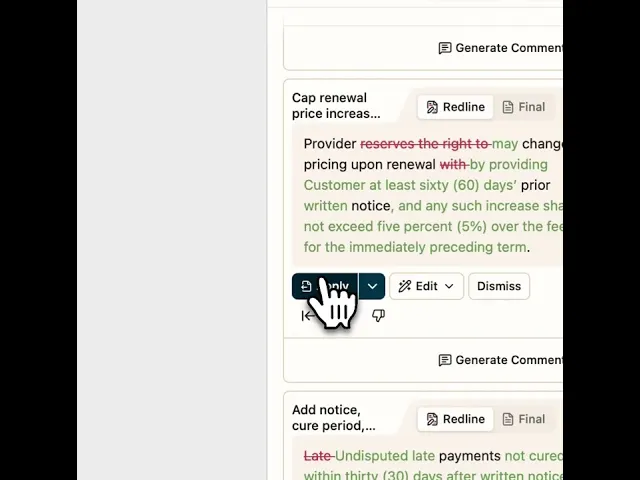
Playbooks run inside GC AI for Word, so the review happens in the document, and every flag traces back to the contract through Exact Quote citations a reviewer can verify at the character level. Because playbooks are literal, the strongest teams add one step after a run: a quick general pass in chat asking what else in the document deserves a look.
Start this week. Pick your highest-volume agreement, most likely the NDA, and list the 10 clauses you negotiate most. Write a preferred position and one fallback for each, then run the review prompt over the draft to catch the undefined terms and hidden escalations before your team does. You will have a working playbook in an afternoon and a tuned one within a few review cycles. If a blank page is the hard part, GC AI’s solutions attorneys will build or tune your first playbook with you. Book a demo below!
New to legal AI classes? Watch a quick overview of GC AI Classes:
For where a playbook fits in the broader review stack, GC AI’s guides to contract redlining software and the best legal AI tools for in-house counsel cover the rest of the workflow.
Frequently Asked Questions
What Is a Contract Playbook?
A contract playbook is your company’s rulebook for reviewing a recurring contract type, such as an NDA, DPA, or SaaS MSA. For each clause your team negotiates often, it records your preferred position, your acceptable fallback, the red line you will not cross, and who must approve an exception. A template is the paper you send first, while a playbook governs how you respond when a counterparty sends theirs.
How Do You Build a Contract Playbook Step by Step?
You build a contract playbook by picking your highest-volume contract type, listing the issues you negotiate most often, and defining for each one a preferred position, a fallback, an escalation trigger, and the role that approves it. Then you format it so AI can run it: standardize the structure, remove ambiguity and contradictions, and spell out acronyms and edge cases. Start with a tight set of 15 to 25 clauses that show up in your real deals before you cover every theoretical issue.
How Long Does It Take to Build a Contract Playbook?
A first contract playbook takes about an afternoon for one high-volume agreement: list your 10 most-negotiated clauses, set a preferred position and a fallback for each, and run a review pass to catch undefined terms. It reaches its working form over the next few review cycles, as you run it on real contracts and tune the positions where the markups miss. Building one clause-set at a time beats trying to cover every contract type at once.
What Is a Good Contract Playbook Example or Template?
A good contract playbook example reads as operational rows a reviewer can act on. Each row names a clause, your preferred position, your fallback, and the red line or escalation, so a reviewer knows exactly what to do with that clause. A practical template covers limitation of liability, indemnification, payment terms, termination, and data privacy, with positions calibrated to how your team negotiates in practice.
Which Contract Playbooks Should an In-House Team Build First?
An in-house team should start with NDAs, DPAs, and MSAs for SaaS, because they are high-volume and follow predictable structures. GC AI includes pre-built playbooks for those three plus MSAs for commercial purchases, so teams customize a working version instead of starting from scratch. Build a separate playbook for your own paper and for third-party paper, since the positions differ by direction.
How Does AI Run a Contract Playbook?
AI runs a contract playbook by applying your encoded positions to every review automatically, classifying each clause as pass, fail, or fallback and surfacing the escalations to chase. Because AI is literal, the playbook has to state plainly what a human reviewer would infer. In GC AI, Playbooks runs inside Microsoft Word and ties every flag back to the contract with Exact Quote citations, so any team member runs the same review and gets a consistent result.
Build a Contract Playbook Your Team Will Run
A playbook is only worth the time it gives back. Encode your positions once, let an AI platform apply them on every review, and free your team for the work that needs a lawyer reasoning from first principles. Teams that build one well see the return on the first busy week, because the review that used to eat the afternoon now runs against a standard the platform already holds.