Matt Gipple spent six years as GC at Cruise, writing California’s first autonomous vehicle regulations from scratch and guiding the company through its GM acquisition. On a recent CZ and Friends podcast episode, Gipple described the moment a Cruise engineer built a full regulatory compliance tracking system in under an hour, having overheard a problem at lunch and solved it.
Cecilia Ziniti, GC AI’s CEO and a three-time general counsel, drew the connection:
“That’s been one of the most fun things about AI: as lawyers, we now have the power to create systems like that. Literally like creating a playbook. We’re launching playbooks, basically checks you can run against a contract. Because what do you do in compliance? You run checks. And AI is objectively better at that than most humans.”
That’s AI contract analysis. Systematic checks against a contract that return structured findings in minutes, at a consistency no manual process can match.
Thirty-plus platforms now make this claim. This guide evaluates them for in-house fit.
Why This Category Is Different for In-House Counsel
Law firms were legal AI’s first early adopters. The use case was obvious: large deal teams, billable hours to protect, and well-defined workflows made the ROI easy to quantify.
In-house counsel have a different constraint: scope. A GC at a 300-person company handles contracts alongside regulatory questions, employment matters, board communications, and whatever lands in the inbox on a Friday afternoon. The platform optimized for billing efficiency solves a different problem.
GC AI was built from that in-house starting point. Cecilia Ziniti has been a GC three times (at Anki, Bloomtech, and Replit) and in-house counsel at Amazon and Cruise. She built GC AI around the full scope of in-house legal work: contract analysis, research, drafting, compliance, and matter memory that persists across a negotiation.
How AI Contract Analysis Works Under the Hood
New to AI contract analysis? This section breaks down how the technology works before you evaluate any platform. Skip ahead if you already know the mechanics.
Modern platforms run four operations, often in sequence.
1. Clause extraction: The AI reads the document and identifies discrete clauses by type: indemnification, limitation of liability, confidentiality, governing law, termination, renewal, auto-renewal, and so on. Generative AI reads clause intent rather than keyword matches, meaning it catches obligations written in unusual language that older rule-based tools missed entirely.
2. Risk flagging: Once clauses are extracted, the platform compares them against risk criteria: a pre-built framework or a custom playbook the legal team configured. High-risk deviations, like an uncapped indemnity or a missing liability cap, surface as a prioritized list the lawyer can act on. The next section covers how to rank them.
3. Market-standard benchmarking: Every GC has been in the negotiation where the other side says “that’s not market” and neither side has a definitive answer. AI contract analysis platforms answer that question directly, but from different sources. Some answer from a proprietary dataset of filed contracts. Others answer from real-time legal research against authoritative sources. Others answer from the underlying large language model’s training on publicly available legal text. Each approach has different tradeoffs in coverage, currency, and confidence. Ask vendors specifically where that market intelligence comes from and how recently it was updated.
4. Data structuring and reporting: For teams managing high contract volumes, the final layer matters most: turning extracted data into structured records: obligation calendars, renewal alerts, counterparty risk views, spend commitments. This is where AI contract analysis and CLM platforms converge most closely.
How to Score and Rank Contract Risk
Contract risk analysis is the step between clause extraction and the redline: it turns a list of flagged clauses into a ranked worklist, so the riskiest terms get attention first. The lawyer still decides what to accept; contract risk scoring sets the order.
A workable rubric scores each flagged clause on two axes and multiplies them.
Likelihood: How often this deviation triggers a problem, from a standard market term (low) to a one-sided position the counterparty rarely concedes (high).
Impact: What it costs when it does, from an administrative annoyance (low) to uncapped financial or IP exposure (high).
The clauses that score highest are the familiar ones: uncapped indemnification, a missing or low limitation of liability, one-sided IP assignment, auto-renewal with a short cancellation window, and broad audit or termination-for-convenience rights. Map the scores to three tiers, review-now, negotiate-if-leverage, and accept, and the analysis produces a ranked plan you can act on.
A legal AI platform runs this scoring consistently across every contract, applying the same rubric whether you review it or a teammate does, and ties each score to the exact clause text with Exact Quote so the ranking is auditable.
Five Questions Worth Asking Before You Choose a Platform
Before running any demos, get clear on these five things.
Does the platform review contracts against your positions (your NDA fallbacks, your MSA liability cap, your DPA data-transfer standards) or return generic risk flags from a training corpus? Ask whether playbooks ship pre-built or whether your team builds them from scratch.
When the AI flags a clause, does it show you the exact text it read? Character-level citation separates a finding a lawyer can act on from one that sends you back into the document.
Does the tool live in Microsoft Word? A separate upload portal means a context switch every time. Context switches kill adoption faster than anything else.
Does the platform remember the matter across sessions? Multi-week negotiations compound fast when the AI starts fresh every conversation.
Can it handle more than contract review? Research questions, drafting needs, compliance monitoring, and board communications are all part of a GC’s day. A platform that covers only one slice creates tool-switching overhead for everything else.
These five questions separate platforms built for in-house teams from platforms built for law firms.
The 7 Best AI Contract Analysis Tools for In-House Counsel
Rankings reflect in-house fit across five dimensions: playbook-based review, Word-native workflow, matter memory, legal research, and full-workload scope. The best platform for an Am Law 100 firm is rarely the best for a 10-person in-house team.
GC AI
Spellbook
LegalOn
Harvey
Ivo
Luminance
Ironclad
GC AI
Best for: In-house teams managing the full legal workload: contract analysis, research, drafting, and compliance in one platform.
GC AI is a legal AI platform used by 2,100+ legal teams across 53 countries, including 200+ public companies and 25 unicorns.
Contract analysis in GC AI runs through Playbooks: automated multi-step review that checks your agreements against your own positions and returns a prioritized findings list.
If you’ve ever drafted the same NDA position 40 times and wished the AI knew your company’s standard fallbacks, that’s exactly what Playbooks solve. Pre-built Playbooks cover NDAs, DPAs, and MSAs, with custom options for any agreement type.
And if you’ve ever had an AI flag a contract risk and then spent ten minutes searching for the clause it supposedly found, this is the feature that fixes it.
The differentiator: Exact Quote. Character-level citation that shows you the precise text the AI read when flagging a risk: the document’s own words, pulled verbatim. Most AI platforms return summaries. GC AI returns evidence you can cite in a redline comment.
When the other side says “that’s not market,” GC AI answers. Our Research feature runs multi-agent real-time searches against authoritative legal and regulatory sources, returning current, citable answers on market-standard questions.
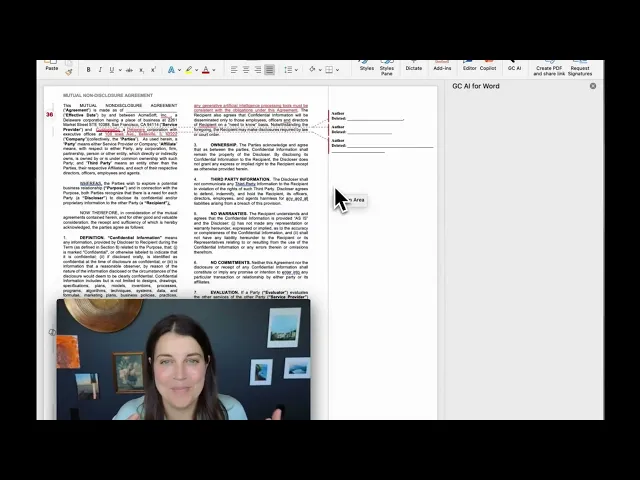
GC AI for Word brings everything inside Microsoft Word: surgical redlines, Chat2 for real-time web research without leaving the document, and the Skill Library, a collection of pre-built prompts for NDAs, DPAs, regulatory summaries, and board consents. Projects keeps matter memory across the full negotiation lifecycle.
A December 2025 ROI study of 100+ active customers found teams save 14 hours per lawyer per week and reduce outside counsel spend by 14%, translating to approximately $252,000 in annual savings per team based on the $1.8M median spend in the ACC Law Department Management Benchmarking Report. Scale the 14% to your outside counsel budget.
More than 6,000 in-house lawyers have completed GC AI’s legal AI courses, California CLE-eligible and taught by former GCs.
Pricing: $500 per seat per month. 14-day free trial, no credit card required.
Is GC AI right for you? If your legal workload extends beyond contract review into research, drafting, compliance, and board communications, GC AI was built for exactly that scope.
Spellbook
Best for: Word-native drafting workflows where market-standard benchmarking from a large proprietary contract dataset is the primary need.
Spellbook has one of the most established Word-native legal AI workflows in this space, with strong Word integration. The Benchmarks feature, trained on billions of lines of legal text, is a genuine differentiator for teams where the market-standard answer needs to come from aggregated contract data.
The constraint: Spellbook is contract-focused. Research, compliance monitoring, multi-matter memory, and agentic analysis are not part of the package. For a GC whose workload extends beyond contract review: that gap is the whole job.
For a detailed side-by-side, see GC AI vs. Spellbook or Spellbook alternatives.
Is Spellbook right for you? If your work is primarily Word-native contract drafting and market benchmarking from a large proprietary dataset is the priority, yes. If your day extends beyond contracts into research, compliance, or multi-matter coordination, GC AI covers the full scope.
Pricing: No public pricing. Contact sales.
LegalOn
Best for: High contract review volume with a clear mandate for dedicated AI contract analysis.
LegalOn is a purpose-built contract review platform. Its January 2025 My Playbooks launch extended customization to team-built review frameworks, letting legal teams encode their own positions into the workflow. LegalOn has a Microsoft Word add-in for contract review within the document environment, and an AI assistant for ad hoc contract questions.
Research, drafting, compliance, and multi-matter memory are outside LegalOn’s current scope.
For a detailed side-by-side, see GC AI vs. LegalOn.
Is LegalOn right for you? If your team has high contract review volume with a clear mandate for dedicated analysis and your work doesn’t extend much beyond review, yes. For teams that also need research, drafting, or broader legal coverage in the same platform, GC AI is built for that.
Pricing: No public pricing. Contact sales.
Harvey
Best for: Large law departments with complex M&A diligence needs and firm-side integration across external counsel relationships.
Harvey built for Am Law 100 firms first and has since expanded its in-house offering. The product structure reflects those roots: Vault for large-scale document review, Assistant for drafting, and Knowledge for cross-matter research.
For a five-person in-house team doing vendor NDAs and MSAs: it’s a lot of platform for the use case.
For a detailed side-by-side, see GC AI vs. Harvey or Harvey alternatives.
Is Harvey right for you? If you’re in a large enterprise law department with M&A diligence needs and firm-side integrations, yes. For a 10-person in-house team doing vendor contracts, the platform is oversized for the use case. GC AI starts at $500 per seat with a 14-day free trial.
Pricing: No public pricing. Contact sales.
Ivo
Best for: Teams with high contract intake volume who need portfolio-wide analysis across many agreements simultaneously.
Ivo’s three-product structure covers the range: Ivo Review for playbook-based redlining, Ivo Intelligence for portfolio-wide contract insights across the full library, and Ivo Assistant for prompt-based drafting and research. Ivo Intelligence stands out for teams managing large existing contract repositories, querying across hundreds of agreements to surface patterns and flag issues at scale.
Smaller teams and solo GCs with full-spectrum legal needs beyond contract analysis may find Ivo’s volume orientation means pairing it with additional tools. For more options, see Ivo alternatives.
Is Ivo right for you? If you’re managing a large existing contract repository and need portfolio-wide analysis across hundreds of agreements, yes. For teams that also need research, compliance, or drafting in the same platform, GC AI covers more ground.
Pricing: No public pricing. Contact sales.
Luminance
Best for: Enterprise due diligence and large-document analysis at M&A scale, with proprietary AI models trained on a large legal corpus.
Luminance has a long track record in M&A diligence. Its proprietary models are trained on a large legal corpus, with particular strength in cross-referencing terms across large document sets, tracking defined terms through hundreds of agreements, and benchmarking against an organization’s past negotiation outcomes.
For everyday in-house contract analysis (commercial agreements, vendor contracts, NDAs), Luminance’s enterprise positioning and implementation requirements can be disproportionate to the use case.
Is Luminance right for you? If you’re doing enterprise M&A diligence at scale with large document review requirements, yes. For everyday in-house contract analysis, the implementation overhead rarely makes sense. GC AI is built for in-house teams.
Pricing: No public pricing. Contact sales.
Ironclad
Best for: CLM teams adding AI analysis inside their contract operations stack, distinct from standalone legal AI platforms.
Ironclad is a CLM platform with built-in AI features for data extraction, obligation tracking, and renewal alerts. For teams already on Ironclad whose primary need is AI-assisted analysis of their existing contract repository: Ironclad’s native AI layer is the logical starting point.
Teams evaluating open-ended legal reasoning, market-standard answers, drafting, and research will find the CLM-plus-AI model a different trade-off than a purpose-built legal AI platform.
Is Ironclad right for you? If your team is already on Ironclad and your primary need is AI-assisted analysis of your existing contract repository, yes. For open-ended legal reasoning, research, and drafting beyond the CLM layer, GC AI handles the intelligence layer.
Pricing: No public pricing. Contact sales.
AI Contract Analysis Platform Comparison
Platform | Best For | Playbook Analysis | Word Integration | Market Benchmarking | Research + Drafting | Pricing |
GC AI | In-house full-spectrum | Agentic, Exact Quote | Yes (GC AI for Word) | Real-time research against primary sources | Yes | $500/seat/mo, 14-day trial |
Spellbook | Word-native + proprietary benchmarks | Yes | Yes | Proprietary contract training data | Yes (drafting) | Contact sales |
LegalOn | Dedicated contract review | Yes (My Playbooks) | Yes (Word Add-In) | Limited | No | Contact sales |
Harvey | Enterprise law departments | Yes (Vault, Assistant) | Limited | Limited | Yes (Knowledge) | Contact sales |
Ivo | Volume portfolio analysis | Yes (Ivo Review) | Yes (Ivo Review) | Limited | Yes (Ivo Assistant) | Contact sales |
Luminance | M&A enterprise diligence | Yes | Limited | Proprietary legal corpus | Limited | Contact sales |
Ironclad | CLM + AI combined | CLM-layer only | No | No | No | Contact sales |
Do You Need Both a CLM and an AI Contract Analysis Platform?
Yes. And they don’t compete.
CLM platforms (Ironclad, DocuSign CLM, Icertis, Evisort now part of Workday, Sirion) handle the operational layer: contract storage, routing, approval workflows, obligation tracking, and renewals. Their AI features have improved, but the underlying models focus on structured data extraction, not the open-ended legal reasoning in-house teams need during active negotiation.
A legal AI platform handles the intelligence layer: what does this clause mean, how does it compare to market, and what should the team negotiate next?
Most in-house legal teams run both. The CLM manages the repository. The legal AI platform handles the legal work. Platforms that do one well rarely do the other equally well.
This guide covers the intelligence layer. CLM integration, where it exists, is a useful bonus. For more on navigating this decision, see AI Contract Negotiation: How to Do It in Word, Without a CLM.
Frequently Asked Questions
What Is AI Contract Analysis?
AI contract analysis is the use of large language models and machine learning to automatically extract clauses, flag risk, benchmark terms against market standards, and structure contract data at a speed and consistency no manual process can match. For in-house counsel specifically, it addresses three structural problems: contract volume that outpaces headcount, inconsistency when playbook standards live only in a senior lawyer’s head, and the absence of a partner-level check before a contract reaches the business.
How Does AI Contract Analysis Differ from AI Contract Review?
AI contract review focuses on reading and redlining a single document, generating suggested edits, and flagging issues for a lawyer to resolve. AI contract analysis is a broader category that also includes extracting structured data across a portfolio, scoring risk across many agreements simultaneously, and generating reporting dashboards. In practice, the best in-house platforms do both: GC AI, for example, runs Playbook-driven review on individual contracts while also enabling cross-portfolio data structuring and risk reporting.
Can AI Tell Me Whether a Contract Term Is Market Standard?
Yes, with the right platform and an important caveat: the answer is only as good as the benchmark dataset behind it. Some tools use a proprietary corpus of millions of executed agreements; others query current legal sources in real time. GC AI’s Research feature runs multi-agent legal research against primary sources to answer market-standard questions with citations, rather than relying on a fixed historical dataset that may not reflect your industry or deal size. Always confirm the source before using a benchmarking answer to justify a negotiating position.
Is AI Contract Analysis Secure Enough for Confidential Legal Agreements?
Security posture varies significantly across platforms, so zero data retention, SOC 2 Type II certification, and GDPR compliance are the minimum baseline to require. The critical question is whether the vendor has a zero data retention agreement with its underlying AI providers, meaning your contract text is never stored or used to train models. GC AI holds SOC 2 Type II and SOC 3 certifications, maintains zero data retention agreements with both OpenAI and Anthropic, and encrypts data at rest and in transit with AES-256.
How Much Does AI Contract Analysis Software Cost?
Pricing spans a wide range. Lightweight contract tools can run a few dozen dollars per user per month, while enterprise CLMs with AI add-ons can reach six figures a year. Purpose-built in-house AI platforms sit in the middle: GC AI is $500 per seat per month and includes a 14-day free trial with no credit card required. Most enterprise platforms, including Harvey and Ironclad, do not publish pricing publicly and require a custom quote (as of June 2026).
Can AI Contract Analysis Replace a Lawyer?
No. AI contract analysis automates the mechanical, high-volume parts of review, such as clause extraction, risk flagging, and first-pass redlines, freeing lawyers for judgment-intensive work like negotiation strategy, stakeholder communication, and final sign-off. The appropriate framing is leverage: GC AI customers report saving an average of 14 hours per lawyer per week and reducing outside-counsel spend by 14%, which means the same team handles more without sacrificing quality or accountability.
Your next contract review doesn’t have to take four hours. Start yours in 30 seconds.