ChatGPT for Lawyers: Why Legal Accuracy Matters
By Caitlin Price, Social Media & Content MarketerUpdated Published
ChatGPT for lawyers can produce research summaries, contract analyses, and first drafts. Check those outputs against the law, the source documents, and your company’s instructions before relying on them.
For example, if you’re reviewing an NDA, ChatGPT might quote a residuals clause correctly and still recommend accepting a term your company doesn’t allow. It could also cite a real case that doesn’t support the point it’s making.
For teams comparing GC AI vs ChatGPT, here are three reasons to choose GC AI:
- More time to weigh the legal trade-offs for your company: GC AI turns plain-language requests into structured legal prompts, reviews agreements against your company’s preferred terms, fallbacks, and approval rules, and provides cited legal research. You can use that work to assess the counterparty’s position, decide which risks to recommend accepting, and explain the choices to the business.
- Spend less time managing the tech: GC AI provides built-in workflows for contract review and questions across your agreements, and develops and maintains the software behind them. Your team supplies its company knowledge and negotiating positions, while attorney-led classes help lawyers apply the tools to their own work.
- Plan for ongoing use and protect company information: GC AI Team plans include unlimited chats, so your team can test an approach, revise its advice, and work through follow-up questions without per-chat charges. Company information stays ring-fenced from other customers and is never used to train GC AI’s model providers’ AI.
What Can Lawyers Use ChatGPT For?
ChatGPT includes web search, Deep Research, Projects, Word integration, and legal plugins, depending on the plan and workspace. For legal work, check the result before using it:
| Legal Task | What to Check |
|---|---|
| Research a legal question | The cited authorities support the analysis, apply in the jurisdiction, and remain current. |
| Review an agreement | The review identifies missing terms, exceptions, and departures from company positions. |
| Draft or revise a clause | The wording has the intended legal effect, with working definitions and cross-references. |
| Explain a policy or shorten a memo | The explanation preserves qualifications and adds no commitments. |
| Organize matter facts | The timeline has reliable dates and sources, with facts separated from assumptions. |
| Prepare for outside counsel | The materials identify the business decision, unresolved issues, and expertise needed. |
Is There a Legal Version of ChatGPT?
Astra for Law is OpenAI’s legal model, built on GPT-6 Astra. It combines legal analysis and writing instructions with an index of U.S. cases, statutes, regulations, court rules, and administrative decisions. Your team needs OpenAI’s Trusted Access approval and must have the model enabled in its workspace.
OpenAI’s work in legal also includes systems built with in-house teams. AT&T’s LegalEdge team is working with OpenAI to connect the company’s legal knowledge to incoming work. One planned system would sort and prioritize requests, bring together relevant precedent and research, and suggest first steps. AT&T’s lawyers would make the decisions.
Can ChatGPT Review a Contract?
Yes, but a first-pass summary does not establish that an agreement is acceptable to your company. Review the language, missing provisions, and proposed edits against your approved positions.
For this mutual-NDA example, provide the agreement, explain who will disclose or receive information, and add your approved review instructions.
Assume the company requires GC approval for residuals rights, which allow use of information retained in someone’s memory. It also requires notice of compelled disclosure where legally permitted and continuing confidentiality duties for retained backups.
Use a task-specific prompt that keeps the agreement language, company position, and proposed change separate:
Review this mutual NDA against the attached company review instructions.
For each issue, show the section, exact language, company position,
and proposed change. Flag missing provisions and instructions.
Separate approved fallbacks from exceptions requiring approval.
Wait for me to select the edits before changing the agreement.
| Illustrative Finding | Next Step |
|---|---|
| The NDA permits residuals rights. | Review the scope, then propose deletion or seek GC approval for an exception. |
| The compelled-disclosure clause has no notice requirement. | Check for notice elsewhere, then review language requiring it where legally permitted. |
| The destruction clause does not address backups. | Confirm operational needs and add a narrow retention exception with continuing confidentiality duties. |
Read the quoted clauses with their definitions and exceptions. To confirm a provision is missing, check the whole agreement. Review the combined effect of proposed edits before accepting them.
Send the reviewed redline with a short note explaining what still needs a decision and who should make it. In this example, the GC would approve any residuals exception, and operations would confirm the backup language. When the counterparty returns a draft, compare it with your redline and obtain the required approvals.
How Accurate Is ChatGPT for Legal Work?
Test the version your team will use on the work it needs to do. A benchmark can help identify where to test more closely.
In GC AI’s May 2026 evaluation, GC AI passed 86.8% of the answer-key criteria, compared with 79.8% for ChatGPT GPT-5.5.
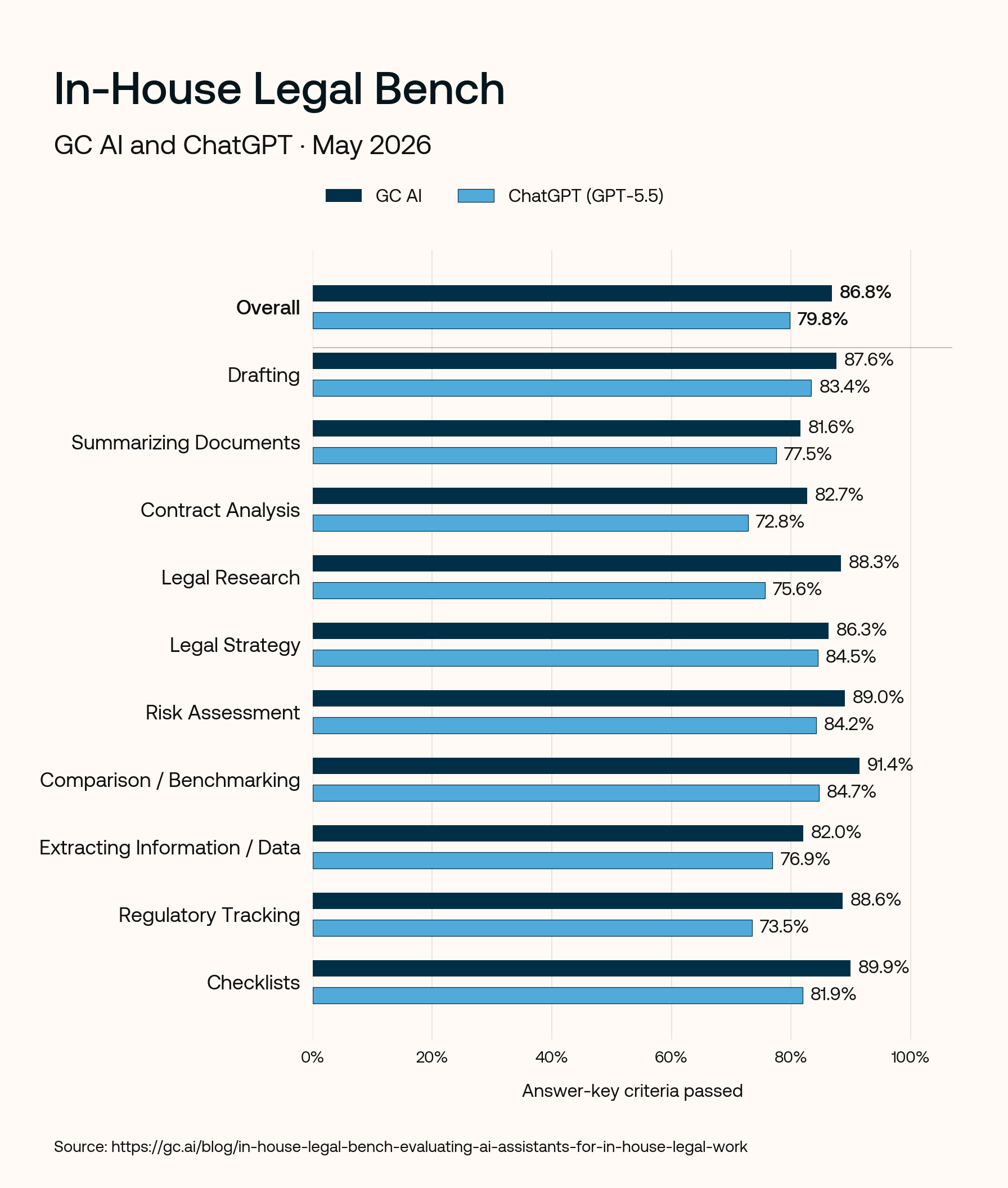
GC AI ran the evaluation on 100 tasks against more than 1,200 attorney-developed criteria. AI scored the answers, and attorneys checked a sample. Some tasks appear in more than one category.
Is ChatGPT Safe for Confidential Legal Work?
Use ChatGPT for confidential legal work only when your organization has approved the service for that matter and data. Check who can access the workspace and what connected apps can retrieve. Review how long the service keeps your data, whether it uses it for training, and any client restrictions. A service that ring-fences data keeps it separate from other customers’ data and limits access to authorized users.
ChatGPT Business and Enterprise exclude business data from model training by default. How long they keep your data and who can access it depend on the service and workspace settings. A no-training promise alone does not resolve confidentiality, retention, or privilege.
In a personal ChatGPT account, turning off model training does not delete saved chats. Temporary chats are excluded from training while temporary, but a copy may be kept for up to 30 days for safety. Confirm your company’s approval before using either for legal work.
What Legal Professional Duties Still Apply When It Comes to AI?
Lawyers can use ChatGPT when the use complies with applicable professional duties, court requirements, and restrictions on the matter and its data. ABA Formal Opinion 512 addresses competence, confidentiality, communication, supervision, candor, and fees. Check whether disclosure or consent is required, supervise the work, and bill according to the applicable rules.
In Mata v. Avianca, the court sanctioned lawyers and their firm in 2023 after they submitted fabricated ChatGPT authorities and continued to defend them.
Use GC AI for Contract Review and Research
GC AI is a turnkey legal AI platform for in-house teams, used by over 2,100 legal teams, including 300+ public companies.
You can use your company’s documents and approved positions to review agreements, research legal questions, and prepare advice for the business.
At Liquid Death, General Counsel and Corporate Secretary Tiffany Lee uses GC AI for contract review. When it flags a missing confidentiality clause, she asks it to draft one:
I'll just ask it to draft one I can drop right into the agreement
See how to apply company review instructions with GC AI Playbooks:
Use GC AI Within ChatGPT
The GC AI ChatGPT plugin connects a GC AI workspace to ChatGPT for supported document, review, redlining, Playbook, and Automation tools. Availability depends on your account and workspace permissions. It is separate from GC AI for Word; ChatGPT for Word does not currently support plugins.
Bring an authorized agreement and your approved positions to a GC AI walkthrough. Ask to see the findings, proposed edits, and decisions still requiring approval.
Frequently Asked Questions
What Does “ChatGPT Attorney” Mean?
Which ChatGPT Account Should Lawyers Use?
Can ChatGPT Verify Its Own Legal Citations?
Related articles
 Resources·Published Sep 30, 2026Claude for Legal: Pros, Cons, and Privilege (2026)Compare Claude for Legal's strengths, gaps, and benchmark results, plus what Heppner means for in-house counsel's privileged work.
 Resources·Updated Jul 29, 2026Perplexity for Lawyers: When It Works, When It Doesn't Perplexity for lawyers can cost you privilege. Heppner explains why. Three safe prompts, and where GC AI picks up when the brief becomes a contract.
 Resources·Published Jul 8, 2026Copilot for Lawyers in 2026: When It Works In-HouseThe Word Legal Agent moved the line on Copilot for lawyers. Here is where it holds up for in-house work, the privilege catch, and how GC AI fills the rest.
 Resources·Published Jul 7, 2026Gemini for Lawyers: What to Trust It With, and What Could Expose YouGemini came bundled with your Workspace plan. Here's the breakdown: what it handles well, where the confidentiality line is, and what the 2026 Heppner ruling changed.
Build practical legal ai buying guides skills with legal AI
See how GC AI supports this work, or build the skills with a practical class for in-house legal teams.