“If you remember one thing about this training, it is that when you are directing AI, you are channeling your inner Meryl Streep.”
That’s how Cecilia Ziniti opens her AI prompting class. The reference is The Devil Wears Prada. Meryl Streep plays Miranda Priestly, the fashion editor who stops her new assistant (Anne Hathaway) on the first day and explains the entire lineage of a cerulean sweater, from Oscar de la Renta through Saint Laurent to a clearance rack, because context is everything. Showing up without knowing your environment is a failure to do the job.
AI is Anne Hathaway, trained on enough text to fill 50 libraries of Congress. But it doesn’t know your company, your counterparties, or the fact that this vendor had a data incident two quarters ago. The lawyers who get real results brief AI the way Miranda briefs Andy: specific, contextual, unambiguous.
Cecilia was a general counsel three times over, at Anki, Bloomtech, and Replit, and in-house counsel at Amazon and Cruise before that. She built GC AI because she’d been the buyer: the GC who needed a 20-page vendor contract reviewed in under an hour, or a litigation update turned into two sentences for the CFO.
More than 6,000 lawyers have completed GC AI’s courses for legal professionals, California CLE-eligible and free, taught by former general counsels. The 15 AI prompts for lawyers below come directly from those classes: run live on real contracts, built around a five-part structure of role, context, task, format, and verification.
What Makes a Great Legal AI Prompt
A Thomson Reuters survey found over 95% of legal professionals expect generative AI to become central to their workflow within five years. For most in-house teams, the gap between “useful occasionally” and “central to daily practice” comes down to one thing: prompt quality.
In GC AI’s free 101 class for legal professionals, Cecilia describes prompting performance on a scale of one to ten.
One is “fire the intern, disable their badge, get them out of the building.”
Ten is “promote them to senior management; that was absolutely amazing.”
Most lawyers start around a five. The AI does something useful, but not quite what was needed. The gap between a five and a nine is almost always the prompt structure.
That’s also why many in-house teams are moving toward purpose-built AI legal assistants instead of relying only on general-purpose AI tools. See AI Legal Assistant for In-House Counsel | GC AI.
The Wolters Kluwer Future Ready Lawyer 2026 report found 56% of legal departments are currently using general-purpose AI tools like ChatGPT. Only 14% have moved to specialized legal AI solutions.
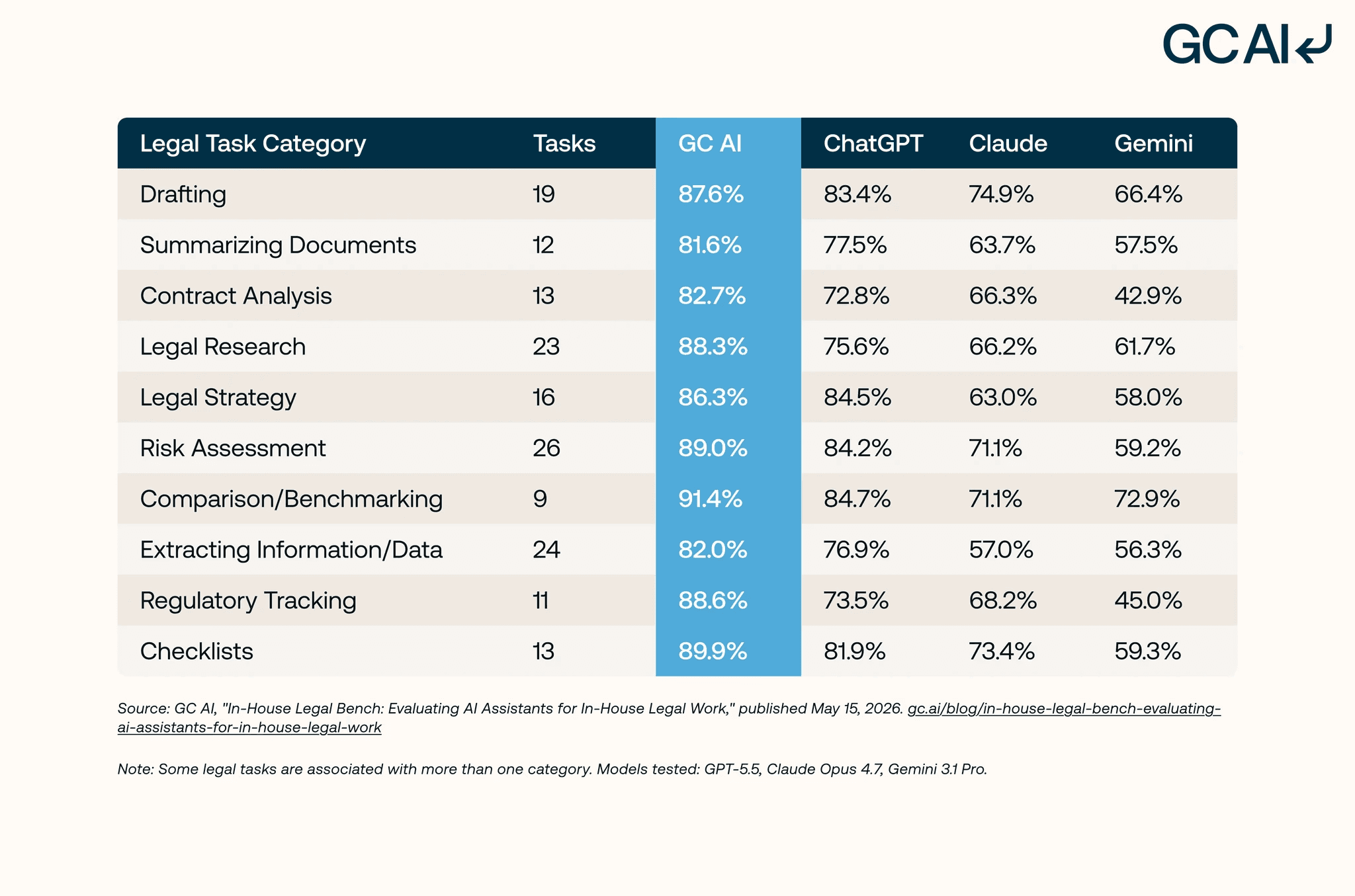
Two things separate the results those groups get: prompt structure and the model underneath it. In the May 2026 In-House Legal Bench, a 100-task evaluation graded against an attorney answer key, GC AI answered 86.8% of tasks correctly overall, ahead of ChatGPT at 79.8%, Claude at 68.4%, and Gemini at 57.5%. GC AI scored 88.3% on legal research and 82.7% on contract analysis, the two workflows most of the prompts below target.
Every strong legal AI prompt has five parts:
Role. Tell the AI who it is. “You are in-house counsel at a technology company reviewing a vendor MSA” activates a legal perspective from the first output. Without a role, the AI defaults to a generalist framing.
Context. Brief the AI the way you’d brief a smart new associate. What is the document? Who are the parties? What does your company care about most? What is the relevant legal or business situation?
Task. Be specific. “Summarize this contract” and “identify the top five issues that create exposure for a SaaS buyer” are different asks that produce completely different outputs.
Format. Tell the AI how to present the output. A table with risk flags is more useful than a narrative when briefing an executive. A numbered list of redlines is more useful than a summary when preparing a negotiation position.
Verify. Request citations. Any finding worth acting on deserves a source. “Quote the exact contract language” separates analysis from summarization. The AI shows you exactly where in the document it found the answer. GC AI’s Exact Quote feature builds this in by default, providing character-level citations so you can confirm what the AI found against the original.
Tricia Kinney, General Counsel at BlueLinx and a CZ and Friends podcast guest, put it in terms every in-house lawyer recognizes:
“You’ve got to think of it as a new hire on your team. You’ve got to coach, you’ve got to give context, you’ve got to give background, and you’ve got to give feedback.”
The prompts below are built around this framework.
Prompt structure changes the quality of the output, but the platform underneath still shapes what the AI can actually do. For a broader look at how different legal AI platforms approach research, drafting, workflows, and in-house use cases, see Legal AI Tools in 2026: The Buyer’s Field Guide.
15 AI Prompts for Lawyers by Use Case
Each prompt maps to a specific in-house workflow:
SaaS vendor MSA key-terms extraction: risk table in under 60 seconds
Client entertainment T&C review: the live Ryder Cup demo from GC AI’s 101 class
Contract risk identification: top five issues, organized High / Medium / Low
Multi-jurisdiction regulatory comparison: side-by-side table across any set of jurisdictions
Regulatory update summary: 30-day scan, organized by urgency, primary sources cited
Contract clause standards research: market-standard analysis for any clause type
Landlord demand letter: IRAC-structured; ready to send in under 2 minutes
Vendor negotiation email: the “take the next step” prompt after any contract review
Executive contract cover note: plain language for executives who won’t read the document
Privacy policy compliance review: flags GDPR and CCPA conflicts by risk level
Compliance checklist for a new activity: covers GDPR, EU AI Act, CCPA, BIPA, and more
Executive summary for business stakeholders: the prompt Jenna Hunt’s team runs on every major contract
Long email thread summary and response: Cameron Clark’s daily workflow at Arc’teryx
Board consent or governance review: completeness checklist for the board secretary
Team-ready Skill Library template: KT Farley’s framework for prompts her team runs independently
Contract Review
Contract review is where most in-house teams start with AI prompting, and where prompt structure makes the biggest difference in output quality. The three prompts below run a legal contract audit on any inbound agreement: each one assigns a role, loads the document, and pulls the exact terms that decide whether it is safe to sign, with the provision quoted for every finding.
SaaS MSA Key-Terms Extraction
In GC AI’s October 2025 101 class, Cecilia ran this on a Zip vendor MSA with a major apparel company as the buyer. Four questions entered. Thirty seconds later: a risk table. The 1x liability cap flagged as High before the output finished loading.
We are [Company Name], a [description] company evaluating [Vendor Name] for [use case]. Attached is the vendor MSA they sent over.
<p>I need to know:</p>
<ol>
<li>How does this contract terminate, and what are our rights on early termination?</li>
<li>What is the limitation of liability -- what is the cap and are there carve-outs?</li>
<li>Can the vendor train AI models on our data?</li>
<li>Can the vendor use our company name or logo in their marketing materials?</li>
</ol>
We are [Company Name], a [description] company evaluating [Vendor Name] for [use case]. Attached is the vendor MSA they sent over.
<p>I need to know:</p>
<ol>
<li>How does this contract terminate, and what are our rights on early termination?</li>
<li>What is the limitation of liability -- what is the cap and are there carve-outs?</li>
<li>Can the vendor train AI models on our data?</li>
<li>Can the vendor use our company name or logo in their marketing materials?</li>
</ol>
We are [Company Name], a [description] company evaluating [Vendor Name] for [use case]. Attached is the vendor MSA they sent over.
<p>I need to know:</p>
<ol>
<li>How does this contract terminate, and what are our rights on early termination?</li>
<li>What is the limitation of liability -- what is the cap and are there carve-outs?</li>
<li>Can the vendor train AI models on our data?</li>
<li>Can the vendor use our company name or logo in their marketing materials?</li>
</ol>
We are [Company Name], a [description] company evaluating [Vendor Name] for [use case]. Attached is the vendor MSA they sent over.
<p>I need to know:</p>
<ol>
<li>How does this contract terminate, and what are our rights on early termination?</li>
<li>What is the limitation of liability -- what is the cap and are there carve-outs?</li>
<li>Can the vendor train AI models on our data?</li>
<li>Can the vendor use our company name or logo in their marketing materials?</li>
</ol>
The output returned in under 30 seconds: termination rights, liability cap, AI training language, and logo use, each with the exact provision quoted and a risk flag.
The 1x cap came back as High risk.
The follow-up negotiation email prompt followed immediately: “Give me an email to Zip that we need a 3x to 5x cap.” Two prompts. One contract reviewed and responded to.
Client Entertainment T&C Review
Run live in GC AI’s October 2025 101 class on the Ryder Cup’s public terms of service. Three criteria evaluated, all of which show up in nearly every events T&C: logo and trademark rights, indemnification, and liability cap. Output: a risk table ready to hand to business ops without editing.
We are [Company Name] and we are considering hosting clients at [Event Name]. Attached is their terms of service and attendance policy.<p></p>
<p>Please review and provide your recommendation on these specific criteria:</p>
<ol>
<li>Logo and trademark usage rights</li>
<li>Limitation of liability</li>
<li>Indemnification obligations</li>
</ol>
We are [Company Name] and we are considering hosting clients at [Event Name]. Attached is their terms of service and attendance policy.<p></p>
<p>Please review and provide your recommendation on these specific criteria:</p>
<ol>
<li>Logo and trademark usage rights</li>
<li>Limitation of liability</li>
<li>Indemnification obligations</li>
</ol>
We are [Company Name] and we are considering hosting clients at [Event Name]. Attached is their terms of service and attendance policy.<p></p>
<p>Please review and provide your recommendation on these specific criteria:</p>
<ol>
<li>Logo and trademark usage rights</li>
<li>Limitation of liability</li>
<li>Indemnification obligations</li>
</ol>
We are [Company Name] and we are considering hosting clients at [Event Name]. Attached is their terms of service and attendance policy.<p></p>
<p>Please review and provide your recommendation on these specific criteria:</p>
<ol>
<li>Logo and trademark usage rights</li>
<li>Limitation of liability</li>
<li>Indemnification obligations</li>
</ol>
The live version used emoji risk indicators (✅ / ⚠️ / ❌) alongside each finding, making the table readable at a glance before anyone opens the contract.
Contract Risk Identification
Every inbound vendor contract negotiation starts with an issues list. This prompt builds it:
You are in-house counsel reviewing a vendor contract on behalf of a [industry] company. Attached is a [contract type] from [Vendor Name].<p></p>
<p>Identify the top five issues that are non-market or unfavorable for a buyer in our industry. For each issue:</p>
<ol>
<li>Quote the current contract language</li>
<li>Explain why it creates risk for us</li>
<li>Suggest preferred alternative language</li>
</ol>
You are in-house counsel reviewing a vendor contract on behalf of a [industry] company. Attached is a [contract type] from [Vendor Name].<p></p>
<p>Identify the top five issues that are non-market or unfavorable for a buyer in our industry. For each issue:</p>
<ol>
<li>Quote the current contract language</li>
<li>Explain why it creates risk for us</li>
<li>Suggest preferred alternative language</li>
</ol>
You are in-house counsel reviewing a vendor contract on behalf of a [industry] company. Attached is a [contract type] from [Vendor Name].<p></p>
<p>Identify the top five issues that are non-market or unfavorable for a buyer in our industry. For each issue:</p>
<ol>
<li>Quote the current contract language</li>
<li>Explain why it creates risk for us</li>
<li>Suggest preferred alternative language</li>
</ol>
You are in-house counsel reviewing a vendor contract on behalf of a [industry] company. Attached is a [contract type] from [Vendor Name].<p></p>
<p>Identify the top five issues that are non-market or unfavorable for a buyer in our industry. For each issue:</p>
<ol>
<li>Quote the current contract language</li>
<li>Explain why it creates risk for us</li>
<li>Suggest preferred alternative language</li>
</ol>
Run this before your first red-pencil pass on any inbound vendor contract. It surfaces the issues worth spending time on and organizes them by priority.
Legal Research
Regulatory comparison and update prompts cover work that used to require a paralegal and a half-day of legal research. Specificity matters: name the jurisdictions, ask for citations, and specify the output format.
Multi-Jurisdiction Regulatory Comparison
Adapted from a live 101 class exercise. A class attendee described using this structure across multiple regulatory schemes: “The result is very good, probably better where there are cultural differences.”
Compare the requirements for [specific obligation, e.g., mandatory data breach notification] across [list jurisdictions, e.g., California, Texas, Illinois, and the EU under GDPR].<p></p>
<p>Present the key differences in a table with a column for each jurisdiction. Include: notification deadline, required recipients, trigger threshold, and any jurisdiction-specific exceptions.</p>
Compare the requirements for [specific obligation, e.g., mandatory data breach notification] across [list jurisdictions, e.g., California, Texas, Illinois, and the EU under GDPR].<p></p>
<p>Present the key differences in a table with a column for each jurisdiction. Include: notification deadline, required recipients, trigger threshold, and any jurisdiction-specific exceptions.</p>
Compare the requirements for [specific obligation, e.g., mandatory data breach notification] across [list jurisdictions, e.g., California, Texas, Illinois, and the EU under GDPR].<p></p>
<p>Present the key differences in a table with a column for each jurisdiction. Include: notification deadline, required recipients, trigger threshold, and any jurisdiction-specific exceptions.</p>
Compare the requirements for [specific obligation, e.g., mandatory data breach notification] across [list jurisdictions, e.g., California, Texas, Illinois, and the EU under GDPR].<p></p>
<p>Present the key differences in a table with a column for each jurisdiction. Include: notification deadline, required recipients, trigger threshold, and any jurisdiction-specific exceptions.</p>
Regulatory Update Summary
Run live in GC AI’s October 2025 101 class on EU Data Act updates Cecilia hadn’t had time to track. Output: organized by urgency, primary sources cited, ready to forward to the compliance team.
I need to get up to speed on recent developments in [regulation or regulatory area]. Summarize updates from the past 30 days.<p></p>
<p>For each development, identify:</p>
<ol>
<li>What changed or was announced</li>
<li>Whether it is already effective or has an upcoming deadline</li>
<li>What our [company type] in [jurisdiction] needs to do to comply</li>
</ol>
I need to get up to speed on recent developments in [regulation or regulatory area]. Summarize updates from the past 30 days.<p></p>
<p>For each development, identify:</p>
<ol>
<li>What changed or was announced</li>
<li>Whether it is already effective or has an upcoming deadline</li>
<li>What our [company type] in [jurisdiction] needs to do to comply</li>
</ol>
I need to get up to speed on recent developments in [regulation or regulatory area]. Summarize updates from the past 30 days.<p></p>
<p>For each development, identify:</p>
<ol>
<li>What changed or was announced</li>
<li>Whether it is already effective or has an upcoming deadline</li>
<li>What our [company type] in [jurisdiction] needs to do to comply</li>
</ol>
I need to get up to speed on recent developments in [regulation or regulatory area]. Summarize updates from the past 30 days.<p></p>
<p>For each development, identify:</p>
<ol>
<li>What changed or was announced</li>
<li>Whether it is already effective or has an upcoming deadline</li>
<li>What our [company type] in [jurisdiction] needs to do to comply</li>
</ol>
Every regulatory practice area has a backlog. Organized by urgency with primary sources cited, the output goes directly into a team brief or a Monday-morning email to compliance.
Contract Clause Standards Research
Based on a prompt run live by a class attendee during a GC AI 101 breakout.
You are a commercial lawyer for a [company type]. I am reviewing our [contract type] with [counterparty type] and want to understand market-standard for [clause type, e.g., change of control clauses].<p></p>
<p>For our side, identify the most important elements to evaluate and negotiate. For each element:</p>
<ul>
<li>What does market-standard look like?</li>
<li>What language should we push for?</li>
<li>Why does each side care about this term?</li>
</ul>
You are a commercial lawyer for a [company type]. I am reviewing our [contract type] with [counterparty type] and want to understand market-standard for [clause type, e.g., change of control clauses].<p></p>
<p>For our side, identify the most important elements to evaluate and negotiate. For each element:</p>
<ul>
<li>What does market-standard look like?</li>
<li>What language should we push for?</li>
<li>Why does each side care about this term?</li>
</ul>
You are a commercial lawyer for a [company type]. I am reviewing our [contract type] with [counterparty type] and want to understand market-standard for [clause type, e.g., change of control clauses].<p></p>
<p>For our side, identify the most important elements to evaluate and negotiate. For each element:</p>
<ul>
<li>What does market-standard look like?</li>
<li>What language should we push for?</li>
<li>Why does each side care about this term?</li>
</ul>
You are a commercial lawyer for a [company type]. I am reviewing our [contract type] with [counterparty type] and want to understand market-standard for [clause type, e.g., change of control clauses].<p></p>
<p>For our side, identify the most important elements to evaluate and negotiate. For each element:</p>
<ul>
<li>What does market-standard look like?</li>
<li>What language should we push for?</li>
<li>Why does each side care about this term?</li>
</ul>
One class attendee ran a version of this live during the breakout:
“Assume the role of a commercial lawyer for a technology startup. You are planning a contract review project focused on change of control clauses in your SaaS agreements with customers. What are the important elements of change of control that you should consider?”
Drafting and Communications
Drafting prompts work best when the AI knows the document, the audience, and the tone upfront. The prompts below front-load that context so the output is review-ready on the first pass.
Landlord Demand Letter
Run live in GC AI’s October 2025 101 class on a commercial lease with an unresolved pest control dispute. Two minutes from prompt to a demand letter ready to copy into Word.
Attached is our commercial lease agreement for the property at [address]. We are experiencing [issue, e.g., a pest infestation] that the landlord has not resolved.<p></p>
<p>Using an Issue-Rule-Analysis-Conclusion framework:</p>
<ol>
<li>Identify the lease provision governing landlord maintenance and pest control obligations</li>
<li>Analyze which party bears responsibility under the lease</li>
<li>Draft a formal letter to the landlord demanding remediation by [specific date]</li>
</ol>
Attached is our commercial lease agreement for the property at [address]. We are experiencing [issue, e.g., a pest infestation] that the landlord has not resolved.<p></p>
<p>Using an Issue-Rule-Analysis-Conclusion framework:</p>
<ol>
<li>Identify the lease provision governing landlord maintenance and pest control obligations</li>
<li>Analyze which party bears responsibility under the lease</li>
<li>Draft a formal letter to the landlord demanding remediation by [specific date]</li>
</ol>
Attached is our commercial lease agreement for the property at [address]. We are experiencing [issue, e.g., a pest infestation] that the landlord has not resolved.<p></p>
<p>Using an Issue-Rule-Analysis-Conclusion framework:</p>
<ol>
<li>Identify the lease provision governing landlord maintenance and pest control obligations</li>
<li>Analyze which party bears responsibility under the lease</li>
<li>Draft a formal letter to the landlord demanding remediation by [specific date]</li>
</ol>
Attached is our commercial lease agreement for the property at [address]. We are experiencing [issue, e.g., a pest infestation] that the landlord has not resolved.<p></p>
<p>Using an Issue-Rule-Analysis-Conclusion framework:</p>
<ol>
<li>Identify the lease provision governing landlord maintenance and pest control obligations</li>
<li>Analyze which party bears responsibility under the lease</li>
<li>Draft a formal letter to the landlord demanding remediation by [specific date]</li>
</ol>
The IRAC instruction forces legal reasoning, not summarization. The output cites the specific lease section, states the legal position, and makes the demand. Copy it into Word.
Vendor Negotiation Email
The follow-up prompt in the Zip MSA demo sequence. After the risk table flagged the 1x liability cap, Cecilia ran this immediately. The negotiation email came back in under 30 seconds.
Based on the contract review you just completed: draft a negotiation email to [Vendor Name] about the limitation of liability clause.<p></p>
<p>The current clause caps liability at [current cap]. This is not acceptable for our risk profile. We require a minimum of [target cap].</p>
<p>The email should:</p>
<ol>
<li>Reference the specific contract section</li>
<li>State our position clearly and professionally</li>
<li>Briefly explain why a higher cap is standard for this contract type in our industry</li>
</ol>
Based on the contract review you just completed: draft a negotiation email to [Vendor Name] about the limitation of liability clause.<p></p>
<p>The current clause caps liability at [current cap]. This is not acceptable for our risk profile. We require a minimum of [target cap].</p>
<p>The email should:</p>
<ol>
<li>Reference the specific contract section</li>
<li>State our position clearly and professionally</li>
<li>Briefly explain why a higher cap is standard for this contract type in our industry</li>
</ol>
Based on the contract review you just completed: draft a negotiation email to [Vendor Name] about the limitation of liability clause.<p></p>
<p>The current clause caps liability at [current cap]. This is not acceptable for our risk profile. We require a minimum of [target cap].</p>
<p>The email should:</p>
<ol>
<li>Reference the specific contract section</li>
<li>State our position clearly and professionally</li>
<li>Briefly explain why a higher cap is standard for this contract type in our industry</li>
</ol>
Based on the contract review you just completed: draft a negotiation email to [Vendor Name] about the limitation of liability clause.<p></p>
<p>The current clause caps liability at [current cap]. This is not acceptable for our risk profile. We require a minimum of [target cap].</p>
<p>The email should:</p>
<ol>
<li>Reference the specific contract section</li>
<li>State our position clearly and professionally</li>
<li>Briefly explain why a higher cap is standard for this contract type in our industry</li>
</ol>
The two-prompt sequence: review, then respond. The risk table tells you what to push back on. This prompt writes the email.
Executive Contract Cover Note
A standard in-house workflow from GC AI’s 101 class: the cover email for VP-level approvers who won’t read the contract. Three paragraphs, plain English, clear action item. Built for the executive who has 90 seconds and a decision to make.
Attached is a draft [contract type]. I need to send this to [Exec Name or Title] for approval.<p></p>
<p>Draft a cover email that includes:</p>
<ol>
<li>A plain-language summary of the 3 most important legal terms (no jargon)</li>
<li>The key business terms and their financial or operational implications</li>
<li>A clear recommended action and deadline</li>
</ol>
Attached is a draft [contract type]. I need to send this to [Exec Name or Title] for approval.<p></p>
<p>Draft a cover email that includes:</p>
<ol>
<li>A plain-language summary of the 3 most important legal terms (no jargon)</li>
<li>The key business terms and their financial or operational implications</li>
<li>A clear recommended action and deadline</li>
</ol>
Attached is a draft [contract type]. I need to send this to [Exec Name or Title] for approval.<p></p>
<p>Draft a cover email that includes:</p>
<ol>
<li>A plain-language summary of the 3 most important legal terms (no jargon)</li>
<li>The key business terms and their financial or operational implications</li>
<li>A clear recommended action and deadline</li>
</ol>
Attached is a draft [contract type]. I need to send this to [Exec Name or Title] for approval.<p></p>
<p>Draft a cover email that includes:</p>
<ol>
<li>A plain-language summary of the 3 most important legal terms (no jargon)</li>
<li>The key business terms and their financial or operational implications</li>
<li>A clear recommended action and deadline</li>
</ol>
Compliance
Compliance prompts are most effective when anchored to specific regulatory frameworks. Name the regulation and the trigger, and the output is an action list instead of general guidance.
Privacy Policy Compliance Review
Before signing any vendor contract that touches personal data, run this:
We are a [industry] company subject to GDPR and CCPA. Attached is the privacy policy from our vendor, [Vendor Name].<p></p>
<p>Flag any provisions where the vendor's data use rights could conflict with our obligations under these regulations. Present in a table with:</p>
<ul>
<li>The exact provision language</li>
<li>The applicable regulation</li>
<li>The conflict or risk it creates for us</li>
<li>Our recommended response: Accept / Redline / Escalate</li>
</ul>
We are a [industry] company subject to GDPR and CCPA. Attached is the privacy policy from our vendor, [Vendor Name].<p></p>
<p>Flag any provisions where the vendor's data use rights could conflict with our obligations under these regulations. Present in a table with:</p>
<ul>
<li>The exact provision language</li>
<li>The applicable regulation</li>
<li>The conflict or risk it creates for us</li>
<li>Our recommended response: Accept / Redline / Escalate</li>
</ul>
We are a [industry] company subject to GDPR and CCPA. Attached is the privacy policy from our vendor, [Vendor Name].<p></p>
<p>Flag any provisions where the vendor's data use rights could conflict with our obligations under these regulations. Present in a table with:</p>
<ul>
<li>The exact provision language</li>
<li>The applicable regulation</li>
<li>The conflict or risk it creates for us</li>
<li>Our recommended response: Accept / Redline / Escalate</li>
</ul>
We are a [industry] company subject to GDPR and CCPA. Attached is the privacy policy from our vendor, [Vendor Name].<p></p>
<p>Flag any provisions where the vendor's data use rights could conflict with our obligations under these regulations. Present in a table with:</p>
<ul>
<li>The exact provision language</li>
<li>The applicable regulation</li>
<li>The conflict or risk it creates for us</li>
<li>Our recommended response: Accept / Redline / Escalate</li>
</ul>
Legal teams onboarding new data processors run this before signing the vendor contract. The GDPR and CCPA gap analysis it produces goes directly into vendor negotiations.
Compliance Checklist for a New Activity
When a product team proposes a new activity that touches regulated data, this prompt builds the legal checklist:
Our company is planning to [business activity, e.g., launch an AI-powered feature that processes biometric data in the EU and California].<p></p>
<p>Generate a compliance checklist for our legal team covering key requirements under [applicable frameworks, e.g., GDPR, EU AI Act, CCPA, BIPA].</p>
<p>Organize by priority, with:</p>
<ul>
<li>The specific legal requirement</li>
<li>The action our team needs to take</li>
<li>The deadline or trigger (if applicable)</li>
<li>Typical owner (legal / engineering / business)</li>
</ul>
Our company is planning to [business activity, e.g., launch an AI-powered feature that processes biometric data in the EU and California].<p></p>
<p>Generate a compliance checklist for our legal team covering key requirements under [applicable frameworks, e.g., GDPR, EU AI Act, CCPA, BIPA].</p>
<p>Organize by priority, with:</p>
<ul>
<li>The specific legal requirement</li>
<li>The action our team needs to take</li>
<li>The deadline or trigger (if applicable)</li>
<li>Typical owner (legal / engineering / business)</li>
</ul>
Our company is planning to [business activity, e.g., launch an AI-powered feature that processes biometric data in the EU and California].<p></p>
<p>Generate a compliance checklist for our legal team covering key requirements under [applicable frameworks, e.g., GDPR, EU AI Act, CCPA, BIPA].</p>
<p>Organize by priority, with:</p>
<ul>
<li>The specific legal requirement</li>
<li>The action our team needs to take</li>
<li>The deadline or trigger (if applicable)</li>
<li>Typical owner (legal / engineering / business)</li>
</ul>
Our company is planning to [business activity, e.g., launch an AI-powered feature that processes biometric data in the EU and California].<p></p>
<p>Generate a compliance checklist for our legal team covering key requirements under [applicable frameworks, e.g., GDPR, EU AI Act, CCPA, BIPA].</p>
<p>Organize by priority, with:</p>
<ul>
<li>The specific legal requirement</li>
<li>The action our team needs to take</li>
<li>The deadline or trigger (if applicable)</li>
<li>Typical owner (legal / engineering / business)</li>
</ul>
Product teams proposing a new feature that touches regulated data can drop the feature description into this prompt. Legal gets back an action checklist organized by owner and deadline.
Business Stakeholder Management
Translating legal work into business language is one of the most time-consuming parts of in-house practice. These prompts handle the communication layer (summaries, cover notes, and thread management) so legal can stay focused on strategy.
Executive Summary for Business Stakeholders
Based on an in-house workflow described in GC AI class sessions. Jenna Hunt, Head of Legal Operations at Tipalti and a CZ and Friends podcast guest, described her team’s approach: “We’ve built a prompt that gives an executive summary -- the dumbed-down version of, hey, business owner, these are the things you should be aware of.”
Attached is a [document type, e.g., vendor contract / regulatory update / litigation filing]. Our business team needs to understand the implications.<p></p>
<p>Draft a plain-language executive summary that:</p>
<ol>
<li>Describes the top 3 risks or action items in plain English (no legal jargon)</li>
<li>States what approval or action is needed from the business team</li>
<li>Notes any deadlines or time-sensitive items</li>
</ol>
Attached is a [document type, e.g., vendor contract / regulatory update / litigation filing]. Our business team needs to understand the implications.<p></p>
<p>Draft a plain-language executive summary that:</p>
<ol>
<li>Describes the top 3 risks or action items in plain English (no legal jargon)</li>
<li>States what approval or action is needed from the business team</li>
<li>Notes any deadlines or time-sensitive items</li>
</ol>
Attached is a [document type, e.g., vendor contract / regulatory update / litigation filing]. Our business team needs to understand the implications.<p></p>
<p>Draft a plain-language executive summary that:</p>
<ol>
<li>Describes the top 3 risks or action items in plain English (no legal jargon)</li>
<li>States what approval or action is needed from the business team</li>
<li>Notes any deadlines or time-sensitive items</li>
</ol>
Attached is a [document type, e.g., vendor contract / regulatory update / litigation filing]. Our business team needs to understand the implications.<p></p>
<p>Draft a plain-language executive summary that:</p>
<ol>
<li>Describes the top 3 risks or action items in plain English (no legal jargon)</li>
<li>States what approval or action is needed from the business team</li>
<li>Notes any deadlines or time-sensitive items</li>
</ol>
Long Email Thread Summary and Response
Based on a workflow described by GC AI customer Cameron Clark, Head of Legal at Arc’teryx.
Attached is a long email thread involving [parties or topic].<p></p>
<p>First, summarize the key outstanding issues and each party's stated position.</p>
<p>Then draft a response email that:</p>
<ol>
<li>Addresses the outstanding issues in order of importance</li>
<li>Proposes a clear path forward on each</li>
<li>Is written in a tone appropriate for [internal stakeholder / external vendor negotiation]</li>
</ol>
Attached is a long email thread involving [parties or topic].<p></p>
<p>First, summarize the key outstanding issues and each party's stated position.</p>
<p>Then draft a response email that:</p>
<ol>
<li>Addresses the outstanding issues in order of importance</li>
<li>Proposes a clear path forward on each</li>
<li>Is written in a tone appropriate for [internal stakeholder / external vendor negotiation]</li>
</ol>
Attached is a long email thread involving [parties or topic].<p></p>
<p>First, summarize the key outstanding issues and each party's stated position.</p>
<p>Then draft a response email that:</p>
<ol>
<li>Addresses the outstanding issues in order of importance</li>
<li>Proposes a clear path forward on each</li>
<li>Is written in a tone appropriate for [internal stakeholder / external vendor negotiation]</li>
</ol>
Attached is a long email thread involving [parties or topic].<p></p>
<p>First, summarize the key outstanding issues and each party's stated position.</p>
<p>Then draft a response email that:</p>
<ol>
<li>Addresses the outstanding issues in order of importance</li>
<li>Proposes a clear path forward on each</li>
<li>Is written in a tone appropriate for [internal stakeholder / external vendor negotiation]</li>
</ol>
“When I’m on long threads, I upload the full context and what I want to convey. It drafts a clear, organized response that pulls the lead up.”
Board Consent or Governance Review
Run this after the draft consent is ready, before it goes to the board secretary for signature:
Attached is a draft board consent or minutes for [Company Name].<p></p>
<p>Review for legal completeness and flag:</p>
<ol>
<li>Any missing required approvals or authorizations</li>
<li>Ambiguous action items or resolutions</li>
<li>Signature requirements and whether all required signatories are identified</li>
</ol>
Attached is a draft board consent or minutes for [Company Name].<p></p>
<p>Review for legal completeness and flag:</p>
<ol>
<li>Any missing required approvals or authorizations</li>
<li>Ambiguous action items or resolutions</li>
<li>Signature requirements and whether all required signatories are identified</li>
</ol>
Attached is a draft board consent or minutes for [Company Name].<p></p>
<p>Review for legal completeness and flag:</p>
<ol>
<li>Any missing required approvals or authorizations</li>
<li>Ambiguous action items or resolutions</li>
<li>Signature requirements and whether all required signatories are identified</li>
</ol>
Attached is a draft board consent or minutes for [Company Name].<p></p>
<p>Review for legal completeness and flag:</p>
<ol>
<li>Any missing required approvals or authorizations</li>
<li>Ambiguous action items or resolutions</li>
<li>Signature requirements and whether all required signatories are identified</li>
</ol>
Corporate governance teams run this after the draft consent is ready, before it goes to the board secretary for signature. It catches authorization gaps before the document is circulated.
Team-Ready Skill Library Template
Based on the Skill Library workflow used by KT Farley, Chief Privacy Officer and Associate General Counsel at Helix, Inc.
I need to create a reusable prompt for my legal team to use when reviewing [contract type, e.g., inbound vendor NDAs].<p></p>
<p>The prompt should be clear enough that a paralegal or junior attorney can run it independently and produce a result I can review and rely on. Structure it as:</p>
<ol>
<li>Role: [Who the AI is and its perspective]</li>
<li>Context: [Standard context about our company and what we care about in this contract type]</li>
<li>Task: [The specific review criteria, numbered]</li>
<li>Format: [How we want the output: table, bullet list, or narrative]</li>
</ol>
I need to create a reusable prompt for my legal team to use when reviewing [contract type, e.g., inbound vendor NDAs].<p></p>
<p>The prompt should be clear enough that a paralegal or junior attorney can run it independently and produce a result I can review and rely on. Structure it as:</p>
<ol>
<li>Role: [Who the AI is and its perspective]</li>
<li>Context: [Standard context about our company and what we care about in this contract type]</li>
<li>Task: [The specific review criteria, numbered]</li>
<li>Format: [How we want the output: table, bullet list, or narrative]</li>
</ol>
I need to create a reusable prompt for my legal team to use when reviewing [contract type, e.g., inbound vendor NDAs].<p></p>
<p>The prompt should be clear enough that a paralegal or junior attorney can run it independently and produce a result I can review and rely on. Structure it as:</p>
<ol>
<li>Role: [Who the AI is and its perspective]</li>
<li>Context: [Standard context about our company and what we care about in this contract type]</li>
<li>Task: [The specific review criteria, numbered]</li>
<li>Format: [How we want the output: table, bullet list, or narrative]</li>
</ol>
I need to create a reusable prompt for my legal team to use when reviewing [contract type, e.g., inbound vendor NDAs].<p></p>
<p>The prompt should be clear enough that a paralegal or junior attorney can run it independently and produce a result I can review and rely on. Structure it as:</p>
<ol>
<li>Role: [Who the AI is and its perspective]</li>
<li>Context: [Standard context about our company and what we care about in this contract type]</li>
<li>Task: [The specific review criteria, numbered]</li>
<li>Format: [How we want the output: table, bullet list, or narrative]</li>
</ol>
“The ability to create and store reusable prompts and share them across the team has completely changed the work required to review standard work. Junior teammates now run the checklist prompt first and bring me the output as the predicate for my review.”
How GC AI Makes Legal Prompting Faster
Two legal AI features are purpose-built for the prompts above.
Easy Prompt converts a rough ask into a fully structured legal prompt. Type “review this contract for risks” and Easy Prompt expands it into a prompt with role, context, task, and format before it reaches the AI. Alexis Palmer, head of legal at Snyk:
“I can put a thought-starter into the platform and it gives me a lovely prompt back. With other tools, you need a perfectly polished prompt for it to work well. With GC AI, I don’t.”
Andrea Peters, Senior Counsel and Global Head of Compliance at Interface:
“Easy Prompt is the best thing that’s happened to generative AI for lawyers.”
The Skill Library is where teams store, share, and standardize their best prompts. Save a reviewed contract prompt, share it with the team, and every team member runs the same workflow. Alexis Palmer:
“Having saved prompts means anyone on my team can run the same review I would. If I’m on PTO, I know they’ll get a similar result and apply their own judgment from there.”
When a prompt earns a permanent place in your rotation, save it as a reusable workflow: the full build process is in how to build Skills in GC AI.
GC AI is an enterprise-ready legal AI platform purpose-built for in-house counsel, used by 2,100+ legal teams as of September 2026, including 200+ public companies and 25 unicorns across 53 countries. Based on a self-reported survey of 100+ GC AI customers, an ROI study published in January 2026 found that customers save an average of 14 hours per week and reduce outside counsel spend by 14%.
The AI Prompting Mistakes That Slow You Down
Six patterns that produce weak outputs, pulled from GC AI class Q&As:
No role. “Review this contract” puts the AI in generalist mode. “You are in-house counsel at a mid-market SaaS company reviewing a vendor MSA” activates legal perspective from the first output.
Missing context. The AI doesn’t know you’re Nike, that your company has a standing 3x liability cap policy, or that this vendor had a data incident last year. Brief it.
Asking for everything at once. “Tell me everything about this contract” returns a comprehensive summary. That’s not analysis. Ask for five specific things.
No format instruction. “What are the risks?” returns a narrative paragraph. “List the top five risks in a table with risk level, exact provision language, and recommended response” returns something brief-ready and auditable.
Ignoring context drift. When switching topics in the same chat, signal the shift. Cecilia’s analogy from the class: “If you’re talking to your intern about privacy, and then suddenly you have a question about the Corporate Transparency Act, signal in the conversation. Otherwise, the intern gets confused and thinks the two things are related.” AI works exactly the same way.
Not verifying citations. GC AI’s Exact Quote feature cites character-level from the document. For any prompt that produces a contractual finding, click through and confirm. An AI that sounds confident and cites nothing is doing summarization from memory, not document analysis.
Start With the Contract on Your Desk
KT Farley didn’t set out to build a team prompting system. She ran one NDA review, got output worth saving, and put it in the Skill Library. Cameron Clark didn’t redesign how Arc’teryx handles contract threads. He uploaded one long email chain and liked what came back.
Pick the contract that’s been sitting longest. Run it through one of the prompts above in GC AI. If the output is worth keeping, save it to your Skill Library and share it with the team.
GC AI’s 14-day free trial requires no credit card. The GC AI 101 class is 75 minutes, earns 1 California CLE credit, and is free.
Frequently Asked Questions
What Are the Best AI Prompts for Lawyers?
The best AI prompts for lawyers are specific, contextual, and structured. A strong legal prompt has five parts: role, context, task, format, and a verification step such as requesting cited provisions. The 15 prompts above cover contract review, research, drafting, compliance, and stakeholder communication, all sourced from GC AI’s 101 class, which has taught more than 6,000 in-house lawyers. GC AI’s Skill Library stores and shares these prompts across the team so any team member can run a reviewed workflow.
How Do I Write an AI Prompt for a Legal Contract Audit?
Give the AI a role, the document, and a numbered list of audit criteria, then require the exact provision quoted for each finding. A contract audit prompt works best when it asks for termination rights, the liability cap and carve-outs, data and AI-training rights, and any non-market terms, presented in a table with a risk flag per item. The SaaS MSA key-terms extraction and contract risk identification prompts above are built for exactly this audit, and GC AI’s Exact Quote feature cites each finding character-level against the source.
What Makes a Good Legal AI Prompt?
A strong legal AI prompt has five parts: role, context, task, format, and a verification step such as requesting the exact cited provisions. Without a role and context, the AI defaults to a generalist framing that lacks the legal and company-specific perspective an in-house lawyer needs. GC AI’s Easy Prompt builds this structure automatically from a plain-language ask.
What Are the Most Common AI Prompting Mistakes Lawyers Make?
The most frequent mistakes are omitting a role, providing no company context, asking for everything at once, skipping a format instruction, ignoring context drift when switching topics, and failing to verify citations against the source document. Each gap produces output that needs more editing than a well-structured prompt would have required. GC AI’s Exact Quote feature addresses the last one by citing character-level from the document.
How Do I Prevent AI From Fabricating Case Law or Contract Provisions?
Request exact citations in every prompt and verify each finding against the original source. GC AI’s Exact Quote feature provides character-level citations by default, so you can confirm what the AI found against the original document rather than relying on a summary from memory. When an AI sounds confident but cites nothing, it is working from memory instead of the document in front of you.
Can I Use General-Purpose AI Tools like ChatGPT for Confidential Legal Work?
Verify the data policies of any tool before uploading confidential documents, since general-purpose AI tools vary by plan and provider. GC AI is SOC 2 Type II and SOC 3 certified, GDPR compliant, and holds zero data retention agreements with OpenAI and Anthropic, with AES-256 encryption. The ABA’s Formal Opinion 512 addresses the confidentiality obligations to weigh when selecting an AI tool.
What In-House Legal Tasks Are AI Prompts Best Suited For?
AI prompts are well suited to contract key-terms extraction, multi-jurisdiction regulatory comparison, compliance checklists, first-draft letters, and translating legal findings into plain-language executive summaries. The 15 templates above cover contract review, research, drafting, compliance, and stakeholder communication, all drawn from GC AI’s 101 class. In the May 2026 In-House Legal Bench, GC AI scored 88.3% on legal research and 82.7% on contract analysis, the two categories most of these tasks fall under.
Does AI Replace the Need for a Lawyer?
No. AI handles the first pass on extraction, summarization, comparison, and first-draft documents faster than any human, but the judgment on whether to accept a term or how hard to push back still requires a lawyer. Holly Hogan, General Counsel at Deepgram and a CZ and Friends podcast guest, put it plainly: “Clear prompting reflects clear thinking. Lawyers should be some of the best adopters of AI.” AI raises the ceiling on what a lean in-house team can produce, with the lawyer providing the judgment layer that makes the output usable.
How Long Does It Take to Learn Legal AI Prompting?
GC AI’s 101 class runs 75 minutes, earns 1 California CLE credit, and is free. By the end of the session, attendees run prompts on real contracts including vendor MSAs, commercial leases, and privacy policies. More than 6,000 lawyers have completed GC AI’s courses.
What Is GC AI’s Easy Prompt Feature?
Easy Prompt converts a plain-language ask into a fully structured legal prompt with role, context, task, and format before it reaches the AI. Alexis Palmer, head of legal at Snyk, noted that other tools require a perfectly polished prompt to work well, while GC AI’s Easy Prompt removes that requirement.
What Is GC AI’s Skill Library?
The Skill Library is where GC AI teams store, organize, and share reusable prompts so any team member runs the same reviewed workflow with consistent output. KT Farley, Chief Privacy Officer and Associate General Counsel at Helix, described how junior teammates now run checklist prompts first and bring her the output as the basis for her review.
How Do In-House Teams Share and Standardize AI Prompts Across the Team?
Teams build a reviewed prompt once, save it to a shared library, and every team member runs the same workflow. On GC AI, the Skill Library handles this directly, and customers like Arc’teryx and Helix use it so junior teammates can run standard reviews independently before escalating to senior counsel.