On May 12, 2026, Anthropic launched Claude for Legal, an open-source suite of practice-area plugins and workflow agents, and the question every in-house team is now asking is whether they can trust it with privileged, confidential work. This piece gives in-house counsel the strengths, the gaps, the benchmark scores, and the one privilege question the launch coverage skipped.
On February 17, 2026, Judge Jed S. Rakoff of the Southern District of New York ruled in United States v. Heppner that a criminal defendant’s written exchanges with Claude carried neither attorney-client privilege nor work product protection. The case is the first-impression precedent for Claude legal AI use, nationwide in effect.
The answer is narrower than the headlines suggest, and more actionable than most coverage acknowledged. Heppner is the first nationwide privilege ruling against generative AI use by a represented party, and Claude is the platform at its center.
GC AI is the legal AI enterprise platform Cecilia Ziniti built for the kind of in-house counsel she used to be at Anki, BloomTech, and Replit. We use Anthropic’s models among others, which means we know where Claude shines for in-house legal work and where the gaps still need closing.
Can In-House Counsel Use Claude AI for Legal Work?
Yes, with the same caveats every generative AI platform now carries. ABA Formal Opinion 512, issued July 2024, confirmed that generative AI use by lawyers is permissible under existing ethics rules, so long as counsel maintains three duties: competence, supervision, and confidentiality.
State bars have built on the same framework. California, New York, Florida, and the D.C. Bar all anchor their guidance on those three pillars.
The hard part is the duties themselves. Competence means understanding what Claude can and cannot do, including hallucination patterns and jurisdictional blind spots. Supervision means treating Claude output like a sharp intern’s draft, something to be checked rather than signed. Confidentiality means knowing what happens to the text you paste, where it lives, who can read it, whether the platform trains on it, and whether your subscription tier carries enforceable confidentiality terms.
Lawyers can use Claude well when the duties hold. The duties carry the work.
Four Rules for Using Claude Legal AI Safely
Four rules govern the safe use of Claude legal AI for in-house work. None of them are new. All of them carry more weight after Heppner and the August 2025 Anthropic policy shift.
1. Choose the right tier, and elect the right setting. For privileged, regulated, or client-identifying work, deploy on Claude for Work or a legal AI platform built on the Commercial Terms posture. For any consumer-tier use that touches sensitive content, confirm the user did not opt in to model training under the August 2025 update.
2. Document the deployment as counsel-directed. The privilege analysis after Heppner turns on whether the AI functions as an agent of counsel. Counsel-directed use on a platform with enforceable confidentiality is the workaround the court left open. A short policy memo from the GC office, on file, that names the platform and the workflow, is the artifact prong three asks for.
3. Verify every citation against a primary source. Verify against Westlaw, LexisNexis, Casetext, the official code, or the actual contract. Claude hallucinates. Counsel signs what counsel verifies, and the verification step is the workflow.
4. Match the scope to the model. Long-context document analysis plays to Claude’s strength. Niche jurisdictional analysis sits outside that strength. Use Claude on the work it is built for, and pair it with a legal-specific platform on the work that requires playbook context, team templates, and verifiable citations.
The rest of this piece unpacks the why behind each rule.
What Claude Does Well for Legal Work
Three Claude strengths matter for in-house work: long context, writing quality, and reasoning across documents. Anthropic built Claude on a long-context model with a writing style that lawyers find unusually compatible with how legal documents read.
Long context. Per Anthropic’s model documentation (May 2026), Claude Opus 4.7 and Sonnet 4.6 offer a one-million-token context window through the API and certain enterprise tiers, roughly 1,500 to 2,000 pages in a single session. Anthropic has since shipped Claude Opus 4.8 (May 28, 2026), Claude Fable 5 (June 9, 2026), the first model in its Mythos-class tier above Opus, and Claude Opus 5 (July 24, 2026), the current flagship. Consumer-tier behavior on the Claude.ai interface varies by plan and underlying model.
For in-house teams, that ceiling covers a full discovery production, a stack of related contracts, or an entire deal binder. The long-context advantage is operational on first-pass document analysis.
Writing quality. Claude produces prose that reads as drafted by a senior associate. For client memos, executive summaries, and translating dense regulatory text into business-readable English, the first draft typically requires light editing rather than rewriting.
Reasoning across documents. Long-context reasoning means Claude can hold a contract and a playbook in the same window and identify deviations clause by clause. Used carefully and reviewed properly, that workflow saves hours on first-pass NDA review.
In-house teams get real value from Claude on the following work, used safely:
Summarizing a 60-page diligence memo into a three-bullet executive version
Drafting a first pass at a regulatory update for engineering or product leads
Issue-spotting in a contract as a second set of eyes on a clause counsel has already reviewed
Outlining a brief or a board memo before counsel fills in the citations
Translating dense statutory text such as GDPR Article 28, DGCL 203, and the EU AI Act into plain English
Generating training outlines, interview questions, or framework sketches for internal legal education
What unites these use cases is that a competent in-house lawyer reviews the output before anything moves. That review is the entire game.
When Claude Searches Instead of Reads
Sure, you can use just Claude for legal work. But that doesn’t mean you should, and here’s one of several reasons why.
Rupert Goodway, Of Counsel at Quinn Emanuel, shared a great story. He asked Claude whether a contract allowed termination at will, and it confidently told him there was no such clause. Thing is, it hadn’t actually read the contract. It ran a keyword search, a coder’s tool it called “grep,” basically Claude’s version of Ctrl-F, found nothing matching, and reported the right didn’t exist.
But a termination-at-will right is rarely drafted in those words. It shows up as “terminate for convenience,” or simply “on thirty days’ notice.” And that’s the whole problem: “I didn’t find the keyword” is not the same as “the contractual right doesn’t exist.” That difference matters in a legal AI.
The fix with raw Claude is manual. You have to insist it reads the whole document, then double-check it did. No shade on Claude; I still use it for math and plenty of other things. But this is exactly the kind of thing purpose-built legal AI is built to catch.
The fix with raw Claude is manual. You have to insist it reads the whole document, then double-check it did. As Cecilia Ziniti, GC AI’s founder and CEO, put it:
“No shade on Claude. I still use it for math, personal things, and various other things, but now that GC AI has connectors, I use it less and less.”
But catching exactly this kind of thing is what purpose-built legal AI is built for.
What United States v. Heppner Changed for Claude Users
For any lawyer using Claude, Heppner is the 2026 update that changes the playbook.
The fact pattern was specific. Bradley Heppner was indicted in October 2025 on securities and wire fraud, conspiracy, false statements to auditors, and falsifying corporate records. After indictment, and after retaining counsel, Heppner used Claude to prepare reports outlining his defense strategy and potential legal arguments. The government moved to compel production of those Claude exchanges. Judge Rakoff held oral argument on February 10, 2026, and ruled on February 17, 2026, that the exchanges were neither privileged nor protected work product.
The case did not end with the privilege ruling. On May 7, 2026, a jury convicted Heppner on all counts after a three-week trial in which prosecutors introduced his Claude exchanges as evidence. Sentencing is set for October 7, 2026. The discoverability risk the ruling named is now a trial record.
Rakoff’s reasoning ran on three tracks. First, the AI is not an attorney, so communications with it cannot be attorney-client privileged on their face. Second, the confidentiality prong failed on the terms of service in effect at the time. Third, Heppner’s counsel had not directed him to use Claude, and self-directed client use is not a counsel-directed channel.
The court left one door open. Under the Kovel doctrine, which extends privilege to accountants, translators, and other agents retained by counsel to help render legal advice, Rakoff acknowledged that counsel-directed use of AI on a platform with contractual confidentiality might preserve privilege. That is the operational workaround, and it is the posture purpose-built legal AI platforms are designed to meet.
For the full breakdown of the ruling and what it means day-to-day, see our deep-dive on the Heppner ruling. The practical takeaway is narrow but actionable: if your Claude use does not satisfy all three Rakoff prongs, assume the chat is discoverable. Outside the Southern District of New York the ruling is persuasive rather than binding, and commentators, including the Harvard Law Review, have argued for a more fact-specific confidentiality inquiry. Until an appellate court weighs in, the conservative read is the operating assumption.
Anthropic’s August 2025 Policy Shift, and Why It Matters Post-Heppner
Anthropic’s August 2025 consumer Claude policy shift changed how Claude legal AI use intersects with Heppner prong two. Coverage of Heppner tends to skip this part of the analysis.
On August 28, 2025, Anthropic updated its consumer Claude terms and introduced a user choice to share chat and coding-session data for model training. Users who opt in get five-year retention on the data they share. Existing users had until October 8, 2025 to make their selection to continue using Claude. Anthropic’s privacy center confirms the posture.
The Commercial Terms tier kept the same posture. Claude for Work, Claude for Government, Claude for Education, and API use remain no-train, with separate enterprise data handling. Anthropic was explicit on this distinction.
Here is what this means for Heppner prong two, in plain English:
Free or Pro Claude with opt-in to model training. Chats train the model and live in Anthropic’s systems for five years. Heppner prong two fails on the face of the terms.
Free or Pro Claude with opt-in declined. Standard retention, no training. Better, and still subject to consumer-tier indemnities and terms.
Claude for Work or API. No training, enterprise data handling, contractual terms negotiable. This is the closest a raw Claude deployment gets to satisfying Heppner prong two, and the configuration is the customer’s responsibility.
The consumer tier serves general consumer needs. Privileged legal work needs different scaffolding.
Claude for Word: What Anthropic Launched in April 2026
On April 11, 2026, Anthropic launched Claude for Word in public beta, with legal contract review as the headline use case. Lawyers can invoke Claude inside Microsoft Word to summarize commercial terms, flag off-market clauses, and work through reviewer comments without leaving the document. It was the first sign of what arrived in full a month later.
Hayley McAllister, Senior Counsel and Head of Commercial Legal at Jasper, put it plainly:
“Once the Word plugin rolled out, I pretty much exclusively started using it for all of my redlining and contract review.”
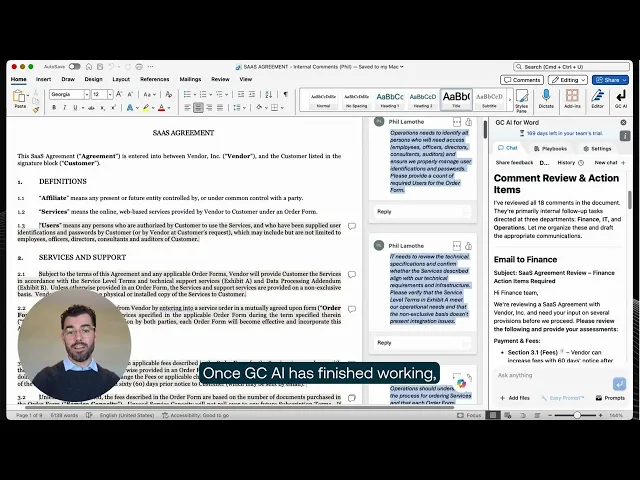
For an in-house lawyer who lives in Word, the live question is whether the AI shows up with the team’s templates, playbooks, and prior context already loaded. For a side-by-side on the in-house deployment, see GC AI for Word.
Claude for Legal: What Anthropic Shipped in May 2026, and the Privilege Question Nobody Is Answering
On May 12, 2026, Anthropic launched Claude for Legal, an open-source suite of 12 practice-area plugins, more than 90 named workflow agents, and data connectors. The named agents run real in-house jobs: a Vendor Agreement Reviewer, a DSAR Responder, a Termination Reviewer, a Claim Chart Builder. It is a far bigger move than the April Claude for Word beta, and it is the development that reshaped every Claude legal AI search result.
The strengths and the gaps, for an in-house team.
For a detailed look at the Claude Legal Plugin, including setup, pricing, and its key limitations, see our Claude Legal Plugin guide.
What Claude for Legal gets right. The agents are real, and several are genuinely useful. Per Anthropic’s own repository, each plugin runs a cold-start interview that learns your playbook and writes a practice profile every skill reads from. The suite connects to the systems legal teams already use, including Ironclad, iManage, DocuSign, Everlaw, CourtListener, and Westlaw through Thomson Reuters CoCounsel. Every contract-touching skill works inside the Claude for Word sidebar with tracked changes, and one thread can span Word, Excel, PowerPoint, and Outlook. The plugins are open source under Apache 2.0. The repo has kept moving since launch: a Thomson Reuters CoCounsel partner plugin, a community legal-builder hub with a security-review layer for third-party skills, and Managed Agents templates that run scheduled watchers such as renewal-watcher and docket-watcher without a lawyer at the keyboard.
Where the gap is for an in-house team. Claude for Legal is infrastructure you assemble. You install Claude Cowork or Claude Code, choose plugins, wire up connectors, run a cold-start interview for each practice area, and maintain the practice profiles. The plugins are free, and running them in Cowork still requires a paid Claude plan. The build-or-buy question is the real one: a legal team can assemble its own stack, the same way a company could build its own version of Microsoft Word, but few choose to.
Our CEO Cecilia framed the build-or-buy choice this way in a June 2026 founder interview:
“It’s the ability to build my own car. I have that ability right now. But when was the last time you changed your own oil? Never. You go to Jiffy Lube.”
The community reaction tracks the same line. In the r/legaltech discussion of the launch, the sharpest takes held that the model plus the Model Context Protocol is the real value, and that the launch exposes overpriced wrappers more than it threatens purpose-built platforms. One in-house practitioner named the security reservation directly:
“I can’t feed in my docs unless I know it’s completely locked down and my company has its own walled garden. I’ll keep waiting.”
Another summed up the buying logic:
“Companies don’t buy software, they buy trust.”
Tricia Kinney of BlueLinx draws the line in-house teams keep landing on:
“I am a huge fan of using legal specific AI tools as opposed to consumer specific AI tools. You want them training in the same context that we’re operating in.”
What the benchmark shows. When GC AI’s R&D team built the In-House Legal Bench (May 2026), a 100-task benchmark of in-house legal work scored against an answer key averaging 12 criteria built by attorneys with more than 80 combined years of practice, the underlying models landed in a clear order:
AI tool | In-House Legal Bench pass rate (100 tasks, May 2026) |
|---|---|
GC AI | 86.8% |
ChatGPT (GPT-5.5) | 79.8% |
Claude (Opus 4.7) | 68.4% |
Gemini (3.1 Pro) | 57.5% |
Claude (Opus 4.7) was the strongest Claude model available when the Bench ran in May 2026, and it is the model the scores above measure. Anthropic has since shipped Opus 4.8 and Fable 5. The plugins add workflow structure on top of the model, and the benchmark measures the reasoning underneath. On 100 tasks drawn from in-house work, Claude passed 68.4%, behind ChatGPT and behind a platform purpose-built for in-house counsel. The plugins make the workflow faster. They do not change the score of the model doing the reasoning.
Anthropic’s own repository says the quiet part out loud. Every plugin ships with the disclaimer that its output is “a draft for attorney review, not legal advice, not a legal conclusion, not a substitute for a lawyer,” and its guardrails apply “conservative defaults on privilege.” The repository states that “the attorney using the plugin, not the plugin, and not Anthropic, is responsible for the legal positions taken in their work product.”
Does Claude for Legal Satisfy the Heppner Privilege Test?
This is the question every in-house buyer is asking, and the launch coverage has largely skipped it. Claude for Legal does not change the Heppner calculus on its own, because privilege turns on how and where you deploy it, not on the plugins.
Prong one, the AI is not an attorney. Unchanged. A plugin is a system prompt and a workflow map. It does not make Claude your lawyer.
Prong two, confidentiality. This depends on the deployment surface. Claude for Legal runs as a Claude Cowork plugin, a Claude Code plugin, or through the Claude Managed Agents API. A consumer-tier Cowork deployment carries the same posture that failed in Heppner. The Managed Agents API on Anthropic’s Commercial Terms is the configuration that can satisfy prong two, and standing it up correctly is the customer’s responsibility.
Prong three, counsel-directed. Unchanged. The plugins automate the workflow. They do not document that counsel directed the use, which is the artifact the Kovel workaround requires.
Molly Abraham at Coinbase put the confidentiality stakes plainly:
“A non-lawyer asking an LLM for legal advice, that LLM is not necessarily their lawyer. If something ingests your confidential information and can spit it out, even in a transformed state, that’s still your confidential information.”
Claude for Legal makes the workflow faster. The privilege posture stays the customer’s to solve, and it takes the enterprise tier, contractual confidentiality, and counsel-directed deployment that a purpose-built in-house platform is built around.
Opus 4.8, Fable 5, Opus 5, and Fable 5.1: The Model Under Claude Keeps Changing
Anthropic shipped four flagship-model events in the sixteen weeks after Claude for Legal launched. Claude Opus 4.8 arrived on May 28, 2026, and the announcement led with legal proof points: Anthropic calls it the first model to break 10% on the all-pass standard of its Legal Agent Benchmark, and Thomson Reuters CoCounsel reported gains in consistency and reasoning quality.
Claude Fable 5, the first model in a new Mythos-class tier above Opus, launched on June 9, was suspended on June 12 under US export controls, and returned on July 1 with a classifier that routes flagged requests to Opus 4.8. Fable 5 ran on usage credits rather than plan limits from July 7 until July 20, when it returned to Max and Team Premium plans at half of standard usage limits; Pro and Team Standard remain on usage credits plus a one-time $100 credit.
Claude Opus 5 shipped July 24, and Anthropic again opened with a legal proof point: Head of Applied Research Niko Grupen called it ‘a clear step up in performance on legal agent work compared to prior Opus models,’ with the largest gains in corporate governance and arbitration, and a colleague reported Opus 5 scored highest of any Anthropic model tested on first-turn redlines, nearly double Opus 4.8. Pricing held at $5 per million input tokens and $25 per million output tokens, the same as Opus 4.8, with a new effort setting that trades speed for reasoning depth.
Three days later, on July 27, the Opus 5 model suite logged roughly an hour of elevated errors.
Anthropic released Claude Fable 5.1 alongside Claude Mythos 5.1 on September 1, 2026, and again opened with a legal proof point: Crosby’s Raymond Lin, Member of Technical Staff, reported on RedlineBench, Crosby’s contract-redlining benchmark:
“Compared to Fable 5, Claude Fable 5.1 was a massive improvement on RedlineBench, our contract redlining benchmark, improving from 47.9 to 57.0. Most of the gain came on first-turn quality, where it doubled the previous score, with substantial gains on counterparty acceptance as well. Its edits were also more concise, with smaller changes on average to the documents.”
For an in-house team, the churn is the point.
Four flagship-model launches, an export-control suspension, a plan-limit reversal, a service incident, and a new enterprise data-handling architecture moved through in a little over three months, and any benchmark score, context window, or data-handling answer now carries a shelf life measured in weeks, not months.
That newest wrinkle, Enterprise Frontier Safeguards (EFS), arrived alongside Fable 5.1: it lets a customer hold its own data on its own cloud infrastructure with human review defaulting to the customer rather than Anthropic, and it is opt-in, requiring the customer to stand up that infrastructure, with a phased rollout starting this fall across Claude Code, Claude Enterprise, Claude Platform, and Anthropic’s cloud partners.
Vetting the model underneath, and now the safeguard architecture around it, is recurring work, and it is work a platform layer absorbs: when the model under GC AI changes, the team’s playbooks, citations, and privilege posture stay put.
How a Claude-Powered Legal AI Platform Closes the Gap
GC AI is the in-house counsel layer Anthropic does not build, used by 2,100+ law departments including 200+ public companies and 25 unicorns, with a privilege posture designed around the Rakoff three-part test.
GC AI is SOC 2 Type II and SOC 3 certified, GDPR compliant, with AES-256 encryption. GC AI works with leading AI providers such as OpenAI and Anthropic. For a full list, see our subprocessor list. None of our providers train on your data.
These protections apply to every customer, including non-enterprise tiers, not just enterprise plans. On top of that infrastructure, the platform layer adds:
Files holds your team’s contracts, templates, playbooks, and prior matters across sessions, so every chat starts with your team’s context loaded.
Projects carries context across conversations within a specific matter, so the second lawyer on a deal keeps what the first lawyer established.
Custom Company Profile encodes your team’s voice, templates, and standards, so outputs arrive calibrated to how your team writes.
Playbooks ships with pre-built workflows for NDAs, DPAs, MSAs for SaaS, and MSAs for commercial purchases, with agentic execution.
Exact Quote pulls character-level verbatim text from your uploaded documents, so every claim about what the contract says points to the line in the contract.
Easy Prompt turns plain-language requests into legally optimized prompts, so a non-prompt-engineer GC gets a usable answer on the first try.
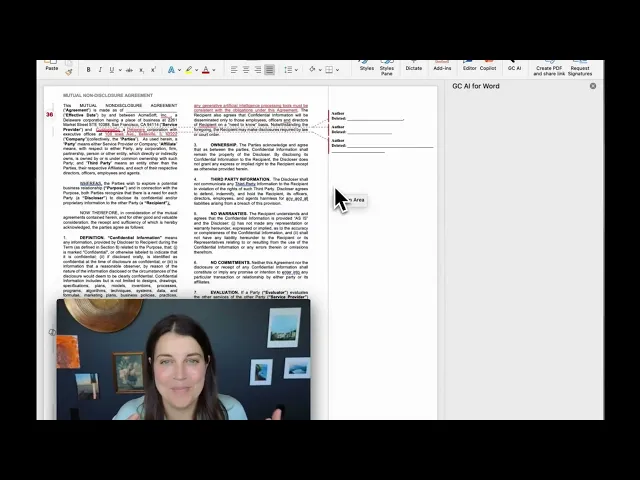
GC AI for Word brings Chat2 web research, Skill Library workflows, Files, Projects, and Easy Prompt directly into Microsoft Word.
Danielle Sheer, Chief Trust Officer at Commvault, said it directly on the CZ and Friends podcast:
“What would be really helpful is if there was an entire universe that was like ChatGPT, but built for and made for the legal world and the compliance world: GC AI.”
The wedge is the in-house legal universe built around the model.
Claude vs GC AI for In-House Legal Work: Side by Side
Five questions every in-house team eventually asks after the first quarter of using raw Claude:
Does our work train the model?
Can we verify what the AI says against the actual document?
Does the second lawyer on a deal start cold every time?
Do our team’s templates and playbooks load by default?
Does the deployment satisfy Heppner’s three-part test?
Axis | Consumer Claude (Free / Pro / Max) | Claude for Work / API | Claude for Legal (plugins, May 2026) | GC AI |
|---|---|---|---|---|
Training on data | Trains only when user opts in (August 2025 update); five-year retention on opted-in data | No training; enterprise data handling | Inherits the tier it runs on: consumer Cowork or Commercial Terms API | SOC 2 Type II, SOC 3, GDPR, AES-256, no provider trains on your data |
Citations | Plausible summaries; no character-level verbatim citations as of May 2026 | Same as consumer | Source attribution with research-connector verification (CourtListener, Westlaw via CoCounsel); citations flagged for review without a connector | Character-level verbatim citations from uploaded documents |
Workflow context | Starts cold every session | Starts cold every session | Per-plugin practice profile from a cold-start interview, plus Cowork file access | Persistent context across sessions, matters, and team templates |
Heppner posture | Fails all three Rakoff prongs | Satisfies prong two when correctly configured | Tracks the tier it runs on; the plugins do not change the privilege analysis | Designed for all three prongs through counsel-directed deployment, contractual confidentiality, and agent-of-counsel posture |
In-house teams switch from raw Claude to a purpose-built legal AI platform when the team grows past three lawyers, when privileged work becomes a regular rather than occasional output, when client data falls under a regulated framework such as HIPAA, GDPR, CCPA, or GLBA, or when the team needs the AI to carry matter context across conversations rather than starting every session cold.
For readers weighing ChatGPT instead, see the sister analysis at ChatGPT for lawyers. For the comparison page, see GC AI vs Claude.
Try GC AI for In-House Legal Work
See how GC AI handles the same prompts you would put into Claude, with SOC 2 Type II and SOC 3 attestation, zero data retention, and the in-house workflow context built in.
Frequently Asked Questions
Does Using Claude AI for Legal Work Waive Attorney-Client Privilege?
Not automatically, but the risk is real. In United States v. Heppner, Judge Rakoff ruled that a defendant’s Claude exchanges were neither privileged nor work product protected because the AI is not an attorney, the consumer-tier terms of service undermined confidentiality, and the use was not directed by counsel.
What Did the Heppner Ruling Hold?
Judge Rakoff held that communications with Claude failed all three elements required for privilege: the AI is not an attorney, the confidentiality prong failed on the terms of service in effect, and the use was self-directed by the client rather than by counsel. The ruling is first-impression precedent, nationwide in effect. Heppner was convicted on all counts on May 7, 2026, with the Claude exchanges in evidence, and sentencing is set for October 7, 2026.
Can Counsel-Directed AI Use Still Be Privileged After Heppner?
Yes, the court left a narrow path open. Under the Kovel doctrine, counsel-directed use of AI on a platform with contractual confidentiality may preserve privilege, but it requires the enterprise tier, enforceable confidentiality terms, and a documented policy showing counsel directed the use. GC AI is designed around all three of those requirements.
What Changed with Anthropic’s August 2025 Consumer Policy Update?
Anthropic introduced an opt-in for users to share chat data for model training, with five-year retention on opted-in data. Consumer-tier users who opted in have chats that train the model, which directly undermines Heppner’s confidentiality prong. Claude for Work and API deployments kept a no-training posture with separate enterprise data handling.
What Does Claude for Legal Ship With?
Launched May 12, 2026, Claude for Legal is an open-source suite of 12 practice-area plugins, over 90 named workflow agents, and data connectors to tools like Ironclad, iManage, and Westlaw. The plugins add workflow structure but do not change the underlying model or resolve the Heppner privilege analysis on their own.
How Much Does Claude for Legal Cost?
The Claude for Legal plugins are free and open source under Apache 2.0. Running them requires a paid Claude plan: as of September 2026, Claude Pro starts at $17 per month billed annually, or $20 month to month; Team at $20 per standard seat per month billed annually, or $25 month to month; and Max from $100 per month, with Enterprise priced on request. The plugins add no separate license fee, though connectors to systems like Westlaw or Ironclad carry their own vendor costs.
How Did Claude Score on In-House Legal Benchmarks?
On GC AI’s In-House Legal Bench (May 2026), a 100-task benchmark scored against an answer key built by attorneys with over 80 combined years of practice, Claude (Opus 4.7) passed 68.4% of tasks, behind ChatGPT (GPT-5.5) at 79.8% and GC AI at 86.8%. The plugins in Claude for Legal add workflow structure but do not change the model’s underlying reasoning score.
What Are the Three Ethical Duties Lawyers Must Meet When Using AI?
ABA Formal Opinion 512 confirms that AI use is permissible under existing ethics rules so long as counsel maintains competence, supervision, and confidentiality. Competence means understanding the model’s limitations, supervision means treating output as a draft to be reviewed, and confidentiality means knowing exactly how the platform handles your data.
Does Claude for Legal Satisfy the Heppner Privilege Test?
Not on its own. The plugins do not make Claude an attorney, do not automatically provide contractual confidentiality, and do not document counsel-directed use. Privilege turns on how and where the platform is deployed, and satisfying all three Rakoff prongs requires the enterprise tier, enforceable confidentiality, and a documented counsel-directed deployment policy.
What Version of Claude Should a Lawyer Get?
Pick the plan before the model. For privileged or client-identifying work, use Claude for Work (Team or Enterprise) or the API, which carry Anthropic’s no-train Commercial Terms; Free and Pro are consumer-tier, the posture that failed the confidentiality prong in Heppner. On models, Claude Opus 5 (September 2026) remains the current flagship for general professional work, and Anthropic replaced Fable 5 with Claude Fable 5.1 on September 1, 2026, citing a jump on Crosby’s RedlineBench contract-negotiation benchmark (47.9 to 57.0) as its named legal proof point. Confirm current plan-limit and usage-credit terms directly with Anthropic before advising a specific tier; those terms changed twice in the ten weeks after the June Fable 5 launch alone. The tier decides the privilege posture, and the model decides the reasoning quality.
Is ChatGPT or Claude Better for Legal Writing?
Claude has the stronger reputation for prose, and lawyers routinely describe its drafts as reading closer to a senior associate’s writing. On measured in-house work the order flips: ChatGPT (GPT-5.5) passed 79.8% of In-House Legal Bench tasks to Claude’s 68.4% (Opus 4.7, May 2026). Use Claude for drafting voice, ChatGPT for broader task coverage, and verify citations from either. For the full analysis, see ChatGPT for lawyers.
How Do You Set Up Claude for Legal?
Four steps. Install Claude Cowork or Claude Code on a paid plan, add the plugins for your practice areas from Anthropic’s repository, run each plugin’s cold-start interview so it learns your playbook, and connect a research connector such as CourtListener or Westlaw through CoCounsel before relying on citations. Budget 10 to 20 minutes per plugin for the interview, and confirm the deployment tier first, because setup does not change the privilege analysis.
When Should an In-House Team Move from Raw Claude to a Purpose-Built Legal AI Platform?
In-house teams typically make the switch when the team grows past three lawyers, when privileged work becomes a regular output, when client data falls under a regulated framework like HIPAA or GDPR, or when the team needs the AI to carry matter context across conversations rather than starting every session cold.