There is no legal version of ChatGPT. OpenAI does not sell one.
This question describes what in-house lawyers want rather than a product they can buy. Law departments want an AI platform that runs the same class of models, then adds instructions tuned for legal work, citations you can check against the source, confidentiality terms a legal team can sign, and a home inside Microsoft Word.
Five products come up when in-house teams go looking for one, as of September 2026.
GC AI, built for in-house legal teams, from solo general counsels to enterprise law departments
ChatGPT Enterprise, OpenAI's general-purpose assistant with company controls
Anthropic's Claude legal plugin, free to install and run on a paid Claude plan
Thomson Reuters CoCounsel, grounded in Westlaw and Practical Law
Harvey, built first for large law firms
GC AI is the enterprise legal AI platform a three-time general counsel (Anki, Bloomtech, and Replit) built for in-house teams. As of September 2026, 2,100+ in-house legal teams use it, including 300+ public companies and the legal departments at Liquid Death, Arc'teryx, Tipalti, and Snyk.
Teams move over from a general assistant for a practical reason. A general assistant returns a fluent answer and leaves the checking to you. A platform built for legal work returns an answer you can send, because it cites the document it came from and runs where the contract already lives.
What a Legal Version of ChatGPT Has to Do
A legal version of ChatGPT has to do four things a general-purpose assistant leaves to the user. Test each candidate against them before you look at price.
Run instructions tuned for legal work: the answer should skip consumer disclaimers, ask a clarifying question before it commits, and flag issues the reader did not raise.
Cite sources you can check: a flagged clause should quote the exact language from the document, and a legal proposition should point to primary law rather than a summary of it. Our AI hallucination legal cases tracker follows what happens when nobody checks.
Keep documents confidential under terms legal can sign: a SOC 2 Type II report, a data processing agreement, a public subprocessor list, and a written commitment that no model provider trains on your data. ABA Formal Opinion 512 makes understanding those terms part of your own competence and confidentiality duties.
Work inside Word: redlines, comments, and playbook checks where the contract already lives, without pasting text into a browser tab.
Any of the five options below can answer a legal question in fluent prose. The four tests show which one fits the work you sign your name to.
Five Options for a Legal Version of ChatGPT
The descriptions come from each vendor's public site or documentation, and the fit line is ours.
Option | Built for | Citations | Where it runs | Best fit |
|---|---|---|---|---|
GC AI | In-house legal teams from solo GCs to Fortune 500 legal departments | Exact Quote gives character-level citations to your own documents, and Research and US Case Law cite primary law | Web app, GC AI for Word, Slack, and an API | In-house teams that want ChatGPT's fluency with their contracts, standards, and Word built in |
ChatGPT Enterprise (OpenAI) | A whole company, with legal supplying its own instructions | Web sources and connected company apps | Web, desktop, and mobile apps | Companies already standardized on ChatGPT, with legal willing to own its own prompts and checks |
Claude legal plugin (Anthropic) | In-house teams working in Claude Cowork | Marked unverified unless a research connector such as CourtListener is attached, per Anthropic | Claude Cowork desktop app and Claude Code | Teams with a lawyer who will own the setup and connect a research tool |
CoCounsel (Thomson Reuters) | Law firms and corporate legal departments on the Westlaw and Practical Law stack | Linked to Westlaw and Practical Law content | Web, Microsoft Word, Outlook, and Teams | Research-heavy work where the department already licenses Westlaw |
Harvey | Large law firms first; also sold to in-house legal teams | Cited research across legal, regulatory, and tax questions | Web, Word, Outlook, and SharePoint | Firm-scale diligence and firm-style drafting |
Vendor facts as of September 2026, from each vendor's public site or documentation. Re-check before you buy, since capabilities change quarterly.
GC AI
GC AI fits in-house legal teams that want ChatGPT's fluency with a lawyer's standards built in. It is an enterprise-grade legal AI platform, designed around in-house scope from the start.
It runs models from OpenAI and Anthropic, among others, under a system prompt of more than 20,000 lines written by Cecilia Ziniti, a three-time general counsel. The answer arrives already assuming an in-house lawyer is reading it.
Each of the four tests maps to a named feature.
Exact Quote for citations, down to the character of the document you uploaded
Research and US Case Law for primary law
Playbooks for your own standards on NDAs, DPAs, and MSAs
GC AI for Word for where the work already happens
Two of those deserve the detail, because they are the two a general assistant hands back to you.
Exact Quote is the first of the two, and it handles citations to your own documents rather than to primary law. A flagged clause comes back carrying the language that triggered the flag, rather than a summary of it.
That matters at the moment you forward the answer. If the review says your indemnity is capped at twelve months of fees, you open the passage and confirm it, instead of rereading the agreement to find out whether the model rounded a number.
Ritesh Patel, Chief Legal Officer at Viant Technology, described what that does to adoption:
"Having sources and links right there builds trust. You can check the law yourself, and that trust drives adoption across the team."
US Case Law is the second, and it runs in the same conversation as the document. A counterparty sends a demand letter, you upload it, ask what the claim rests on, and research the authority behind it without opening another tool.
That keeps the research attached to the matter that raised it, which is how in-house questions actually arrive. US Case Law is included on Team and Enterprise plans and available as an add-on for a single seat.
A general assistant leaves both jobs with you. Anthropic's README says its plugin citations are unverified until you connect a research tool, and the sanctions collected in that tracker follow one pattern, a citation nobody opened.
GC AI is SOC 2 Type II and SOC 3 certified, GDPR compliant, and encrypts data with AES-256. It works with leading AI providers such as OpenAI and Anthropic, none of which train on your data, and maintains zero-data-retention agreements with its LLM providers wherever feasible.
The full subprocessor list is public, and our data security guide walks through the controls. The price is public too. The Individual plan is $500 a month, or $5,000 a year for a single seat, with team pricing on request, and the 14-day trial starts without a sales call.
Pick it if your work is in-house work: contracts, policies, research questions, and board papers. To see where the rest of the field lands, read best legal AI tools for in-house counsel.
ChatGPT Enterprise
ChatGPT Enterprise fits companies that want one assistant for the whole company, with legal writing its own rules on top.
OpenAI says it does not train on your business data by default across ChatGPT Business, Enterprise, and the API. The Enterprise tier adds retention control, SAML single sign-on, and an enterprise contract, per OpenAI's enterprise privacy page, updated January 8, 2026.
The product stays general-purpose. As of September 2026, legal instructions, playbook positions, and citation checks come from you, chat by chat or through a custom GPT.
Pick it if your company has already standardized on ChatGPT Enterprise and your legal team will build and maintain its own prompts and checks, starting with how private ChatGPT keeps a document on each plan and what counts as a confidentiality breach. If you want to go deeper, GC AI vs ChatGPT compares the two feature by feature.
Claude Legal Plugin
The Claude legal plugin fits in-house teams already working in Claude Cowork who will invest time in setup. Anthropic released it on February 3, 2026, and on May 12, 2026 expanded it into Claude for Legal: 12 practice-area plugins and more than 20 connectors, published as open source under an Apache 2.0 license on GitHub.
Anthropic sets the boundaries itself. Its README states that "every output from these plugins is a draft for attorney review," that the cold-start interview takes 10 to 20 minutes per plugin, and that citations "are unverified without" a connected research tool.
The plugins cost nothing to install, and running them requires a paid Claude plan. Pick it if a lawyer on your team will own the setup, keep the practice profile current, and connect a research tool before trusting a citation.
Privilege and the Word workflow are the next questions, and our guide to Claude for legal work covers both, including Claude for Word. GC AI vs Claude weighs the two platforms against each other.
CoCounsel
CoCounsel fits departments whose bottleneck is research depth. Thomson Reuters describes it as reasoning from "authoritative Westlaw content, trusted Practical Law guidance, and your organization's own knowledge," with linked citations an attorney can click through and verify.
Thomson Reuters relaunched the product as CoCounsel Legal in August 2025, around agentic workflows and Deep Research.
It runs in Word, Outlook, and Teams, and it serves law firms and corporate legal departments. Pick it if research is the deliverable and your department already licenses Westlaw or Practical Law.
The in-house fit is the harder question, and GC AI vs CoCounsel covers the platform differences.
Harvey
Harvey fits legal work that looks like a law firm's. It launched with large law firms, and as of September 2026 its products span Vault for bulk review of large document sets, Knowledge for cross-domain research, Agents that execute legal work end to end, and Contract Intelligence for negotiation and review, inside Word, Outlook, and SharePoint. Harvey also sells to in-house legal teams.
Harvey does not publish pricing, and quotes come through its sales team, as of September 2026. Pick it if your matters involve firm-scale diligence sets and firm-style output.
The GC AI vs Harvey page goes deeper.
What About a Custom GPT for Legal Work?
A custom GPT is the closest thing to a do-it-yourself legal version of ChatGPT. You write the instructions once, and every chat opens with a legal role, the output shape you want, and the consumer disclaimers stripped out.
That covers the first of the four tests. Where your documents live, how a citation gets checked, whether the review runs in Word, and which contract governs your data all stay with the underlying ChatGPT account.
A platform holds all four in one place.
Files and Projects keep your document collections and matter context across chats
Exact Quote checks the citation against the document it came from
GC AI for Word runs the review inside the document
A data processing agreement and the public subprocessor list govern the data
The prompting side is what GC AI teaches directly: more than 8,000 lawyers have completed its legal AI classes, learning how to get a legal-grade answer out of any AI system, prompt by prompt.
What Legal In-House Teams Pick
Run the four tests and the field narrows quickly.
Trisha Mauer, VP of Legal at Tonal, compared the two directly:
"I go straight to GC AI for everything from research requests to litigation responses. I've compared against ChatGPT, GC AI gives more comprehensive responses appropriate for a lawyer to use. After six months of use, I'm sure I've saved hundreds of hours."
That side-by-side test is worth running before you buy. Ask both platforms the same question, then read the two answers as a lawyer deciding which one is fit to send.
Alexandra Sepulveda, Assistant General Counsel at Trust & Will, put it in budget terms:
"If you only have a budget for one tool, choose the one fine-tuned for in-house legal."
The In-House Legal Bench, a 100-task benchmark GC AI ran in May 2026, measured the gap on in-house work: GC AI passed 86.8% of the answer-key criteria and ChatGPT (GPT-5.5) passed 79.8%. The benchmark compared GC AI with general-purpose models only, so it says nothing about CoCounsel or Harvey.
Here is the shape of a first hour on a GC AI trial, using a vendor NDA your team has already reviewed. The steps are illustrative.
Open the NDA in GC AI for Word and run the pre-built NDA Playbook: the review returns each flagged term with the clause quoted and a fallback proposed.
Check one flag against the source: Exact Quote links the flag to the exact language in the document, so verification is one click, and the lawyer decides whether the fallback holds.
Type the research question the NDA raises, such as "Is a two-year non-solicitation of employees enforceable against a Delaware counterparty under California law?": Research returns primary law with citations you can open.
Compare the redline to the one your team sent, and count what the platform caught, missed, or over-flagged.
An hour on a document your team already knows will answer the question for your own contracts.
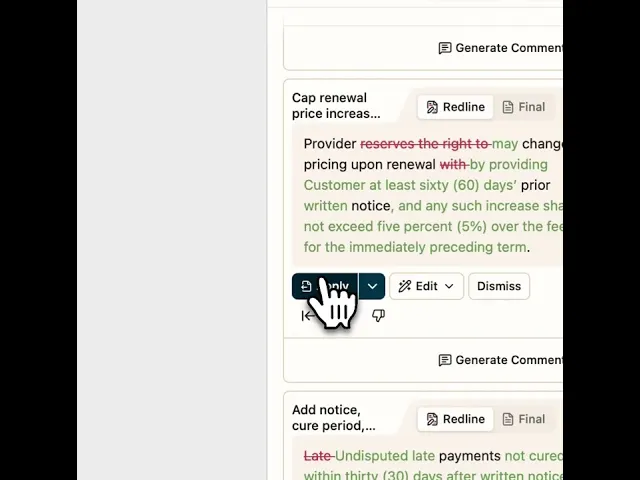
Here is that review running inside Word:
Frequently Asked Questions
Is There a ChatGPT for Legal?
No, OpenAI does not offer a ChatGPT for legal or a ChatGPT for lawyers. Legal AI platforms run the same class of models with legal instructions, verifiable citations, confidentiality terms, and Word integration built in. GC AI is the platform built for in-house legal teams. CoCounsel and Harvey serve research-heavy and firm-side work, and the Claude legal plugin adds legal workflows to Claude Cowork.
Is ChatGPT Safe for Contracts?
ChatGPT is safe for contract work only on a Business or Enterprise workspace, and only for documents where confidentiality obligations and privilege are not in play. The consumer tiers use conversations to train models unless you opt out, per OpenAI's privacy policy. Even on Enterprise, a contract review still needs citations you can check against the document, which is the layer a legal AI platform adds. Is ChatGPT Confidential? covers what counts as a breach.
What Is the Best Legal Version of ChatGPT for In-House Counsel?
For in-house counsel, GC AI is the closest thing to a legal version of ChatGPT: OpenAI and Anthropic models under a 20,000-line legal system prompt, Exact Quote citations to your own documents, Playbooks for contract review, and GC AI for Word, at a published $500 a month or $5,000 a year for a single seat, with a 14-day trial. In the In-House Legal Bench (May 2026, 100 tasks, run by GC AI), GC AI passed 86.8% of answer-key criteria against 79.8% for ChatGPT. CoCounsel fits Westlaw-centered research, and Harvey fits firm-scale diligence.
Is There a Free Legal Version of ChatGPT?
No free legal version of ChatGPT exists from OpenAI. Anthropic publishes its Claude for Legal plugins as open source at no charge, and running them requires a paid Claude plan. GC AI offers a 14-day trial of the full platform, including GC AI for Word, before any purchase.