For a general counsel at a PE-backed company, the business often grows faster than the legal team. Legal AI for private equity portfolio companies helps close that gap. Acquisitions add contracts and products, while the sponsor needs cleaner reporting. The legal team has more to review.
One general counsel at a PE-owned software company worked through that mismatch. After 15 acquisitions, the company had grown to nearly $700 million in revenue, with more than two dozen product lines and a ten-lawyer legal team.
She had a phrase for that mismatch:
"We're private equity owned... we're lean is lean. The size of our team is not commensurate with the size of our company. But you know what? You just buy in and dig in, and no sleep is overrated."
As the company grows, the team must decide what to keep in-house, what to systematize, and what to send to outside counsel.
GC AI CEO Cecilia Ziniti explored the same problem in an interview with Chuck Kable, General Counsel and Corporate Secretary at Innovative Renal Care. The interview was part of CZ and Friends, GC AI's podcast with in-house legal leaders. Kable has led legal at private-equity-backed healthcare companies through a $500 million sponsor deal and a $400 million acquisition.
Ziniti asked him what a lawyer has to understand about private equity. A recruiter had once passed on her for a PE-backed GC seat with the feedback "you just don't understand PE." Kable's answer:
"You're kind of forced to run lean... On the private side, they're interested in buying a business, growing it, and selling it. Part of that is understanding what's expected of legal in a way that can make it tough for a solo GC or even a small legal team to manage, but you have to figure out the right way to balance out the workload, manage outside spend, and then execute on the needs of the business."
The hold lasts longer than it used to. Bain's Global Private Equity Report 2026, published in February 2026, reports that buyout funds now hold companies for around seven years before exit. That is up from five to six years between 2010 and 2021. The industry also holds 32,000 unsold companies worth $3.8 trillion.
That gives legal a longer planning horizon. A team staffed for a five-year plan may still have the same headcount in year seven. Add-ons add pressure: they made up 72.9% of all US buyouts in 2025, according to PitchBook data compiled by Cherry Bekaert.
GC AI is an enterprise legal AI platform for in-house teams, used by 2,100+ legal teams as of September 2026, including teams at Snyk, Arc'teryx, and Tipalti.
The private equity legal AI workflows below use six GC AI capabilities:
Contract Intelligence finds the terms you name across signed agreements in a source-cited View and links amendments into a contract family.
Custom Company Profile holds the ownership structure and risk posture so drafts start from the positions the GC has set.
Playbooks check third-party paper against standard positions, clause by clause.
Files reads a contract set of up to 1,500 pages at once, the shape of a diligence folder.
Research answers questions from primary law with citations when an acquisition adds a jurisdiction the team has not worked in.
Skill Library saves reusable workflows so a contract manager can start with the same review structure as the GC.
What Private Equity Ownership Means for the In-House Legal Team
For an in-house legal team, private equity adds recurring demands: support acquisitions, control outside counsel spend, and keep the company ready for its next transaction. A lean team cannot send every question to a firm, so it needs a clear line between work it can handle internally and work that needs specialist counsel.
At Emerus, Kable sorted outside counsel work into what a firm had to do and what his team could absorb. He describes the same split in reducing outside counsel spend:
"We had a category of spend that was called essentially unnecessary outside spend. That's what got eliminated. We took that to zero. Unnecessary was essentially stuff that we categorized as otherwise being able to be handled internally."
Sophisticated joint venture negotiations still went to outside firms. Kable brought the rest in-house.
That in-house-versus-outside distinction also shapes AI adoption. Where can the portfolio company build a repeatable use case, and what value can it show? In FTI Consulting's 2026 Private Equity AI Radar, 95% of funds said their AI initiatives met or beat the original business case. The report draws on a May 2026 survey of 200 fund and operating leaders. It also found that 36% of respondents reported portfolio-company AI use across use cases, while 7% reported enterprise-scale deployment.
A repeatable contract workflow gives the legal team a concrete deployment to bring to the board. It can show which work moved in-house, how the review is controlled, and what the team can measure. Kable puts the goal plainly:
"Legal should not be satisfied being the cost center bottleneck."
A sponsor's other portfolio companies can offer practical examples. Sharon Johnson, SVP and Chief Legal Officer at MODE Global, once asked a private equity contact for the list of general counsels across the firm's companies:
"I want to reach out to them and... share information that's not from a confidential nature among businesses, but forms and things like this. This is before we had AI... And he's like, nobody's ever asked me that before."
Ask for the list and compare the forms and workflows other teams have already handled.
Six Ways a PE-Backed Legal Team Uses Legal AI
Start with the recurring questions that grow with the portfolio.
Tracking license terms across acquired product lines
Answering sales and sponsor questions without a CLM
Holding one risk posture across ten lawyers
Diligence and integration reading on a deal timeline
Standing up legal after a carve-out
Training the contract manager and the junior lawyer
Tracking License Terms Across Acquired Product Lines
Acquisitions bring product lines, and each product line can carry a different license model. SaaS, on-premises, and source-code-driven products bring different terms into the same customer base.
Those terms sit inside customer agreements. The current team may inherit paper it did not negotiate. It needs to know which customers hold a perpetual license grant, which agreements block assignment without consent, and which carry a most favored nation clause from a deal signed years ago.
With Contract Intelligence, the team can answer those questions across the portfolio. Bring the agreements into a Vault from SharePoint, Google Drive, or a direct upload. Describe the terms you want as Columns, and the View fills in with a citation behind each cell.
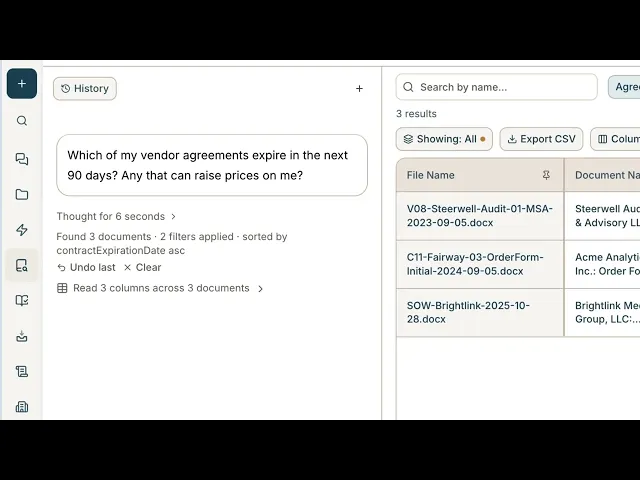
Amendments, SOWs, and renewals link into a contract family, and the in-force terms roll up into a Current Terms view. When a product line reaches end of life, filter for customers whose agreements require longer notice.
Answering Sales and Sponsor Questions Without a CLM
A portfolio company can start with the repository it already maintains. Signed contracts may live in SharePoint. A saved extraction prompt can pull the terms into a table for the sales or sponsor question in front of the team. The AI for law departments workflow begins with a clear set of fields.
A saved prompt can run at signature, so the data set grows one contract at a time. Sales gets the review, the sponsor gets customer-level reporting, and the legal team has a repeatable answer before the board meeting.
The prompt can start simply:
Extract from this signed agreement: customer, product line, license type (SaaS, on-prem, or source code), term and renewal date, termination notice period, assignment and change-of-control consent, and any most favored nation clause. Return one row with a column per term, and cite the clause behind each value.
At portfolio scale, Contract Intelligence handles that extraction with citations attached. The AI contract management article explains where a legal AI platform replaces the repository and where a CLM's workflow layer stays. The team can ask the question in plain language:
Which customers can terminate for convenience on 30 days, and which of those came in with the last acquisition?
Holding One Risk Posture Across Ten Lawyers
A PE-backed company's risk posture has to hold across the legal team and its product lines. Put that posture in Custom Company Profile so the team starts from the same ownership context and standard positions.
Review recent deals in a batch to see whether the team's risk posture is holding:
"I just did five contracts of the same ilk, putting them all in and saying, okay, where did we land?... Now we're getting big enough that we kind of have to be more thoughtful about scope creep on our risk profile, and whether or not our team members in a product line are getting pushed further than we want them to be."
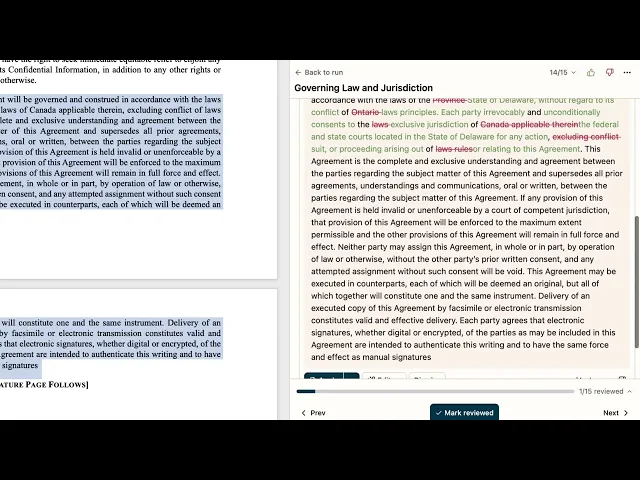
Write that posture into a Playbook. Each clause on incoming paper comes back as pass, fallback, or flag. Run the last five signed MSAs through the same Playbook. The flags show which lawyer conceded what, creating a scope-creep report in one pass.
Diligence and Integration Reading on a Deal Timeline
Add-on deals run on the sponsor's timeline. The diligence question comes first: what changed when the target joined the portfolio?
The team reads the target's contracts before signing and again after closing. That is when integration questions start. Ashley Good, Associate General Counsel at Vuori, remembers the manual version from her firm years:
"I still remember leading a team of 6 associates reviewing and manually cataloging every contract for a $9B acquisition. What took us three exhausting weeks could now be completed in hours with this technology."
Files can hold a diligence folder of up to 1,500 pages as one collection. The change-of-control question can then run across the whole set at once. Each answer comes back with the passage behind it through Exact Quote. The AI due diligence article covers the request list, and ARKO's 26-acquisition legal department tells the integration story.
After closing, the acquired contracts go into the Vault, so the team can review the next product line's terms alongside the rest of the portfolio.
Standing Up Legal After a Carve-Out
A carve-out can hand a legal team a healthy company with no legal function attached. Ali Hartley, Chief Legal Officer at SimplePractice and a GC AI customer, described the transition:
"SimplePractice was part of a holding company that was a public company, which was then bought by a private equity firm and taken private. And then the subsidiaries of that holding company were all spun out as separate companies... We feel like we're in founding building mode, but at a really healthy company."
Templates and the vendor process get built in the same months as the team's AI habits. Put the inherited documents into Files as the reference library. The new company's templates can then draw from the paper it already signed, while Research covers the jurisdictions the spun-out entity now operates in.
Hartley started her team with a no-stakes exercise, 30 minutes to build anything with AI, and one person built a website for a cafe:
"I was trying to shift from fear to innovation."
Training the Contract Manager and the Junior Lawyer
A lean team also needs a way to give newer teammates context without turning routine questions into a senior lawyer interruption. KT Farley, Chief Privacy Officer and Associate General Counsel at Helix, describes the pattern:
“The ability to create and store reusable prompts and share them across the team has completely changed the work required to review standard work. Junior teammates now run the checklist prompt first and bring me the output as the predicate for my review.”
The senior lawyer still reviews the output. The reusable checklist gives the junior teammate a concrete first pass and a shared standard for learning.
Save that review as a skill in the Skill Library. About a third of the people on the GC AI platform are not lawyers, including people in marketing, procurement, HR, and sales.
What the Platform Covers and What Stays With You
Across all six jobs, GC AI organizes the evidence and produces a first pass, while the legal team makes the call. The table maps each workflow to the person waiting and the decision that remains with you:
The work | Who is waiting | What the platform hands you | What stays with you |
License terms across product lines | Product and finance | License, assignment, and MFN terms from the agreements in one View, with the passage behind each cell | Which legacy terms to migrate at renewal and which to live with |
Sales and sponsor questions | Sales and the board | The customer list that matches the question, filtered from the contracts themselves | What the company commits to in the QBR and the board deck |
One risk posture | The sponsor | The last five deals sorted pass, fallback, or flag against the Playbook | Where the posture moves, and which lawyer gets pulled back |
Diligence and integration | The deal team | Change-of-control, consent, and exclusivity terms pulled across the target's contracts | Which findings change price, structure, or closing conditions |
Carve-out build | The new CEO | First drafts of templates and policies from the documents you inherited | What the new company's standard positions are |
Training | The team | The redline with the reasoning, calibrated to the reader's seniority | When the junior lawyer's judgment is ready to sign off alone |
The platform can organize the work, but you still own the calls that affect the business.
Preparing a Portfolio Company for Exit Diligence
The contract data also helps with exit diligence. Buyer's counsel reads your contracts the way you read a target's contracts, and the request list arrives on the sponsor's timeline. Change-of-control and anti-assignment terms across the customer base often sit near the top of that list. Buyers also look for agreements with exclusivity, most favored nation, or termination-for-convenience rights.
A legal team that already runs its portfolio through Contract Intelligence can save that list as a View. Each cell includes the source passage for buyer's counsel to check. The change of control clause page covers the consent mechanics, and the data room index builds from the same View.
Kable's turnaround at Cardon Outreach, the first of those private-equity-backed healthcare companies, ended in a $400 million acquisition and a 16x valuation increase, according to the episode. His rule for the hold applies to the exit too: run legal like a business unit. Report to the board with legal department metrics the way the CFO does, and keep the data-room answers ready.
Confidentiality for Board Decks and Sponsor Reporting
Board decks, investment committee memos, and the sponsor's own reporting pass through the legal team. A private company expects more from a vendor's confidentiality answer than a line about training data. Put the controls in writing with any enterprise legal AI vendor before sponsor materials go in.
GC AI keeps each customer's data in a segregated database and encrypts it at rest and in transit. GC AI works with leading AI providers such as OpenAI and Anthropic. For a full list, see our subprocessor list. None of our providers train on your data. GC AI's security materials also describe zero-data-retention agreements with LLM providers wherever feasible.
The SOC 2 Type II and SOC 3 reports are downloadable from the Trust Center, and the platform is GDPR compliant. Your organization decides which model providers are enabled. The platform logs who changed that setting and when, which answers the sponsor's audit question.
Apply the same diligence you ran on the data room provider.
How to Tell Whether a Legal AI Platform Fits a Portfolio Company
A legal AI platform fits a portfolio company when it covers the work the team needs to systematize, clears the security review, and gives people a workflow they will keep using. Start with the standard you want first-pass reviews to follow.
Scope comes first. Contract review is one of the six jobs, and a platform that covers the other five keeps the team from buying five point solutions.
A CLM stores the signed portfolio and runs approvals and signature. Contract Intelligence replaces the repository half of that job. Whether the workflow half stays depends on how much of your CLM is workflow and how much is storage, a split mapped in corporate legal software.
Adoption comes next. Put the first workflow in front of the people who will use it, then check whether the output shortens a recurring review and gives a senior lawyer a reliable first pass.
The budget case is measurable too. In GC AI's December 2025 ROI study of more than 100 active customers, respondents reported 14 hours saved per lawyer per week and a 14% reduction in outside counsel spend. Against the $1.8M median outside counsel spend in ACC benchmarking, that 14% reduction is roughly $252,000 a year, calculated as 14% of $1.8M.
Those workflows become easier to scale when the team can teach them.
Start With the Contracts You Inherited
Take the last acquisition's customer agreements. Review them using three Columns: license grant, assignment, and termination notice. Then compare the View with whatever spreadsheet integration left behind.
Frequently Asked Questions
What Is the Best Legal AI for Private Equity Portfolio Companies?
GC AI is purpose-built for the in-house legal team at a portfolio company. Contract Intelligence answers portfolio-wide questions across acquired contracts with a citation behind each cell. Playbooks hold the risk posture the sponsor signed off on, and Custom Company Profile carries the ownership structure into each draft. On the In-House Legal Bench (May 2026), GC AI's benchmark of 100 in-house tasks scored 86.8%, ahead of ChatGPT, Claude, and Gemini in that test. The best legal AI tools for in-house counsel page compares the wider field by in-house fit.
What AI Do Private Equity Firms Use?
Private equity firms use AI at two levels. Deal teams at the fund run finance-research and data-room platforms for sourcing, diligence, and portfolio monitoring, and the fund's own counsel adds contract automation for fund documents. Inside portfolio companies, the in-house legal team runs a legal AI platform such as GC AI for contract review, portfolio-wide contract questions, research, and drafting, which is the layer covered here.
Is Legal AI Different for PE-Backed Companies Than for Public Companies?
Legal AI for PE-backed companies covers the same review, research, and drafting work as at a public company. On a leaner team, however, more of the work centers on sponsor reporting, add-on integration, and exit preparation. GC AI's Custom Company Profile holds the ownership structure and risk posture, so first drafts already assume a sponsor will read the board deck. Contract Intelligence keeps the acquired contracts answerable from one View.
How Does a Lean Legal Team at a Private Equity Portfolio Company Keep Up?
A lean legal team at a PE-backed company sorts work by value and risk, sends sophisticated matters to outside counsel, and uses a legal AI platform for recurring reviews. A saved extraction prompt can turn signed contracts into a source-cited table, while shared skills give junior teammates a consistent first pass for senior review.
Is AI Safe for Board Materials and Sponsor Reporting at a Private Company?
A legal AI platform can be safe for board materials and sponsor reporting when its controls and your organization's terms support that use. GC AI's public security materials say it keeps each customer's data in a segregated database and encrypts data at rest and in transit. GC AI works with leading AI providers such as OpenAI and Anthropic, and says those providers do not train on your data. It also publishes its subprocessor list. Confirm those controls in writing with any vendor before an investment committee memo or a board deck goes in. Also check who in your organization can change the model settings.
Does Legal AI Help a Portfolio Company Prepare for an Exit?
Yes, when the legal team saves a cited View of exit-related terms across its contracts. Contract Intelligence can create a saved View of change-of-control, assignment, exclusivity, and termination terms across the customer base, with source passages behind each result. The legal team can use that View to build the data-room index and answer buyer questions from the contracts themselves.