

Dive Deeper
Transcript
Episode Overview
Chuck Kable has spent his career leading legal at private equity-backed healthcare companies, where legal cannot afford to be a bottleneck and where each dollar of outside spend gets scrutinized.
On his first day as a general counsel, the head of HR pulled him into his office to explain that the company was buried in bet-the-business litigation, with three law firms on retainer and no resolution in sight.
The settlement Kable architected got signed at midnight, built on a framework the mediator initially said would never work.
Turning legal into a growth engine, in Kable's playbook, comes down to four moves for in-house counsel: audit outside counsel spend before you accept it, categorize legal work by value and risk, automate or delegate the low-value low-risk quadrant with legal AI and self-service workflows, and report to the board with data the way a CFO does.
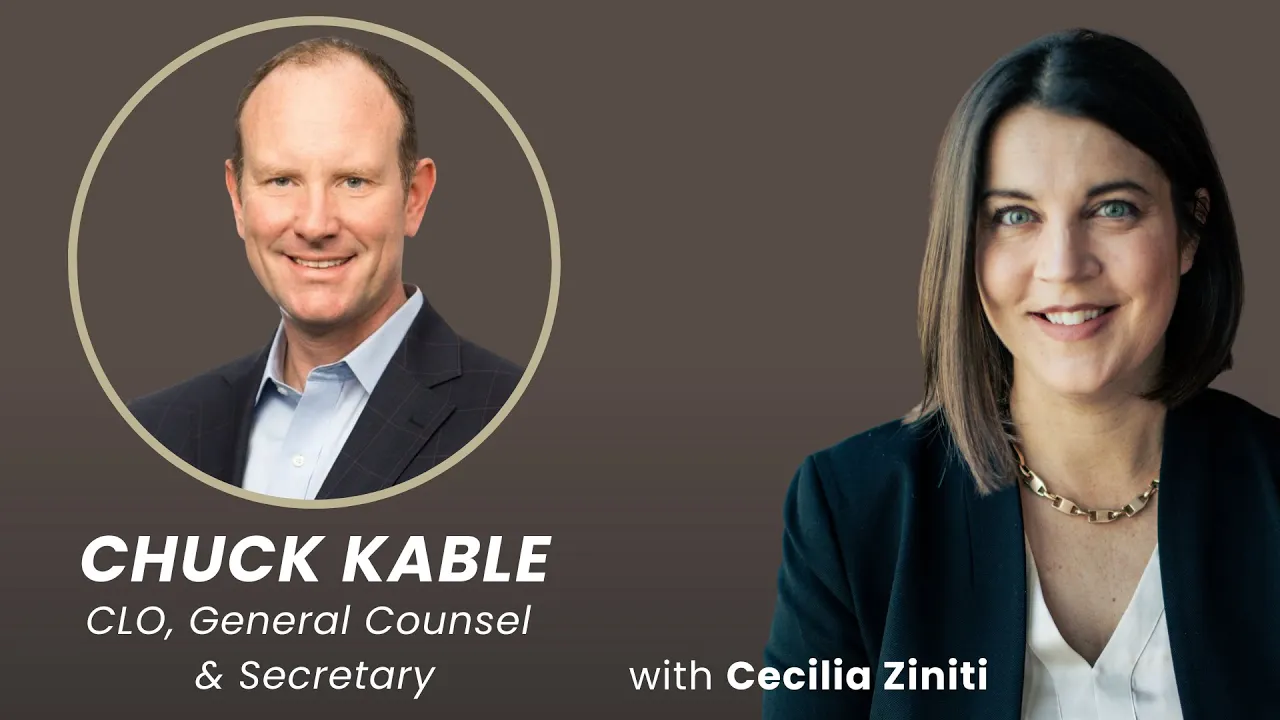
In this conversation with GC AI co-founder and CEO Cecilia Ziniti, Kable walks through how he ran that playbook at Cardon Outreach (now Elevate Patient Financial Solutions), Emerus, and now Innovative Renal Care.
About Chuck Kable
Chuck Kable is General Counsel and Corporate Secretary at Innovative Renal Care, a dialysis provider, where he is rebuilding the legal function from the ground up.
He has held executive legal roles at Axiom Medical, Emerus, and Cardon Outreach, now Elevate Patient Financial Solutions.
As Ziniti notes in the episode, he orchestrated a turnaround at Cardon that ended in a $400 million acquisition and a 16x valuation increase, and at Emerus he built an entire legal department while leading a $500 million private equity deal.
He began his career as a litigator at regional firms in Metro Detroit, an experience he credits for his instinct to scrutinize budgets and timelines.
Key Takeaways
Audit before you automate. Map your workflow by value and risk, then automate, delegate, or eliminate the low-value, low-risk quadrant, which Kable estimates covers about 20% of matters.
Evaluate risk magnitude and risk likelihood separately. Leadership teams get blindsided when they gloss over high-magnitude risks because the probability feels low.
Run legal like a business unit. CFOs and COOs arrive at board meetings with data tied to business decisions, and legal should do the same.
Pace the change you put on your team. Name the Valley of Despair before you enter it, and stop failed experiments without treating them as a loss.
Design intentional client interactions. As AI absorbs routine work, the incidental touchpoints that build trust with the business disappear, so lawyers have to create them on purpose.
What Should In-House Counsel Know Before Joining a Private Equity-Backed Company?
Private equity-backed companies run lean by default. The investors' goal is to buy a business, grow it, and sell it, and legal exists to serve that plan.
Compared with a public company, where regulation, governance, and Wall Street expectations bolt structural expense onto the business, a PE-backed legal team has to defend its blend of inside and outside support against constant scrutiny.
In-house lawyers who succeed in PE do so because they are ruthless about what they keep on their plate and what they send out. At Emerus, Kable eliminated an entire category he calls unnecessary outside spend.
Kable explains:
"We had a category of spend that was called essentially unnecessary outside spend. That's what got eliminated. We took that to zero. Unnecessary was essentially stuff that we categorized as otherwise being able to be handled internally."
Sophisticated joint venture negotiations still went to outside firms. Kable led them, but needed the firms to do the execution work.
The discipline was in the sorting: work that belonged in-house came in-house, and the relationships that remained turned from cost issues into value adds.
He names the partners he still calls at Norton Rose in Houston and McDermott in Chicago as proof that cutting spend and keeping strong outside relationships are compatible.
How Do You Bring Litigation Spend Under Control?
Start with an audit.
When Kable's boss at Cardon told him on day one that the company was buried in litigation debt, his first move was to ask for the invoices: how much per month, across which firms, on what strategy, and why three firms at once.
Nobody had asked before. That question earned him his seat at the table.
"It's not just about winning. It's about how much it costs to get there and the risk associated with potentially not winning."
Kable then did what business operators do: he got specific about fixing the problem. He challenged line items, moved billing from quarter-hour to tenth-of-an-hour increments, and cut administrative charges.
The audit established a culture where legal spend would be managed like any other line on the P&L.
That audit-first playbook is the same one that opens GC AI's guide on how to reduce outside counsel spend with AI, which walks through the five mechanisms in-house teams use to keep work off outside counsel's desk in the first place.
The audit also reframed the endgame. Knowing roughly what it would cost to get from that day to trial gave Kable a number to beat, and mediation became the way to beat it.
"I was the one that architected the game plan that got that case resolved at midnight that night. We were there all day, all night, and we got the thing done. It's taking the economic view and then applying it to the fact pattern, coming up with gives and takes."
The mediator's partner at Ogletree Deakins heard half the framework and said it would never work. Kable finished it. The response changed to "that could work."
Kable's broader point for in-house counsel is that law firms run a process, and the process has value, but the GC is the one who has to say which issues matter and which do not.
Deciding what matters is the GC's call, and that judgment is what in-house counsel is there for.
How Do You Run a Legal Department Like a Business Unit?
Report to the board with data the way CFOs and COOs do, categorize incoming work by value and risk, and automate the low-value, low-risk quadrant. That frees attorney capacity, lowers per-matter cost, and gives the department a quick win it can demonstrate back to the business.
During Kable's first week as GC at Innovative Renal Care, the CFO asked for a templated NDA.
It took three attorneys two to three days to produce it. That single anecdote summed up the problem, and the opportunity, in front of him.
"Legal should not be satisfied being the cost center bottleneck. ... It means looking at technology and how we can utilize it to drive enhancements in quality, efficiency, and capacity. You have to set the vision with the team."
His fix was self-service automation: log in, enter the counterparty information, get a clean PDF in minutes, with a Word copy standing by for the lawyers if the document gets redlined. Tasks that had taken three attorneys two days were finished in minutes.
That same shift, from a document three lawyers assemble by hand to one AI triages and redlines in minutes, is what GC AI's guide on AI NDA review walks through in more detail, including which clauses still need a lawyer's judgment.
What Should a Legal Team Automate First?
Kable's framework starts with categorizing work by value and risk, with high value and high risk at one end and low value and low risk at the other. The bottom quadrant is what you automate, delegate, or eliminate.
On average, he estimates 20% of matters fall there, which means a legal team can free meaningful attorney capacity without adding a single headcount.
From there, teams can get more sophisticated: lease renewals, vendor termination letters, and other plannable work can move to an annual plan executed by support staff instead of clogging attorney bandwidth. Tracking workflow this way is the same discipline behind the legal department metrics in-house teams report to the board.
How Do You Lead a Legal Team Through Change?
Set the vision, then match your behaviors to your words.
Kable treats change management as the hardest part of modernizing a legal department, because lawyers of any tenure resist working differently than they have historically worked. His approach: name the discomfort in advance, build trust through visible follow-through, and pace the volume of change so the team can absorb it.
"There's this concept in change management, it's called the Valley of Despair, and we're gonna get there. We are gonna bottom out, and you're gonna think, this stinks, Chuck, it's never gonna work, it's causing me more work."
Naming the valley before you enter it is the point. So is being willing to end experiments without drama.
At Innovative Renal Care, Kable tried an on-demand paralegal service for two months, saw it was not delivering, and stopped.
"My personal philosophy has always been if it's wrong, we'll readjust. And if it doesn't work, we'll stop doing it. It doesn't scare me to try something that doesn't work."
The other half of the discipline is restraint.
Kable has intentionally deferred the outside-spend workstream at Innovative Renal Care to next year, because his team has already absorbed a new matter management system, a new intake portal, and new workflows. Piling on more process would break the trust that makes any of it stick.
Benchmarks help here too. He sets them to hold the team, and the internal clients, to a shared standard, and he is clear that they exist to set expectations, not to grade people at review time.
Where Does Legal AI Fit in an In-House Team?
In Kable's model, legal AI does the first-pass work so attorneys can spend their time on judgment.
Let the platform handle intake, triage, playbook-based first-pass redlines, and discussion drafts. Then put that draft in front of an attorney who reviews, refines, and sends it to the other side.
That keeps the attorneys on judgment and the pipeline moving faster.
"The AI tools like GC AI are a force multiplier for my support level folks, for my paralegal team." ""We can use AI tools to get to a discussion draft at the very least, that can then be immediately presented to attorneys for feedback, comments, and then off to the other side."
His ten-year prediction for the profession follows directly: fewer lawyers, more technology, more support.
How Do You Keep Client Relationships as AI Takes the Routine Work?
Design the interactions on purpose.
Kable's warning is that the incidental touchpoints, the NDA request that turns into a hallway strategy conversation, disappear as self-service and automation absorb routine work. Lawyers who wait for work to generate facetime will find the facetime gone.
"As you look to the future, the focus is gonna be on creating intentional interaction, finding the right things to go and talk to the business leaders about. ... We need to design interactions, our team does, to continue to enforce the strategic importance that we bring to the table."
Ziniti's example on the episode makes the stakes concrete. Early Uber's lawyers did not hand over a "driver agreement." They structured a platform access agreement and IP license, because they understood where the business was going and what the employment-law exposure would be. That is the strategic layer no automation replaces, and the layer intentional interactions protect.
Chuck's model hands your attorneys a first-pass draft they can react to in minutes, so the team moves faster without new headcount.
Recommended Reading
The Department of How: A GC's Playbook for Building Teams That Drive Business Growth: David Morris on running legal as a business partner, the same board-ready, data-driven posture behind Kable's "run legal like a business unit" playbook.
How Great GCs Think About Growth, Risk, and Crisis Management: Tricia Kinney on calibrating risk to the business, a direct companion to Kable's risk magnitude vs. risk likelihood framework.
Ask Stupid Questions, Tackle Hard Problems: Kaniah Konkoly-Thege's Philosophy for Better Legal Leadership: Konkoly-Thege on asking the basic question nobody else will, the same instinct behind Kable's invoice audit ("why do we have three law firms involved?").


