When David Morris, General Counsel at Snyk, ran a trial of GC AI, the reaction from his own team caught him off guard:
“This was the first time that after a trial, the team came to me and said, so we can’t live without this. No one ever was this excited about any legal technology ever.”
Morris runs legal at Snyk, a security company that sells to the enterprise, so his lawyers live in other-party contracts and regulatory terms all day. His team’s reaction is the question every in-house buyer is weighing about enterprise legal AI: can a platform carry the security, scale, and procurement load of a real legal department, and hold up well enough to put a team’s daily work on it?
The numbers you read about a legal AI platform are often a year out of date by the time they reach you. Judge it the way procurement will, against criteria you can verify yourself.
Enterprise readiness for a legal AI platform comes down to five things you can test:
Security you can put in front of procurement
Proof the platform runs at scale
A design built around in-house work
Accuracy you can verify
Procurement and rollout support a large team needs
Here is what to check, and how GC AI measures up against each one.
What Enterprise Legal AI Means for an In-House Team
Enterprise legal AI is a legal AI platform built to run across an entire in-house legal department: high contract volume, multiple jurisdictions, many lawyers, and the security and procurement review a large company requires before any platform touches confidential data. For an in-house team, the bar is higher than “can it draft a clause.”
The platform has to clear a security review, fit the company’s identity stack, stay consistent across a whole team, and produce work a general counsel can put in front of the CEO.
That is a higher bar than general-purpose AI clears. Generic models hallucinate, skip citations, and apply content policies that block routine legal outputs.
A platform built for in-house work is measured on whether it carries a department’s real load: vendor reviews, employment questions across states, security questionnaires, board consents, and the steady stream of contracts that keeps the business moving. The five criteria below are how in-house buyers separate a platform that demos well from one a team can run on every day.
For the wider category, see our legal AI buyer’s field guide and our breakdown of in-house counsel AI software.
The Five Criteria to Evaluate
Security and compliance you can hand to procurement
Proof the platform runs at enterprise scale
A platform designed around in-house work
Accuracy you can verify against the source
Procurement, identity, and rollout support
Security and Compliance You Can Hand to Procurement
Procurement asks the security questions before the business partners do, so the first gate for any enterprise legal AI is your own security review. Before a platform touches a contract, your security and IT teams need certifications, encryption standards, and a clear answer on what happens to your data. SOC 2 Type II is table stakes.
What stacks on top is the differentiator: SOC 3, GDPR, AES-256 encryption, zero data retention across the AI providers that process your content, and a published subprocessor list a security team can audit line by line.
GC AI is SOC 2 Type II and SOC 3 certified, GDPR compliant, with AES-256 encryption at rest, TLS 1.2+ in transit, and customer data held in a segregated database. Each AI provider in the stack, OpenAI, Anthropic, and Google among them, is prohibited from using your data to train its models and maintains a zero data retention agreement wherever feasible, and every vendor that processes your data is SOC-2 compliant.
We publish our subprocessor list, naming each provider, what it processes, and where, and its core infrastructure runs on US-based providers. Those facts live on the security page in a form your security team can review directly, and the Trust Center carries the SOC 2 Type II, SOC 2 Type I, and SOC 3 reports for download alongside the DPA and the corporate policy suite.
Here is the full artifact set, and where each reviewer gets it, so InfoSec, privacy, and procurement can run in parallel instead of in sequence.
What your team asks for | What GC AI provides | Where to get it |
Certifications | SOC 2 Type I, SOC 2 Type II, and SOC 3, plus GDPR compliance | |
The audit report itself | SOC 2 Type II, SOC 2 Type I, and SOC 3 reports, available for download | |
Model providers and data retention | Each AI provider in the stack, OpenAI, Anthropic, and Google among them, is prohibited from training on your data, maintains zero data retention wherever feasible, and is SOC-2 compliant | |
The data processing agreement | Published, so your privacy counsel starts from a document | |
Encryption and tenancy | AES-256 at rest, TLS 1.2+ in transit, customer data in a segregated database | |
Cross-border transfers | Standard Contractual Clauses | |
Retention and deletion | Inputs and outputs deletable in-app, organization-level erasure on written request | |
Admin controls | Enterprise SSO with SAML through WorkOS on the Team plan and above, organization-level control over which model providers are enabled, and audit logging of who changed a model opt-in and when | |
Corporate policies | Acceptable use, anti-bribery and corruption, anti-slavery, and code of conduct | |
Uptime and incidents | Status monitoring in the Trust Center, incident response plans on the security page | |
Questionnaire ownership | Managed procurement and onboarding on the Enterprise tier |
The framing that keeps this accurate: your security, privacy, and regulatory obligations stay with your company, and the platform supports that work while keeping your data out of model training.
Proof the Platform Runs at Enterprise Scale
A platform is exactly as mature as the companies that bet their legal work on it. Weigh the roster and the real usage.
GC AI is in production across 2,100+ legal teams in 53 countries, including 200+ public companies and 25 unicorns. The legal teams at Hitachi, Eventbrite, Viant Technology, and Interface run their in-house work on it, alongside high-growth companies like Gusto, Snyk, Tipalti, and Tekion.
Scale shows up in how teams describe the work. Columbia Sportswear‘s Associate General Counsel, Melissa Robertson, names the problem most enterprise departments are solving for:
“GC AI is a powerful tool in the hands of a seasoned legal professional, helping Columbia’s legal team extend its capacity without adding headcount.”
Cameron Clark, Head of Legal at Arc’teryx, describes the same compression on a smaller team:
“With GC AI, we’ve handled the workload of a full legal team with just one or two lawyers.”
The business keeps growing, and the platform absorbs the volume the headcount cannot.
A Platform Designed Around In-House Work
Ask one question that sorts the field fast: was the platform built around the in-house day from day one, or adapted to it after starting somewhere else, a law firm or a consumer app? Both can help a team, and we weigh the field in our guide to the best legal AI tools for in-house counsel.
The difference shows in the defaults: the vendor reviews, the employment questions, the security questionnaires, and the tone you use with a business partner across a deal.
GC AI was built for that day. Its CEO and co-founder, Cecilia Ziniti, was a general counsel three times, at Anki, BloomTech, and Replit, and an in-house counsel at Amazon and Cruise.
Ziniti built GC AI to solve the problems she encountered firsthand as an in-house lawyer, and that experience is embedded directly into GC AI’s system prompt, tone, and workflows. In practice it covers a department’s real range of work:
Contract review against your standards: Playbooks is how GC AI holds your standard: it reads an incoming contract against your positions and returns a redline with rationale, the core of AI contract review. Pre-built playbooks ship for NDAs, DPAs, and SaaS MSAs.
Redlining in the document you already use: GC AI for Word brings the review and the redline into Microsoft Word, then syncs back to the web app.
Research across jurisdictions, with citations: Research is how GC AI answers it: work across authoritative legal and government sources, returned with citations you can open. For US matters, US Case Law searches 13M+ court opinions directly in chat and returns a cited answer with treatment flags confirming the law still holds.
Long-document analysis: Files analyzes up to 1,500 pages at once and surfaces the clauses and changes that need attention.
Consistency across the team: A Custom Company Profile encodes your team’s voice, templates, and standards, so output arrives calibrated to how your company writes. The Skill Library is how that consistency travels: it holds reusable reviews, so any lawyer on the team can run the same review you would.
Every request starts with Easy Prompt, which turns plain language into an optimized legal prompt, so the first output is usable. See the platform handle a full request end to end:

Accuracy You Can Verify Against the Source
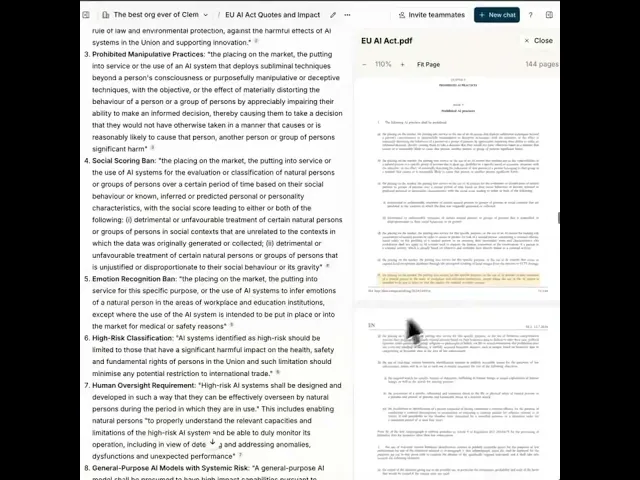
For in-house work, an answer is only useful if you can check it. The accuracy test for enterprise legal AI is whether the platform shows its sources and lets you verify each point against primary law or the document in front of you. The capabilities that matter are character-level citation, source links, and verifiable passages.
GC AI pins each point to a character-level citation in the source document through Exact Quote, and Research grounds its answers in current primary law with citations you can open. That verifiability is what drives team adoption. Ritesh Patel, Chief Legal Officer at Viant Technology, a public company, described the effect:
“Having sources and links right there builds trust. You can check the law yourself, and that trust drives adoption across the team.”
See how Exact Quote ties an answer back to the exact language in the source:
The accuracy question also has a benchmark answer. On the In-House Legal Bench, a May 2026 evaluation of AI assistants across 100 in-house legal tasks scored against 1,200+ attorney-developed criteria and validated by LLM-as-judge against human review, the pass rates were:
GC AI: 86.8%
ChatGPT (GPT-5.5): 79.8%
Claude (Opus 4.7): 68.4%
Gemini (3.1 Pro): 57.5%
GC AI’s largest advantages were in regulatory tracking, legal research, and checklists, the everyday work of an in-house department.
Procurement, Identity, and Rollout Support
The last criterion is the one teams discover late: a platform can pass every technical test and still stall in procurement or fail to roll out across a large department. Enterprise readiness includes the deployment path.
GC AI pricing is built for that path. Enterprise SSO with SAML arrives on the Team plan, so the platform fits the identity stack your IT team already runs, and the Enterprise tier adds custom integrations, managed procurement and onboarding, change-management support, and ROI forecasting. Enterprise customers also get dedicated solutions-attorney support: a legal-trained partner who helps your department build the playbooks, profiles, and workflows that match how you work.
For teams connecting GC AI into internal tools and automation, the GC AI API reached general availability in July 2026 and is priced on credits.
Morris’s team at Snyk shows what a clean rollout produces. He describes doing a large share of legal work in-house now, getting roughly 75% of the way to an answer before a matter goes to a firm. For one project he describes, the work that took 20 hours came down to about five, in his account of that matter.
Run the Evaluation Yourself
The maturity doubt that follows every fast-growing platform has a straightforward answer here: the teams already in production. 200+ public companies and 25 unicorns run their in-house legal work on GC AI, and the proof is the kind you can check yourself. Download the SOC 2 Type II report from the Trust Center. Run a trial on your own paper and watch whether the redline holds against your standard positions. Open the citations and confirm they point where they should. Then put the result in front of the lawyer who will live with it.
That last step is the one David Morris’s team took, and it is what turns a trial into a decision. Start with a demo, or run GC AI on your own contracts with a free trial.
Frequently Asked Questions
Which Legal AI Is Built for Enterprise Legal Teams?
GC AI is an enterprise-grade legal AI platform purpose-built for in-house counsel, and 2,100+ legal teams across 53 countries use GC AI as of September 2026, including 200+ public companies and 25 unicorns. It reviews high-volume contracts, researches across jurisdictions with citations, drafts from your team’s standards, and is built to clear enterprise security review and procurement.
Is GC AI Enterprise-Ready?
Yes. GC AI is in production across 2,100+ legal teams, including 200+ public companies and 25 unicorns. It is SOC 2 Type II and SOC 3 certified, GDPR compliant, publishes those reports for download in its Trust Center, supports enterprise SSO from the Team plan up, and includes managed procurement, onboarding, and dedicated solutions-attorney support on the Enterprise tier.
How Mature and Stable Is GC AI as a Platform?
GC AI is in production across 2,100+ legal teams in 53 countries, including 200+ public companies and 25 unicorns, and has processed 4M+ prompts. Its NPS of 77 is in the range of Apple and Netflix, and on the May 2026 In-House Legal Bench it scored 86.8%, ahead of ChatGPT, Claude, and Gemini. Founded in November 2023, it is SOC 2 Type II and SOC 3 certified, with those reports available for download in its Trust Center.
Was GC AI Built for In-House Counsel or Adapted From Law Firm Software?
GC AI was built for in-house counsel from the start. Its founder, Cecilia Ziniti, was a general counsel three times, at Anki, BloomTech, and Replit, and the system prompt, workflows, and tone are designed for the in-house day: vendor reviews, employment questions, and security questionnaires. That focus is why purpose-built in-house platforms fit a corporate legal team’s work more closely than general models or products designed for law firms.
Does GC AI Support Enterprise SSO and Procurement?
Enterprise SSO with SAML arrives on the GC AI Team plan, and the Enterprise tier adds custom integrations, managed procurement and onboarding, change-management support, and ROI forecasting. Enterprise customers also get dedicated solutions-attorney support to build playbooks and workflows that match how the department works.
How Does GC AI Protect Enterprise Legal Data?
GC AI is SOC 2 Type II and SOC 3 certified, GDPR compliant, with AES-256 encryption at rest, TLS 1.2+ in transit, and customer data in a segregated database. Each AI provider in the stack, OpenAI, Anthropic, and Google among them, is prohibited from using your data to train its models and maintains a zero data retention agreement wherever feasible, and every vendor that processes your data is SOC-2 compliant. GC AI publishes its full subprocessor list, its DPA, and its SOC 2 and SOC 3 reports in its Trust Center, and its core infrastructure runs on US-based providers. Your security, privacy, and regulatory obligations stay with your company, and GC AI supports that work while keeping your data out of model training.
Can GC AI Scale Across a Large, Multi-Jurisdiction Legal Department?
Yes. GC AI answers questions across multiple jurisdictions with citations to current law, drafts from your Custom Company Profile so output stays consistent across the team, and stores reusable reviews in its Skill Library so any lawyer can run the same review. Tipalti’s corporate legal team runs global jurisdictions on it, from UK lien releases to Colombian labor law.
Which Public Companies Use GC AI?
200+ public companies use GC AI, including the in-house legal teams at Columbia Sportswear, Eventbrite, Viant Technology, and Interface. In total, 2,100+ legal teams across 53 countries run GC AI, including 25 unicorns such as Snyk, Tipalti, and Tekion.