

Dive Deeper
Transcript
Episode Overview
Matt Gipple read a one-page investment term sheet from General Motors, flagged an IP clause that would have given GM rights to Cruise's core intellectual property, and told GM that owning the IP meant buying the company. GM said yes.
The acquisition, reported at more than $1 billion, closed in 2016.
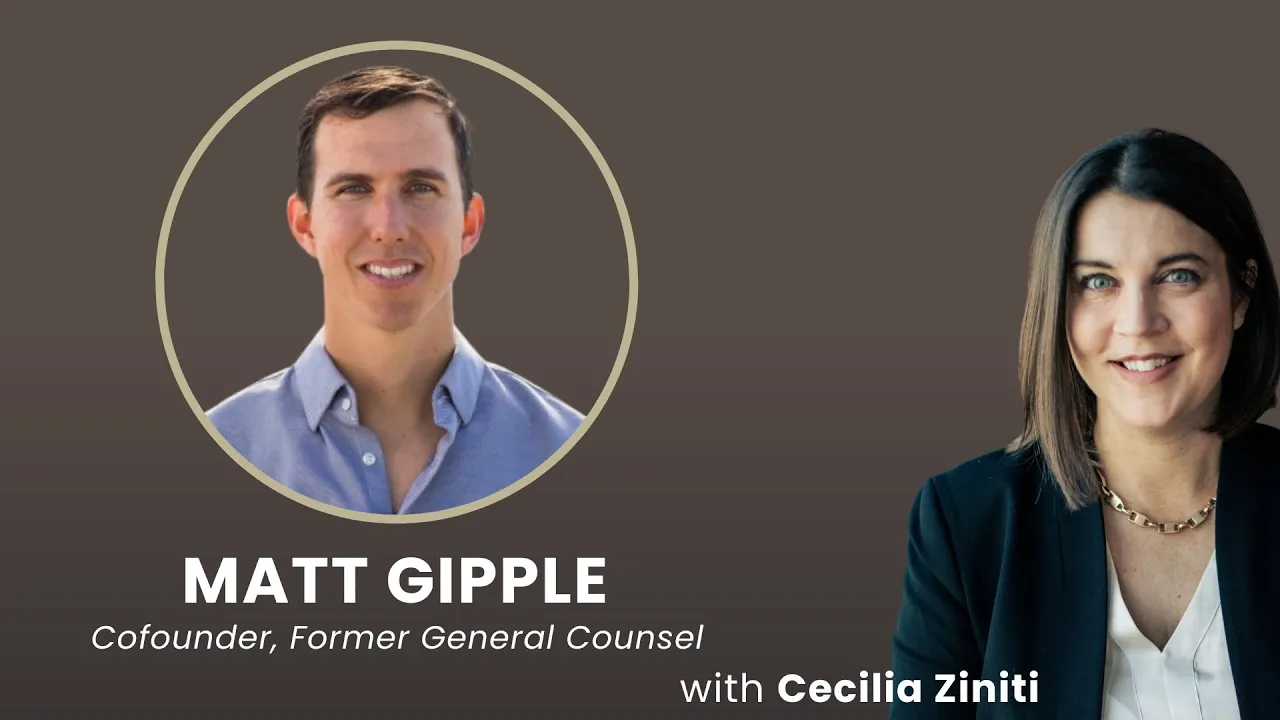
In this episode of CZ and Friends, the former Cruise general counsel and Dryvebox co-founder discusses how an in-house lawyer interprets a regulation nobody has applied before, what product counseling looks like when the advice ships inside a self-driving car, and why he thinks the push for in-house counsel to call themselves business people goes too far.
About Matt Gipple
Matt Gipple is a co-founder of Dryvebox, the mobile golf simulator company he joined in the summer of 2021. Before that he was the first lawyer and general counsel at Cruise, the autonomous vehicle company, where he led legal, compliance, and government affairs from a 25-person garage startup through its acquisition by General Motors and nearly five years of growth that followed.
He started his career as an associate at Latham & Watkins practicing litigation and competition law, clerked for Judge Maxine M. Chesney of the U.S. District Court for the Northern District of California, and later served as Head of Legal at healthcare company Forward. He holds a JD from Stanford Law School.
Key Takeaways
Reading every word of a term sheet triggered a billion-dollar acquisition. Gipple flagged an IP clause in GM's one-page term sheet and told GM that owning Cruise's IP meant buying the company outright, and GM agreed.
Build a new-regulation interpretation from three sources. When no one had applied a rule before, Gipple leaned on legislative history, the people who wrote the rules, and the company's own culture to decide what to do.
Product counseling means the advice ships inside the product. Gipple and Cruise's engineers mapped the entire California motor vehicle code into the car's own decision logic, down to when it signals near a driveway.
Non-lawyers solve legal problems too. A junior engineer overheard Gipple describing Cruise's manual disengagement-tracking problem at lunch and built an automated fix in about an hour.
Lawyers serve the business best by staying excellent lawyers, not by rebranding as business people. Gipple calls the industry push to say "we're as much in the business as you are" overblown, since he was not, in his words, a business person at Cruise.
From Federal Clerkship to First Lawyer at Cruise
In 2015, Gipple was clerking in federal court with every intention of returning to Latham & Watkins, where antitrust work and a return bonus were waiting. Then his friend Kyle Vogt, who had already sold Twitch to Amazon, asked him to come look at the robots he was building in a San Francisco garage.
Vogt's investors kept asking legal questions he did not want to answer. Gipple said no, and Vogt kept working on him.
Gipple recalled the argument that landed:
"Eventually he said: look, if you come do this, what's the worst thing that happens? It fails, and then next year Latham takes you back, and then you're better. That worked."
He showed up to 25 people in a modified house that happened to have a garage. To his surprise, between his yes and his first day, Cruise had pivoted from highway autopilot to full self-driving. Nobody had mentioned it to the incoming lawyer.
How Do You Interpret a Regulation Nobody Has Applied Before?
Gipple's method had three parts. He studied the legislative history, talked to the people who wrote the rules, and calibrated the interpretation to his company's culture.
California's autonomous vehicle regulations had come out shortly before he joined, and his first question was whether Cruise needed a testing permit at all. He decided it did.
The next year brought a harder question. Cruise had to report "disengagements," the moments a human driver takes over, and nobody had filed a report before.
The standard was subjective enough that Cruise's vehicle operators had to judge whether their takeover averted a crash, which meant the legal standard had to live with the operators themselves. By Gipple's recollection, the six or seven companies reporting landed in a similar place, except Tesla, which reported zero.
Gipple described the judgment underneath the analysis:
"You're operating in a space where there are no answers. So you work with where your company is, how you're gonna be, what your culture is, and what you think is gonna work. If your culture is report zero takeovers, you know you're gonna fight about it. If that's what you're gonna do, so be it. That's the path you take."
The conversation with Vogt was shorter than the analysis. Gipple walked in with the regs, said here is what he thought they should do, and Vogt told him that made sense, go make sure it happens.
The IP Clause That Turned GM's Investment Into an Acquisition
By 2016, GM had been circling Cruise as an investor. The term sheet that arrived was informal, closer to a one-pager, and it contained an IP term Gipple describes as unworkable. GM would effectively own Cruise's intellectual property while calling the deal an investment.
Gipple told the story from the cold open:
"We went back to GM and said, hey, we're interested in an investment. This IP thing doesn't work. If you want this kind of IP, you need to buy us. And then GM was like, well, let's talk about that. And that was kind of like, whoa, we did not anticipate that being real."
He is quick to deflate any deal-lawyer mystique about the moment:
"I'm not a deal attorney, so I don't know what a normal term sheet looks like. I was just reading the words and seeing what the words say. That happens to be what you do as a lawyer a lot: read the words that other people don't want to read."
The story echoes another CZ and Friends guest, Jordan Breslow, the GC whose reading of stock option rules kept Ben Horowitz out of the backdating scandal at Opsware.
Gipple stayed nearly five years after the deal closed, flying to Detroit as one of the designated "ambassadors" whose job was to keep a 100-year-old public company from accidentally smothering the startup it had bought.
What Does Product Counseling Look Like Inside an AV Company?
Product counseling at Cruise meant the legal analysis got built into how the car drives. Gipple and the engineers went through the entire California motor vehicle code and mapped every rule of the road into questions the vehicle had to answer.
His favorite example turns on a Burger King entrance. The code says to signal 200 feet before a right turn, but a Burger King entrance sits between the car and the real street. When does the blinker go on?
The code does not say. Cruise decided earlier is better, even if the car looks like it wants a burger.
The tracking problem got solved the same way. Cruise's early takeover logging was manual until a junior engineer overheard Gipple talking about it at lunch. Gipple still sounds delighted:
"He built a thing that would drop a pin whenever there had been a takeover, and it would immediately take a note and take all the stats ... And he did it in like an hour ... My mind was blown."
His larger point is that a product counselor's job is to manifest the advice:
"As a product counselor, you're supposed to manifest your advice. You're working with engineers to build the thing to make it work. Now it's: go build your own thing to make it work."
Is the General Counsel a Business Person?
Gipple's lightning-round myth to debunk is the profession's favorite self-description. Gipple put it plainly:
"There's this big push in legal to say, hey, we're as much in the business as you are. I think that can be taken too far. You don't see it happening in practice, you see it in words ... You still need to help the business, but you aren't. I was not a business person at Cruise."
He speaks from both sides of the line now. The founder seat, he says, is harder than the GC seat, and he prefers practicing law:
"Your role is to advise on legal issues in the context of the business. As a founder, your role is to make the best decision, period. It's pretty weird to leave legal issues sitting because you only have so much time, resources, whatever to deal with the things that are more priority."
At Dryvebox, the company his college friend Adeel Yang founded after patenting a road-legal trailer that expands wide enough to swing a golf club, 98% of the problems have no legal component. Gipple runs operations, hiring, fundraising, and all the words on the website.
The 2% that is legal, including the patent litigation Dryvebox now finds itself in as a plaintiff, is the part that gives him the most intellectual satisfaction. On the episode he counts 50 Boxes across the US and UK (with Canadian locations per the show intro), with one headed to Hawaii.
Recommended Reading
AI for Startup Legal Operations: How Lean Legal Teams Scale: how small in-house teams absorb 2-3x the work with legal AI instead of hiring, the same lean-team reality Gipple describes at Dryvebox.
How Great GCs Think About Growth, Risk, and Crisis Management: GC Tricia Kinney on calibrating risk to the business and treating legal AI as a new hire, a direct companion to Gipple's "modulate your advice to the client" method.
The Department of How: A GC's Playbook for Building Teams That Drive Business Growth: David Morris on legal as a business partner, the exact tension Gipple pushes back on in "Is the General Counsel a Business Person?"


