AI in the legal field is now in the workflow of in-house counsel all across the world. They now point it at the contract that landed an hour ago, the jurisdiction nobody on staff has practiced in, and the board memo due Friday.
Alexis Palmer, Senior Managing Counsel at Snyk, had to pull every termination provision scattered through a long enterprise agreement so her accounting team could see them in one place:
“Normally that would have taken me at least an hour. Instead, I had a list in zero time, and she came back in three minutes saying, ‘This was amazing, how did you do this so fast?’”
AI in the legal field means using artificial intelligence for the language-heavy core of legal work: reading contracts, drafting, legal research, and document review. The lawyers who rely on it have mostly stopped narrating the change out loud.
More than half of in-house counsel, 52%, were actively using generative AI in 2025, up from 23% the year before, according to an October 2025 ACC survey of 657 in-house professionals across 30 countries. A doubling in a single year tells the story: the experiment phase is over for in-house legal teams.
Legal AI platforms built for that work, GC AI among them, take the first pass on the language-heavy tasks so the lawyer keeps the judgment.
The Five Legal Workflows AI Changed First
Five legal workflows changed first as AI moved into in-house practice: contract review, redlining, legal research, document review, and first-draft writing. These are the patterns GC AI sees across more than 1,900 in-house legal teams, including the legal departments at Liquid Death, Arc’teryx, Tipalti, and Snyk. The five workflows share one trait. Each is high-volume, language-heavy work that used to consume the hours an in-house lawyer would rather spend on judgment.
Contract review
Contract redlining and negotiation response
Legal research across jurisdictions
Document review and issue spotting
First-draft legal writing
Contract Review
Contract review is the highest-volume task in most in-house legal departments. AI handles the first pass: it reads the full agreement, flags missing or off-market terms, summarizes obligations, and surfaces the clauses a lawyer needs to negotiate. The lawyer keeps the judgment and hands off the reading.
Tiffany Lee, General Counsel at Liquid Death, put the math plainly:
“The bread and butter of any in-house lawyer is contract review. Every agreement has to be read, flagged, and summarized. It’s repetitive work that eats into the time you should be spending on strategy.”
Her team runs incoming agreements through review first, then drafts straight from the result. When the review surfaces a missing confidentiality clause, she asks the platform to draft one she can drop into the agreement without leaving the system. Teams that want the same review applied the same way every time run it through Playbooks, repeatable contract review workflows that check each contract against a single company standard. The hundredth review holds the same line as the first.
Redlining and Negotiation Response
Contract redlining is contract review’s active half: marking up the document and drafting the reply that goes back to the other side. AI compresses both. It proposes edits tied to the source language and drafts the cover note explaining each position.
Cameron Clark, Head of Legal at Arc’teryx, measured the change:
“What used to take an hour, like reviewing contract feedback and drafting a reply, now takes ten minutes, and the results are better.”
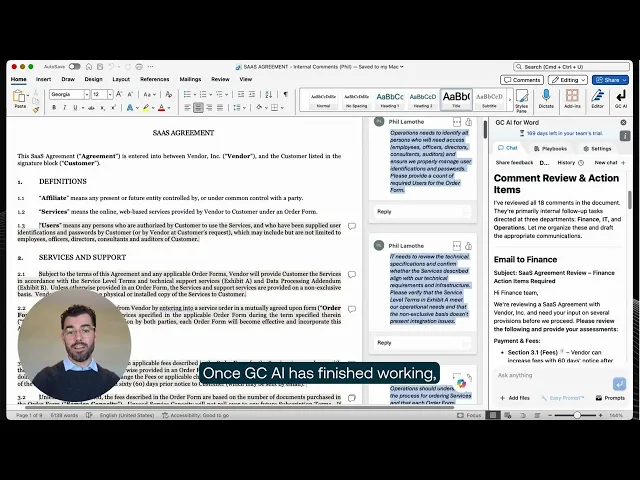
For that work, the venue matters. Most in-house lawyers redline inside Microsoft Word, so GC AI for Word, the platform’s add-in inside Microsoft Word, puts the analysis where the document already lives. The redline and the cover note come out of the same window. See it run:
Legal Research Across Jurisdictions
Legal research changed from a billable-hour outside task into an in-house first step. AI returns answers from primary law with citations, which lets a lawyer scope a question before deciding whether it needs outside counsel at all.
Joys Choi, Senior Director, Legal at Tipalti, runs corporate matters globally:
“Instead of spending hours translating Colombian labor law, I ask GC AI questions and it provides me with links and summaries in English.”
The time compounds. Choi reports saving 609 hours year to date, the equivalent of 76 full working days, and credits that capacity with letting her run corporate legal on a lean team. The best AI tools for legal research ranks the platforms built for it.
Document Review and Issue Spotting
Document review is the diligence layer: reading a stack of agreements, policies, or disclosures and naming the issues that need attention. AI takes the first read and returns a structured issue list a lawyer can verify and rank.
Ritesh Patel, Chief Legal Officer at Viant Technology, made it his default first move:
“I use it for research and issue spotting. If there’s an HR or privacy question, I’ll run it through GC AI first. Before, I’d call outside counsel and pay by the hour for a generic answer. Now, I can analyze it myself, see where it gets me, and call outside counsel if I’m truly out of depth.”
Reviewing a document set this way depends on citation that traces back to the source text, which is what Exact Quote provides: character-level citation to the exact language in the file. The first-pass internal analysis is the structural change. Straightforward issues close in-house; complex ones still go to an expert, but they go with a foundational understanding already in hand.
First-Draft Legal Writing
Legal writing covers more than contracts. In-house counsel draft internal memos, stakeholder notes, board summaries, and policy explanations all week. AI produces the structured first draft, and the lawyer edits for judgment and tone.
Alexandra Sepulveda, Assistant General Counsel at Trust & Will, uses it for the communication layer around legal advice:
“Imagine a redline comes back asking for unlimited indemnity. I’ll tell GC AI, ‘Here’s the clause and why we can’t accept it. Draft a four-sentence response to sales, collaborative tone, options to move forward.’ It gives me a clear, diplomatic note I can send fast.”
Everyone knows AI can take a first pass on vendor agreements and privacy policies, Sepulveda notes. The less obvious win is wrapping legal advice in the right internal communication when the day is already full.
Start this month by picking the one workflow above that consumes the most of your week, running it through AI for ten working days, and logging the time difference. The other four can wait until the first one is a habit.
What AI in the Legal Field Still Leaves to Lawyers
AI in the legal field leaves courtroom advocacy, final judgment calls, and the relationship a general counsel holds with the business to the lawyer. Generative AI for legal compresses the work that produces an answer. Deciding what to do with that answer stays with the lawyer. In-house counsel hold AI output to the same standard they hold their own work to: trust, precision, and craft, verified before anything reaches the business.
The courtroom and the negotiation table. Litigators still appear; general counsels still sit across the table. AI prepares the position, and the lawyer holds it in the room. Cameron Clark works through negotiation strategy with AI the night before, then leads the discussion with the company’s CFO himself the next morning.
The final judgment call. A structured issue list is an input, and a recommendation to the CEO is a decision. Anirma Gupta, a strategic legal advisor and the former SVP and Chief Legal Officer of Unity, put it directly on CZ and Friends, GC AI’s podcast hosted by CEO Cecilia Ziniti:
“AI is going to put even more emphasis on the judgment aspect of being a lawyer.”
The duty to verify every output. ABA Formal Opinion 512, the 2024 ethics guidance on generative AI tools, ties a lawyer’s duties of competence and candor to every AI-assisted output. Each one gets checked against the source before it leaves the building.
Michele Murray, who leads legal at ARKO Corp and joined CZ and Friends, framed the discipline:
“It’s really only as good as a user. There has to be a knowledge base for the person, because you do have to verify the results.”
AI makes verification faster, and the duty to do it stays exactly where it was. Character-level citation back to the source document turns a slow cross-check into a fast one.
The 2026 Baseline: From Table Stakes to Cutting Edge
By 2026, a baseline set of AI capabilities became standard equipment for in-house legal teams. A second set still separates the leading departments from the rest.
How well a platform delivers those capabilities is measurable, and the gap is wide.
The In-House Legal Bench, a May 2026 benchmark built by GC AI’s R&D attorneys, scored four AI platforms on 100 tasks drawn from in-house legal work, each graded against an answer key averaging 12 attorney-developed criteria.
GC AI passed 86.8% of the tasks.
The general-purpose models trailed:
ChatGPT (GPT-5.5) at 79.8%
Claude (Opus 4.7) at 68.4%
Gemini (3.1 Pro) at 57.5%.
The distance reflects the legal-specific layer a platform built for in-house work carries: a system prompt written for legal voice, citation grounding, and playbooks that hold a team’s positions.
Table stakes, the capabilities most in-house teams now expect:
AI-assisted contract review and redlining inside Microsoft Word
Legal research with citations to primary law
First-draft generation for memos and stakeholder communication
Reusable, shareable prompts so a whole team runs the same review the same way
KT Farley, Chief Privacy Officer and Associate General Counsel at Helix, built her team’s review process on that last point:
“Junior teammates now run the checklist prompt first and bring me the output as the predicate for my review.”
The Skill Library, GC AI’s set of ready-to-run prompts for common workflows, makes that pattern portable across a team.
Cutting edge, what the leading in-house teams do now:
Agentic research that runs several lines of inquiry at once
Repeatable playbooks that encode a company’s negotiation standard and apply it automatically
Matter-level memory that carries context across an entire deal
A team-wide AI baseline, where every lawyer on the department is fluent
Training closes the gap between the two lists. A department gets there by building AI fluency across every lawyer, the way it would build any other shared competency. GC AI’s free legal AI classes, taught by former general counsels and California CLE-eligible, exist to move a team from one power user to a fluent department.
Where AI in the Legal Field Goes Next
Over the next 12 months, AI in the legal field moves from assisting on single tasks to running multi-step workflows end to end. The agentic direction already shows up in the benchmark data: GC AI’s widest In-House Legal Bench margins landed on the most multi-step, research-heavy categories, regulatory tracking, legal research, and checklists. Those are the workflows that chain into sequences first.
From task to workflow. A research question today returns an answer. The same question soon triggers a sequence: pull the primary law, draft the memo, flag the open risks, and queue the stakeholder note. The lawyer reviews the chain instead of running each link.
From individual to department. Adoption stops being one enthusiast and becomes a baseline expectation for every lawyer on the team. David Morris, General Counsel at Snyk and a CZ and Friends guest, watched it happen on his own team:
“This was the first time that after a trial, the team came to me and said, so we can’t live without this.”
A platform that learns a company’s templates, risk tolerance, and voice closes the loop: outputs arrive calibrated to how the team already works, and the lasting advantage belongs to the platform that knows the company best.
How GC AI Supports In-House Legal Work
Legal AI built for in-house work shares one design principle: it assumes the user is a lawyer inside a company, accountable to the business and its timelines. GC AI is the legal AI platform built for that user.
GC AI’s CEO and co-founder, Cecilia Ziniti, was a general counsel three times (Anki, Bloomtech, and Replit), and an in-house counsel at Amazon and Cruise. Ziniti built GC AI to solve the problems she encountered firsthand as an in-house lawyer. That experience is embedded directly into GC AI’s system prompt, tone, and workflows.
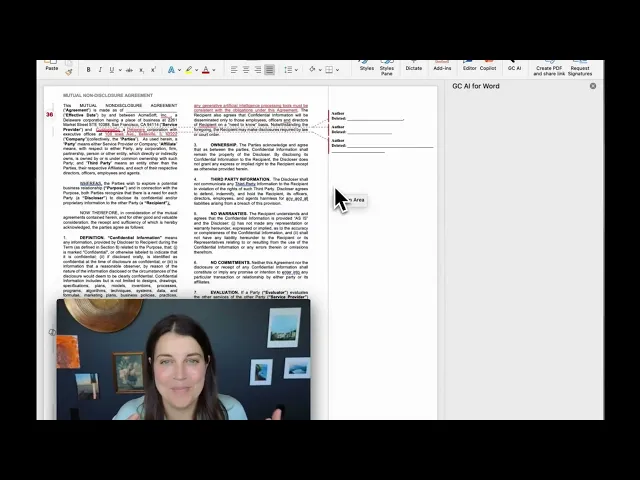
The five workflows above run on one connected platform. Beyond the features each section above already names, Research runs multi-agent legal research from primary law, Files holds document collections of up to 1,500 pages, and Easy Prompt turns plain language into an optimized legal prompt.
Andrea Peters, Senior Counsel and Global Head of Compliance at Interface, describes the second-order effect:
“I’m happier in my job because I can get more work done quickly, more efficiently, without feeling overwhelmed.”
GC AI’s December 2025 ROI study of more than 100 active customers found teams save an average of 14 hours per week and reduce outside counsel spend by 14%, with 97.5% seeing value within the first month. For the median company, that outside-counsel reduction is roughly $252,000 a year, which is 14% of the $1.8 million in median outside counsel spend reported in the ACC Law Department Management Benchmarking Report. Teams can run their own numbers with the GC AI ROI calculator.
At Liquid Death, Arc’teryx, Tipalti, Viant, Snyk, Trust & Will, Helix, and Interface, AI is a standing part of the legal week, and the hours it returns go back into judgment, negotiation, and the calls only a lawyer can make. For any legal department, the open question is which platform clears the bar in-house counsel set for their own work. The fastest way to answer it is to run a contract your team already knows through GC AI and compare.
Frequently Asked Questions
What Is AI in the Legal Field?
AI in the legal field refers to software that uses large language models and legal-specific training to perform work that lawyers and in-house counsel would otherwise do manually: contract review, legal research, document drafting, redlining, issue spotting, and summarization. Adoption is accelerating: a 2025 ACC survey of 657 legal professionals across 30 countries found 52% of in-house counsel actively using generative AI in 2025, up from 23% the year before.
How Will AI Affect the Legal Field?
AI is reshaping legal work by automating time-intensive, repeatable tasks so lawyers can focus on judgment, strategy, and client relationships. A December 2025 study of more than 100 GC AI customers found teams save an average of 14 hours per week and cut outside counsel spend by 14%, which is roughly $252,000 a year for the median company. The role of the lawyer does not disappear; it shifts toward higher-order work that machines cannot replicate.
What Are Some Ways AI Is Used in the Legal Field?
AI in the legal field powers five core workflows: contract review, redlining and negotiation response, legal research across jurisdictions, document review and issue spotting, and first-draft legal writing. In-house teams also use it to run playbooks, standardize templates, and reduce outside counsel dependency on routine matters that previously required external billing.
What Are the Generative AI Use Cases in Legal Work?
Generative AI handles drafting (contracts, memos, NDAs, policies), research synthesis across case law and regulations, redline generation from standard positions, summarization of lengthy documents, and comparative analysis across jurisdictions. Platforms with multi-agent Research capabilities, like GC AI’s Research feature, can run parallel queries across uploaded company files and external sources at once, returning cited, source-grounded answers rather than unsupported summaries.
What Is the Best AI Software for the Legal Field in 2026?
The best choice depends on practice context. In-house legal teams benefit most from platforms built specifically for their workflow, including tools with enterprise security certifications, document-upload capacity for large contract sets, and citation-to-source features that satisfy the ABA Formal Opinion 512 duty to verify AI output. GC AI, built by three-time general counsel Cecilia Ziniti, scored 86.8% on a 100-task In-House Legal Bench evaluation (May 2026), ahead of general-purpose models. It offers a 14-day free trial, with custom pricing available through a demo.
How Do Legal AI Tools Handle Confidentiality and Data Security?
Enterprise-grade legal AI tools protect confidential data through contractual zero data retention agreements with the underlying model providers, AES-256 encryption, and independent security certifications. GC AI is SOC 2 Type II and SOC 3 certified, GDPR compliant, and holds zero data retention agreements with both OpenAI and Anthropic, meaning uploaded contracts and legal files are never used to train external models. Consumer AI tools generally do not offer these protections and are not appropriate for privileged or confidential legal work.
Can You Trust AI Output in Legal Work?
AI can generate plausible-sounding but incorrect citations or legal holdings, a well-documented risk that is highest with general-purpose tools. The answer is not to avoid AI but to use tools with citation-to-source features and to treat every output as a first draft that requires attorney review. ABA Formal Opinion 512 is explicit: lawyers have a duty to verify AI-generated content before relying on it. GC AI’s Exact Quote feature provides character-level citations back to the source text, giving attorneys a direct audit trail for every claim the tool surfaces.
Do Lawyers Need Technical Skills to Use Legal AI Tools?
Most modern legal AI platforms require no coding or data-science background. The learning curve is closer to learning a new research database than learning software engineering. Tools designed for in-house counsel, with guided prompting, prebuilt Playbooks, and a Skill Library of templated workflows, let attorneys start generating value on day one. GC AI’s Easy Prompt feature translates plain-language requests into optimized prompts automatically, removing the trial-and-error usually associated with generative AI.
How Do You Choose the Right AI Tool for In-House Legal vs. a Law Firm?
In-house teams prioritize data security, integration with internal document repositories, and workflows tied to business outcomes like contract cycle time and outside counsel cost. Law firms often weight billing integration and matter-management compatibility more heavily. For in-house counsel, the key criteria include SOC 2 certification, zero data retention with model providers, document capacity (GC AI supports up to 1,500 pages per upload), citation traceability, and whether the tool was built with in-house workflows, not law-firm workflows, as the primary use case.