

Dive Deeper
Transcript
Episode Overview
A general counsel builds board trust through consistency, calm, and judgment about when to engage. Show up to every meeting prepared on the issues that are genuinely yours to own.
Reach out between meetings only when a matter needs board attention, and arrive with the issue crisply framed and two or three solutions ready.
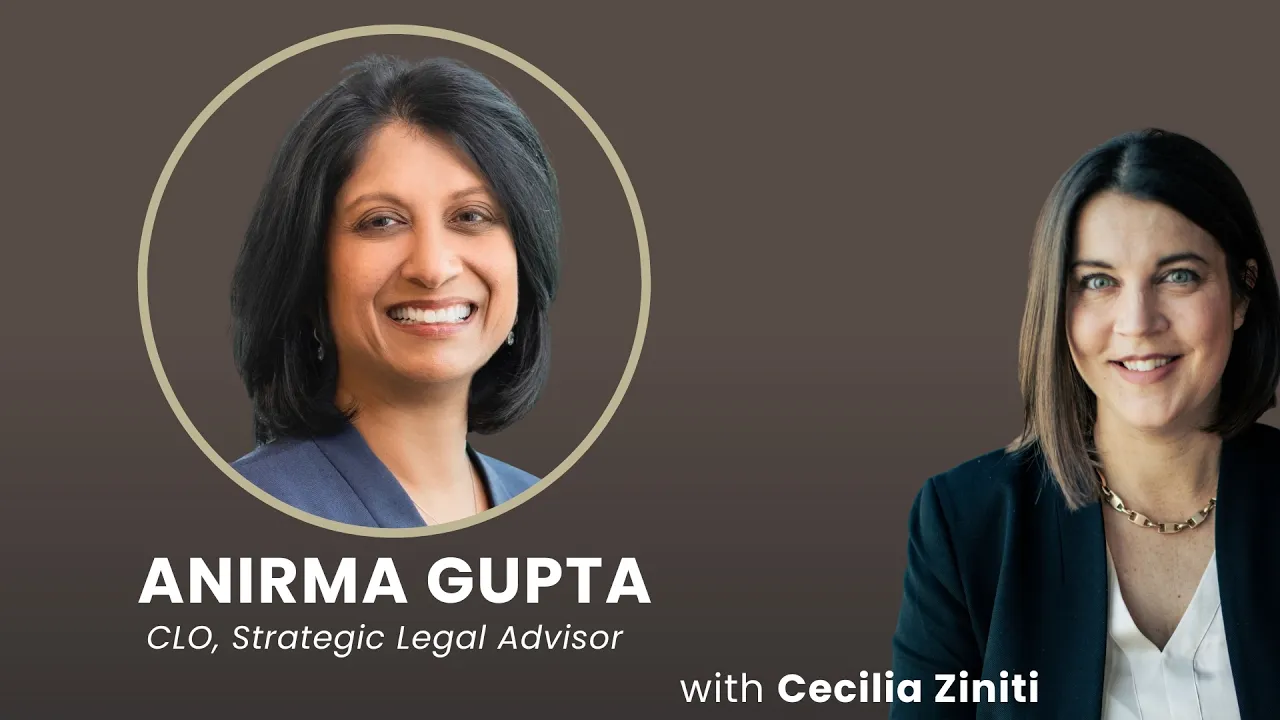
Anirma Gupta built that playbook across a career spanning cybersecurity, AI, and enterprise software, most recently as Chief Legal Officer of Unity, the engine behind millions of the world’s most popular games.
Multiple board members have described Gupta as calm and grounded. She treats that as a job requirement, the visible half of a philosophy that comes down to creating the conditions where people can make good decisions consistently.
Anirma Gupta, Strategic Legal Advisor and former Chief Legal Officer at Unity, put it this way:
“Leadership today is about judgment, not just speed. It’s about values and not just outcomes. And it’s about building organizations that can move quickly without losing trust.”
In this episode, GC AI founder Cecilia Ziniti and Gupta get pragmatic: how a CLO earns a board’s confidence, how to hand a career-defining project to a lawyer two levels down without abandoning them, how to name the anxiety endemic to the legal personality, and which calls stay with the general counsel no matter how good legal AI gets.
About Anirma Gupta
Anirma Gupta is a Strategic Legal Advisor and the former SVP and Chief Legal Officer of Unity, the game engine software company.
Across more than three decades in technology and law, she has built and led legal teams at companies in cybersecurity, AI, data privacy, SaaS, and advanced technology, guiding them through GDPR implementation, the SEC's cybersecurity reporting rules, and multiple CEO transitions.
She started her career as an IP litigator and continues to advise Unity today.
Key Takeaways
A CLO's job is creating conditions for good decisions. That means picking the right person for the project, mapping the right stakeholders, setting checkpoints, and offering support when the path gets complicated.
Board trust compounds through consistency and calm. Show up prepared on the issues that are yours to own, and keep governance, legal, and compliance as your lane while strategy stays with the CEO.
Engage the board with judgment. Reach out when a matter genuinely needs board attention, articulate the issue crisply, and bring two or three solutions so the discussion starts at problem solving.
The settle-or-litigate decision is a judgment call AI cannot make. AI can surface the facts and assess exposure; weighing depositions, distraction, and the state of the business stays with the CLO.
Legal departments will get smaller in the AI age. The lawyers who thrive will be the ones who build judgment deliberately, through an apprenticeship model.
How Does a General Counsel Build Trust With the Board?
Board trust accrues through repetition. Show up to every meeting prepared to engage on the issues that are genuinely yours to own, deliver difficult news with the homework already done, and hold your lane.
Governance, legal, and compliance belong to the CLO, while strategy questions belong to the CEO and the business leaders.
Do that consistently, Gupta says, and directors learn they can rely on your judgment before a crisis ever tests it.
Gupta has worked with boards through CEO transitions, regulatory shifts, and high-pressure quarters. Her starting point is understanding each director.
She learns what they care about, where they come from, and what perspective they bring.
The trust itself gets built the unglamorous way, issue by issue.
Cecilia raised a line from her interview with Rebecca Fike, the Reed Smith partner and former SEC lawyer. In a crisis, she said, she is not there to be the board's friend. Gupta agreed, with an in-house nuance.
Inside the company you carry more context, which means deeper conversations about the business and the people. The discipline is the same.
Gupta said:
"Being laser focused on what the issue is and what you're trying to solve for, and doing that consistently and time and time again, is how you build trust over time."
She is deliberate about the CLO-CEO boundary too. Asking the critical strategy questions is the CEO's dialogue with the board.
The CLO's board relationship lives in governance, legal, and compliance, and in being the person directors feel free to call when something lands on their desk.
When Should a General Counsel Bring an Issue to the Board?
Only when it genuinely needs board attention, and only after the homework is done. Board members are busy operators, sitting on multiple boards or running their own organizations.
Reaching out every time something crosses your desk erodes the relationship. Gupta applies a filter instead.
She exercises judgment about whether the issue requires the board at all, and if it does, she arrives with the issue defined and options in hand.
Gupta said:
"It's important to... exercise judgment about when do you need to engage with the board or not. And... if it is something that you need to engage with the board on, be ready to articulate very crisply what you think the issue is, why you think the board member needs to know about it, and then have a couple of solutions ready as well so that the discussion can be very focused on problem solving."
The two or three solutions matter as much as the crisp framing. They move the conversation from "what happened" to "what do we do," and they respect the director's time, which is its own form of trust building.
How Do General Counsels Stay Calm Under Pressure?
Gupta treats composure as a professional obligation, and she maintains it with infrastructure. She exercises every day to start with a clear head.
She keeps a group of GC peers who work through similar issues. And whatever is happening inside, the company sees a leader who can think.
Gupta said:
"You need to be there for the company. You need to be there for the team. And you always put your game face on and help others... So whatever's going on inside, you gotta have the game face on."
Asked whether consistency is a superpower, she widened the answer:
"I've had multiple board members talk about me being calm and grounded. And I think that, again, is part of the role and part of how we need to show up as GCs and CLOs."
The calm is learned, the same discipline that built her board playbook. It comes from preparation, practice, and knowing which issues deserve the energy.
How to Enable Your Team to Run High-Stakes Projects
When the SEC's cybersecurity reporting rules came out, Gupta did not run the project herself. She picked a lawyer two levels down, smart and eager to step up, and handed them the effort.
Then she did the work that makes delegation succeed. She defined the end game together, mapped the stakeholders (finance, IT, internal audit, comms), assembled a lean tiger team, and scenario planned so that if an incident ever forced a disclosure decision, nobody would be scrambling to figure out who does what.
She ran the same play during GDPR implementation at a cybersecurity company years earlier. In both cases, the attorney took ownership, built the framework, and executed.
And the business noticed.
Gupta said:
"When you have people who are enabled to do their best work, they often step up and do a great job. And then the business notices it."
Enabling, in her telling, is a checkpoint discipline:
"It's figuring out... what is the end game? What is the end result that we want from this project? Making sure that they have the support that they need. Being there as a sounding board and as a resource through checkpoints... Are they hitting any roadblocks? Do they need any further support? Are they getting pushback from anybody else on the executive team?... Those are all elements of enabling."
The same philosophy governs who gets in front of the board.
Some leaders always want to be the face of the function. Gupta considers that a development failure:
"Part of my philosophy is to create those opportunities where my leaders can interact with management and interact with the board because that's how they're going to learn. And then I need to be there initially by their side... helping them think through the issues... and then let them handle the situation with me by their side, and over time, handle situations on their own."
How to Help Your Legal Team Manage Lawyer Anxiety
Name it before it shows up when it counts. Lawyers are trained to see everything that can go wrong, and the professional duty to name risk slides easily into catastrophizing.
Gupta addresses the anxiety directly instead of pretending senior lawyers do not feel it, and she turns the worry into preparation. She has them surface the specific fear, then works through the scenarios until it has somewhere constructive to go.
Gupta said:
"I like to be a safe space. I tell them, it's okay to be nervous. Tell me what you're worried about. Let's talk through what potential solutions might be to the issue that's causing you worry. If you address it upfront, it's less likely to show up when it counts."
When someone on her team gets upset, her sequence is listen first, understand the cause, then decide what they need: air cover, support, or advice.
When Should a Company Settle Instead of Litigate?
It depends, and Gupta means that precisely. The inputs include the state of the business, how much the company cares about the issue, how much distraction a case will cause, who gets deposed and for how long, where the case sits, and what settling signals to future plaintiffs.
Sometimes the full picture says settle. When a patent troll backed by a well-known plaintiff's firm is testing you, it says the opposite.
Gupta, who started her career as an IP litigator, said:
"When you're dealing with patent trolls and you've got a well-known plaintiff's law firm, if you settle with them once, they're going to come after you 10 more times. In that case, you absolutely are gonna fight it."
The hardest input is emotion. Cecilia described managing her first big litigation as a GC and discovering how much of it was driven by feeling; a mediation judge once told her that sometimes you pay money to get crazy people out of your life.
Gupta has run that conversation from the CLO chair many times:
"I've had situations over my career where somebody wanted to make a decision because of the emotion. They were angry or frustrated. And part of my job is to talk through, OK, I hear you. If you want to litigate, here's what it's going to look like. Here's what it's going to take. Is that what you are ready to sign up for?"
More than half the time, she says, the answer changes once the executive pictures deposition prep.
Asked whether forgiveness is a business value, Gupta reframed it as pragmatism. Some fights are not worth the company's time and energy, and some will shape the future of the business and demand that you dig in.
How Will AI Change the In-House Lawyer's Job?
AI changes how much an in-house lawyer can get through, and how fast. Gupta sees legal AI digesting the flood of regulatory alerts no team can keep up with, accelerating drafting, and running agents that automate the routine work of a legal department.
What it cannot do is weigh three executives' depositions against the precedent of settling with a repeat plaintiff, or read the emotional state of a CEO who wants to fight. Those calls belong to the general counsel.
Gupta said:
"\[AI\] is going to put even more emphasis on the judgment aspect of being a lawyer. Because AI can help you gather facts and information and synthesize it. But the real value add for us lawyers is at the judgment layer. It's being able to take that information, understanding the business context, understanding your risk profile, and being able to help the company make tough decisions."
Her prediction for the profession is blunt. Legal departments and law firms will get smaller, and there will be fewer opportunities for lawyers unwilling to develop genuine judgment.
The uncomfortable part is that judgment comes from experience, and AI is absorbing the exact work junior lawyers used to learn on. Gupta's answer is a return to the apprenticeship model, with leaders coaching people through situations instead of solving the problems themselves.
Building the AI fluency side of that equation is already teachable; GC AI's free, CLE-eligible legal AI classes exist for exactly that reason. The judgment side, in Gupta's view, is on every legal leader who manages people.
Gupta built her career creating the conditions where lawyers make good decisions consistently. GC AI clears the research, drafting, and routine work off your team's plate so more of the week goes to the judgment calls. Ready to give your own team that time back?
Recommended Reading
Why Judgment Is the New Superpower for In-House Lawyers in the Age of AI: the judgment layer Gupta says AI makes more valuable, not less.
Chief Trust Officer Danielle Sheer on Company Culture, AI, and Leading With the Business Goal: the trust theme Gupta points to when she references Danielle in this episode.
How Great GCs Think About Growth, Risk, and Crisis Management: leading a legal function through crises and CEO transitions.


