Every team at the company has a Legal they ping with a "quick one": sales, procurement, HR, the founder with a term sheet they negotiated over dinner. Every "quick one" is a priority, there are always a lot of them, and they all land on the same desk: yours.
"The bread and butter of any in-house lawyer is contract review. Every agreement has to be read, flagged, and summarized, and it's repetitive work that eats into the time you should be spending on strategy."
Tiffany Lee, General Counsel and Corporate Secretary at Liquid Death, is describing the work that fills most of the week. AI contract review is how a growing number of in-house teams take that first pass off their plate: the legal AI reads the agreement, flags the terms that break your standards, and drafts the redlines, so you spend the saved hour on the calls that need a lawyer.
GC AI is the enterprise legal AI platform a three-time general counsel built for in-house teams. Its founder, Cecilia Ziniti, was general counsel at Anki, Bloomtech, and Replit before she built it, and her rule for the product came from that seat: an in-house lawyer is a business person with a legal skill set, so the AI should move the deal forward and leave the judgment to you.
For contract review that means Playbooks that hold your positions, Exact Quote citation you can click straight back to the source clause, and GC AI for Word so the review happens where you already redline.
What Is AI Contract Review?
AI contract review is the use of artificial intelligence to read a contract, identify its key terms and clauses, flag legal and commercial risks against a set of standards, and draft suggested redlines. Purpose-built legal AI platforms complete a first-pass review in minutes, and the lawyer keeps final judgment on every change.
Artificial intelligence contract review and AI contract analysis describe the same work, and contract review is the highest-volume form of AI legal document review, the broader category that also covers due diligence sets, policies, and discovery. Picture the actual task: a human reads a 60-page MSA, spots the indemnification clause that runs the wrong way, checks it against the team's standard, and drafts the redline. AI runs that same first pass in minutes, and you review, refine, and keep every judgment call.
Three adjacent categories get sold as the same thing, and knowing the difference keeps you from buying the wrong one:
Contract lifecycle management (CLM) platforms move contracts through intake, negotiation, signature, and storage. The product is workflow, and any analysis rides on top of it.
Research-first legal AI like Thomson Reuters CoCounsel and Lexis+ AI sits on case law databases, built for legal research.
General-purpose AI like ChatGPT and Claude can read a contract and return plausible notes. A purpose-built platform adds the legal system prompt, playbook enforcement, and source citation that make the output ready to send to a business partner.
How AI Contract Review Works
Every platform runs the same four steps, and the gaps between them are where quality is won or lost. First it ingests the file, converting a PDF or Word document into text a model can read, and a scanned PDF or a messy table degrades everything downstream.
Then it applies your context: your standard positions, your prior agreements, and the counterparty's past paper. A model that knows your 2x liability cap and your data-retention line produces redlines the whole team can stand behind, and that context is what turns a generic first draft into your team's actual position.
From there it runs the analysis, identifying clauses, flagging deviations, suggesting language, and writing the summary. Finally it cites, and the strongest platforms link every finding to the exact passage in the source document, so a lawyer verifies with a click and moves on.
Why In-House Contract Review Breaks Without AI
Three structural gaps separate in-house review from law-firm practice, and legal AI closes all three.
The Volume Outruns the Headcount
In-house teams review hundreds or thousands of contracts a year, and the budget to hire lags the volume.
At a payments company that runs on GC AI, a newly hired deputy general counsel inherited a two-month backlog of sales contracts on day one, with no one to hand them to. Working solo, she cleared it in her first week.
A regional bank, another GC AI customer, described the same squeeze, down a headcount with no budget to backfill.
AI clears the backlog with the team you already have, so every contract stops stealing time from board counsel, regulatory work, and deal structuring.
Consistency Slips Without Encoded Standards
Five lawyers reviewing the same NDA against the same playbook produce five different sets of redlines. A properly configured playbook produces the same output every time, so your institutional knowledge lives in the system where the whole team can apply it. That is how a team of three reviews like a team of ten.
There Is No Partner Checking the Work
Law-firm associates send drafts up to a partner. In-house counsel are the last read before the board, the business, or opposing counsel sees it. AI adds a second set of eyes that stays consistent on the hundredth contract and remembers last quarter's negotiated position, so the work that leaves your desk holds up.
The Five Capabilities That Decide In-House AI Contract Review
Benchmark every shortlist against these five, on your own contracts, not the vendor's demo file.
Playbook automation
Character-level citation
Word-native workflow
Matter memory
Multi-document review
Playbook Automation
Strong platforms let you encode your standard positions once, then apply them to every incoming contract automatically.
GC AI's Playbooks come pre-built for NDAs, DPAs, and SaaS MSAs, and you can build your own from your prior agreements in about an hour.
Run a vendor's SaaS MSA through the matching Playbook and GC AI returns a clause-by-clause report against your house standards. It flags, for example, a limitation of liability cap that lands at 1.5x against your 2x rule, quotes the source clause word for word, and drafts the redline before you open the file. Ask a vendor whether its playbook encodes your team's positions or applies a generic standard.
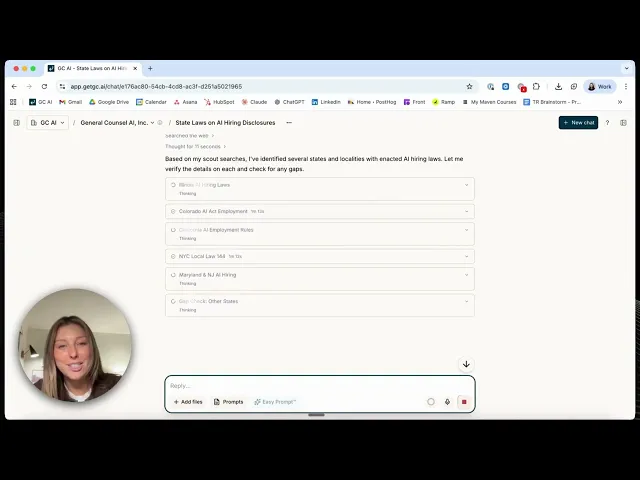
Here is what that looks like on a real agreement. A GC AI solutions attorney runs a SaaS MSA Playbook on a live vendor contract, sorting each clause into pass, fallback, or flag, and catches a DPA that hyperlinks its terms instead of attaching them:
Character-Level Citation
When the AI says the cure period is thirty days, you need to confirm that in seconds. GC AI's Exact Quote links every output to the verbatim language in the source, so you click the citation and see the exact passage highlighted. Anything short of character-level is a verification tax on every output that goes to the CEO.
Word-Native Workflow
Lawyers redline in Word. A platform that lives outside Word gets opened when someone remembers it exists. GC AI for Word puts Playbooks, research, and matter memory inside the document, so the review is right there every time you redline.
Matter Memory
A vendor deal ties to a DPA, a side letter, a security addendum, and last year's MSA. GC AI's Projects hold that memory. Upload the deal set once, and two weeks later the platform still knows which MSA governs and which cap was negotiated. That is what turns AI from a one-shot task into a deal-team member.
Multi-Document Review
The next step is reading across documents. When you ask whether a new vendor agreement conflicts with your existing DPAs, GC AI pairs Projects and Playbooks with agentic Research to analyze the full set and surface the specific clauses at issue. That is all five capabilities in one platform, and the real test is running them on your own contracts.
The Best AI Contract Review Software in 2026
We rank the best AI contract review software on the five capabilities above, judged on real in-house contracts rather than a scripted demo.
Most in-house teams end up running more than one type of platform, so the table shows what each is built for and how to think about the pick.
Platform | Built For | Pricing | Trial |
|---|---|---|---|
GC AI | In-house legal teams | $500/seat/month | 14 days, no credit card |
Spellbook | Transactional attorneys, firms and in-house | Not published | Sales-led |
Harvey | Large law firms, expanding in-house | Not published | Via sales |
LegalOn | Dedicated contract review | $550/month billed annually | Via sales |
Ironclad | CLM with AI | Enterprise | Via sales |
ChatGPT Business | General-purpose AI | $20 to $25/user/month | Free tier |
Landscape and pricing as of July 2026.
Choose GC AI if you run an in-house function and want contract review, research, and matter memory in one platform built end-to-end for your workflow. 1,900+ in-house teams across 53 countries use it as of July 2026, including the legal teams at Arc'teryx, Tipalti, Snyk, and Columbia Sportswear, plus 80+ public companies.
Choose Spellbook if your work is heavily transactional and Word-first.
Choose Harvey if you are an AmLaw firm or a large enterprise legal department with a formal procurement cycle. Choose LegalOn if you want a dedicated contract-review specialist.
Run a CLM like Ironclad to move contracts through their lifecycle, and pair it with a legal AI for the analysis.
Reach for general-purpose AI like ChatGPT for non-confidential first drafts, and keep client documents on a platform with zero data retention.
One note on the category's history - LawGeex and Evisort no longer operate as standalone products, so focus your shortlist on platforms that are actively developed.
For more details, see GC AI vs Spellbook, GC AI vs Harvey, and GC AI vs LegalOn.
What AI Contract Review Looks Like by Contract Type
The clauses AI flags first shift with the agreement on your desk.
Contract Type | Clauses AI Flags First |
|---|---|
NDAs | Confidentiality scope, permitted use, term and survival, standard carve-outs |
SaaS MSAs | Limitation of liability cap, indemnification symmetry, auto-renewal, governing law |
DPAs | Sub-processors, retention periods, breach-notification windows, cross-border transfer |
Employment agreements | Non-compete enforceability by state, IP assignment, arbitration |
Vendor and commercial | Representations and warranties, change-of-control, termination rights |
For the market standard on any single clause, GC AI's Clauses Library breaks down what each provision does, where it varies, and how to redline it, from confidentiality and indemnification to non-compete and termination.
How to Evaluate AI Contract Review Software
Run one week on your own paper, in this order.
Day 1: Load your hardest documents: A non-standard MSA, a live NDA, a DPA, and an employment agreement your team owns. Do not let the vendor pick the test contracts.
Day 2: Test playbook discipline: Define three to five positions the team holds, run an incoming NDA, and check whether the AI flags the deviations your senior attorney would and quotes the source clause word for word.
Day 3: Test matter memory: Upload a full deal set, come back the next morning, and ask which DPA governs and what cap was negotiated. A platform that forgets between sessions fails here.
Day 4: Pressure-test security: Get the platform's data-retention, SOC 2, GDPR, and encryption posture in writing, because procurement will ask for it.
Day 5: Talk to an in-house reference and decide: A team your size, your industry, your contract volume. A firm-side testimonial tells you little about how the platform holds up on in-house work.
GC AI is SOC 2 Type II and SOC 3 certified, GDPR compliant, with zero data retention agreements with OpenAI and Anthropic, and AES-256 encryption.
What In-House Teams Measure After Adopting AI Contract Review
According to GC AI's December 2025 customer survey of more than 100 active users, lawyers using AI contract review report saving an average of 14 hours per week and a 14% reduction in outside counsel spend.
Applied to the ACC's reported $1.8 million median in-house outside counsel spend, that 14% works out to roughly $252,000 a year for the median company. 97.5% of respondents reported seeing value before the end of their first month. Individual teams run past the average: one global manufacturer on the platform reports saving more than 40 hours a week across its legal team, with a contract task that once took a full week now finishing in 10 to 15 minutes.
In GC AI's In-House Legal Bench (May 2026), a 100-task benchmark scored by attorneys with more than 80 combined years of practice, GC AI led the contract-analysis category:
GC AI: 82.7%
ChatGPT (GPT-5.5): 72.8%
Claude (Opus 4.7): 66.3%
Gemini (3.1 Pro): 42.9%
For the lawyers running these workflows, the payoff shows up as reclaimed hours. Ritesh Patel, Chief Legal Officer at Viant Technology, puts the value in terms of his own day:
"If a contract review takes 45 minutes less, that's real time back in my day."
The Role of AI Education and Team Adoption
Prompting, auditing AI output, and building playbooks are the skill layer every in-house lawyer now needs, and adoption follows education. GC AI has taught 6,000+ lawyers through its free, California CLE-eligible AI courses for legal professionals, led by former general counsels, including sessions on AI-assisted redlining in Word and building Playbooks for automated contract review. When the curriculum comes with the product, the change management is built in.
Start With One Contract That Matters
The contracts that decide whether a platform earns a place in your stack are the ones with non-standard indemnification, unusual non-compete language, or counterparty paper that tests your standards. A platform that handles those earns daily use.
Run GC AI on one of them this week. The 14-day trial starts with no credit card and no seat minimum, so a solo GC can be in the product the same afternoon.
Frequently Asked Questions
How Does AI Contract Review Differ From General-Purpose AI Like ChatGPT?
General-purpose tools can read a contract and return plausible analysis. A purpose-built platform adds the legal system prompt, playbook enforcement, and character-level citation that make the output ready to send, and GC AI applies your organization's standards automatically and links every finding back to the exact language in the source document.
Can AI Extract Key Terms and Clauses From Large Contracts?
Yes. AI contract review extracts key terms, dates, obligations, and specific clauses from long contracts in seconds and returns them as a structured summary. GC AI links every extracted term back to the exact language in the source document with Exact Quote, so you can verify a clause with a click.
Which AI Contract Review Tools Integrate With Microsoft Word?
GC AI for Word runs contract review, Playbooks, research, and matter memory inside the document, so the review happens where the redlining already does. Word-native workflow is one of the capabilities that keeps a platform in daily use, because a lawyer never has to upload a document to a separate web app to get a full review.
What Are the Limitations of AI Contract Review?
AI contract review handles the first pass, and a lawyer still owns the final call on novel terms, commercial strategy, and heavily negotiated language where the model can miss context a person catches. Character-level citation keeps those limits manageable, because it makes every finding checkable against the source document.
Does AI Contract Review Replace the Lawyer?
No. These platforms handle the first read so lawyers focus on judgment calls: commercial context, negotiation strategy, and risk tolerance the business needs from legal. The lawyer remains the final decision-maker on everything that leaves the legal team.
What Are the Most Effective AI Contract Review Platforms for Risk Mitigation?
The most effective platforms flag risky terms against your standard positions at the first pass, while there is still time to negotiate them. GC AI's Playbooks check each incoming contract against your positions on liability, indemnification, and data terms, flag every deviation, and quote the source clause, so the risk is visible and verifiable.
What Is the Best AI for Reviewing NDAs, MSAs, and DPAs?
The most effective AI applies a pre-built playbook for each agreement type that flags deviations from your standard positions, then drafts your preferred redlines before you open the file. GC AI comes with pre-built Playbooks for NDAs, SaaS MSAs, and DPAs, adds character-level Exact Quote citation, and runs the review inside Microsoft Word.
Is AI Contract Review Safe for Confidential Documents?
With the right platform, yes. Enterprise-grade platforms are SOC 2 Type II and SOC 3 certified, GDPR compliant, with zero data retention agreements with their underlying model providers, and AES-256 encryption at rest. GC AI runs on OpenAI, Anthropic, Cohere, Reducto, and Google, with zero data retention agreements with OpenAI and Anthropic. Consumer AI products that use conversations for training by default create confidentiality risk for client documents.
Does AI Contract Review Provide an Audit Trail?
Yes. GC AI's Exact Quote links every finding to the verbatim language in the source document, giving you a checkable trail from each output to the clause it came from, and the Enterprise tier adds audit logs for team-level activity. That is what lets a lawyer stand behind AI output that goes to the board or a regulator.
What Is the Best AI Contract Review Software for In-House Counsel?
GC AI is a legal AI platform purpose-built for in-house counsel, used by 1,900+ in-house legal teams across 53 countries. Key capabilities for contract review include Playbooks for repeatable review against your standards, Exact Quote for character-level citation, GC AI for Word for Word-native workflow, and Projects for persistent matter memory. Pricing is published at $500 per seat per month with a 14-day free trial and no seat minimum.
How Do I Measure AI Contract Review ROI for My CFO?
The two numbers CFOs care about are time saved per lawyer and outside counsel spend reduction. Per GC AI's December 2025 customer survey of 100+ in-house teams, lawyers report saving 14 hours per week and a 14% reduction in outside counsel spend. Applied to the ACC's reported $1.8 million median in-house outside counsel spend, a 14% reduction is roughly $252,000 in annual savings.
How Much Does AI Contract Review Cost?
GC AI publishes pricing at $500 per seat per month with a 14-day free trial, no credit card, and no seat minimum. Firm-side platforms like Spellbook and enterprise platforms like Harvey require a sales conversation. Dedicated contract review platforms like LegalOn publish an individual plan at $550 per month billed annually as of July 2026. General-purpose AI like ChatGPT Business runs $20 to $25 per user per month.
How Is AI Contract Review Different From a CLM?
Contract lifecycle management platforms move contracts through intake, negotiation, execution, storage, and obligation tracking. AI contract review handles the lawyer's analysis, redlining, research, and cross-domain work. In-house teams often run both, because they solve different problems.