The MSA redline landed in your inbox before you got to the office. Section 11.3 caps indemnity at three times annual fees, and the vendor wants it closed by Friday’s renewal call. Your last real answer on that number lives in an old deal file and in the head of a colleague who is out on parental leave. The AI legal research platforms your team was supposed to shortlist last quarter are still open tabs in your browser.
This is our ranked list of the 10 best AI tools for legal research in 2026, written for in-house counsel. We built GC AI. That’s why it’s #1, and also why we set four rules for ourselves before writing this:
Each platform gets a real limitation. Ours included, and it lives up front in the first section where readers will see it.
We state pricing when a vendor publishes it, and mark “not published” when they do not. Eight of ten do not publish, which in a category that sells itself on “save lawyers time” is a choice.
Accuracy numbers in this piece come from the 2024 Stanford RegLab hallucination study. Vendor-authored accuracy claims do not count as evidence.
The decision tree near the end sends you to the right platform for your primary job. If that job is case-law research in litigation, Westlaw is the right pick.
A few names still show up on other listicles but did not make this one, because half this category rebranded or shut down in the past two years:
Casetext is now Thomson Reuters CoCounsel (acquired 2023, folded into the Westlaw stack).
Lexis+ AI became Lexis+ with Protégé on February 24, 2026. Every “Lexis+ AI review” published before that date describes a product that no longer carries that name.
Leya rebranded to Legora in 2024. The company is based in Sweden.
Ross Intelligence shut down in 2021.
We re-review this list every quarter. If you are reading anything else in the category that is older than nine months, check the product names before you trust anything else in it.
GC AI’s CEO and co-founder, Cecilia Ziniti, was a general counsel three times (Anki, Bloomtech, and Replit), and an in-house counsel at Amazon and Cruise. Ziniti built GC AI to solve the problems she encountered firsthand as an in-house lawyer.
That experience is embedded directly into GC AI’s system prompt, tone, and workflows. It shows up in the research layer specifically: answers land in the document you are drafting rather than out to a browser tab you will close after. Which is why GC AI is first on the list below, and also why we felt qualified to rank the rest of the category.
For the broader evaluation framework on when AI legal research works and when it does not, start with our companion guide: AI for Legal Research Beyond Case Law.
How We Ranked Them
We scored every platform on five things that matter for in-house research: the corpus each one reaches, the quality of its citations (character-level or just footnoted), whether the answer lands in the document you are drafting or lives in a separate browser tab, whether pricing is published or gated, and whether an independent accuracy benchmark exists.
We did not test pure litigation case-law depth. Westlaw and Lexis own that by virtue of their corpora, and no AI overlay changes that math. This list is aimed at legal teams of one to fifty, working on commercial contracts, regulatory questions, employment law, IP, and the daily inbox.
For a broader look at how legal AI categories fit together beyond research alone, see Legal AI Tools in 2026: The Buyer’s Field Guide.
AI Legal Research Tools at a Glance
Platform | Corpus | Workflow | Primary Audience | Pricing |
|---|---|---|---|---|
GC AI | Primary law, regulatory sources, uploaded documents | Agentic research in app and inside Word | In-house counsel | $500/user/month (Individual) |
Westlaw Precision AI | Westlaw case-law corpus | AI-Assisted Research + KeyCite | Litigators, US case law | Not published |
Lexis+ with Protégé | Lexis corpus + Shepard’s | Conversational research, citation validation | Lexis subscribers | Not published |
Thomson Reuters CoCounsel | Westlaw corpus | Deep Research reports, Guided Workflows | Westlaw subscribers | Not published |
Harvey | Uploaded documents, Vault corpus, EDGAR | Assistant, Vault, Workflow Agents | AmLaw firms, enterprise legal | Not published |
Spellbook | Aggregated contract benchmarks | Drafting and review inside Word | Contract-first teams | Not published |
vLex Vincent AI | 100+ countries of primary law | 20+ prebuilt workflows, Vincent Studio | Multi-jurisdictional teams | Not published |
Legora | European and US primary law | Tabular review, Word add-in, agentic research | Europe and North America teams | Not published |
Paxton AI | All 50 US states + federal | Chat-based research, contract analysis | Solos, small firms | $499/user/month (Individual) |
Alexi | Single-jurisdiction primary law | Litigation research, document analysis | Litigation-heavy firms | Not published |
Legalfly | Uploaded docs + Discovery research (130+ jurisdictions) | Contract review and research, Word + Outlook | In-house and enterprise teams | Not published |
Capabilities and pricing as of June 2026.
The 10 Best AI Tools for Legal Research
The order is our editorial read on fit for in-house counsel. GC AI is first because we built it for the in-house workload. For any other primary job, the decision tree near the end sends you to the right platform.
GC AI
GC AI does research the way in-house teams need it done: fast, cited, and landing inside the document being drafted. These are the kinds of questions it was built for: What is the Delaware fiduciary duty angle on a proposed bylaw change? Does California Labor Code §2870 save this employee invention assignment? Is a 3x fee cap on indemnity defensible in a SaaS MSA in 2026?
GC AI is a full legal AI platform: research, drafting, contracts, and daily chat in one system. The pieces that matter most for the research workload:
Research deploys multiple agents in parallel across authoritative legal databases, primary law, and government sites.
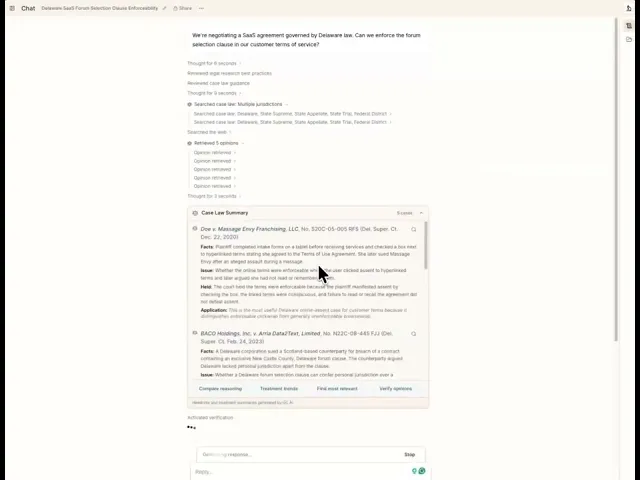
US Case Law searches a dedicated database of 13M+ US federal and state court opinions from a plain-English question, reads the full opinions, flags whether each case is still good law, and links every citation to the full opinion in a built-in reader.
Exact Quote returns character-level citations from uploaded documents, so verification takes a click rather than a careful re-read.
Playbooks turn a team’s standard positions (NDAs, DPAs, SaaS MSAs) into repeatable review workflows a new hire can run on day one.
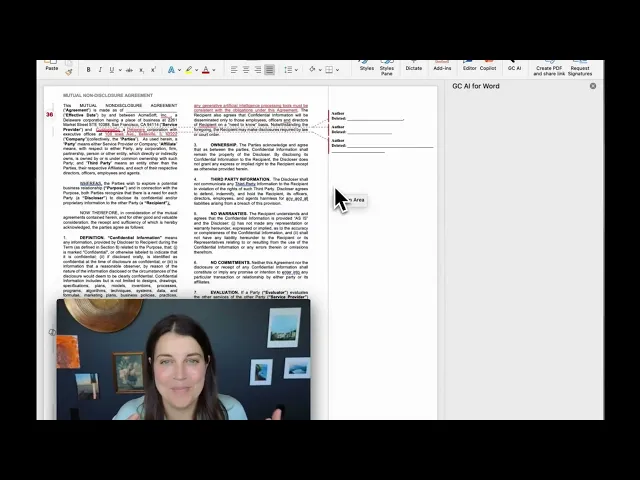
Chat2 inside the GC AI for Word Add-in brings research into the document you are drafting, which is where research has to live or it does not get used.
All of it runs on a 20,000-line legal system prompt that tells the model it is an in-house lawyer, trained on in-house workflows.
The research questions that show up in-house are narrower than “what cases are on point.” They look like: a 50-state survey on new AI-in-hiring rules before the head of People opens a new office. A translation-plus-summary of Colombian labor law because the head of BD just signed a rep in Bogotá. A check on whether a 3x indemnity cap holds up across this year’s comparable SaaS deals. GC AI handles exactly that work.
Legal research is only one part of how in-house teams use AI today. For a broader look at how legal departments apply AI across contract review, drafting, document analysis, and daily legal workflows, see our guide to AI in the legal field.
For a broader look at how in-house teams use GC AI across drafting, research, contract review, and daily workflows, see AI Legal Assistant for In-House Counsel.
Over 1,900 in-house teams across 53 countries use GC AI, including 200+ public companies and 25 unicorns across tech (Vercel, Snyk), consumer (Liquid Death, Vuori, SKIMS), and fintech (Tipalti).
Our December 2025 ROI study surveyed more than 100 active customers and found:
14 hours a week saved per user, on average
14% reduction in outside-counsel spend
21% greater accuracy than generic AI like ChatGPT
$252,000 in median annual savings per company (the 14% reduction applied to the $1.8 million median outside-counsel spend in the ACC Law Department Management Benchmarking Report)
Across the full user base, customers have run more than 4 million prompts and reclaimed over 600,000 hours of legal work. NPS sits at 77.
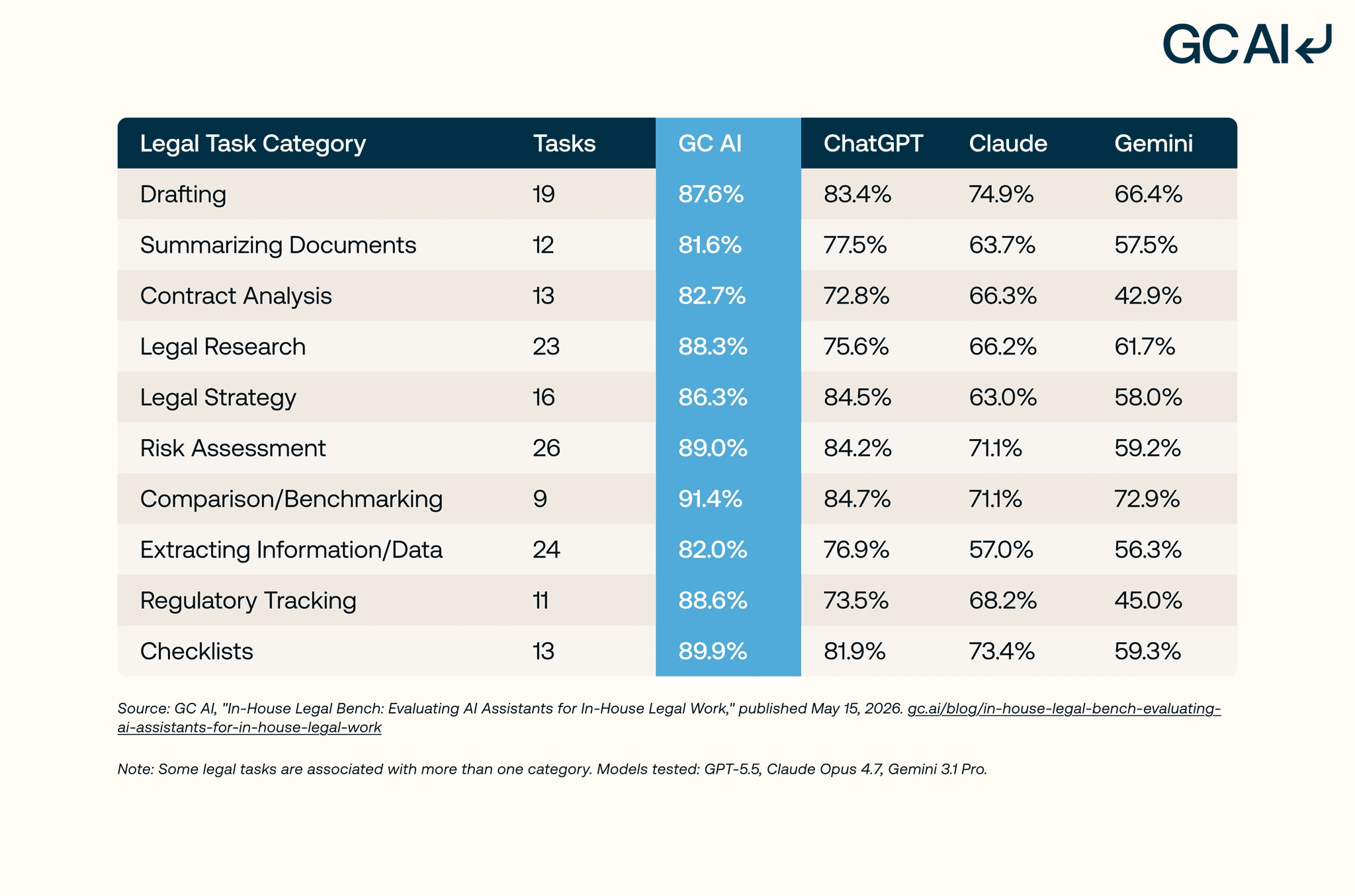
In GC AI’s own In-House Legal Bench (May 2026), a 100-task benchmark scored against an answer key built by attorneys with more than 80 combined years of practice, GC AI passed 88.3% of legal-research tasks, ahead of ChatGPT (GPT-5.5) at 75.6%, Claude (Opus 4.7) at 66.2%, and Gemini (3.1 Pro) at 61.7%. The bench measures GC AI against general-purpose AI, not the case-law databases on this list.
Joys Choi, VP of Legal at Tipalti:
“GC AI has become a daily partner for our lean legal team. It gives us fast, reliable analysis across multiple jurisdictions and keeps us ahead of regulatory change. It’s transformed how we operate.”
Cameron Clark, Head of Legal at Arc’teryx, who spent his first year there as the only lawyer:
“I couldn’t do my job without it. For the first year, I was the only lawyer at Arc’teryx. We simply wouldn’t have been able to keep up without GC AI.”
GC AI is SOC 2 Type II and SOC 3 certified, GDPR compliant, with zero data retention agreements with OpenAI and Anthropic, and AES-256 encryption.
The honest limitation is that we built this for in-house. AmLaw-scale litigation research is a different job. If your job is decades of primary-law depth at your fingertips, Westlaw Precision or Lexis+ are deeper on case law specifically. We do not pretend otherwise.
As of June 2026, GC AI does search US case law directly, 13M+ federal and state opinions read and checked for good-law treatment in the same chat, so many in-house case-law questions now resolve here, while exhaustive litigation research still belongs on a dedicated case-law platform.
Choose GC AI if you run a corporate legal function and want one platform for research, drafting, contracts, and the daily chat volume.
Westlaw Precision AI
Thomson Reuters built the Westlaw corpus over fifty years, and Precision AI sits on top of it. If you have read cases on Westlaw since law school, you already have muscle memory for the interface that no competitor has replicated. The overlay adds AI-Assisted Research, with KeyCite for treatment validation and Quick Check for brief scanning.
The catch, per the 2024 Stanford RegLab study: AI-Assisted Research hallucinated on roughly one-third of tested research queries, the highest rate among the products tested. Thomson Reuters has released updates since the paper, so your verification process matters before an AI-paraphrased case lands in a brief.
Pricing is not published. If you already run Westlaw, Precision AI is a bolt-on. If you do not, the platform assumes Westlaw-scale research is the job.
Choose Westlaw Precision AI if your work is case-law heavy in US jurisdictions, primarily litigation, and you want the Westlaw corpus behind each answer.
Lexis+ with Protégé
LexisNexis rebranded its AI flagship on February 24, 2026. Lexis+ AI is now Lexis+ with Protégé, which means roughly half the “Lexis+ AI review” articles on Google describe a product that no longer exists. (If you are doing buyer research in this category, checking publish dates on reviews is a load-bearing step.)
Protégé is the assistant layered on the Lexis research database, Shepard’s citation service, and drafting tools. Shepard’s is the differentiator if you are validating citations at scale.
Per the Stanford RegLab study, the predecessor (Lexis+ AI) hallucinated on roughly 17% of tested research queries. No independent benchmark exists for Protégé yet, so the diligence is yours.
Pricing is not published.
Choose Lexis+ with Protégé if you already run Lexis for primary-law research and want the AI assistant layered on the corpus you are already paying for.
Thomson Reuters CoCounsel
Originally Casetext, acquired by Thomson Reuters in 2023 and folded into the Westlaw platform. The version you are buying today is not the scrappy independent startup that launched with a lot of press. Evaluating CoCounsel now means evaluating the Thomson Reuters stack.
Deep Research produces cited research reports on a prompt. Guided Workflows run multi-step agentic tasks (review a contract, summarize a deposition, analyze a regulation). Westlaw integration pulls from primary law directly.
Pricing is not published.
Choose Thomson Reuters CoCounsel if you run Westlaw and want an AI assistant on the same platform.
CoCounsel’s Westlaw foundation and Harvey’s workflow-first approach solve different problems. See Harvey vs CoCounsel: 2026 Side-by-Side Comparison. If you’re comparing GC AI and CoCounsel, see our GC AI vs CoCounsel comparison for a detailed side-by-side breakdown.
Harvey
Harvey initially launched with AmLaw firms in 2022 and is the legal AI that firm partners name when asked which one their firm approved this year.
The product surfaces are Assistant (research and drafting), Vault (bulk document analysis for due diligence and compliance review), Knowledge (firm-specific document access), and Workflow Agents for multi-step automation. Harvey has since added a dedicated in-house solution, listing over 500 in-house teams as of March 2026. That in-house surface is newer than its firm-side product.
Pricing is not published.
Choose Harvey if your team evaluates AI across a large firm, or across a large in-house function that already runs like a firm, and bulk diligence is a primary use case. For an in-house side-by-side, see GC AI vs Harvey.
If Legora is also on your shortlist, our Legora vs Harvey comparison breaks down how the two platforms differ across legal research, document review, cross-border capabilities, and fit for in-house legal teams.
Spellbook
Spellbook lives inside Microsoft Word and handles drafting, redlining, and contract review. Its Benchmarks feature compares proposed contract terms against aggregated industry standards, and Spellbook Associate chains drafting and review as an agentic workflow.
Spellbook’s core use cases are contract drafting and review. The broader research workload (regulatory updates, multi-state surveys, outside-counsel brief validation) sits outside Spellbook’s contract-first focus. For teams where contracts are the primary job, Spellbook belongs on the shortlist. For teams where research is the primary job, the tradeoff is that you will be using a contract-centric tool for non-contract questions.
Pricing is not published.
Choose Spellbook if contracts are your primary job and research is a supporting workflow. For an in-house side-by-side, see GC AI vs Spellbook.
vLex Vincent AI
Vincent AI is vLex’s legal research assistant, built on a global database covering primary law in 100+ countries. It ships with 20+ prebuilt workflows, including a 50-State Survey for comparative regulatory research, complaint analysis, and litigation intelligence. Vincent Studio lets teams build their own workflows without writing code.
Pricing is not published.
Choose vLex Vincent AI if your work spans jurisdictions (multi-state US or cross-border) and you need a research engine that covers global primary law. If your work lives in one state, this is more tool than you need.
Legora
Sweden-based, and if you see “Leya” in older reviews, that is Legora’s old name (the company rebranded in 2024). The product runs tabular review (rows of contracts or documents analyzed in parallel), a Word add-in, and agentic research workflows. US footprint is growing. Its focus is European and US primary law with tabular review, rather than the deep US case-law corpora that Thomson Reuters and LexisNexis own.
Pricing is not published.
Teams evaluating Legora beyond its research capabilities should read our full Legora Legal AI Review, which covers Tabular Review, Workflows, Portal collaboration, Word integration, pricing considerations, and its fit for in-house legal departments.
Choose Legora if your team spans Europe and North America and wants an agentic platform with both tabular review and research in one stack. For an in-house side-by-side, see GC AI vs Legora.
Paxton AI
The other vendor on this list that publishes pricing. Individual is $499 per user per month or $2,999 per user per year, with Enterprise custom, verified on Paxton’s pricing page as of June 2026. The research engine covers all 50 US states and federal law, with contract analysis and medical chronology generation rounding out the product. Paxton serves solo practitioners, small firms, and in-house teams.
No independent peer-reviewed hallucination benchmark exists for Paxton, which is worth knowing before you sign.
Choose Paxton AI if you are a solo lawyer, small firm, or small in-house team and you want per-user pricing you can see before a sales call.
Alexi
Alexi serves law firms where “no cloud” still means something and single-tenant deployments get their own procurement review. The product focuses on litigation-style research and document analysis, with customers in North American mid-sized to large firms. Benchmarking claims are self-reported rather than third-party validated.
Pricing is not published.
Choose Alexi if you are a firm with a strict security posture (single-tenant deployment) and a litigation-heavy docket.
These research tools represent only one segment of the legal AI market. Our Legal AI Technology in 2026 guide compares the major legal AI categories across 100 in-house legal tasks.
Match the Tool to the Job
For in-house commercial, regulatory, contract, and daily chat work, pick GC AI. We built it for this.
For case-law research in litigation, pick Westlaw Precision AI or Lexis+ with Protégé.
For Word-native contract drafting with research as a supporting job, pick Spellbook.
For multi-jurisdictional research across US states or borders, pick vLex Vincent AI.
For AmLaw firm-scale deployment where bulk diligence is the primary use case, pick Harvey.
For solo, small-firm, or small in-house teams that want published pricing, pick Paxton AI.
For teams that span Europe and the US, pick Legora.
For firms with single-tenant security requirements and a litigation-heavy docket, pick Alexi.
For European-headquartered teams that want contract review and research together with document anonymization, evaluate Legalfly.
For a broader in-house buyer’s guide that goes beyond research (drafting, contracts, daily chat), see our guide on the best legal AI tools for in-house counsel. Teams evaluating the broader orchestration versus AI execution stack should also see our guide to legal workflow software for in-house counsel.
Which Tool for Which Research Job
The right platform depends less on the brand than on the research job in front of you. The most common in-house research jobs and where each points:
Research job | Best fit |
|---|---|
Is a 3x indemnity cap market in this SaaS MSA? | GC AI (answer lands in the doc); Spellbook Benchmarks |
50-state or cross-border regulatory survey | vLex Vincent AI; GC AI for in-house surveys |
Employment law across multiple states | GC AI; vLex Vincent AI |
Case-law and litigation research | Westlaw Precision AI; Lexis+ with Protégé; GC AI for many in-house case-law questions |
Regulatory-change monitoring on a policy | GC AI (research, then redline in Word); vLex |
Validating an outside-counsel brief’s citations | Westlaw KeyCite; Lexis Shepard’s |
Run Your Two Finalists Through the Same Prompt
Ten platforms is a lot to evaluate. You will not demo ten. You will demo two, maybe three. Use the decision tree above to pick your finalists, then run one real research question through each. Same prompt, same document, same deadline. The platform that returns a cited answer you can defend in front of a senior lawyer wins.
“I’ve compared against ChatGPT, GC AI gives more comprehensive responses appropriate for a lawyer to use. After six months of use, I’m sure I’ve saved hundreds of hours.” —Trisha Mauer, VP of Legal at Tonal
If ChatGPT is one of the tools you’re evaluating, our ChatGPT for Lawyers guide explains where it works well for legal teams, practical prompting techniques, and what lawyers should never paste into it.
Frequently Asked Questions
Can I Use ChatGPT or Claude for Legal Research?
General-purpose AI tools are not built for legal research and are prone to hallucinating case citations that do not exist. For work requiring verifiable authority, purpose-built platforms that draw from verified legal databases are the appropriate choice.
How Accurate Are AI Legal Research Tools?
Accuracy varies significantly by platform. The 2024 Stanford RegLab hallucination study found that Westlaw Precision AI hallucinated on roughly one-third of tested queries, while Lexis+ AI hallucinated on roughly 17%. GC AI’s own In-House Legal Bench (May 2026) found GC AI passed 88.3% of legal research tasks, compared to 75.6% for ChatGPT (GPT-5.5) and 66.2% for Claude (Opus 4.7).
Which AI Legal Research Tool Is Right for In-House Counsel?
The right tool depends on the primary job. For in-house commercial, regulatory, contract, and daily chat work, GC AI was built specifically for that workload. For case-law-heavy litigation research, Westlaw Precision AI or Lexis+ with Protégé are deeper on US primary law.
What Is the Difference Between Database-Backed and General-Purpose AI Tools?
Database-backed tools like Westlaw and Lexis anchor answers to editorially curated legal corpora, which reduces the risk of fabricated citations. General-purpose tools generate responses from broader web data, making them unsuitable for citation-heavy legal research.
Do AI Legal Research Tools Publish Their Pricing?
Most do not. Of the ten platforms on this list, only GC AI ($500 per user per month) and Paxton AI ($499 per user per month, as of June 2026) publish individual pricing. The remaining eight list pricing as not published, requiring a sales call to get a number.
Is Client Data Safe to Upload to AI Legal Research Platforms?
Enterprise-grade platforms maintain security standards including encryption and policies against training models on your data. GC AI, for example, is SOC 2 Type II and SOC 3 certified, GDPR compliant, and holds zero data retention agreements with OpenAI and Anthropic.
How Do AI Legal Research Tools Handle Multi-Jurisdictional Questions?
Coverage varies by platform. vLex Vincent AI covers primary law across 100+ countries and includes a 50-State Survey workflow. GC AI deploys multiple research agents across authoritative legal databases and handles multi-state regulatory surveys as part of its in-house workflow.
What Happened to Casetext, Lexis+ AI, and Leya?
Casetext was acquired by Thomson Reuters in 2023 and is now Thomson Reuters CoCounsel. Lexis+ AI rebranded to Lexis+ with Protégé on February 24, 2026. Leya rebranded to Legora in 2024. Reviews predating these changes describe products that no longer exist under those names.
How Should I Compare AI Legal Research Tools Before Buying?
Run one real research question through your two finalists using the same prompt, the same document, and the same deadline. The platform that returns a cited answer you can defend in front of a senior lawyer is the right choice for your team.
Is Legalfly Good for Legal Research?
For legal research specifically, Legalfly is a secondary fit: its core is contract review, and research lives in a separate Discovery module that covers primary law across 130+ jurisdictions. Teams whose primary job is deep legal research rather than contract review with research alongside will get more from a platform built research-first.
Can AI Legal Research Tools Replace Westlaw or LexisNexis?
Not as a direct replacement for citation-critical work. The Stanford RegLab 2024 study found Westlaw’s AI hallucinated on roughly one-third of tested queries and Lexis+ AI on about 17%, so accuracy risk exists across both categories. The most effective approach is a hybrid workflow: AI surfaces candidate authorities quickly, and citators like KeyCite or Shepard’s confirm whether they still stand. Purpose-built legal AI reduces the volume of traditional database searches needed without eliminating them.
What Is the Best AI Tool for a 50-State Employment or Regulatory Survey?
vLex Vincent AI and GC AI are the two tools in this roundup most explicitly built for multi-state surveys. Vincent AI includes a prebuilt 50-State Survey workflow drawing on primary law in 100+ jurisdictions. GC AI deploys agentic research across authoritative legal databases and government sources, suited to multi-state regulatory questions common in in-house departments, such as mapping new AI-in-hiring rules before a regional expansion. Attorney review of all results before reliance is essential.
How Do In-House Lawyers Rate AI for Legal Research?
Practitioner sentiment shows up most in community threads (Reddit’s r/Lawyertalk, legal-ops Slacks) and YouTube walkthroughs, where in-house lawyers praise the hours saved on first drafts and multi-jurisdiction questions but add one consistent caveat: verify every AI-surfaced citation against the source before relying on it. The enthusiasm is real, and so is the discipline around verification, which is why character-level citation matters more than raw speed.
Which AI Tool Is Best for Validating Outside-Counsel Brief Citations?
Tools with character-level citation sourcing reduce the manual spot-check burden the most. GC AI’s Exact Quote feature pins each research finding to the specific passage in source material, making it straightforward to confirm that a cited case stands for the proposition outside counsel used it for. CoCounsel, grounded in Westlaw, is also strong here because KeyCite integration flags overruled or questioned authority directly in the workflow.
Which AI Legal Research Tools Support Natural Language Search?
GC AI runs legal research inside the same chat-native workspace used for contract review, drafting, and company-context questions, so a natural language query returns a cited answer without switching tools or learning a new search syntax. The other platforms on this list are AI-native too, meaning you ask a research question in plain English instead of building a Boolean search string, but most add that layer on top of a legacy database originally built for keyword search. Westlaw Precision AI, Lexis+ with Protégé, Thomson Reuters CoCounsel, and vLex Vincent AI all work this way. When comparing vendors on natural language search specifically, ask whether the AI sits on top of a decades-old search engine or was the product’s original architecture.
What Are the Most Affordable AI Legal Research Tools for In-House Teams?
Of the ten platforms above, only two publish per-seat pricing, verified July 2026: GC AI at $500/user/month, also available at $5,000/user/year on an annual plan, and Paxton AI at $499/user/month or $2,999/user/year. GC AI’s plan includes a self-serve 14-day free trial, no credit card or demo required. The other eight, Westlaw Precision AI, Lexis+ with Protégé, Thomson Reuters CoCounsel, Harvey, Spellbook, vLex Vincent AI, Legora, and Alexi, require a sales conversation, and quotes are typically sized for enterprise legal departments rather than a lean in-house team. If you’re a startup or small in-house function comparing affordable AI legal research tools, ask any quote-gated vendor for pricing scaled to your actual seat count, and confirm the quote covers legal research specifically rather than a bundled suite.