


Dive Deeper
Transcript
Episode Overview
Michele Murray once dialed a phone number off a licensing spreadsheet and reached a deceased mayor's cell phone. The woman who answered wanted to know where Murray got the number.
Murray explained that she was trying to make sure the town got paid its sales tax, and she walked away with the license. That is what it looks like to scale an in-house legal team through acquisitions in one of the most license-heavy industries in America, where a single convenience store can carry 10 to 15 separate permits.
Scaling a legal department, in the ARKO playbook, comes down to three disciplines: hire smart people when the work demands it rather than when the org chart suggests it, give each person full ownership of their domain, and treat the team you acquire as the expert in its own business.
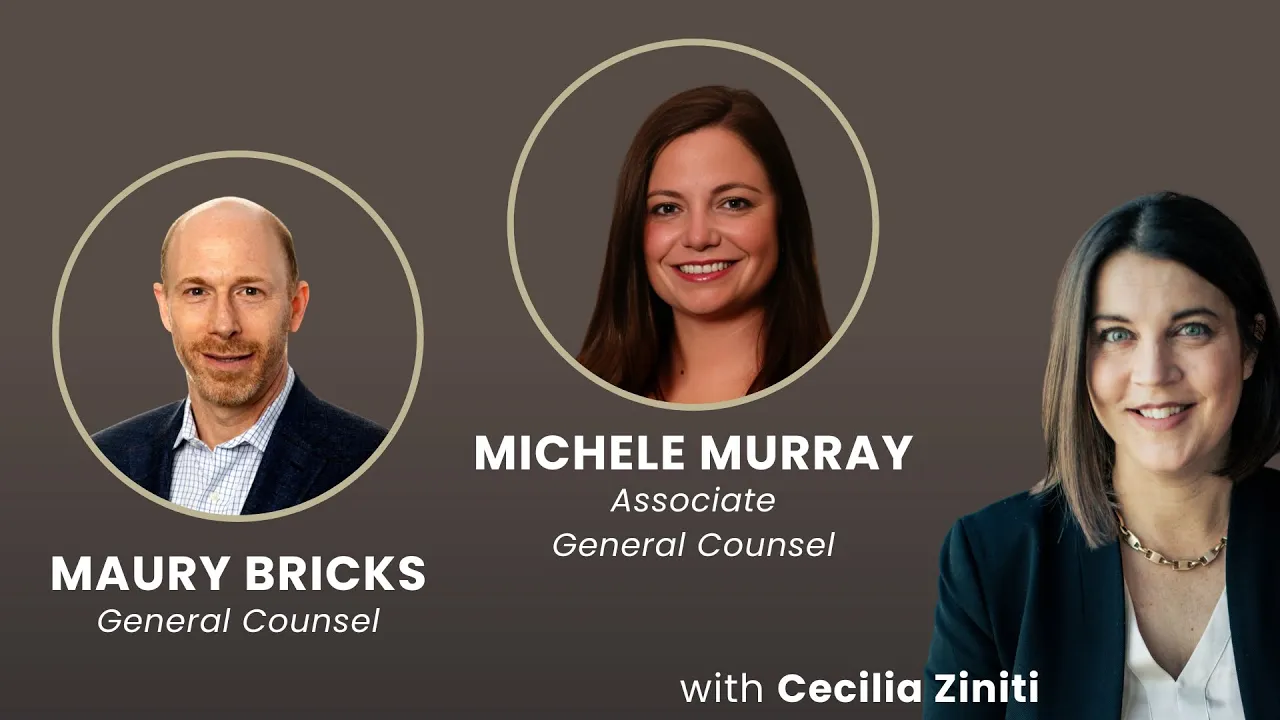
On this episode of CZ and Friends, GC AI co-founder and CEO Cecilia Ziniti talks with Maury Bricks and Michele Murray of ARKO Corp, a Fortune 500 company and the sixth largest convenience store operator in the United States, about how a legal department of one became a team of more than 30 across legal, risk, and compliance, and how a privacy lawyer who once blocked AI became the person recommending it at Chief Legal Officer events.
Michele Murray and Maury Bricks
Maury Bricks is General Counsel and Secretary of ARKO Corp (Nasdaq: ARKO) and GPM Investments. He joined GPM in January 2013 as a legal department of one, after eight years as an attorney at Greenberg Traurig, where GPM was his client; he came in-house during a deal he had helped structure as outside counsel.
Earlier in his career he worked in finance for the pipeline and retail natural gas divisions of Shell Oil Company. Today he leads a team of more than 30 people across legal, risk, and compliance at a company with more than 1,300 retail locations.
Michele Murray is Associate General Counsel at ARKO Corp and GPM Investments, and Bricks's second in command. She joined as the department's second legal hire from a technology startup in Atlanta, without an M&A background, and has become a trusted leader across the company's real estate and corporate work.
Before going in-house she practiced real estate litigation.
Key Takeaways
Scale a legal department by hiring only when the work demands it. Bricks grew ARKO's legal function from a department of one in 2013 to more than 30 people across legal, risk, and compliance, one need at a time.
Treat the acquired team as the expert in its own business. On ARKO's largest wholesale acquisition, the company put both sides' contract forms on the table and built the best of both, with the acquired team leading.
Keep outside counsel spend minimal and specialist-only. In-house lawyers are on salary, so there is no marginal cost to pulling more of the work in-house.
A live demo with verifiable citations can flip an AI skeptic. Murray went from blocking AI on privacy grounds to recommending it at CLO events after watching GC AI summarize a thousands-of-pages trial transcript with page-level citations.
AI output is only as good as the lawyer verifying it. Murray points to an attorney sanctioned $25,000 for filing an AI-drafted motion response without checking the facts; it is still your work product.
How Do You Scale a Legal Department From One Lawyer to More Than Thirty?
Hire when the work demands it, for aptitude rather than resume fit, and build new functions around the risks the business picks up as it grows. Bricks did not plan a 30-person department. Whoever ran GPM's budgeting in 2013 did not plan one either. The team grew acquisition by acquisition, need by need.
The pattern started with his second hire. When Bricks went to his CEO to ask for another lawyer, the CEO asked whether he was sure he needed one. Bricks's answer: "We have the work for three lawyers, I'm doing two, and one's not getting done at all. So what do you think?"
The job description he wrote for that role turned out to matter less than the person who applied for it.
Bricks recalls:
"I was looking for somebody, I put together a job description. Michele had zero of the requirements of what I thought I wanted on there, but I could tell she was smart and eager and could learn the business."
That hiring lens now runs through the whole department. ARKO has absorbed people from finance, marketing, and HR who were smart, underused, and eager to grow.
One administrative assistant moved into compliance and earned an anti-money laundering certification about 40 years after she had last sat in a classroom. It opened a new career for her.
Functions grew the same way. Licensing used to run through accounting like any accounts payable item, until acquisitions turned it into a real risk area and ARKO built a dedicated licensing department to confirm the right subsidiaries held the right licenses and to stop paying for ones that no longer existed.
The pattern maps to any corporate legal department structure. The org chart grows out of the risks the business takes on, one need at a time.
How Did ARKO Secure 1,300 Store Licenses in Eight Weeks?
With a spreadsheet, a licensing director Murray calls a machine, and direct calls to the state and local offices that issue the licenses. Convenience stores can require 10 to 15 licenses per site: alcohol, tobacco, lottery, business licenses, egg handling, and permission to sell milk, sometimes filed in triplicate on carbon paper with a notary, for a $15 fee. Multiply that across a large acquisition and licensing becomes the legal work that unlocks the company's right to operate.
Murray had no M&A background when ARKO's CEO walked into her office and asked her to help on the company's first big deal. She learned the business by doing the unglamorous work nobody else wanted, which included talking her way to a license through a deceased mayor's cell phone.
Murray draws the lesson:
"Everyone is good at their job and knows something you don't know. Just because of where we sit, it doesn't mean there are things that so many employees at every level could do that I don't know how to do."
The licensing director told her exactly what to file. A postal worker once taught her how to send certified mail, after a panicked call to her mom from the office bathroom on her first legal job. The people doing the frontline work knew things she didn't, and asking got 1,300 licenses done.
The trial by fire taught Murray ARKO's entities, org chart, and business model faster than any onboarding deck. Teams doing that diligence now have help the 2010s never offered. AI due diligence surfaces the license, entity, and compliance questions before panic time.
How Do You Build Trust on an In-House Legal Team?
Give people full ownership of their domains and route questions to the expert by name. For Bricks, bandwidth is the reason. A general counsel guiding a public company through constant deals cannot check everyone's work twice.
"I have to trust everyone. I don't have time to check up on what they're doing. So once I send out an email, I assume it's handled."
At conferences, Bricks hears other GCs describe copying themselves on everything because people want the GC's voice. He does the opposite. He tells stakeholders that Michele is handling it, or that insurance requirements sit with the colleague who maintains the master standards, and that he will not put terms in a contract without checking with that person first.
Whoever owns the work gets named to the business as the person who owns it.
Murray describes the other side of that trust: caring about the work product, getting it done, and being willing to say "I don't know" before something becomes a problem.
Neither of them arrived fully formed. Murray's first legal job included that certified-mail crisis at 21. Bricks once misplaced a bearer bond, a piece of paper worth millions to whoever physically holds it, for what he claims was 10 seconds and admits was closer to a few hours. When the bosses joke about their own early mistakes, the rest of the team feels safer admitting what they don't know.
What 26 Acquisitions Taught ARKO About Legal Team Integration
Treat the acquired team as the expert in its own business, and set that tone in the first weeks. ARKO has closed 26 acquisitions in Bricks's 13 years, a pace of two a year, so integration never gets to be a project with a clean start and finish. The discipline that survives that pace is humility about whose way of doing things is better.
The clearest example came when ARKO, focused mainly on retail, acquired a company with deep wholesale expertise, along with the first sizable legal team ARKO had ever picked up in a deal.
Bricks explains:
"We knew they were the experts in that. We took our wholesale forms, we took their wholesale forms. We created the best of both, with them as the leaders. Then we went out to outside regulatory counsel to vet them."
Outside regulatory counsel vetted the merged forms, and ARKO keeps updating them as litigation, new states, and new cases teach the team something. Bricks contrasts that with the large counterparties every in-house lawyer recognizes: "You edit their form and they're like, we don't take any changes. And I'm like, but you misspelled your name.
And they're like, well, we have an every two year cycle where we can fix that." ARKO does not play that game. Murray adds that the acquired team's lawyers now meet with ARKO's for regular best-practices sessions, and the personalities fit because both GCs set a collaborative tone from the top before the supporting attorneys ever met.
When Should In-House Teams Send Work to Outside Counsel?
As little as possible, and only for specialists. ARKO runs one of the leaner outside counsel models you will hear a public-company GC describe on the record.
"We try to use outside counsel on a minimal basis. We try to do as much in-house as possible. We're on salary, so there's no marginal cost no matter how hard we're working."
The exceptions are genuine specialists: HSR filings, environmental counsel, and local counsel in the small communities where gas stations sit and top firms have no bench. Murray keeps a wide network of firms instead of funneling everything to one, because ARKO rarely gets much notice before it needs help, and a long relationship means a firm that knows the business almost as well as the team does.
One category has been shrinking. Bricks notes that Murray has moved more privacy work to AI and away from outside privacy counsel. GC AI's guide on how to reduce outside counsel spend runs through the same analysis for any team.
How Did ARKO's Legal Team Go From Blocking AI to Recommending It?
A live demo with verifiable citations changed Murray's mind. As the lawyer responsible for privacy, her first exposure to AI was bioethics. She watched surveillance footage, cameras, and algorithmic decision-making raise hard questions about what AI could do to people, so when ARKO first explored AI, she was the one saying no. The company had a Copilot license and little else.
Then she watched Cecilia Ziniti demo GC AI at an event for Chief Legal Officers, and heard a competitor at a roundtable describe using it for permitting. She made another attendee move seats so she could sit next to Ziniti at dinner and ask more questions. The test that sold her was a thousands-of-pages trial transcript from a complicated eminent domain proceeding with three competing appraisal approaches.
"The output was insane. It was citing pages of the trial transcript and I was just sitting there thinking, okay. … This is a tool that can save us a lot of time, especially in our environment where we have to answer questions quickly."
Bricks took more convincing. He had been proudly avoiding ChatGPT, on the theory that he was smart and could do his own work. What won him over was Easy Prompt, which turns a plain request into the specific questions a lawyer needs answered.
"I type in please redline this document, and press easy prompt, and it's like, did you mean you wanted to know these 40 things? And I'm like, yes, that's exactly what I wanted."
The workflows spread from there. ARKO's corporate secretary uses the platform, and Murray runs zoning notices across the company's 1,300-plus locations, prompting it to review a notice and the underlying project and advise on the impact for nearby convenience stores, enough to know who needs to show up at the hearing.
Her favorite finishing move is asking for a summary with the four key points leadership needs, advice she traces to a boss who told her to write it in crayon.
Bricks used GC AI on a Sunday to confirm his film-student son did not need a permit to shoot in an upstate New York county. The law was on the son's side, but the sheriff said permit, the sheriff had a gun, so the crew waited a week for a permit that never existed.
What Should Junior Lawyers Know About Using AI?
Use it, verify it, and never let it substitute for knowing the law. Murray is unconcerned about AI replacing in-house lawyers, and clear-eyed about how it goes wrong. The day of the recording, a consultant had told her team about an attorney sanctioned $25,000 for preparing a response to a motion using AI-generated content without verifying it. Ziniti notes on the episode that more than 300 AI hallucination legal cases have now raised that question in courts.
"It's really only as good as the user. There has to be a knowledge base, because you have to verify the results."
Murray's advice to young attorneys: learn the indemnification clause, the reps and warranties, and the multi-state regulatory nuances the old way, with a boss who marks up your redlines, then let AI expand what you can do with that knowledge. Both guests see the demands on lawyers going up, because faster answers mean the business acts on them sooner. One thing never gets automated. As Murray puts it, AI cannot send certified mail, so learn that too.
Recommended Reading
How Great GCs Think About Growth, Risk, and Crisis Management: Tricia Kinney on risk framing and crisis prep, the natural next read on leading a lean in-house team (live, verified Jul 19, 2026).
In-House Legal Bench: Evaluating AI Assistants for In-House Legal Work: the benchmark behind the AI-adoption story Murray and Bricks tell (live, verified Jul 19, 2026).


