Enterprise legal management (ELM) connects the operating records of a corporate legal department: matters, outside counsel spending, invoices, approvals, and reporting. A team needs it when those records have to connect and the current process cannot keep them accurate.
At GC AI, we are an enterprise legal AI platform for in-house law departments. We do the lawyer's work on a matter, the reading, analysis, and drafting, with sources you can open, and we run beside whatever system keeps that matter's record. As of September 2026, 2,100+ legal teams including Columbia Sportswear, Snyk, TIME, Wayfair, Nestle and Bass Pro Shops.
Our CEO, Cecilia Ziniti, was a general counsel three times (Anki, Bloomtech, and Replit) and an in-house counsel at Amazon and Cruise. She started GC AI after teaching lawyers to use ChatGPT, and those classes told her what the software had to do. She left Replit on November 2023, incorporated GC AI about a week later, and described those months to Crunchbase News:
"I would teach these classes in the morning and tell my co-founder in the afternoon, 'Our software needs to provide accurate citations. Our software needs to tell you where in the document it's getting the backup for this. Our software needs to speak in this way.'"
Hold your matter records to the same standard. Pick a matter your team already handles: can you name its owner, find the approved budget, follow the invoice decisions, and explain the cost in a management report? If any answer means rebuilding the history, you have a concrete problem to evaluate.
What Does Enterprise Legal Management Cover?
ELM software connects matter management and legal spend management with workflows and reporting. CLOC's Core 12 puts financial management, firm and vendor management, and business intelligence among the competencies of a legal operations function, and ELM software is where a department runs those three. Depending on the team's process, the requirements may also include outside-counsel records, engagement terms, and vendor oversight.
Vendors draw the category differently, so write your requirements before you read a feature list.
The main functions serve related but distinct jobs:
Matter management: Keep the owner, status, relevant documents, deadlines, and activity associated with a legal matter.
Legal spend and e-billing: Connect outside counsel budgets and invoices to the work, review charges, and route approvals.
Workflow: Assign work and record the decisions needed to move it forward.
Reporting: Use those records to examine workload, spending, and progress across matters.
A system of record is the agreed place your team relies on for a particular fact. An ELM commonly connects matter status, outside-vendor records, approved invoices, and reporting inputs, while finance may own payment status.
Define that responsibility for each record. Buying a platform does not settle it.
Follow One Matter From Intake to Reporting
Consider an illustrative employment dispute that requires outside counsel. Use this sequence to test how your process handles the work.
Open the matter. Give it a unique identifier, an internal owner, a business unit, and a matter type. Set access for the people who need the record.
Record the engagement and budget. Link the firm, the agreed scope, the applicable billing guidelines, and the budget. Identify who can approve a change.
Connect the invoice to the matter. The reviewer should be able to compare the bill with the engagement and see earlier invoices without reconstructing the file from email.
Record the decision. Keep the approval, adjustment, or request for clarification with the invoice. Define how the approved invoice reaches finance and how payment information comes back.
Build the report from those records. Check whether the report's figure means billed, approved, or paid. Keep those labels distinct, and agree on how the report treats work incurred but not yet invoiced.
Step one only works if requests reach the system.
Chuck Kable, General Counsel and Corporate Secretary at Innovative Renal Care, installed a matter management system within two months of starting the job and told CZ and Friends, GC AI's podcast where CEO Cecilia Ziniti interviews legal leaders, what had to happen next:
"I also need my internal clients to utilize our front door, right, the portal to ask for stuff. And that'll help capture more of those matters and give us more visibility so we can continue to do that categorization exercise."
A matter that arrives by hallway conversation has no record to follow, so the legal intake process is the first thing to fix.
Now change one detail: the matter moves to a different internal owner. Can the next person follow the work and spending decisions from the saved record? If the answer is no, the next question is which system should own that record.
How ELM Relates to Matter Management, CLM, and Legal AI
These categories overlap, a product may combine several of them, and ELM platforms can include AI, so start with the job you need to complete.
Matter management organizes individual legal matters, either as a standalone product or as a component of ELM. If ownership, status, and deadlines are your main problem, investigate that requirement before assuming you need a broader suite.
E-billing focuses on receiving, reviewing, and approving legal invoices. If your billing platform already has matter or reporting capabilities, test whether those capabilities can support the process you need.
Contract lifecycle management (CLM) centers on agreements, including their preparation, negotiation, approval, signature, and ongoing administration. A contract can relate to a matter, but its versions and obligations answer different questions from a matter's workload and spending history.
Enterprise legal AI helps lawyers perform substantive work, such as analyzing documents, researching questions, and drafting, and that is the layer GC AI occupies. Evaluate the specific task, the sources, and the review controls; the guide on enterprise legal AI covers that buying decision in more depth.
For the wider stack, see the guide on corporate legal software. ELM is the right purchase when the records themselves are the problem.
When Does a Legal Team Need Enterprise Legal Management?
The category has a clear before and after. Ron Bell, Chief Legal and Administrative Officer at Collective Health and former General Counsel of Yahoo, described Yahoo's legal department in the early 2000s, when e-billing was new and the bills were still paper:
"Half the time the thing got lost on somebody's desk, or somebody would go out on vacation and it would take like three years to pay the outside counsel."
He took the problem to then general counsel Mike Callahan, who told him to go find out what was available. Once the department moved to e-billing, the view changed:
"Mike could say in real time, here's how we're doing against our budget, and here's what's trending, and here's what's not, and inform the decisions at the corporate level in a way that suddenly went from we're kind of flying blind or at least three to six months delayed, to really being able to know where we were putting our spend and how efficient we were being and where we needed to make changes."
The signals below are smaller versions of the same gap:
Matter ownership is hard to establish. Requests and updates sit in separate inboxes, and another team member cannot reliably find the current status.
Spending reports require repeated reconciliation. Legal and finance use different matter names, categories, or definitions, so someone must reconcile them each reporting cycle.
Approvals are difficult to trace. The team can find an invoice but has to search elsewhere to learn who approved it and why it changed.
Reporting depends on one person's spreadsheet work. The process works while that person is available, but another owner cannot reproduce the result.
Each one is a reason to look at a shared process and the software behind it. First check whether clearer ownership, consistent fields, or an existing module would resolve the problem, because a team with a maintained tracker, reliable billing records, and manageable outside counsel management may have more pressing investments. If the gap remains, start with the record you cannot reconcile, then expand once the owners and fields are clear.
Sruthi Kosuri, Director of Legal Operations at Marvell Technology, said on the CZ and Friends podcast that her team extended a system it already had:
"So like we just used what we had for our e-billing process, expanded that into matter management."
Before replacing software, test how much of your proposed process the current system can support. Write the requirement in operational terms: "The matter owner can review the invoice against the approved budget, and finance can trace the approval." That gives you something observable to test.
Who Should Own an ELM Implementation?
Assign a legal operations lead or another named legal owner to the process. Give that person partners in finance and IT, plus the lawyers and staff who will maintain the records.
The platform and the person arrive together. Kim Woodward, VP and Head of Legal at Overjet, built Okta's legal operations function starting in 2018 and described how the team grew on the CZ and Friends podcast:
"as the team grew, we needed more things. We needed an e-billing platform, and I needed somebody to manage it."
The pre-signature decision is where an implementation goes wrong first. Jenna Hunt, Head of Legal Operations at Tipalti, said on the CZ and Friends podcast that an earlier contract lifecycle management platform failed at Tipalti because the team defined the problem after the purchase:
"the salesperson convinces you that they are solving all your problems that you didn't even realize you had. And then suddenly you've got this, you know, piece of technology in your company that doesn't connect to anything."
Her second lesson was the data: know which legacy records you will import and what cleanup they need before the vendor's timeline starts. Tipalti's team walked away from that contract, got its money back, and applied both lessons to its next two implementations.
Before configuring the system, agree on a small set of decisions:
Which system owns each fact, including matter status, approved amounts, and payment status.
Who opens, updates, and closes matters.
Which categories and required fields reporting depends on.
Who can view sensitive matters and approve spending.
How records move between systems, including manual steps.
Start with one representative matter type. Test the full sequence with the people who will use it, including the handoff to finance, and reconcile the resulting report with the underlying records before expanding.
The same exercise tells you whether you have a software gap or a process gap. A report cannot become dependable while its owners use the same field to mean different things.
How GC AI Supports Enterprise Legal Management
Once a matter has an owner and a reliable record, the lawyer still needs to read the documents, assess the issues, and decide what to do. That is the work GC AI takes on, whatever system holds the record.
Kacie Zanassi, Director of Employment, Litigation, and Legal Operations at Eventbrite, describes the change in her published customer story:
"Tasks that previously required several hours of manual work now begin with AI-generated first drafts that I can refine and verify."
You can test that approach on the illustrative dispute above. The update runs in six steps:
Gather the Source Material
Give a Specific Instruction
Read What Comes Back
Verify the Draft
Save the Reviewed Result
Keep the Useful Instructions
Gather the Source Material
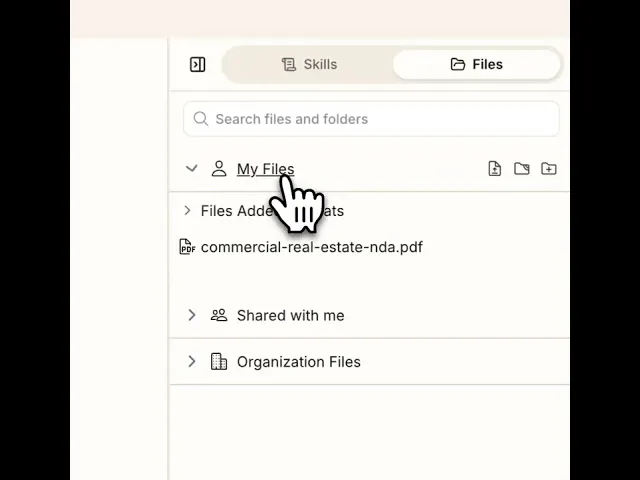
Upload the relevant correspondence, the agreement, and the current matter update with Files, and keep them together in a Project scoped to this matter so later chats can reference earlier work. Use materials your organization has approved for this workflow.
The Files demo shows how a matter's documents stay together:
Give a Specific Instruction
Name the audience, the format, and the sourcing rule. Here is the shape of an illustrative ask:
Draft an internal status memo on this dispute for the general counsel. Separate established facts, disputed points, missing information, and proposed next steps. Cite the document and passage behind every factual statement, and list anything the documents do not establish.
Read What Comes Back
The draft arrives in the four sections you asked for, each statement carrying a citation to a specific document. The missing-information section is the one to read first, because it tells you what the file cannot yet support.
Verify the Draft
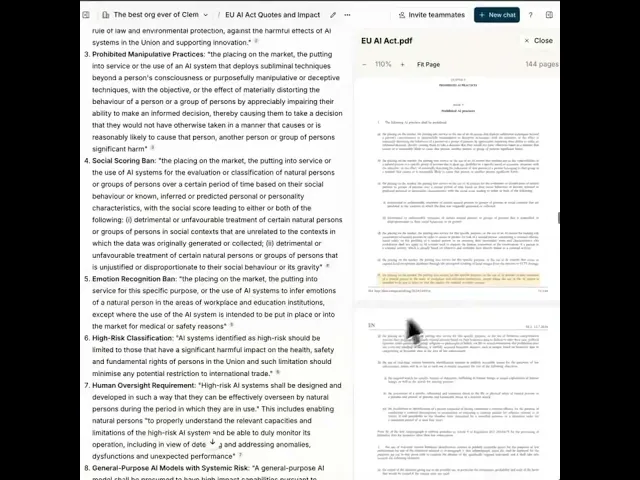
Open each citation and compare the statement with the source. Exact Quote opens the original document with the quoted passage highlighted, so the check takes one click.
The lawyer checks the analysis and decides what the final memo should say.
Watch Exact Quote open the cited passage:
Save the Reviewed Result
GC AI exports a full chat or a single message as PDF, DOCX, or Markdown. Export the reviewed memo, then file it in your matter record the way your team files any other work product.
Keep the Useful Instructions
Retain the ask and the approved memo format as project instructions for the next update, and refresh the source documents each time. GC AI Classes teach the prompting and review habits behind this workflow, with current sessions and accreditation listed in the catalog.
This example uses a manual handoff. A team that wants to automate it can build against GC AI's API; confirm the exact integration and permissions before designing an automated connection to your ELM.
Bring a representative matter update to a demo and ask to see the path from source documents to a reviewed memo. That gives your team a specific legal task to evaluate alongside its operational requirements.
Enterprise Legal Management FAQs
Is ELM Only for Large Legal Departments?
A smaller team can need ELM when several people must coordinate matters, spending, and approvals. Assess the work and reporting burden before buying. If a maintained tracker and existing billing tools meet those needs, define the gap a new platform would close.
Can ELM Track Matters Handled Entirely In-House?
Yes. An internal legal matter can still need an owner, status, deadlines, documents, and reporting even when no outside firm handles it. Define which internal work belongs in the matter system and how staff will keep the records current. E-billing becomes relevant when a matter generates outside counsel invoices.
How Should You Compare ELM Products That Include AI?
Ask the vendor to demonstrate the AI task on a representative matter and show the sources, review controls, and saved result. Then test the matter, billing, and reporting functions separately. An AI feature and a reliable operational record each need their own evaluation.