

Dive Deeper
Transcript
Episode Overview
The legal operations team at Marvell Technology got smaller while everything around it got bigger. When Cindy Prabhakar joined, five ops professionals supported a global legal team of 50.
Today three support nearly 80, inside a semiconductor company that posted record fiscal 2026 revenue of \$8.195 billion, up 42% on AI infrastructure demand, and took a \$2 billion investment from NVIDIA in March 2026.
Scaling legal operations without adding headcount comes down to four moves in the Marvell playbook: make legal spend visible by practice group so leaders own their budgets, auto-triage incoming agreements so no single person is the bottleneck, negotiate the master service agreement hard once so routine statements of work become 15-minute self-serve requests, and build AI fluency across the team before buying anything new.
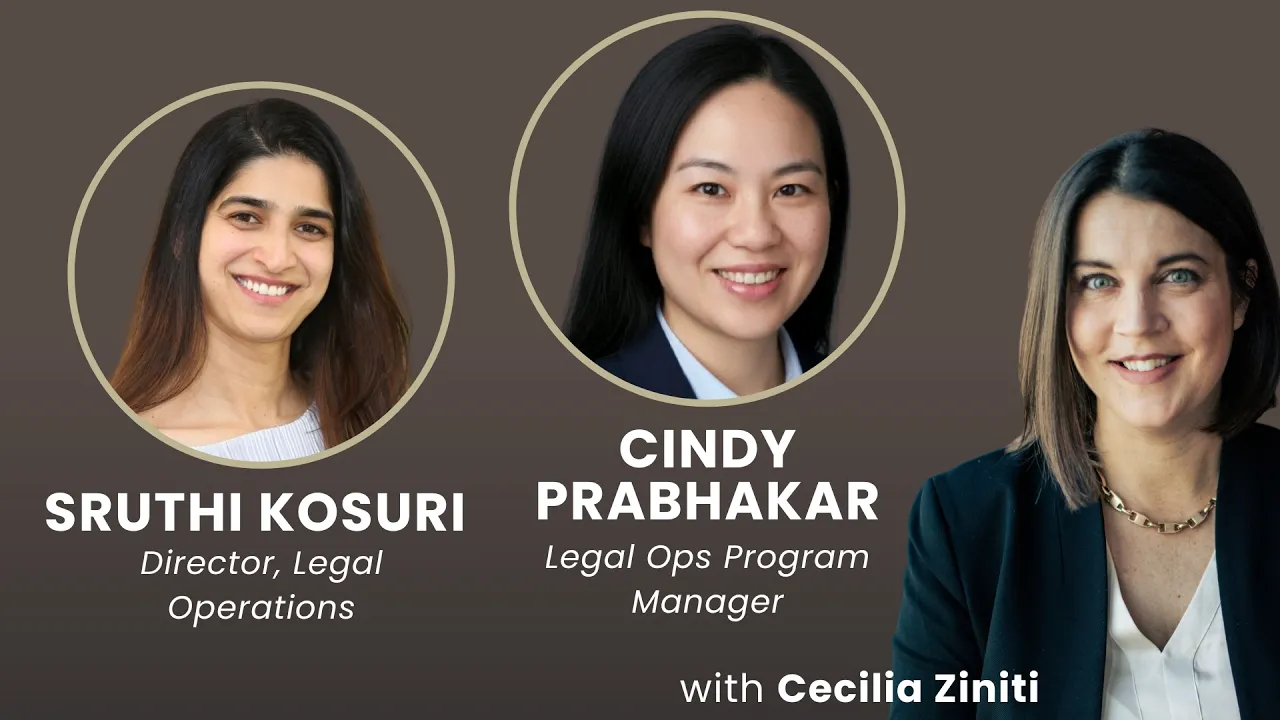
In this episode of CZ and Friends, GC AI co-founder and CEO Cecilia Ziniti talks with Sruthi Kosuri and Cindy Prabhakar about how each move landed, including the budget change nobody wanted.
About Sruthi Kosuri and Cindy Prabhakar
Sruthi Kosuri is Director of Legal Operations at Marvell Technology, where she joined after legal operations and analytics roles at Maxim Integrated and Analog Devices, semiconductor companies where she saw the automation Marvell was missing. She reports into a function led by Mark Casper, Marvell's Executive Vice President and Chief Legal Officer, and legal ops now sits on the CLO's staff, a seat the function did not hold before her arrival.
Cindy Prabhakar is Legal Operations Manager at Marvell Technology. As she says on the episode, she joined when some colleagues did not yet know what legal ops was.
She drove the contract efficiency work discussed in this episode, and Kosuri notes that Marvell's IT team is amazed at how much technical fluency she has built in the past year and a half.
Key Takeaways
Follow the money first. Splitting one legal cost center into practice-group budgets created ownership, and leaders who once dodged the conversation now come to legal ops asking what their year looks like.
Expand the system you have before buying a new one. Marvell stretched its e-billing platform into matter management instead of introducing another system to learn.
Auto-triage removed the single point of failure in contract intake. 40% of incoming agreements route automatically, and the rest land with the right person within 24 business hours.
A 15-minute statement of work rides on an MSA negotiated once. Marvell's self-serve IT SOW and change order workflows dropped from about five hours to 15 minutes.
AI adoption sticks when it is a habit with a scoreboard. The team checks whether an AI agent or workflow can cover a process before adding one, and gamified daily AI use as the Legally Brilliant Challenge.
How Does a Legal Ops Team Earn a Seat at the Table?
By taking on work leadership can measure. Marvell's legal ops function moved from administrative support to the CLO's staff by automating manual processes, giving practice-group leaders visibility into their own spend, and proving the model scales: the ops team went from five people to three while the legal department it supports grew from 50 to nearly 80.
Both guests credit the conditions above them. Kosuri is careful to name Mark Casper, Marvell's Chief Legal Officer, as the executive who saw the function could do more and set the mission: automate as much as you can, reduce manual work, and be more efficient.
Kosuri recalls what she found when she arrived:
"There was nothing automated. Everything was so manual. And that's where things started changing."
Prabhakar watched the perception shift from the inside.
Prabhakar says:
"Some people don't even know what Legal Ops was at the time when I joined the company. Once we got the seat at the table, things turned around quickly."
The proof shows up in how the rest of the company behaves. Other SG&A groups now ping legal ops directly when they see an issue, and business units send appreciation through Marvell's company-wide recognition platform for work that no longer waits on outside counsel.
Why Should Legal Operations Start With the Budget?
Because a single cost center hides everything. When all of Marvell's legal spend ran through one budget line, nobody could say which team owned which work, who approved a law firm invoice, or whether the project behind it needed to happen.
Kosuri's first initiative split that line into practice-group budgets, which turned spend from an abstraction into something each leader owned.
The demand came straight from the CLO. Kosuri recounts his questions:
"He's like, How do I get my hands on the data? How do I know who is spending what? How do I know which team owns what?"
She points to the mechanics that made the old system unaccountable: law firm bills arriving as PDFs covering multiple groups' work, signed off by one person guessing at who used what. Splitting the budgets flipped the dynamic.
Practice-group leaders now come to legal ops asking what their budget is, how much they have spent, and where the year is heading. Kosuri sums up the change in one word on the episode: accountability.
Budget visibility also underpins the legal department metrics in-house teams track for the board.
How Do You Handle Pushback When You Change How Legal Works?
Meet each objection one-on-one before escalating. Kosuri booked walks, coffee chats, and standing one-on-ones with each leader who resisted the budget split, on the theory that you cannot fix a fear you have not heard out.
When relationships alone could not close the gap, the CLO supplied the backstop.
She is direct about where the resistance came from:
"The people who pushed back were those who did not want this happening, who were scared of seeing their budget, who were scared about us seeing what work was done in-house and outside."
Her method for the persuadable majority became the team's standard for change management:
"I can't just come and demand something to be changed just because I think or I fancy it, or legal fancies it for that matter. So we go, we sit with our IT partners, our finance partners, our HR partners to see what's happening at your end... What is your pain point? We'll make sure that we accommodate your pain points too. That's where we get a lot of buy-in."
For the few who diverted each one-on-one to a different topic, the CLO drew the line. Kosuri recalls the message: you either do this or you don't do this with us.
The change nobody wanted became the system leaders now rely on.
Kosuri paired the people work with a deliberate technology choice. She resisted adding a new system to fix the problem, and instead expanded the platform legal already ran its e-billing on to cover matter management, sparing the department a second rollout in the same year.
That instinct, to squeeze the stack you have before growing it, is the same buying discipline covered in GC AI's guide to legal matter management software.
"I am not a huge believer in going and bringing a new system each time I see a problem. I'd like to try and revamp what we have to the most extent possible."
How Did Marvell Cut Contract Request Time by 73%?
The 73% drop rests on two systems working together, auto-triage on intake and self-serve workflows on execution. As Ziniti notes on the episode, legal request time for contracts fell 73% across a 7,000-person user base.
Kosuri credits Prabhakar as the driver, along with Marvell's commercial transactions team.
The triage half killed a single point of failure. One person used to assign each incoming agreement by hand, which meant one sick day could stall the whole pipeline. Prabhakar explains the fix:
"If one person is out, then you gotta train the backup person. So now we've auto-triaged, I would say, about 40%. And then we have a global team who will auto-triage the rest. Things are assigned almost within 24 hours, business hours."
The self-serve half turned the pandemic-era flood of IT purchases into a template problem. Marvell built self-serve workflows for IT statements of work and change orders, and the results are the episode's headline numbers:
"We created the IT SOW self-serve and change order self-serve, basically an amendment to any SOW. That was our number one goal, pulling in our constant influx of IT agreements. It has been able to go down from maybe five hours to 15 minutes. If you have an MSA in place already, you have the terms and conditions. All you need to do is add extra technical support, put in your scope of work, pop it into the system, and it will send out a DocuSign."
The 15 minutes only exist because the hard negotiation happened once, up front. Marvell pushes its own paper as the starting point, holds a short list of must-haves when it has to work from the counterparty's draft, and is templatizing terms for common SaaS vendors so the framework extends.
The last efficiency is organizational. At the suggestion of Marvell's head of commercial transactions, each attorney now supports named business teams, so the foundry group knows exactly who its lawyer is.
When Should Work Stay In-House Instead of Going to Outside Counsel?
Check internal capacity first. Before any Marvell team engages new outside counsel, legal ops asks whether existing resources, a new hire, a contractor, or a secondment could cover the work.
The premise runs ahead of the signature, and the ops team enforces it without apology.
Prabhakar owns the enforcement role cheerfully:
"We don't mind being the bad guys because we know this is what we have to do in order to get things to work more efficiently. So we tell them before you DocuSign anything, come to us."
The rule bends where it should. A recent acquisition brought Marvell a team in Greece, and Prabhakar is clear they will not be planting an attorney there anytime soon.
Niche jurisdictions still get outside expertise. The default flipped, so now a team justifies each new outside-counsel engagement before legal ops signs off.
How Do You Build AI Fluency on a Legal Team?
Make it a habit with a scoreboard. Marvell's legal ops team checks each process change against a build-first question, and Kosuri gamified daily AI use so daily practice turned into a friendly competition.
Prabhakar named the result on the episode: the Legally Brilliant Challenge, launched at the start of the year.
Prabhakar describes the reflex the team has built:
"Anytime we think of process improvements or even implementing a process, we check in to see if we can build this in-house, if we have an AI agent or a workflow that we can work with."
The fluency compounds across functions. The team works with IT on the data and technical side, and the commercial transactions lead now asks legal ops for AI that can give a fast thumbs up or down on low-value procurement contracts so attorneys never touch them.
For in-house teams building the same muscle, GC AI classes for legal professionals teach the prompting and workflow skills in free, CLE-eligible sessions taught by former general counsels.
What Does the Future of Legal Operations Look Like?
Bigger scope, same headcount. Kosuri sees legal ops operating like a practice group in five years, partnering with the business units to deliver operations for the larger company, beyond the legal team alone. Prabhakar goes further, and gives the episode its best line:
"We're not just legal operations, we're global operations. We go where we're needed and we're able to create 2D, 3D versions of us where we go."
Scale through tools, agents, and workflows, in other words, at a company whose chips power the AI making that possible.
Prabhakar names Connie Brenton, whom she calls the mother of legal ops, as the leader she studies and seeks out at conferences. Kosuri's advice to her younger self doubles as advice for anyone modernizing a legal department:
"Be patient. I was a Spitfire who wanted things to be done really fast. But coming to this age, I think patience was the best thing that happened that made things work for me."
The finance system took a year to build, and the auto-triage percentage is still climbing. The transformation Marvell's business units now thank legal for was built one budget line, one coffee chat, and one workflow at a time.
Recommended Reading
AI in Legal Operations: The 2026 Five-Layer Playbook: the architectural framework behind Marvell's build-first instinct, layer by layer from intake to compliance.
In-House Legal Bench: Evaluating AI Assistants for In-House Legal Work: how to judge whether an AI agent can carry the routine work, the same question Marvell asks before adding a process.
How Great GCs Think About Growth, Risk, and Crisis Management: the leadership mindset that turns a legal function into a strategic partner.


