

Dive Deeper
Transcript
Episode Overview
When Kim Woodward pitched a legal operations function to Okta's general counsel in 2018, his first response was that legal ops is not a thing. Two weeks with his GC peer groups changed his mind.
Building a legal ops function from scratch means mapping the work no practicing lawyer has time to do, tying each gap to business value, and asking for the headcount to close it. That is the case Woodward made.
Her deck was built on CLOC's competency wheel, with an opening ask of two headcount. The function she pitched is now a 15-person team inside a legal department approaching 100 people, and the same playbook now drives how Okta's legal team adopts AI.
Kimberly Woodward
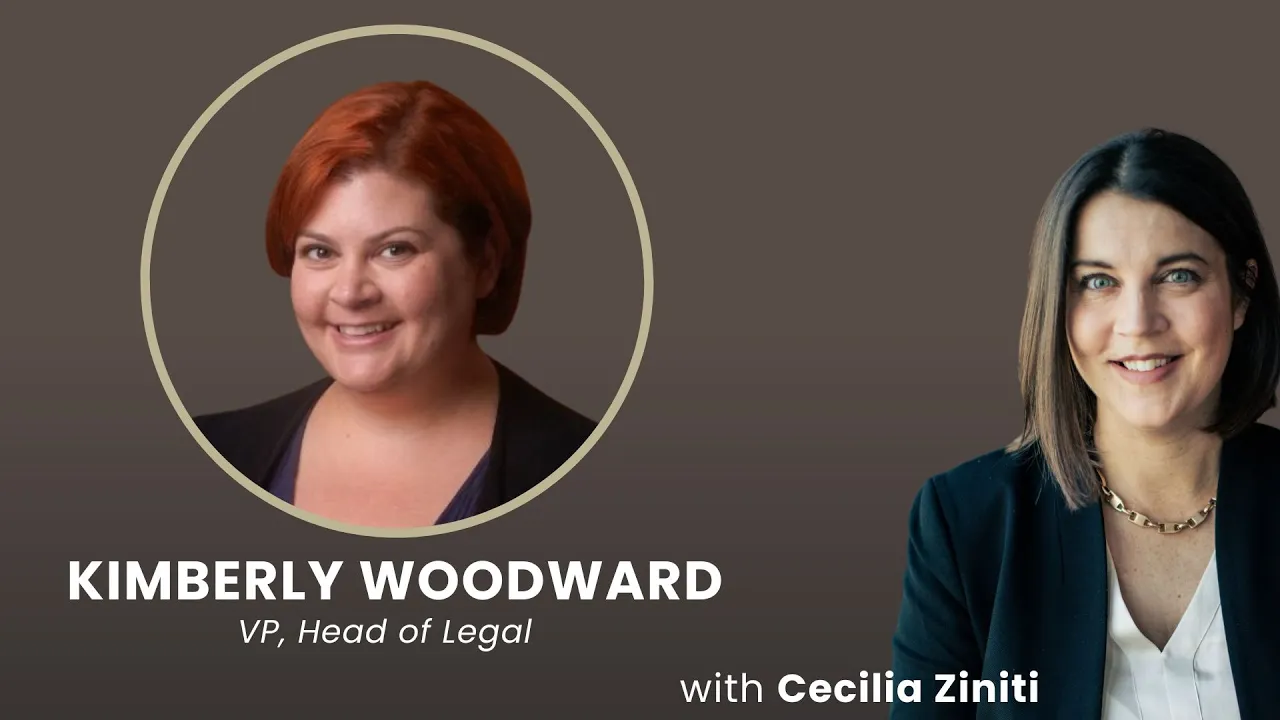
Kim Woodward is the former VP of Legal and Chief of Staff at Okta, the identity and access management company, where she spent nearly 11 years and where this episode's stories take place. In August 2026, she stepped into her first head-of-legal seat as VP, Head of Legal at Overjet, the dental AI company.
She joined Okta in October 2015 as its third attorney, after negotiating against the company on behalf of a law firm client and getting recruited by the sales rep on the other side of the deal.
She ran the open source review for Okta's IPO, stood up its contract lifecycle management system, and pitched the legal operations function she then led from 2018 on. The team grew to 15 people covering contracts management, e-billing, technology, and a dedicated AI lead.
She holds a J.D. and High Tech Law Certificate from Santa Clara University School of Law, is a ChIPs General Counsel Boot Camp participant, and mentors legal ops leaders building the function elsewhere.
Key Takeaways
Sell the function first, yourself second: Kim Woodward pitched "we need legal ops" and "I should run it" as separate arguments, because Okta's GC could fund one without the other.
Ask for headcount in the pitch, and keep a running list of what you can't do: Woodward's 2018 deck asked for two hires, and her running can't-do list wrote each new headcount case for her.
AI ownership can't be a side job: Okta legal hired a dedicated AI lead this year, because the moment demands more than "a paralegal who moonlights as your AI person."
A training that scares half the team can still be a win: Okta's first legal AI day scared half the room, and that wake-up call made two legal AI days a quarter a team KPI.
If you want to be a GC, you do numbers: Woodward makes mentees strike "I went to law school, not math school" from their vocabulary; ROI calls on tools, counsel, and headcount are the job.
Why Do Open Source Code Scans Matter in an IPO?
Unmanaged open source code can put a software company’s core IP at risk, which makes it diligence material for underwriters and acquirers. Woodward had seen it kill a deal outright.
On a prior team, an acquisition died because the target had effectively open sourced its own code.
At Okta, her GC learned she had deep open source experience, listened to her 30-minute whiteboard talk, and handed her the whole workstream for the IPO. Step one was a code scan, and the CTO refused.
Woodward said:
“Your opinion doesn’t matter. It’s happening. So assign somebody and get on board.”
She reported herself to the GC before the CTO could, and promised the scan would surface code nobody knew was there, with a thank-you due inside six months. He swore he would never thank her.
Months later, after the refactoring proved out and she had taken the underwriters’ open source questions for him, he allowed in an elevator that it had been an interesting project. She informed him that counted.
How Do You Pitch a Legal Operations Function to a Skeptical GC?
Woodward’s pitch had to clear two separate bars. The function had to be worth funding, and she had to be the right person to run it.
She treated those as different arguments and built the deck to win both.
Woodward recalled the moment that started it:
“I said, I think we need an actual legal ops department. And by the way, I think I should run it and you should move me into this role. His first response was legal ops is not a thing.”
The no didn’t hold. Her GC took the idea to his GC peer groups, came back converted, and asked her to pitch him properly, with no promise the job would be hers.
The deck leaned on CLOC’s competency wheel, the framework that maps the 12 functional areas a legal ops team owns. She used it to show where Okta had gaps and to land the argument that no lawyer doing legal work had time to close them.
Marvell’s legal ops leaders made a similar case on their episode, scaling coverage without adding lawyers.
The pitch closed with an ask for two headcount, and with a discipline she still teaches:
“One of the key things that I did and I’ve done my whole time as a legal ops leader is knowing what I can do with what I have… But here are all the things I can’t do. And I think that part is just as important.”
The answer came over lunch at a Thai restaurant in San Francisco. Yes to the function, and yes to her running it.
How Does a Legal Ops Team Grow From Two Hires to Fifteen?
Okta’s legal ops team grew the same way it was pitched, by naming a gap, tying it to business value, and asking for the person to close it. The first two hires were a hybrid who split legal work with ops support, and a contracts manager to run the new CLM.
Woodward herself stayed fractional, still doing contracts for her first couple of years, until legal ops broke out as its own function.
Each wave of growth followed a system that needed an owner. An e-billing platform. A technology lead who now has two people under her. Contracts management, which sits under legal ops and accounts for a large share of the team.
Woodward said:
Who Should Own AI on an In-House Legal Team?
Woodward’s answer is a dedicated person whose whole job is legal AI, once the team is big enough to justify one. Okta legal made that hire this year.
Woodward explained why the side-job model fails:
“I hear a lot of stories where it’s basically a paralegal who moonlights as your AI person on nights and weekends. That’s not the moment we’re in right now. You need somebody who can think about this.”
The charter is creative and hands-on, down to building agents directly in the tools.
The role also owns a judgment call most teams get wrong in AI legal ops strategy, deciding when a bespoke point solution is worth it and when the platforms the company already pays for cover the need.
How Do You Keep a 100-Person Legal Team Engaged With AI?
Woodward’s program rests on a KPI, a wake-up call, and a culture fix. The KPI is two legal AI days a quarter for the full team.
The wake-up call was the first one.
That session landed with the most advanced lawyers, scared the middle, and lost the beginners, and Woodward defends it:
“I think everyone’s realizing that everyone’s behind. It really doesn’t matter where you are on the AI curve.”
Some attendees didn’t know what an MCP was. A couple had never opened the company’s enterprise AI account.
Seeing the gap is what got them moving.
The culture fix is harder, because lawyers are not trained to share their work. Everyone builds useful things alone, and nobody else benefits.
Her team now collects use cases across the department, looking for the personal workflow that, rebuilt properly, serves the whole team.
She models the vulnerability that sharing requires, including letting a teammate watch her build an agent badly:
“I think it’s that vulnerability to be willing to say, let’s learn together, and we’re all gonna make mistakes, and you might feel silly or dumb or whatever, which is really hard for legal people, but that’s okay.”
The showcase moment came around Okta legal’s global summit in Montreal in May, with a Shark Tank-style pitch competition judged by a panel the team called the council. The top three vote-getting ideas were pitched live, every deck in the room was built with AI, and the winning idea is now getting built.
The winners got company points and hand-assembled Montreal gift bags. Woodward ran all over the city collecting the candies and syrup herself.
What Are the Three Hats In-House Lawyers Wear?
Woodward’s framework asks lawyers to keep three hats in rotation. The lawyer hat is the training and the judgment.
The human hat remembers that everyone, CEO included, is just a person. The business hat treats the legal department as the business unit it is.
The human hat is the one she sees lawyers forget first:
“I think sometimes as lawyers and any business person, you forget that we’re all human beings… at the end of the day, we’re all people. We’re just humans.”
Her favorite evidence is generational. Okta’s interns Slack senior attorneys, and the CLO, to ask for coffee.
She loves the gumption precisely because her own generation would never have dared.
Why Should Lawyers Learn to Do Numbers?
Because running a legal team means managing budgets, vendors, and ROI, and pleading innumeracy hands that power to someone else. Woodward considers this the business hat’s core discipline, and she came to it the hard way.
Her old line was “I went to law school, not math school.” She now tells people to never say it, and jokes that she “would like to go back and slap me for saying it in the past.”
In the ChIPs GC Boot Camp, she pushes back when lawyers say they don’t do numbers:
“If you want to be a GC, guess what? You do do numbers. Stop saying that, take that out of your vocabulary.”
Her practical advice removes the intimidation. Nobody expects a lawyer to be an accountant.
You know more than you think, and asking the FP&A team to explain a line item is how everyone learns.
The payoff shows up in staffing decisions. Every option costs money, and the cheapest one that fails is the most expensive of all.
Her rule is to define exactly what you need, set the budget, then buy the best thing the budget allows.
What Keeps a Lawyer at One Company for 11 Years?
Candidates ask Woodward this in almost every interview, and her answer is that Okta kept changing underneath her.
Pre-IPO, IPO, a new CLO, a restructure. It has felt like working at several companies without leaving one.
Woodward said:
“I’ve always felt that I was learning and growing… You could always raise your hand and say, hey, I really wanna do this thing. And people have been supportive.”
She has also made her ambition public. At a leadership AMA two years ago, in front of the whole team and her CLO, she said she wants a GC seat next, even though that likely means leaving someday.
She sees normalizing that conversation as part of the culture, the way finance teams brag about the CFOs they have produced. Okta board member David Schellhase traced a similar arc across three GC seats on his episode of the show.
The week before this episode aired, she took the step she had named at that AMA. In August 2026, after nearly 11 years, Woodward left Okta to become VP, Head of Legal at Overjet, the dental AI company, her first head-of-legal seat.
One more lesson from her lightning round belongs in every junior lawyer’s toolkit, from a mentor early in her career:
“Don’t go and do a ton of research when you can just ask me a question and get the answer in two minutes… Just ask me. I’ll tell you.”
If your legal team is where Okta’s was in 2018, one part conviction and zero dedicated headcount, start with GC AI’s legal AI classes, or try GC AI free on a real matter today.
Recommended Reading
AI in Legal Operations: The 2026 Five-Layer Playbook: a layer-by-layer map of where AI fits the function Woodward built, from intake to outside counsel spend.
CLOC’s Core 12: the competency wheel Woodward used to structure her original pitch deck, still the standard map of what legal ops owns.


