An in-house legal team can see a steady stream of NDAs every week. The mutual one a sales rep needs signed before a demo. The vendor’s paper sitting in the shared inbox. The one-way agreement an acquirer sent over with a five-year survival buried on page three.
Most are routine. Almost none turn on a novel point of law. And together they eat the part of the week that was supposed to go to the work only a lawyer can do.
That is the work in-house lawyers are handing to AI first. A standard NDA review is pattern work: check how Confidential Information is defined, confirm the term and survival periods are sane, and make sure the carve-outs protect your side. Pattern work is exactly what a legal AI platform built for lawyers does well, which is why NDA review is one of the first places GC AI customers point it.
The best AI to review an NDA for an in-house legal team checks each clause against your playbook, drafts the redlines inside Microsoft Word, and cites the source language for each flag. GC AI, the legal AI platform purpose-built for in-house counsel, led the contract analysis category of the In-House Legal Bench at 82.7%, ahead of ChatGPT at 72.8%. The comparison later in this piece maps five platforms to the teams they fit.
Jenna Hunt, Head of Legal Operations at Tipalti, named the problem on the CZ and Friends podcast:
“Lawyers negotiating NDAs is not practicing at the top of their license. So that was sort of low hanging fruit … we added all those up and realized that’s where we were spending the bulk of our time. And not on these strategic initiatives.”
Add up the NDA hours and they belong somewhere else. The teams getting real leverage do not just review NDAs faster. They change how the work flows: triage the inbound, let AI check the clauses that matter, redline in the document, and reserve human judgment for the two or three calls that need it.
What GC AI Is
GC AI is a legal AI platform built for in-house teams, used by 2,100+ legal departments across 53 countries.
GC AI’s CEO and co-founder, Cecilia Ziniti, was a general counsel three times (Anki, Bloomtech, and Replit), and an in-house counsel at Amazon and Cruise. Ziniti built GC AI to solve the problems she encountered firsthand as an in-house lawyer. That experience is embedded directly into GC AI’s system prompt, tone, and workflows.
Triage First: Match the Review to the Risk
Sort before you read. An inbound NDA usually drops into one of three lanes, and AI makes the sort fast enough to run the moment it lands.
Standard approval. Your own template, mutual, no markups. AI confirms it matches the approved form, flags nothing material, and the deal owner signs. No lawyer touches it.
Counsel review. The counterparty’s paper, but a routine NDA with a handful of redlines. AI runs the clause check, proposes positions, and a lawyer spends ten minutes confirming the calls instead of an hour building them.
Full review. A one-way NDA where you are the disclosing party, an unusual residuals clause, a five-year survival on trade secrets, or a counterparty whose paper is genuinely hostile. This goes to a human, with AI as the first-pass issue spotter.
The point of triage is to stop treating a clean mutual NDA from a known vendor the same as a one-sided agreement from an acquirer. Alexis Palmer, Senior Managing Counsel at Snyk, described what the saved time turns into:
“I don’t use that time to do more NDAs, I use it for higher-level work or things I find more interesting.”
The first review you save is the one you never needed to do by hand.
NDA Red Flags and Clauses AI Checks Before You Sign
A good NDA review is a checklist run with judgment. AI runs the checklist; you supply the judgment. These are the clauses that decide whether an NDA is safe to sign, and what AI surfaces on each.
Mutual vs. one-way. AI identifies which party bears the confidentiality obligation. A “mutual” NDA that obligates only you is the most common trap, and the fastest one to miss when you are reading the tenth NDA of the day.
Definition of Confidential Information.This is the clause that decides everything downstream. AI checks whether the definition is overbroad (capturing publicly available information), whether it requires marking, and whether oral disclosures are covered.
Term and survival. AI separates the term of the agreement from the survival of the confidentiality obligation, which are different periods and frequently confused. A perpetual survival on ordinary business information is a flag; a defined survival on trade secrets is standard.
Permitted use and carve-outs. AI confirms the standard exceptions are present: information already known, independently developed, publicly available, or lawfully received from a third party. Missing carve-outs are a redline, every time.
Residuals clause. AI surfaces whether a residuals clause exists and what it permits, because a broad residuals clause can gut the confidentiality protection you negotiated everywhere else.
Return or destruction. AI checks the obligation to return or destroy confidential materials on termination, and whether the receiving party may retain copies for legal-hold or backup purposes.
Non-solicit. AI flags any non-solicitation language riding inside the NDA, which is a frequent add-on that deserves its own decision rather than a reflexive accept.
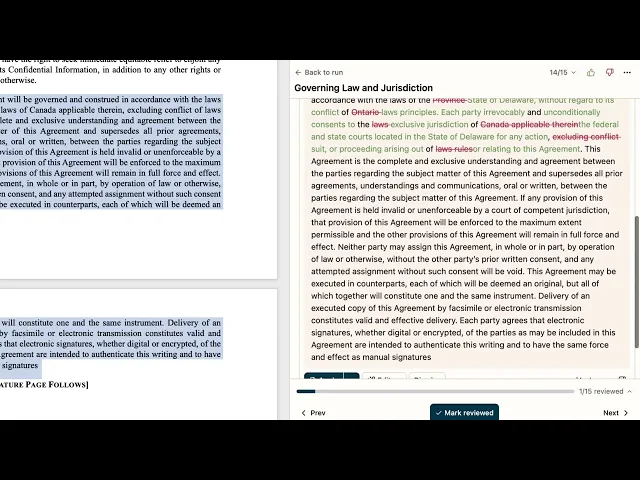
Governing law and jurisdiction. AI reports the chosen law and venue against your standard positions, so an unfamiliar jurisdiction does not slip through on autopilot.
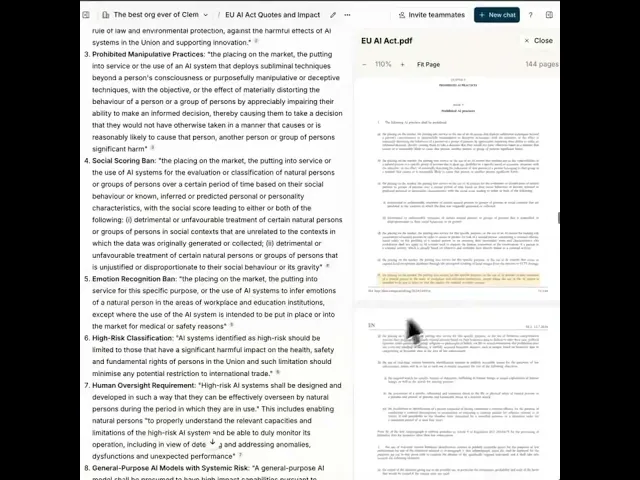
GC AI’s Exact Quote is what makes the clause check trustworthy. Instead of paraphrasing what the NDA says, it pulls the verbatim language from the document, character for character, so you are checking the text. For a clause as definition-dependent as Confidential Information, that accuracy is the bar.
Tiffany Lee, General Counsel and Corporate Secretary at Liquid Death, described the moment it clicks:
“If it sees a missing confidentiality clause, I’ll just ask it to draft one I can drop right into the agreement, no leaving the system, no reformatting.”
The Best AI to Review an NDA, by Team and Volume
For in-house legal teams, the best AI to review an NDA is GC AI, purpose-built for in-house counsel and used by 2,100+ legal teams as of September 2026. Other platforms fit other jobs.
In-house legal teams. GC AI ships NDA, MSA, and DPA Playbooks out of the box, redlines inside Microsoft Word, and ties each flag to the exact clause language with Exact Quote.
Contract lifecycle pipelines. Ironclad and LinkSquares review NDAs inside a broader CLM, a fit when intake, approvals, and storage already run through one enterprise system.
Law firm and in-house drafting. Spellbook is designed for both law firms and in-house teams, with drafting and review inside Word. GC AI vs Spellbook walks through the differences.
High-volume due diligence. Luminance is built for reviewing large document sets in diligence and audits.
General-purpose AI. ChatGPT is the world’s best general-purpose AI, but it was not built for legal work. Teams running NDAs through a general chatbot should ask how the plan handles data retention and how the output gets checked against their playbook.
The fastest way to choose: run your last ten signed NDAs through a 14-day trial and compare the redlines to what your team sent. Reviewing the MSAs behind those NDAs? AI for MSA Review: 6 Platforms Compared for In-House Teams walks through the full comparison.
Redline the NDA Where You Already Work
Spotting issues is half the job. Redlining is where AI NDA review either saves time or creates more, by forcing you to leave the document, copy text out, and paste edits back in.
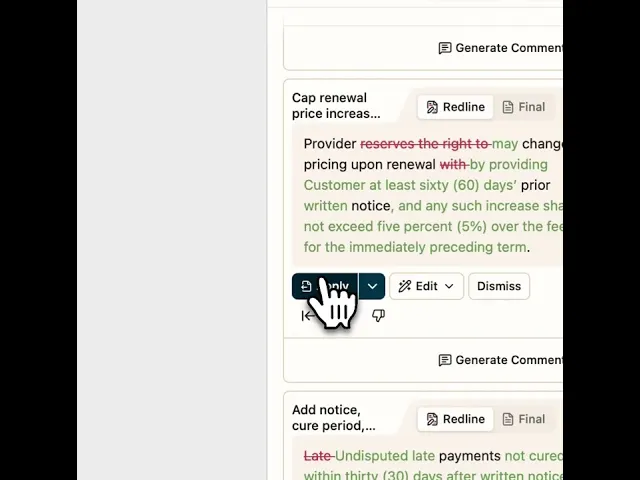
GC AI for Word keeps the redline inside the document. You select a clause or the whole NDA, ask for a redline against your positions, and the suggested changes land as tracked edits in Word, where in-house lawyers already do contract work. No exporting, no reformatting, no second screen.
Alexandra Sepulveda, Assistant General Counsel at Trust & Will, uses the same workflow to mark up the clause and wrap the redline in the right business communication:
“Imagine a redline comes back asking for unlimited indemnity. I’ll tell GC AI, ‘Here’s the clause and why we can’t accept it. Draft a four-sentence response to sales, collaborative tone, options to move forward.’”
The NDA review and the note to the deal team come out of one workflow.
Turn the NDA Review Into a Repeatable Playbook
GC AI ships a pre-built NDA Playbook that encodes the clause checks above as a repeatable workflow. As the Playbooks feature page puts it, Playbooks “automatically apply defined legal standards and positions to every contract, helping you spot issues and act faster.” Pre-built playbooks also ship for DPAs, MSAs for SaaS, and MSAs for commercial purchases, so the NDA workflow is the on-ramp to a broader review practice.
The team upside is consistency. KT Farley, Chief Privacy Officer and Associate General Counsel at Helix, described it:
“Junior teammates now run the checklist prompt first and bring me the output as the predicate for my review.”
The playbook runs the first pass; the senior lawyer reviews its output. That is the leverage Jenna Hunt was after when she added up the NDA hours and decided they belonged somewhere else.
Train the Team: AI Courses for Legal Professionals
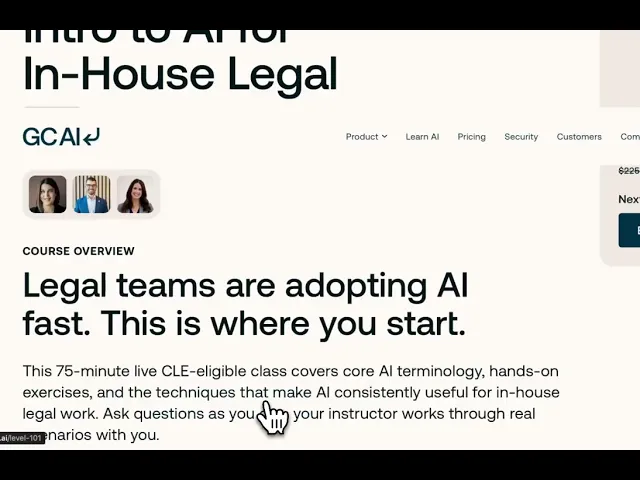
A playbook only spreads as fast as the team’s comfort with the tool. The teams adopting AI fastest pair the workflow with real training. GC AI’s free, California CLE-eligible classes, taught by former general counsels, cover running and building playbooks, prompting for legal work, and using AI inside Word. For a shortlist of where to start, see GC AI’s guide to AI courses for legal professionals.
The Calls That Still Need a Lawyer
AI runs the pattern. The lawyer makes the judgment, and on an NDA that judgment lives in a short list of decisions AI should tee up but never make alone.
Whether a five-year survival is acceptable depends on what you are disclosing and to whom. Whether to accept a residuals clause is a risk decision tied to the relationship, not a clause-library default. Whether an unfamiliar governing law is a dealbreaker or a shrug depends on the counterparty and the stakes. And whether a one-way NDA where you are the disclosing party needs outside counsel is exactly the kind of call that should reach a human early. AI gives you the issue, the standard position, and a proposed redline. You decide.
That division of labor is what teams at Hitachi, TIME, SKIMS, RIOT Games, Eventbrite, Vercel, Snyk, and Columbia run today, alongside 200+ public companies on GC AI: AI carries the volume, and the lawyer carries the decisions that move the business. To go deeper on the full review workflow beyond NDAs, see GC AI’s guide to AI contract review.
Start With the Contract You Review Most
The NDA is the right place to start because the payoff is immediate and the risk is contained. Drop your next inbound NDA into GC AI, run the clause check, and compare the redline to what you would have marked by hand. Every NDA your team automates is time back for the work that needs a lawyer.
Frequently Asked Questions
What Is AI NDA Review?
AI NDA review uses a legal AI platform to triage, analyze, and redline non-disclosure agreements clause by clause. It checks the definition of Confidential Information, term and survival, permitted-use carve-outs, residuals, return-or-destruction, non-solicit, and governing law, then proposes redlines against your standard positions. A lawyer reviews the output and owns the final judgment calls.
What Clauses Should You Check When Reviewing an NDA?
The clauses that decide whether an NDA is safe to sign are: mutual vs. one-way obligation, the definition of Confidential Information, the term and the separate survival period, permitted-use carve-outs, any residuals clause, return-or-destruction obligations, non-solicit language riding inside the NDA, and governing law and jurisdiction. AI checks each against your standard positions and flags the ones that need a redline.
Can AI Review an NDA Accurately?
Yes, for the pattern work that makes up most of an NDA. AI identifies which party bears the confidentiality obligation, whether the definition of Confidential Information is overbroad, and whether the carve-outs and survival periods are standard. GC AI’s Exact Quote pulls the verbatim contract language character for character, so you verify against the text rather than a paraphrase. A lawyer still owns the risk-weighted judgment calls.
Can AI Redline an NDA Inside Microsoft Word?
Yes. GC AI for Word lets you select a clause or an entire NDA and return suggested changes as tracked edits directly in the document, where in-house lawyers already work. There is no exporting or reformatting, which is why teams use it for redlining and contract review without leaving Word.
Is It Safe to Use AI to Review Confidential NDAs?
Yes. GC AI is SOC 2 Type II and SOC 3 certified, GDPR compliant, with zero data retention agreements with OpenAI and Anthropic, and AES-256 encryption. That security posture is why 2,100+ legal teams, including 200+ public companies, run confidential contract work through it.
What Should a Human Still Decide When Using AI for NDA Review?
A human should own the risk-weighted calls: whether a long survival period is acceptable for what is being disclosed, whether to accept a residuals clause, whether an unfamiliar governing law is a dealbreaker, and whether a one-way NDA needs outside counsel. AI surfaces the issue and a proposed position; the lawyer decides.
What Is the Best AI to Review an NDA?
For in-house legal teams, the best AI to review an NDA is GC AI: NDA Playbooks ship out of the box, redlining runs inside Microsoft Word, and Exact Quote cites the source language for each flag. GC AI led the contract analysis category of the In-House Legal Bench at 82.7%, ahead of ChatGPT at 72.8%, and pricing is public at $500 per seat per month with a 14-day trial. Ironclad and LinkSquares fit CLM-centered teams, Spellbook serves law firms and in-house teams, and Luminance targets high-volume diligence.
Can AI Tell You If an NDA Is Safe to Sign?
AI surfaces the red flags that decide the question: a mutual NDA that binds only one party, perpetual survival on routine business information, missing carve-outs, a residuals clause that guts the protection, or a non-solicit riding inside the NDA. GC AI checks each one against your playbook and drafts the redline with the source clause cited. A lawyer makes the final sign call, weighing your risk tolerance and the relationship.