


Dive Deeper
Transcript
Episode Overview
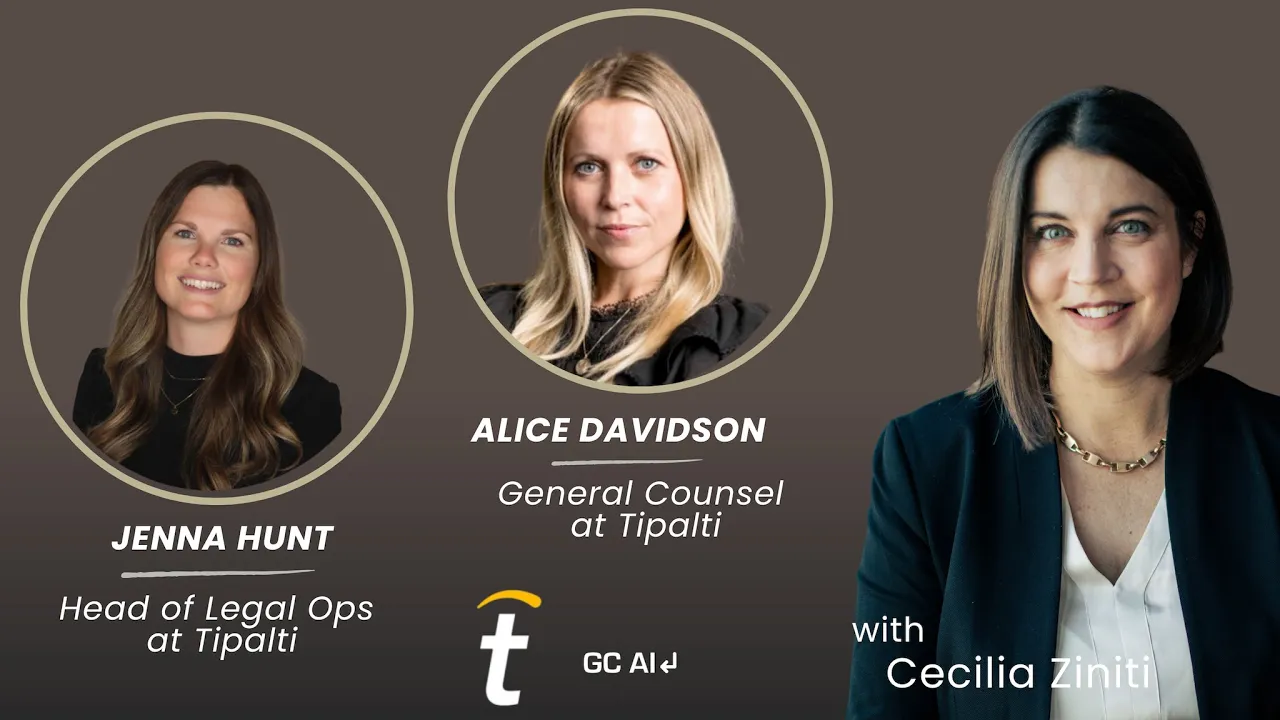
Guests: Alice Davidson, General Counsel at Tipalti, and Jenna Hunt, Head of Legal Operations at Tipalti
Legal ops automation and contract playbooks let a lean in-house team scale with the business instead of adding a lawyer for every new market. That is how Tipalti's legal team supports payments across 200 countries, 120 currencies, and 50 payment methods: playbooks that codify the company's standard positions, decision trees the business can run without legal, and automated workflows for standard NDAs.
Davidson and Hunt got so good at partnering with the business that legal became the default for everything, from NDA reviews to typos. This conversation is about how they fixed that.
About Alice Davidson and Jenna Hunt
Tipalti is a global payments automation platform that helps finance and accounts payable teams manage cross-border payments, procurement, and compliance across international markets.
Alice Davidson is General Counsel at Tipalti, where she leads the legal and regulatory compliance function for the global fintech company. A securities and M&A lawyer by training, she previously served as Chief Legal Officer at Mogo. She describes herself as "a full-time business person with a legal background."
Jenna Hunt is Head of Legal Operations at Tipalti. She built the company's legal ops function from the ground up after starting in an administrative role supporting the commercial team, drawing on a customer success and sales background to translate between legal and the rest of the business.
Key Takeaways
Legal ops needs non-lawyers. Hunt's customer success background lets her translate legalese into language sales and marketing teams can act on, a lens the attorneys on the team did not have.
Practice at the top of your license. That means reserving attorney time for work that requires a law degree; Tipalti's lawyers found the "quick five-minute asks" consumed the bulk of their time.
Contract playbooks and automated NDA workflows let the business self-serve. Decision trees and standard workflows for routine agreements mean legal reviews only the exceptions.
A failed CLM implementation teaches pre-signature diligence. Define the problem before the demo, understand legacy data migration, map downstream stakeholders, and pad every timeline.
Tipalti runs signed vendor contracts through AI to generate executive summaries. Each summary flags user limits, renewal terms, and key obligations for the business owner.
How Do You Build a Legal Ops Function From Scratch?
Start with the person already doing the work. When Davidson joined Tipalti as General Counsel, Hunt was an administrative assistant supporting the commercial team, spending her days on project management and communication between legal and the rest of the company.
Davidson formalized that work into a legal operations function, and Hunt built it out from there, starting with the tasks the team repeated most.
Hunt recalls the moment the function was named:
"Alice was sort of like, you're not doing just admin of this, you're doing legal ops, so let's create a legal ops function. Definitely kudos goes to Alice for recognizing that's what I was actually doing and allowing me to start up that function and roll with it."
Her background in customer success gave her a lens the lawyers did not have. She could translate legalese into information the sales team understood, spot when a training email was full of jargon, and predict what customers would say when presented with new terms in a renewal. As Davidson puts it:
"The infusion of the traditional legal with legal ops and having non-attorneys on the team is part of the secret sauce."
What Does Practicing at the Top of Your License Mean for In-House Lawyers?
Practicing at the top of your license means reserving attorney time for work that requires a law degree: international expansion, regulatory strategy, acquisitions. Routine NDA negotiation, proofreading, and status-chasing fall below that line.
Hunt and Davidson added up the "this will only take five minutes" requests and found they consumed the bulk of the team's time while strategic initiatives kept sliding down the priority list. Hunt puts it directly:
"Lawyers negotiating NDAs is not practicing at the top of their license... We added all those up and realized that's where we were spending the bulk of our time, and not on these strategic initiatives."
How Do Contract Playbooks and Legal Ops Automation Cut Routine Legal Work?
Tipalti's legal ops automation started with the low-hanging fruit: contract playbooks that codify the company's standard positions, decision trees the business can follow without a lawyer, and automated workflows for pre-signed NDAs. Business teams self-serve the routine agreements, and legal sees only the exceptions.
That freed Davidson's attorneys for the work that moves the company forward, including international expansion, regulatory complexity, and acquisitions.
If your team reviews dozens of NDAs and routine contracts monthly, this is the workflow Playbooks automates, with pre-built playbooks for NDAs, DPAs, and MSAs, plus custom playbooks built from your own standard terms.
How Do Legal Teams Translate Legalese for the Business?
Being bilingual means delivering legal guidance in language the receiving team can act on. When Hunt started at Tipalti, lawyers were sending compliance emails and running training sessions that other lawyers loved but that landed as a foreign language everywhere else. As Hunt explains:
"You're speaking a different language. They don't have the same background, the same context, the same training that you guys do. So we need to make this ingestible if we actually want them to learn and empower them to be able to do that."
The translation work built so much trust that it created the episode's funniest problem. Legal became the "Department of Default," the go-to owner for typo checks and lost documents.
When legal becomes the default owner of work nobody else claims, the answer is more enablement, clearer intake, and self-service for everything that does not require legal judgment.
What Can Legal Teams Learn From a Failed CLM Implementation?
Hunt's checklist from Tipalti's failed CLM: define the problem you are solving before you watch a demo, understand what importing legacy data will take, map the downstream stakeholders and their own tech roadmaps, and assume implementation will run longer than planned. Davidson's contribution was permission to quit a project that had already cost money and a year of effort:
"We walk away from this. It didn't work. Let's cut our losses today. To me that's not a failure. We've tried something and it didn't work... and we took the lessons away."
Hunt tells the full story, and what to buy instead, in the guide to legal matter management software. Her verdict on adding GC AI to the stack:
"It didn't even feel like an implementation. It was just an on switch."
How Should Legal Teams Set Goals When Priorities Keep Shifting?
Tipalti's legal team anchors annual planning to three durable pillars, then lets tactics stay fluid: a thriving and engaged legal team, strong partners across the business, and operational excellence.
Company goals layer on top, specific OKRs build from there, and the team cuts anything that no longer matters at quarterly business reviews. When priorities conflict, Davidson hands the trade-off to the business:
"I'm telling you, out of these 10 things, we're gonna be able to accomplish four by the end of the quarter. You tell us which four you wanna see."
How Does Tipalti's Legal Team Use GC AI Day to Day?
Two workflows anchor Tipalti's legal AI use: communication translation and post-signature vendor summaries. After a vendor contract is signed, the team runs it through a saved prompt in GC AI that generates an executive summary for the business owner of that technology: user limits, renewal terms, notice deadlines, and key obligations. Hunt describes the workflow:
"After the vendor contract is signed, we've built a prompt in our team that they then run through GC AI, and it gives an executive summary. Hey, business owner of this new piece of technology, these are the things you should be aware of in the contract."
Hunt calls AI the team's future "super intern." Davidson sees compounding returns:
"It's never going to displace us. It's just going to make us more efficient. As we feed our models and the models get to know our business, I just think it's going to become that much more powerful."
Tipalti is a GC AI customer. The team has saved 609 hours year-to-date (76 working days), an average of 14 hours per lawyer per week, and used GC AI to replace outside counsel on a benefits analysis project completed in three business days. As Joys Choi, Senior Director of Legal - Corporate at Tipalti, puts it in Tipalti's GC AI case study: "Out of all the AI tools I've used, GC AI delivers the most impact for attorneys."
Hunt and Davidson freed their lawyers by writing their standard positions down where the whole business could use them. Ready to try the same motion with your own team?
Recommended Reading
AI in Legal Operations: how legal ops teams put automation to work, the natural next read after Hunt's playbook-first approach.
Corporate Legal Software: the buyer's-eye view of the stack Tipalti evaluated, including CLM and matter management.
How Great GCs Think About Growth, Risk, and Crisis Management: the strategic lens behind Davidson's three-pillar planning.


