Joseph Schohl, founder of Inside Counsel Academy and former Fortune 500 GC, coaches in-house lawyers for a living and evaluates legal training programs the way you evaluate a vendor contract: with specific criteria and a low tolerance for hand-waving.
On the CZ and Friends podcast, he described his experience evaluating AI courses for legal professionals, starting with GC AI’s 101 and 201 sessions:
“I’d say that really accelerated my understanding and use of the GC AI tool and other tools as well. So I’m a big fan. And I remember thinking like there should be more training of people how to write prompts… and you guys were one of the first ones.”
This legal AI skill is learnable. In 75 minutes, you can go from knowing what AI is to having a prompt structure that produces lawyer-grade output on a real contract.
Six programs made this shortlist, covering structured prompting, contract Q&A, multi-jurisdiction research, and playbook development for standard NDAs and MSAs. Each is assessed on price, CLE credit, format, and in-house relevance.
GC AI’s curriculum gets the most attention here because it is purpose-built for the in-house context: every session, every prompt framework, and every example built from the general counsel seat.
Why Most AI Training for Lawyers Doesn’t Stick (and What to Look for Instead)
AI is already embedded in how legal work gets done. ABA Formal Opinion 512 (July 2024) states that lawyers using GenAI should reasonably understand the tool’s capabilities and limitations and consider related duties, including confidentiality and verification. That duty applies whether or not your organization has deployed an AI tool yet.
The harder question is readiness: will you have the skills to use AI well when your organization expects it of you?
The gap between a subscription and a team that has changed how it works is almost always a training gap.
Legal departments that went through a product demo and no structured training are still reverting to prior workflows a year later. There are four things worth checking before signing up for any course:
CLE Eligibility: A handful of programs earn California MCLE credit while building a real skill. GC AI (101, 201, and 110), Berkeley Law, and Lawline are the ones that do.
In-House vs. Firm Focus: Law firm AI training and in-house AI training solve different problems. Most programs on this list were built for firm-side work. One was built specifically for in-house.
Live vs. Self-Paced: The feedback loop is where skill becomes habit. Self-paced is convenient. Live is effective.
Price: Before paying anything: can you apply this to a real contract before the session ends?
To apply what a class teaches the same week, follow how to build Skills in GC AI.
CLE Eligibility
California-barred lawyers and those in states with active CLE requirements can earn credit from some AI courses while building a real skill.
Of the six programs in this guide, GC AI’s core classes carry California MCLE credit (1 to 1.25 hours per class on 101, 201, and 110), and Berkeley Law’s Power User Edition carries 6.5 California MCLE hours. GC AI’s classes satisfy California’s specialist CLE requirement on technology in the practice of law under Rule 2.72(C)(2)(a)(iv), which requires every California licensee to complete at least one hour of education addressing technology in the practice of law. Lawline offers AI-focused CLE content with multi-state credit across dozens of jurisdictions.
As of May 2026, Coursera and Harvard do not offer CLE credit on these programs.
In-House vs. Firm Focus
Law firm AI training and in-house AI training solve different problems.
Firm-side courses optimize for client deliverables, partner memo quality, and billable hour leverage.
In-house courses should optimize for contract review speed, outside counsel cost reduction, cross-functional communication, and multi-jurisdiction research turnaround.
GC AI built its curriculum exclusively for in-house teams. Berkeley’s program targets the broader legal leadership audience, without an in-house or firm-specific frame.
This distinction matters more than it sounds. A prompt structure designed to produce a client-ready partner memo will produce worse results for a GC answering a CFO’s question at 6 p.m. than a prompt calibrated to the in-house context.
Live vs. Self-Paced
Live courses let you bring actual contracts, policy drafts, and vendor agreements to class and work through them with an instructor who can respond to the specific clause you are looking at.
Self-paced courses let you move on your schedule but miss the feedback loop that separates one-time awareness from actual fluency.
For most in-house lawyers with a full plate, a 90-minute live session once a week is a more realistic commitment than a 20-hour self-paced module waiting in a browser tab.
Price
The range in this guide runs from free to $950. Before paying for anything, ask the provider: can I take a real contract from my current workload and apply what I learned before the end of this session? If the answer is no, the practical utility is limited regardless of the price.
The 6 Best AI Courses for Legal Professionals as of May 2026
The six best programs for legal professionals, in order of in-house counsel relevance:
GC AI Classes: best for in-house counsel who need practical AI skills they can use today
Berkeley Law GenAI for the Legal Profession: best for senior legal leaders building AI strategy fluency
Coursera AI for Legal Professionals: best for self-paced foundational AI literacy
Lawline AI CLE Library: best for earning multi-state CLE credit on AI topics
Harvard Law AI and the Law: best for executives focused on AI governance and regulation
National Judicial College AI for Judges and Lawyers: best for judges and courtroom practitioners
GC AI is evaluated in this guide with firsthand learner data, instructor experience, and platform outcomes. Descriptions of other programs are based on publicly available course materials and provider information. Verify current pricing and credit before registration.
Program | Price | CLE Credit | Format | Best For |
GC AI Classes | Free | 1–1.25 CA MCLE hrs (101, 201, 110) | Live, 60–90 min per session | In-house counsel needing practical AI skills today |
Berkeley Law GenAI | $950 | 6.5 CA MCLE hrs | Self-paced + optional live sessions, ~8 hrs | GCs and CLOs building AI strategy or presenting to a board |
Coursera | Free to audit | None | Self-paced, ~20 hrs | Legal ops and paralegals building foundational AI literacy |
Lawline | Subscription | Multi-state, dozens of jurisdictions | On-demand video | Lawyers prioritizing multi-state CLE credit on AI topics |
Harvard Law | $7,800 | Not listed | In-person with live components | CLOs and senior executives focused on AI governance |
National Judicial College | $2,528 (tuition + fees) | Likely (confirm at registration) | In-person, Dec 7–10, 2026 | Judges and courtroom litigators |
GC AI Classes: Best for In-House Counsel
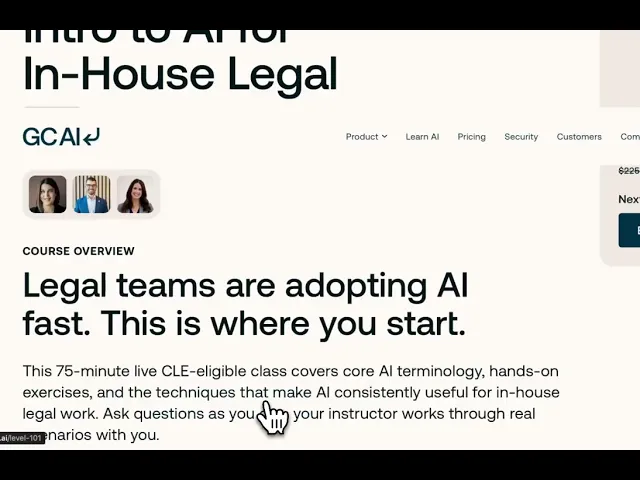
Best for: In-house counsel, associate GCs, legal ops, and general counsel who need practical AI skills now
Price: Free (individual class rates of $225-$325 waived; 14-day GC AI trial access included)
CLE: 1 to 1.25 California MCLE hours per class (courses 101, 201, and 110)
Format: Live, 60-90 minutes per session; multiple sessions per month
Prerequisite: None for 101; prior AI experience recommended for 201 and above
Among all six programs in this guide, GC AI’s curriculum is purpose-built for in-house legal teams. The instructors are former general counsels and GC AI solutions attorneys: lawyers who have sat in the seat your team occupies. Every session runs live, which means participants can use their own work examples, subject to their confidentiality obligations and GC AI’s applicable terms.
The full curriculum covers six courses, each standalone and immediately applicable.
101: Intro to AI Prompting for In-House Legal
The session runs 75 minutes and carries 1 California MCLE hour. It covers structured prompting fundamentals, including the Meryl Streep framework: be specific and contextual with AI the way a demanding director is specific with a smart actor. AI is capable of lawyer-grade output. It needs your context to get there. Register for free.
201: Advanced AI for In-House Legal
The 201 class runs 90 minutes and carries 1.25 California MCLE hours. It is designed for lawyers already using AI who want to understand how large language models work and build more sophisticated legal workflows. In 2026 GC AI 201 session polls, 91 to 100% of attendees report their legal teams already have formal AI goals. Register for free.
105: AI in Word for In-House Legal
The 105 class runs 60 minutes. It is designed for lawyers who work in Microsoft Word daily: in 2026 GC AI 105 class polls, 97% of participants do. The session covers surgical redlines, document Q&A, and end-to-end contract projects from inside Microsoft Word without switching applications. Register for free.
106 and 107: Using and Building Playbooks
The 106 class runs 75 minutes and 107 runs 60 minutes. Both are designed for lawyers who want to create reusable contract review workflows that apply company-specific standards to every NDA, DPA, and MSA automatically. Register for free.
110: Legal AI Ethics for In-House Legal
The 110 class runs 60 minutes and carries 1 California MCLE hour. It covers California bar ethics credit on AI professional responsibility, including the practical questions in-house lawyers face when deploying AI in client-facing and internal workflows. Register for free.
As of May 2026, more than 6,000 lawyers have completed GC AI’s curriculum. The lawyers who skip the months of trial-and-error are the ones who had structured training first.
Cecilia Ziniti, GC AI’s CEO and co-founder, was a general counsel three times (Anki, Bloomtech, and Replit) and in-house counsel at Amazon and Cruise. She built GC AI because she lived the gap between what legal AI tools promised and what in-house teams needed. The curriculum reflects that directly: every course is built around the in-house context.
For in-house counsel specifically, GC AI is where you can arrive with a real vendor NDA, work through it live with a former GC, earn California MCLE credit, and leave with something you apply the next morning.
Berkeley Law GenAI for the Legal Profession: Best for Senior Legal Leaders
Best for: GCs, CLOs, and legal department heads framing an AI strategy or presenting to a board
Price: $950 (discounts for alumni, nonprofits, and government; group rates available)
CLE: 6.5 California MCLE hours (includes ethics and technology practice credits)
Format: Self-paced online, approximately 8 hours; optional live Zoom Jam Sessions
Prerequisite: None
Berkeley Law’s Power User Edition is the most substantive academic option in this guide. The instructor is Wei Chen, Chief Legal Officer at Infoblox. The content comes from someone who has navigated enterprise AI adoption from inside a legal department. The tagline: “Stop Prompting. Start Leading.”
The 9-module curriculum covers AI foundations, ethics, research, drafting, organization, presentations, and governance, with a focus on building durable AI habits rather than learning specific prompts. Content access runs through February 15, 2027. The 6.5 California MCLE hours is a genuine credit amount for lawyers who need to justify the investment to a firm or department.
At $950, Berkeley serves a specific moment: a GC or CLO who needs to present an AI governance framework to leadership, advise a board on enterprise AI risk, or build a department-wide AI adoption case. A lawyer who needs measurable speed gains on contract review this week will get a slower return here.
The tradeoff: $950 upfront before you’ve established whether the material translates to your work. Self-paced delivery gives you no feedback on the specific clause you’re looking at. The 8-hour runtime works best scheduled as a quarterly investment.
Coursera AI for Legal Professionals: Best for Self-Paced Fundamentals
Best for: Legal ops professionals, compliance teams, and paralegals building foundational AI literacy
Price: Free to audit; as of May 2026, certificate requires Coursera Plus subscription or individual purchase
CLE: None
Format: Self-paced, approximately 20 hours across 8 modules
Prerequisite: None; beginner level
Coursera’s AI for Legal Professionals is offered through AI CERTs, not a law school. The eight-module structure covers AI and machine learning fundamentals, natural language processing in legal research, contract review automation, predictive analytics, ethics, and implementation, referencing tools including ChatGPT, Humata, and Amto alongside the conceptual material.
The right audience is a legal ops professional, paralegal, or compliance specialist who needs a structured AI literacy foundation and can work through 20 hours independently over a few weeks. As of publication, the program offers no CLE credit, no live instruction, and no in-house-specific framing. Free to audit; certificate requires payment or a Coursera Plus subscription.
The tradeoff: The course is offered through AI CERTs, a certification provider, rather than a law school or practicing law faculty. If institutional credentialing matters in your organization’s training approval process, verify that before recommending it internally. Twenty hours of self-paced video without a feedback loop or in-house framing. The content builds AI literacy; it does not have you apply AI to a real vendor NDA before the session ends. No CLE credit.
Lawline AI CLE Library: Best for Multi-State CLE Credit
Best for: Legal professionals who need CLE credit on AI topics across multiple jurisdictions
Price: Subscription-based
CLE: Multi-state credit across dozens of jurisdictions
Format: On-demand video
Prerequisite: None
Lawline is a CLE aggregator with a growing library of AI-focused on-demand sessions. If the primary constraint is multi-state CLE credit on AI topics, Lawline is the most efficient path.
The tradeoff: On-demand CLE content on AI topics tends toward survey coverage. Lawline is built for credit hours. If skill-building is the goal, live instruction returns faster results.
Harvard Law AI and the Law: Best for AI Governance and Policy
Best for: Senior executives, CLOs at public companies, and those focused on AI regulation
Price: $7,800 (verify current pricing at registration)
CLE: Not listed
Format: In-person with live components; 8+ years of professional experience recommended
Prerequisite: Senior experience recommended
Harvard Law’s program frames AI through the lens of regulation, judicial treatment, and enterprise governance: the content a CLO needs to chair an AI governance committee or brief a board. The program added hands-on components. The 8+ years experience guideline signals an executive audience rather than a skills-building one.
At executive education pricing, Harvard is the right investment for a legal leader whose primary responsibility is governance. For an in-house lawyer whose primary constraint is getting through the contract queue, it is a significant overinvestment.
The tradeoff: At $7,800, this is a governance investment, not an annual training line item. The experience requirements (8+ years recommended) and in-person format confirm the audience: a CLO with board-level responsibilities. For in-house counsel whose workload is contracts, research, and outside counsel management, the curriculum addresses the right technology at the wrong altitude.
For a practical framework for evaluating AI tools before they enter the business, see AI Governance Intake: 7 Questions That Trigger Review.
National Judicial College AI for Judges and Lawyers: Best for Courtroom Practitioners
Best for: Judges, courtroom litigators, and lawyers in regulatory proceedings
Price: $2,528 ($1,979 tuition + $549 conference fee); four-day in-person program, San Diego
CLE: Likely (confirm at registration)
Format: In-person, December 7-10, 2026
Prerequisite: None listed
The National Judicial College’s AI program covers AI fundamentals through the lens of evidence, judicial independence, and courtroom proceedings. The framing is courtroom-specific. For most in-house counsel, the content is tangentially relevant. For litigators and judges, it is the most purpose-built option on this list.
The tradeoff: Four-day in-person commitment in December with curriculum calibrated for courtroom practitioners. For in-house counsel with no litigation responsibilities, the curriculum addresses a different role.
How In-House Teams Build AI Fluency
Courses teach the skill. The team conversation that follows is what embeds it.
Elana Freeman, Head of Legal and Compliance at Swing Education and a CZ and Friends guest, described what happened immediately after taking both GC AI prompting courses with her colleague:
“We also shared tips, especially close after the prompting classes… I was like, how are you using it? What’s been working? How can we experiment? So exchanging, hey, how do you do this? I tried this today. Now, do you use it this way? How did you use it? Any other creative ways you’re using it?”
That pattern (course as catalyst, peer conversation as accelerant) is how in-house teams build AI fluency across a department. The course gets everyone to a baseline. The team conversation is where the baseline becomes a habit.
The CZ and Friends podcast is the ongoing version of that conversation. Hosted by GC AI CEO Cecilia Ziniti, it brings GCs from Snyk, Tipalti, Arc’teryx, BlueLinx, and others on to walk through how they changed their practice. Free, on all podcast platforms, and more candid than most course curricula.
How to Choose the Right AI Course for Your Situation
The right course depends on what you need to accomplish before your next contract review, your next board presentation, or your next CLE deadline.
If you review contracts daily and need to be faster this week: GC AI’s 101 class is 75 minutes, free, and live. Bring a contract from your own queue.
If you’re a GC or CLO presenting an AI strategy to a board: Berkeley Law’s Power User Edition covers governance, enterprise adoption, and leadership framing. 6.5 California MCLE hours.
If CLE credit is the constraint: For California MCLE, GC AI’s 101, 201, and 110 classes each carry 1 to 1.25 hours. For multi-state credit across dozens of jurisdictions, Lawline covers the most ground.
If your team is building foundational AI literacy: GC AI’s 101 class is 75 minutes, free, and built for in-house work. For self-paced foundational literacy without a live component, Coursera’s AI for Legal Professionals is free to audit at 20 hours.
If you’re a litigator or judge: The National Judicial College’s December program is purpose-built for courtroom context.
If you are managing a legal department, the pace of AI adoption across your team matters more than the price of any single course.
Legal professionals who complete GC AI’s structured curriculum build consistent AI habits significantly faster than those who go through a product demo alone. The 75 minutes is not the cost. The months of slower adoption without structured training is the cost.
Where to Start: GC AI for In-House Counsel
Every program in this guide is worth recommending to the right person. Berkeley and Harvard serve the governance level. Lawline covers multi-state CLE. Coursera builds foundational literacy for legal ops teams.
For in-house lawyers whose primary work is contracts, research, and outside counsel management, GC AI is where to start.
The 101 class is 75 minutes, free, taught by a former GC, and immediately applicable: bring a real contract from your queue and leave with a prompt structure you use before your next review. If you want to see the full platform first, GC AI offers a live demo and a 14-day free trial.
Frequently Asked Questions
What Are the Best AI Courses for Legal Professionals in 2026?
The best AI courses for legal professionals in 2026 depend on your role and primary goal. For in-house counsel who need practical daily-use skills, GC AI’s free classes (101, 201, 105, 106, 107, and 110) are the strongest option: California MCLE-eligible, taught by former general counsels, and immediately applicable to contract review, research, and drafting. As of September 2026, more than 8,000 lawyers have completed GC AI’s curriculum across 2,200+ legal departments. For senior legal leaders building AI strategy, Berkeley Law’s GenAI Power User Edition ($950, 6.5 CA MCLE hours) is a well-regarded program. Coursera’s AI for Legal Professionals is the best self-paced foundational option, free to audit.
Are There Free AI Courses for Lawyers?
Yes. Several free options exist for lawyers. GC AI’s full curriculum (101, 201, 105, 106, 107, and 110) is free to attend. The 101 class covers structured prompting fundamentals in 75 minutes; 201 covers advanced AI workflows in 90 minutes; 105 covers AI inside Microsoft Word; 106 and 107 cover building and using reusable contract playbooks; and 110 covers legal AI ethics. Three courses (101, 201, and 110) carry California MCLE credit. Classes are live, are taught by former GCs and GC AI legal instructors, and run multiple sessions per month. Coursera’s AI for Legal Professionals is free to audit: 20 self-paced hours across 8 modules covering AI fundamentals, contract review automation, and NLP in legal research. No CLE credit; a certificate requires a Coursera Plus subscription. Clio’s Legal AI Fundamentals Certification is free and self-paced, approximately 2.5 hours across five short videos with a quiz. No CLE credit; aimed primarily at law firm practitioners. Justia offers free AI and ethics webinars; some jurisdictions accept these for CLE credit via reciprocity or self-submission.
Which AI Courses for Lawyers Count for CLE Credit?
GC AI’s 101, 201, and 110 classes each carry 1 to 1.25 California MCLE hours. Berkeley Law’s GenAI Power User Edition carries 6.5 California MCLE hours, including ethics and technology practice credits. Lawline offers AI-focused CLE content with multi-state credit across dozens of jurisdictions. The ABA’s AI in Action course offers 1 ethics CLE credit hour. Justia AI ethics webinars may qualify for CLE credit via self-submission in some jurisdictions. As of May 2026, Coursera and Harvard do not list CLE credit on their AI programs. Confirm eligibility with your state bar before registering.
What AI Skills Should In-House Lawyers Focus on First?
Start with structured prompting: the skill of giving AI the context it needs to produce lawyer-grade output. A well-structured prompt is the difference between a usable first draft and a paragraph that misses your company’s standard positions. Once prompting is reliable, document Q&A returns time immediately on an active contract queue: extracting specific answers from long agreements without reading every page. GC AI’s 101 class covers both in 75 minutes, with participants using real contracts from their own work.
What AI Skills Do Lawyers Need to Learn in 2026?
The competence floor is rising. ABA Formal Opinion 512 (July 2024) establishes a duty to understand the capabilities and limitations of any AI tool used in practice, making AI literacy a professional responsibility requirement. In-house lawyers working at AI speed in 2026 have four skills in common: structured prompting (getting reliably lawyer-grade output from AI), document Q&A (extracting answers from long agreements without reading every page), research synthesis (first-pass multi-jurisdiction analysis before outside counsel escalation), and playbook development (reusable contract review workflows for NDAs, DPAs, and MSAs that apply company-specific standards automatically). GC AI’s curriculum is built around that sequence: 101 for prompting foundations, 201 for advanced workflows, and 106 and 107 for playbooks.
Is GC AI’s Curriculum Appropriate for Lawyers Who Already Use AI Tools?
Yes. GC AI’s 201 class and specialist courses (105 for Word, 106 for Using Playbooks, 107 for Building Playbooks) are designed for lawyers with prior AI experience who want to go deeper. In 2026 GC AI 201 session polls, 91 to 100% of attendees report their legal teams already have formal AI goals. The 201 class covers how large language models work and builds more sophisticated legal workflows on that foundation.
What Is the Difference Between GC AI’s Classes and Academic AI Programs?
GC AI’s classes teach you to use AI in your legal work today, with real documents and real legal questions from participants brought to each live session. Academic programs (Berkeley, Harvard) teach you to understand, strategize, and govern AI at an enterprise level. Both are valuable and serve different moments in a legal leader’s career. Most in-house teams need the practical skills layer first, with the strategic layer added as AI becomes embedded in daily operations.
How Do I Make the Budget Case for an AI Course to My Legal Department Head?
GC AI’s 2025 ROI study of more than 100 active customers found that legal professionals save an average of 14 hours per week and reduce outside counsel spend by 14%. The GC AI ROI Calculator takes your team size, hours spent on contracts, and annual outside counsel budget and returns an annual dollar impact estimate. For GC AI’s classes specifically: they are free, California MCLE-eligible, and 75 to 90 minutes per session. One Associate General Counsel in pharma described the class as “easily the most valuable continuing education/CLE I have ever taken” and said it would be “worth 5X the cost.” The budget conversation is straightforward.