“Force multiplier.” That is the phrase General Counsel and Corporate Secretary at Innovative Renal Care, used on the CZ and Friends Podcast when he described what AI does to his paralegal team. Inside in-house departments running AI today, the answer to the replacement question is already playing out. Here is how Kable put it:Chuck Kable,
“The AI tools like GC AI are a force multiplier for my support level folks, for my paralegal team… We can use AI tools to get to a discussion draft at the very least that can then be immediately presented to attorneys for feedback, comments, and then off to the other side.”
Danielle Sheer, Chief Legal and Trust Officer at Commvault, frames the same shift from a level up:
“What I think AI does is it creates space… I have more time to build relationships because now I have the answer quicker.”
Kable is describing the document compression paralegals already own. Sheer is describing what that compression frees up: relationship work, judgment work, the parts of legal practice that have always been the highest-paid and that AI cannot touch.
AI is not replacing paralegals as a profession. State bars regulate what a paralegal can and cannot do without attorney supervision, AI does not appear in court, and witness prep is not a chatbot job. What AI is doing is taking over the first-pass document work that used to set the rhythm of a paralegal’s day. Paralegals on legal teams running legal AI well are turning matters around faster than they did two years ago and reaching for work that used to sit a level above them. Fluency in these tools is what unlocks that lane.
Dozens of conversations on the CZ and Friends Podcast, hosted by CEO Cecilia Ziniti, with general counsels, chief legal officers, and legal ops leaders, line up with what Clio’s 2024 Legal Trends Report found at scale: 69% of the hourly billable work paralegals perform is automatable by AI. That is task volume. The role sits at a different layer.
Picture the inbound NDA queue on a Tuesday morning. Five vendor NDAs by 9am. In 2022, that was a full day of pasting standard markup, hunting for fallback positions, and writing the cover note to the attorney. In 2026, a paralegal on a team running Playbooks opens each one, runs the team’s NDA Playbook against it, and hands an attorney five marked drafts before lunch.
The attorney reviews the redlines instead of generating them. The same paralegal spends the afternoon on the work AI cannot do: prepping a witness, judging whether a counterparty will walk over a data-residency requirement before the head of sales commits to a timeline, and making the calls that turn on knowing how this GC, this business, and this counterparty behave. AI can pull the deal history in seconds; deciding what it means is still the paralegal’s.
What AI Is Already Handling for Paralegals
Legal AI handles a growing share of high-volume paralegal workflows inside in-house legal teams. Here is what the shift looks like, organized by the workflows paralegals own.
Document review and due diligence. AI scans thousands of contracts in minutes, flags non-standard language against a team’s preferred playbook, and surfaces missing or non-conforming clauses. A document review pass that ran nights and weekends in 2020 now runs in hours. For a fuller breakdown, see AI Contract Review for In-House Counsel.
Contract redlining and drafting. AI generates first-pass drafts for NDAs, DPAs, MSAs, vendor agreements, and routine commercial terms. GC AI Playbooks run agentic multi-step contract review against the team’s own standards before a paralegal opens the document.
The paralegal moves from drafting from scratch to reviewing and tightening AI output. That is faster work at a higher skill level. It is also the workflow most exposed to compression: the paralegal who runs five inbound NDAs a week through a Playbook handles ten now without adding hours.
Legal research and case law retrieval. AI retrieves relevant case law, regulatory guidance, and secondary sources with citations. GC AI Research, GC AI’s multi-agent legal intelligence layer, deploys agents simultaneously across authoritative databases and government sites, then returns a structured brief with linked sources a paralegal can hand to an attorney.
Document intake and matter organization. AI extracts party names, key dates, deal terms, and obligations from incoming documents and routes them into the right matter folder. The intake stack that used to require an hour of paralegal time per new matter runs in minutes.
Calendaring and deadline tracking. AI parses court orders, settlement agreements, and procedural rules to surface filing deadlines and statute-of-limitations dates. The paralegal verifies and owns the calendar; the data extraction step compresses.
E-discovery and document production. AI clusters documents by topic, flags privileged material for human review, and accelerates the responsiveness coding that paralegals historically owned.
First-draft client communications and memos. AI drafts status updates, regulatory summaries, and internal memos using the team’s own voice and template library, which a paralegal then refines before an attorney signs.
For an in-house paralegal who used to wait on outside counsel for clean drafts, that shift is significant. The first pass is theirs to run now. AI handles the bulk of the task volume. You own the last mile judgment, validation, and the relationship work, which is now the highest-paid part of the job.
Why AI Cannot Replace Paralegals as a Profession
Even with AI absorbing the first-pass workflow, paralegals carry six obligations and capabilities AI cannot hold. These are the parts of the role that stay human, with no automation path on the horizon.
Supervised practice and the unauthorized practice of law. Every state bar regulates what a paralegal can and cannot do without attorney supervision. A paralegal sits inside a regulatory and ethical framework. An AI model sits outside both. ABA Formal Opinion 512, issued July 29, 2024, made explicit that lawyers using AI retain professional responsibility, including the duty to supervise non-lawyer assistants who use AI.
In Mata v. Avianca, a Southern District of New York lawyer was sanctioned in 2023 for filing a brief with AI-fabricated case citations. The licensed human stays on the hook for what AI produces. The paralegal supporting that human is accountable for the validation step.
Court appearances and filings. Paralegals interact with court clerks, file motions, deliver service of process, and handle the procedural mechanics that move a matter forward. AI does not appear in court.
Witness preparation and client interviews. Sitting across from a witness, reading their reactions, adjusting questions in real time, building the rapport that makes a hard interview productive: these are presence skills. AI drafts the email. The paralegal builds the relationship.
Ethics, conflicts, and confidentiality. Conflict checks, privilege protection, and ethical boundary calls are professional responsibility work that lives with the supervising attorney and the paralegal who supports them. AI carries no duty of confidentiality. The paralegal does.
Judgment under ambiguity and edge cases. A document review pass surfaces 200 issues. Which three matter for this deal, this counterparty, this risk tolerance, this week? That is judgment, layered with context about the business, the partner, and what the lawyer is trying to accomplish. AI is reliable on the typical. Atypical fact patterns, novel deal structures, and matters with overlapping jurisdictions still need a paralegal who can flag what falls outside the standard pattern.
Institutional knowledge and cross-team coordination. Some of what used to count as institutional knowledge now lives in the tools. A Playbook captures which clauses the GC will never accept; the deal archive shows which counterparty negotiates hard on indemnity. What stays with the paralegal is the read on top of it: knowing why the GC drew that line, when an exception is worth raising, and which executive needs the one-line summary before they will open the memo. That judgment comes from years in the seat, and it is what keeps outside counsel, in-house attorneys, and business stakeholders aligned across multi-firm matters and cross-functional projects.
The same dynamic is reshaping paralegal expectations. Hiring managers comparing two paralegal candidates now ask a different question: which one walks in with a Playbook open and a Skill Library already configured? The candidate who can answer that without flinching is the one moving up. A paralegal who runs AI on the first-pass workflow above and owns these six layers is doing the work of two paralegals at the same comp band, with more interesting matters and less weekend rework.
The Best AI Tools for Paralegals
Your work already lives inside Word, inside the team’s standards, and inside the matter context the paralegal is holding in their head. The buying decision for a paralegal-heavy workflow looks different from a buying decision led by a litigator or a transactional partner. Paralegals need workflow tools that can be configured to the team’s voice and house style. The in-house counsel AI software guide covers the evaluation framework end-to-end.
Six capabilities separate the AI tools worth evaluating for paralegal work from the ones built for a different buyer.
Native Word integration. Paralegals draft, redline, and track changes inside Word. AI that lives in a browser tab and requires copy-paste sits outside where the work happens. Ask any vendor whether their AI runs inside Word with full track-changes support, or whether their integration is a sidebar that exports a comment file.
Team standards and playbook support. A paralegal’s value is partly their fluency in the team’s preferred clauses, fallback positions, and house style. The AI tool has to learn those. Ask whether the platform ships pre-built playbooks for the agreement types the team handles most (NDAs, DPAs, MSAs, vendor agreements) and whether the team can build and version its own.
Source-anchored citations. A paralegal handing a draft to an attorney needs to be able to point to where every claim came from. Ask whether the platform returns character-level citations to the underlying document, or paraphrases that look authoritative without an anchor.
Multi-document research with linked sources. Legal research that crosses statutes, regulations, and case law has to return citations that the paralegal can verify. Ask whether the platform deploys multiple agents across authoritative databases simultaneously and returns linked sources, or whether it pattern-matches from training data.
Security and confidentiality posture. A paralegal handling client documents needs to know the AI does not train on the inputs. Ask for SOC 2 Type II, SOC 3, GDPR compliance, and zero data retention agreements with the underlying LLM providers in writing.
Embedded training. AI fluency compounds with practice. Ask whether the platform ships free, structured training (live classes, recorded sessions, CLE credit), how the team can move from individual use to department-wide fluency within a quarter, and whether the curriculum was designed by lawyers who have been in the seat.
The legal AI market splits into purpose-built in-house platforms, law-firm-first platforms, contract-lifecycle-management tools with bolt-on AI, and general-purpose enterprise AI.
The legal AI tools guide and the best legal AI tools for in-house counsel guide cover the category map and what to evaluate inside each lane. GC AI sits in the purpose-built in-house category. Chuck Kable described the platform above as a force multiplier for his paralegal team.
How Legal Teams Run Paralegal Workflows on GC AI
Cameron Clark, Head of Legal at Arc’teryx, who spent his first year as the company’s only lawyer and built the legal function with paralegal support, described the platform-level impact:
“We couldn’t do our job without it… We simply wouldn’t have been able to keep up without GC AI.”
What the platform actually does for high-volume paralegal-style work breaks down by feature.
GC AI Playbooks run agentic, multi-step contract review against the team’s own standards. A paralegal starts a Playbook on an inbound NDA, the platform runs the team’s preferred markup against the document, and the paralegal hands an attorney a marked draft that is already substantially aligned with where the team wants to land. Playbooks ship pre-built for NDAs, DPAs, and MSAs for both SaaS and commercial purchases, with custom Playbooks available for the agreements unique to a team.
GC AI for Word puts AI directly inside Microsoft Word, where paralegals already do most of their drafting and redlining. Chat2 inside the Word add-in lets a paralegal run research, ask follow-up questions, and pull web context without switching applications. Web chats sync into Word with one click.
Exact Quote returns character-level citations from the underlying document. When a paralegal hands an attorney a memo or contract summary, every claim is anchored to a specific clause in a specific document. The validation step that used to require re-reading the source is built into the output.
The Skill Library ships ready-to-use prompts for the workflows paralegals run repeatedly: NDA review, DPA review, regulatory summaries, board consents, deposition prep memos. A paralegal can run a workflow without writing a prompt from scratch.
Files lets a paralegal upload and organize matter documents into permanent collections accessible across every chat. Analyzing up to 1,500 pages at once means the entire data room is one query away, with the team’s style and standards already loaded.
The paralegal workflows the platform supports come directly from that experience: she ran them herself, and she knew which ones had to be automated for in-house teams to scale without doubling headcount.
The gap between a platform built for this work and a general-purpose chatbot shows up clearly in testing. In the In-House Legal Bench (May 2026), GC AI’s R&D team scored four AI platforms against 100 real in-house legal tasks, each graded on an answer key built by attorneys with more than 80 combined years of practice.
GC AI led every one of the 10 task categories. On the work paralegals run most:
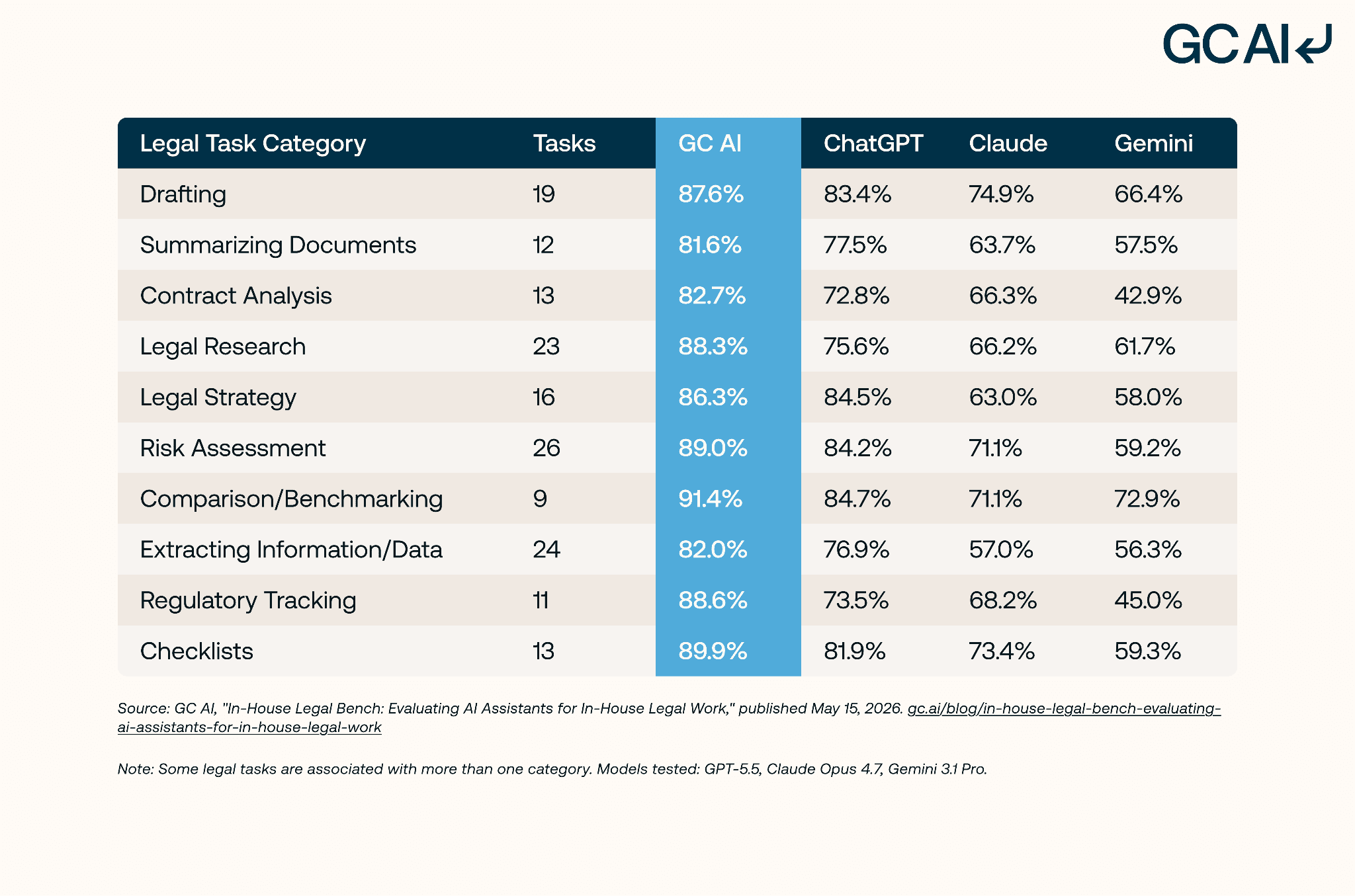
For a paralegal handing work up to an attorney, that accuracy gap is what determines how much validation a draft still needs before it moves.
The GC AI ROI study, published in January 2026 and covering more than 100 active GC AI customers, found teams save an average of 14 hours per lawyer per week and cut outside counsel spend by 14%. That 14% reduction works out to approximately $252,000 in annual savings for the median company, applied against the $1.8 million in outside counsel spend a median in-house department reports in the ACC Law Department Management Benchmarking Report. Those savings reach the whole team. Every Playbook run, every Skill Library workflow, and every GC AI for Word session a paralegal completes feeds the reclaimed hours behind them.
How to Train as a Paralegal for the AI Era
The single biggest predictor of how AI shifts a paralegal’s role today is whether the paralegal has invested in fluency.
AI fluency for paralegals breaks into three skill layers.
Prompt fluency. Knowing how to brief an AI model the way you would brief a junior associate. Most paralegals are comfortable here within a week because the structure mirrors how they already explain matters to new attorneys. The class GC AI teaches on this, 101 Intro to AI Prompting, is 75 minutes long, free, and CLE-eligible in California for one credit hour. As of May 2026, more than 6,000 lawyers have completed GC AI’s curriculum.
Workflow fluency. Knowing which platform features handle which tasks: when to run a Playbook versus an ad-hoc chat, when to pull a Skill versus write a prompt. This compounds with practice. GC AI Classes 105 (AI in Word), 106 (Building Playbooks), and 107 (Using Playbooks) cover the workflow layer directly.
Validation fluency. Knowing how to read AI output critically: which citations to verify, which summaries to trust, which edge cases the model tends to mishandle. This is the most senior skill of the three and the one that takes longest to build. It is also the skill that most cleanly separates a senior paralegal from a junior one today. Trust, precision, and craft are the values legal work runs on; AI fluency is how the paralegal who validates and the in-house lawyer who signs the result carry them forward.
Frequently Asked Questions
Will AI Replace Paralegals?
AI will not replace paralegals as a profession, and it is already replacing the document-heavy first-pass work paralegals historically owned. The supervised practice framework, court-facing work, and client relationships sit outside what AI can do. The 2024 Clio Legal Trends Report estimates that 69% of hourly billable paralegal work is automatable by AI, which describes task volume across the role. Inside in-house legal teams running AI well, the consistent pattern is paralegals taking on more matters and harder work.
Will AI Replace Paralegals by 2030?
The most credible expert view is no, not as a profession. AI will continue to compress paralegal task volume in document review, drafting, research, and intake through the rest of the decade. It will leave intact the supervised-practice, court-facing, and client-relationship functions that anchor the role. Paralegals who build AI fluency take on more complex matters and become more valuable to their teams.
What Are the Best AI Tools for Paralegals in 2026?
The best AI tools for paralegals run inside Word, learn the team’s standards, return source-anchored citations, and meet security requirements for confidential client work. GC AI is purpose-built for in-house legal teams, including the paralegals who support them, and runs inside Word with Playbooks, Exact Quote citations, and a Skill Library of ready-to-use legal workflows. Other categories worth considering include law-firm-first legal AI platforms (strong model accuracy, lighter in-house playbook layer), contract lifecycle management with bolt-on AI (good for routing and signature, lighter on legal reasoning), and general-purpose enterprise AI inside the broader productivity suite (sits outside the legal domain). The best legal AI tools for in-house counsel guide goes deeper on the evaluation framework.
What AI Training Should a Paralegal Take?
A paralegal new to AI should start with a structured class on legal AI prompting, then build daily-use habits inside the tools the team has adopted. GC AI Classes include 101 Intro to AI Prompting (75 minutes, free, CLE-eligible in California for one credit hour) and 105 AI in Word, both designed for legal professionals at any seniority level. More than 6,000 lawyers have completed the curriculum as of May 2026. Prompt fluency is week one; workflow and validation fluency build over the first quarter.
Will AI Make Paralegals Obsolete?
AI will not make paralegals obsolete. The supervised practice framework that defines paralegal work requires a human inside a regulated profession. AI accelerates the document-heavy parts of paralegal work and leaves the judgment, validation, and relationship parts intact. Paralegals who adopt AI tools become more productive and more strategically important to their legal departments.
How Will AI Affect Paralegals in Law Firms vs. In-House?
In-house paralegals see the biggest near-term productivity lift from AI because in-house legal departments adopt AI faster than law firms. As Diane Honda, CAO at Redis, put it on the CZ and Friends podcast, “[AI] now puts at the in-house counsel’s fingertips what really associates and other paralegals in law firms had better access to.” Law firm paralegals are catching up as firms roll out AI platforms, and the in-house side is moving first because the buying decision sits with one person inside a single department.
Can AI Replace Paralegals in Document Review?
AI handles the high-volume, rules-based parts of document review, including privilege flagging, responsiveness coding, and document clustering across large sets. It cannot make the final judgment calls about strategic significance, edge cases, or how findings shape the broader matter strategy. AI compresses document review time substantially. The paralegal overseeing the work becomes more valuable because the validation step is now the differentiator. See AI Contract Review for In-House Counsel for the workflow breakdown.
What About Paralegal Jobs Long Term?
The U.S. Bureau of Labor Statistics projects little or no change in paralegal employment from 2024 to 2034, with about 39,300 openings per year over the decade. Those openings come almost entirely from turnover and retirement, and the BLS specifically calls out AI as a factor limiting net headcount growth. That makes AI fluency the differentiator. The paralegals best positioned for the next decade are the ones building AI fluency now, taking on matters that previously required associate-level work, and developing the validation skills that AI cannot replicate. The historical pattern of legal technology adoption, from e-discovery through contract management, has been that the role gets more valuable as the tools get better.
Should Paralegals Be Worried About AI?
The most useful posture for paralegals on AI is adoption. Paralegals who run AI on their high-volume tasks every day take on more complex matters, with shorter turnaround, than they did two years ago. The faster a paralegal builds fluency, the more room they have to grow inside their team, their department, and the broader profession.