In-House Counsel AI Software: What to Buy, What to Skip
By Caitlin Price, Social Media & Content MarketerUpdated Published
Your CFO wants to know why the legal department is adding another SaaS line item. That is the real starting point for in-house counsel AI software in 2026.
The question is no longer whether a legal team will use AI. 52% of US in-house counsel started using generative AI tools in 2025, more than double the year before, according to the 2026 ACC Chief Legal Officers Survey of 1,049 CLOs across 43 countries, and over 90% of lawyers now use at least one AI tool in daily work, per the 2026 Wolters Kluwer Future Ready Lawyer Report. The question is which platform earns a line on the stack, survives the renewal review, and returns a number you can defend to finance.
That decision usually lands on one person: the legal ops leader who owns the vendor list and the renewal calendar, the associate GC who runs the contract review workload, or the head of legal who has to present the spend to a CFO. This page covers how to build the business case, what to buy, what to skip, and how to run a vendor evaluation that reaches a decision in a week instead of a quarter. For a tool-by-tool reading aimed at the individual lawyer choosing a daily driver, see Best Legal AI Tools for In-House Counsel.
We built GC AI for this decision. Cecilia Ziniti, our CEO and co-founder, was a general counsel three times (Anki, Bloomtech, and Replit), and an in-house counsel at Amazon and Cruise. Ziniti built GC AI to solve the problems she encountered firsthand as an in-house lawyer. That experience is embedded directly into GC AI's system prompt, tone, and workflows. The working hypothesis behind the product: the in-house workflow is its own shape, and the platforms that fit it well are the ones built for it from the first line of code.
Can In-House Counsel Use AI?
Yes. In-house counsel can use AI on legal work, including confidential and privileged matters, when the platform and the workflow satisfy the duties that already govern the practice.
ABA Formal Opinion 512, issued July 29, 2024, is the American Bar Association's first formal ethics guidance on generative AI. It permits the use and attaches duties: competence under Model Rule 1.1, confidentiality under Model Rule 1.6, and supervision under Model Rules 5.1 and 5.3. Confidentiality is the duty that decides which platform a legal department can buy. Our guide to AI legal ethics walks through all six.
The evidentiary side points at the same control. In United States v. Heppner (S.D.N.Y., February 2026), Judge Jed Rakoff held that a defendant's self-directed exchanges with a consumer AI platform were protected by neither attorney-client privilege nor the work-product doctrine, in part because the consumer terms let the provider train on inputs and disclose them. Counsel-directed use of a platform with contractual confidentiality, zero-data-retention, and no training on your data is the posture that holds up. Our breakdown of the Heppner ruling covers the reasoning in full. Outcomes are fact-specific, and nothing here is legal advice for a specific matter.
That is the gate every platform in this guide has to clear before the buying question is worth asking.
How to Build the Business Case
The stack-builder's job is to turn hours saved into a number the CFO will approve. The math fits on one slide, and the inputs are ones the team already tracks.
The formula:
Annual value = hours saved per lawyer per week × number of lawyers × fully-loaded hourly rate × 47 working weeks
Each input is defensible:
-
Hours saved per lawyer per week. GC AI's December 2025 ROI study of 100+ active customers measured roughly 14 hours saved per lawyer per week, so 14 is the benchmark to model against and verify during the trial.
-
Number of lawyers. Use your seat count, the same number finance sees on the invoice.
-
Fully-loaded hourly rate. Divide the total annual cost of a lawyer, including salary, benefits, and overhead, by working hours. A $250,000 fully-loaded lawyer at roughly 1,880 working hours runs about $133 an hour.
-
47 working weeks. Start from 52 weeks, subtract holidays and time off, and adjust to your team's policy.
Worked example. Take a 6-lawyer department saving 14 hours per lawyer per week at a $133 fully-loaded rate across 47 weeks: 14 × 6 × 133 × 47 equals roughly $525,000 in recaptured capacity per year. At GC AI's published $500 per seat per month, six seats cost $36,000 per year, for a modeled return of roughly 14x before any reduction in outside counsel spend.
The second line item the CFO cares about is outside counsel. The same ROI study benchmarks a 14% reduction in outside counsel spend. Run that against the department's outside counsel budget and add it to the capacity number above. For a team spending $1,000,000 a year outside, 14% is another $140,000.
Present both numbers, the recaptured internal capacity and the outside counsel reduction, against the published seat cost. The point of publishing the formula rather than the conclusion is that finance can change the inputs and still reach a yes. The GC AI ROI Calculator runs the same math with the team's own numbers.
What In-House Counsel AI Software Does
In-house counsel AI software is a category of legal AI platforms built for corporate legal departments. The work splits across five use cases: contract review and drafting, redlining inside Microsoft Word, regulatory and case-law research, document analysis across company files, and chat grounded in the team's own playbooks, policies, and standards.
For how these five use cases run together as one operating layer under the GC, from intake through the CFO report, see AI for General Counsel Operations.
The 2026 ACC Generative AI survey of 657 in-house legal professionals found the biggest reported benefits are efficiency gains in drafting (73%) and legal research (53%).
On legal research specifically, GC AI now runs case-law research inside the same chat, so a precedent check happens alongside the contracts, Projects, and company context already loaded, without bouncing to a separate research platform. Ask a question in plain English and GC AI searches a dedicated database of 14M+ US federal and state court opinions, reads the full text, checks whether each case is still good law, and writes a cited analysis. Every citation opens the full opinion in a built-in reader, and the new US Case Law capability also runs inside Projects and Automations. GC AI also offers International Law, with case law and legislation from 30+ jurisdictions across Europe, Asia-Pacific, and Latin America.
Firm-side legal AI (Harvey, Spellbook) is a different category. The products are designed around partner-and-associate workflows and large-matter pricing. Consumer legal AI is a third category, pitched at founders without counsel. In-house counsel sit in the middle category, with their own workflow, their own buyer, and their own product requirements.
Matter management and contract lifecycle management platforms (Ironclad, LawVu, Dazychain) run the operational flow of a legal department. In-house counsel AI software runs the analytical work on top of that flow. The two categories coexist on typical in-house stacks, and one does not replace the other.
What separates AI software built for in-house counsel from AI software built for law firms:
-
Outputs calibrated for a business audience (the CFO, the CRO, the board) instead of a court filing
-
Native Microsoft Word integration, because in-house lawyers draft in Word
-
Published, per-seat pricing that fits a procurement cycle
-
Security posture designed to pass enterprise procurement on day one
General-purpose AI (ChatGPT, Claude) still has a role in non-confidential drafting. Teams keep both. In-house counsel AI software replaces a different workaround: pasting redacted contracts into ChatGPT and hoping the output reads like a lawyer wrote it.
What to Buy For in In-House Counsel AI Software
Four capabilities separate the in-house counsel AI software platforms that earn daily use from the ones that fall off the roster: character-level citation, real Microsoft Word integration, Playbooks that encode your team's standards, and enterprise security procurement will sign.
Character-Level Citation
When the AI makes a claim about a document, the lawyer should see the exact words it pulled from. “See page 12” sends the reader back to reading the document. Character-level citation shows the specific passage and highlights it in the source PDF.
GC AI implements this as Exact Quote. This is the top criterion on the list, because AI output that reaches the CEO or the board carries the lawyer's name and the lawyer's reputation. Trust is the gating factor on ROI: only 22.1% of legal teams report high trust in AI output, and high-trust teams are 3x more likely to report positive ROI (ALSP Factor survey of 200+ in-house and law firm leaders, 2026).
Verifiable, character-level citation is how a team earns that trust.
See how it works:
Real Microsoft Word Integration
In-house lawyers draft in Word. A browser-only platform forces copy-paste, breaks formatting, loses tracked changes, and adds friction at each step. A real Word Add-in runs the same redlining, drafting, Playbooks, and research the web app does, with no context switching.
GC AI for Word ships as a full Add-in with Chat2 for web research from inside the document, Easy Prompt, Playbooks, Projects, and the Skill Library (ready-to-use AI skills for prompting, NDAs, DPAs, regulatory summaries, and board consents), all inside Word. For a side-by-side comparison of the leading legal AI tools built for Microsoft Word, see The 4 Best Legal AI for Word for In-House.
The teams that pull ahead turn tested prompts into shared team practice, and how to build Skills in GC AI shows the full build.
Playbooks That Encode Your Team's Standards
Playbooks encode the team's standards into repeatable workflows that scale across a team, so each NDA gets reviewed against the same confidentiality clause list and each DPA against the same privacy baseline. GC AI's Playbooks ship pre-built for NDAs, DPAs, MSAs for SaaS, and MSAs for commercial purchases, and run agentically: a single Playbook runs a multi-step review end-to-end rather than a single-shot prompt.
Joys Choi, VP of Legal at Tipalti, has described what this looks like for a lean, multi-jurisdictional team:
GC AI has become a daily partner for our lean legal team. It gives us fast, reliable analysis across multiple jurisdictions and keeps us ahead of regulatory change. It's transformed how we operate.
Check out how it works:
Enterprise Security Your CISO Will Sign
Procurement asks the security questions before the business partners do. GC AI is SOC 2 Type II and SOC 3 certified, GDPR compliant, and AES-256 encryption. We maintain zero-data-retention agreements with our LLM providers wherever feasible. The DPA, SOC reports, and sub-processor lists live at trust.gc.ai. Ask for the link on the first call. Vendors who cannot produce one are not ready for enterprise procurement in 2026.
What to Skip in In-House Counsel AI Software
Five signals disqualify an in-house counsel AI software platform on the first call: no published pricing, a law-firm retrofit, citation paraphrase, a thin Word Add-in, and consumer-grade AI-plus-lawyer hybrids:
-
No published pricing
-
Platform built for law-firms, retrofitted for in-house
-
AI that will not cite, or cites at the page level
-
A thin Word add-in
-
Consumer grade AI plus lawyer hybrids
No Published Pricing
A vendor that withholds pricing until you sign an NDA is signaling one of two things: pricing designed around the buyer's budget rather than a rate card, or a sales cycle longer than the value the platform will return. In-house teams shopping for AI software in 2026 should expect published per-seat pricing and a real free trial. At GC AI, we're transparent with our pricing.
For the stack-builder, the procurement risk is concrete. No published price means no apples-to-apples line item for the budget, no way to model per-seat cost as the team grows, and a sales cycle that stalls on a custom quote and an NDA before evaluation can even start
As of June 2026, Harvey requires a sales conversation for pricing, and Spellbook structures pricing around license size without publishing a per-seat figure. Legora and Legalfly likewise gate pricing behind a booked demo with no published per-seat figure.
Platform Built for Law Firms, Retrofitted for In-House
Several platforms that now pitch in-house counsel started as law-firm products. The retrofit always has a tell. The demo story leads with a 200-page diligence summary or a 50-state survey, because that is what AmLaw firms buy the product for. The outputs come back in memo style with “the foregoing notwithstanding.” The workflows assume a partner delegates to an associate who queries the AI and redlines the output before surfacing it. In-house teams do not run that way. Ask on the first call which audience the product was built for.
AI That Will Not Cite, or Cites at the Page Level
A platform that cannot point to the exact words in a source document forces the lawyer to re-read the document to verify each claim. The result is a second review layer dressed as AI output. Disqualify platforms that paraphrase without verifiable character-level citation.
A Thin Word Add-in
A Word Add-in that summarizes but cannot redline, draft, or run Playbooks is marketing theater. If the product demo runs entirely in the browser, the Word experience is thin. Test the Add-in on a real redline during the trial, not on the vendor's staged document.
Consumer-Grade AI-Plus-Lawyer Hybrids
A growing category of products pairs AI with on-demand attorneys for small businesses.
Inhouse.ai leads the category, combining AI contract drafting and review with attorney escalation, priced by subscription from $49/month, with a $149/month lawyer-backed tier that bundles attorney time, targeting founders and small businesses without a full legal team. Products in this category work for the founder audience.
They do not clear the bar for a corporate legal department with confidential material, enterprise procurement, and a legal AI governance framework. Do not evaluate them alongside purpose-built in-house legal AI.
Generic AI for Privileged Client Work
General-purpose AI keeps a role for non-confidential drafting, and the best in-house teams keep a seat for it. The line to hold is privileged and confidential client work.
Free and consumer tiers of general-purpose tools can use conversations for model training by default, which puts attorney-client privileged material and confidential company documents into a training pipeline the legal team does not control. There is no verifiable citation to the source document either, so every claim has to be re-checked by hand. Use general-purpose AI for public-information work, and route anything privileged or confidential to a platform with zero-data-retention and character-level citation.
If your team also uses Google's AI tools, see our Gemini for Lawyers guide for where Gemini fits into legal work and where additional safeguards are needed.
CLM Tools That Call Themselves AI
Contract lifecycle management platforms have added AI labels to features that are mostly metadata extraction, pulling renewal dates, party names, and clause types into a database. That is operations work, and it is valuable, but it is not the analytical review layer. A CLM's AI module will not read a 50-page filing, flag an off-market indemnification clause, draft the redline, and quote the exact passage it relied on. Do not buy a CLM expecting it to replace in-house legal AI.
The CLM runs intake, routing, approval, and obligation tracking, and the legal AI platform runs the analysis on top. They are different layers, and a team that conflates them ends up with neither the operational backbone nor the analytical depth.
The In-House Counsel AI Software Landscape in 2026
The in-house counsel AI software landscape in 2026 breaks into four category groups: purpose-built legal AI for in-house counsel (GC AI, Ivo, Legalfly), firm-side legal AI (Harvey, Spellbook), dedicated contract review (LegalOn, Luminance, Kira Systems, Sirion), and general-purpose AI with legal use cases (ChatGPT Business, Claude Cowork, Microsoft 365 Copilot). A fifth group, SMB AI-plus-lawyer hybrids, sits outside the category because the fit is wrong for corporate legal departments, covered in “What to Skip” above.
The distinction between categories matters: comparing two platforms from different categories is comparing different products, with different use cases, different pricing models, and different adoption curves. Several of these categories complement GC AI on a modern in-house stack rather than compete with it.
| Platform | Built For | Pricing | Word Integration | Citation | Security | Training |
|---|---|---|---|---|---|---|
| GC AI | In-house legal teams | $500/seat/mo | GC AI for Word, full add-in | Character-level (Exact Quote) | SOC 2 Type II, SOC 3, GDPR, zero-data-retention with LLM providers wherever feasible, AES-256 | Free, California CLE-eligible |
| Harvey | Large law firms, expanding in-house | No public pricing | Yes | Yes | SOC 2 Type II, ISO 27001, GDPR, CCPA | Harvey Academy, no CLE |
| Spellbook | Transactional, firms and in-house | No public pricing (as of June 2026) | Word-native | Yes | SOC 2 Type II, GDPR, CCPA, HIPAA | Learning Hub, no CLE |
| LegalOn | Dedicated contract review | Individual $550/mo billed annually; Teams custom (legalontech.com/pricing, as of June 2026) | Word add-in | Yes | SOC 2 Type II, GDPR | Attorney-curated content |
| ChatGPT | General-purpose | From $20/seat/mo (Business, annual), as of June 2026 | No | No character-level | SOC 2 Type II, varies by tier | No |
Comparison data as of June 2026.
Purpose-Built Legal AI for In-House Counsel
GC AI anchors this category. The platform covers the full in-house workload in a single product: contract review and drafting, document analysis, regulatory and case-law research, matter memory, and Word-native editing. US Case Law searches 14M+ US court opinions. GC AI also offers International Law, with case law and legislation from 30+ jurisdictions across Europe, Asia-Pacific, and Latin America. The clearest way to test the fit is to drop in a document your team has already reviewed and compare the output. 2,100+ legal teams across 53 countries use GC AI daily, including 200+ public companies and 25 unicorns, with an NPS of 77.
“Every day, our legal team depends on GC AI to enable us to move at the lightning speed of Vercel's business, and it's the first product I've felt is truly built for the kind of lawyer I aspire to be.” (Wendra Liang, VP of Legal at Vercel)
Ivo ships an AI contract intelligence product with Intelligence, Review, and Assistant, plus Word-native redlining. Legalfly positions as a “legal operating system for corporates,” with document anonymization before analysis, ISO 27001 and SOC 2 Type II certifications, and regulatory monitoring across 60+ jurisdictions. Both serve a portion of this audience; GC AI covers a broader in-house feature set across review, research, drafting, and matter memory. If you're evaluating Ivo specifically, our Ivo Legal AI Review 2026: Is It Right for In-House Counsel? provides a detailed breakdown of its features, pricing, strengths, and ideal use cases.
For buyers comparing Ivo with a Word-native platform, see Spellbook vs Ivo: Is Either Built for In-House Teams?, which breaks down their different approaches to contract AI.
The full tool-by-tool breakdown lives in Best Legal AI Tools for In-House Counsel.
Firm-Side Legal AI
Harvey is the leader for AmLaw firms. The product suite centers on large-scale diligence (Vault), drafting (Assistant), cross-domain research (Knowledge), and Workflow Agents for custom automations. Harvey designed the product for firm economics, partner-and-associate delegation, and AmLaw procurement cycles.
Spellbook is a popular Word-native pick for firm-side drafting, with Review, Draft, Ask, Benchmarks, Associate, and a Clause Library. Spellbook's product shape reflects firm-side origins.
Firm-side legal AI can coexist with GC AI on a SaaS stack. A company's outside counsel may run Harvey or Spellbook on the firm side of diligence and cross-domain research while the in-house team runs GC AI for day-to-day work. Some in-house teams keep a firm-side seat for large-matter diligence while GC AI handles daily review, drafting, and research.
See the full breakdowns in GC AI vs Harvey and GC AI vs Spellbook.
Dedicated Contract Review
LegalOn offers AI contract review with prebuilt playbooks, a clause library, and attorney-curated review content. Luminance, Kira Systems, and Sirion sit in this category as well, each priced at enterprise rates with longer implementation cycles than purpose-built legal AI. See our Luminance review for its contract workflows and document-volume pricing.
For in-house teams whose review workload extends beyond contracts into policies, filings, and regulatory documents, a contract-only platform covers one slice of the week. Dedicated contract review platforms can coexist with GC AI on teams that have already invested deeply in a contract-only deployment. GC AI handles the broader in-house workload while the existing tool continues to run the contract workflow.
General-Purpose AI with Legal Use Cases
ChatGPT Business, Claude Cowork, and Microsoft 365 Copilot cover non-confidential drafting, brainstorming, and research. These platforms work well for first drafts and public-information work. In-house teams keep a seat for horizontal productivity alongside GC AI's legal-specific workflow.
Treat general-purpose AI as a daily productivity layer for non-confidential work, and rely on a purpose-built legal AI platform for confidentiality posture, citation discipline, and legal system prompting.
See the full breakdowns in GC AI vs ChatGPT and GC AI vs Claude.
How GC AI Fits Into a SaaS Legal Stack
A modern SaaS legal stack runs on four layers: a contract lifecycle management platform for contract operations (Ironclad, LinkSquares, Docusign CLM), matter management for department work (Xakia, LawVu), a legal research subscription (Westlaw, Lexis+), and a legal AI platform for the analytical work.
GC AI plugs in as the legal AI layer. The CLM keeps running contract intake, routing, approval, execution, and obligation tracking. GC AI drafts the first redline, flags off-market terms such as a one-sided termination clause, and summarizes the counterparty's position for the business owner, inside Microsoft Word and inside the web app, with Playbooks aligned to the team's standards.
The other layers keep their roles. ChatGPT Business, Claude Cowork, and Microsoft 365 Copilot handle non-confidential drafting and brainstorming. A SaaS team's outside counsel may run Harvey or Spellbook on diligence and cross-domain research. eDiscovery platforms (Relativity, Everlaw, DISCO) sit alongside the daily review stack for litigation-specific workflows.
The stack pattern fast-growing SaaS legal teams converge on: a CLM as the operational backbone, GC AI as the analytical and drafting layer, and a thin layer of general-purpose AI for everything outside confidential material.
Technology is only one layer of the operating model. Team structure matters just as much. How to Build a Corporate Legal Department Structure breaks down roles, reporting lines, and how legal teams scale as the workload grows.
How to Run a 14-Day Trial That Tells You What to Buy
A free trial earns its keep when it stress-tests the platform on month-two conditions rather than demo-day conditions. The platforms that pass the staged demo and fail at month two share six tells a 14-day trial will surface, if the trial is structured for it.
The Bloomberg Law 2026 State of Practice survey found that only 23% of in-house lawyers use AI daily, and 27% have not used it in the past six months. The gap traces back to platforms that passed procurement and never earned the workflow. The six steps below are how to stay on the right side of that gap.
For a complete framework on comparing vendors, scoring evaluation criteria, and running a structured pilot across multiple platforms, see our How to Evaluate Legal AI Vendors guide.
Start With the Highest-Volume Documents on Your Team
Do not run the trial on the vendor's sample documents. Start with the document type the team handles at the highest volume (the NDA, the vendor DPA, the policy refresh, the board memo). Vendors know which paper demos well. The trial needs to span the paper that lands on the team's desk day-to-day.
Time the First Useful Output
Start a timer when you upload the first document. The metric to track is time-elapsed until the first output the lawyer would forward to a business partner without rewriting. Per GC AI's December 2025 ROI study of 100+ active customers, 97.5% of teams see value from GC AI before the end of month one.
Verify Citations on the Hard Paper
Ask the AI a specific factual question about a 50-page 10-K risk factors section. Then ask the same class of question on a five-clause NDA and a policy section due for refresh. Click each citation. Check whether the claim matches the exact text. Citation discipline breaks down at the edges first (the long filing, the non-contract document), and those edges are where the in-house workload lives.
Test the Word Add-in on Real Drafting
Use the Word Add-in for redlining, drafting, and summarization on a document the team would otherwise work in the browser. Run a research question from inside Word without opening a second tab. If the lawyer catches themselves leaving Word to get a better answer, the Word integration is not production-ready.
Read the DPA, Check the Trust Portal, Match the Answers
Pull the data processing agreement and match it against the security requirements from “What to Buy For” above. The vendor's trust portal should list current sub-processors, SOC reports, and audit attestations. If procurement asks questions the trust portal does not answer, escalate before signing.
Calculate ROI Before the Trial Ends
Run the numbers for the team before the trial ends. The GC AI ROI Calculator takes team size, hours on contracts, and annual outside counsel spend as inputs and returns the annual dollar impact for your team. Present the output to the CFO at the end of the trial, before the seat roster goes to procurement.
The Role of AI Fluency in the Buy Decision
A platform is a head start. Fluency is what bends the line. The in-house teams pulling the biggest gains from legal AI in 2026 have treated prompting, output auditing, and Playbook building as their own craft, the kind of skill the team practices, shares, and keeps sharpening. The platform that ships with real education rather than a help doc is the one that earns compounding daily use across months two through twelve.
6,000+ in-house lawyers taught through GC AI Classes, free and California CLE-eligible, led by former general counsels. The current lineup:
-
101: Intro to AI Prompting. Prompting fundamentals for in-house work.
-
201: Advanced AI Prompting. Sharper prompting patterns, multi-step workflows, and auditing AI output.
-
105: AI in Word. AI-assisted drafting, redlining, and document summarization inside Microsoft Word.
-
106: Using Playbooks. Running a Playbook on a real contract and tuning the output.
-
107: Building Playbooks. Encoding a team's standards into a Playbook the department can run.
The instructor bench includes founder and CEO Cecilia Ziniti, former general counsels Phil Lamothe and Amanda Ferriss, Solutions Attorneys Courtney O'Brien and Carla Lamb, and Solutions Advisors Jenna Hunt and Lauren Picconi. For teams that want a tailored curriculum, a custom class runs $3,000 with a 30-day trial.
GC AI's Skill Library is where the team's reusable prompting work lives: ready-to-use legal skills for NDAs, DPAs, regulatory summaries, board consents, and other recurring in-house documents, available inside the web app and inside GC AI for Word.
Prompting, done well, becomes a library of skills the team saves, versions, and shares across matters. A platform that does not give the team a place to save and share prompts as skills is asking the team to rebuild the craft from scratch each week.
What In-House Teams Measure After Adopting AI Software
The four numbers worth tracking: hours saved per lawyer per week, reduction in outside counsel spend, time-to-value for new users, and the perceived-accuracy delta against generalist AI.
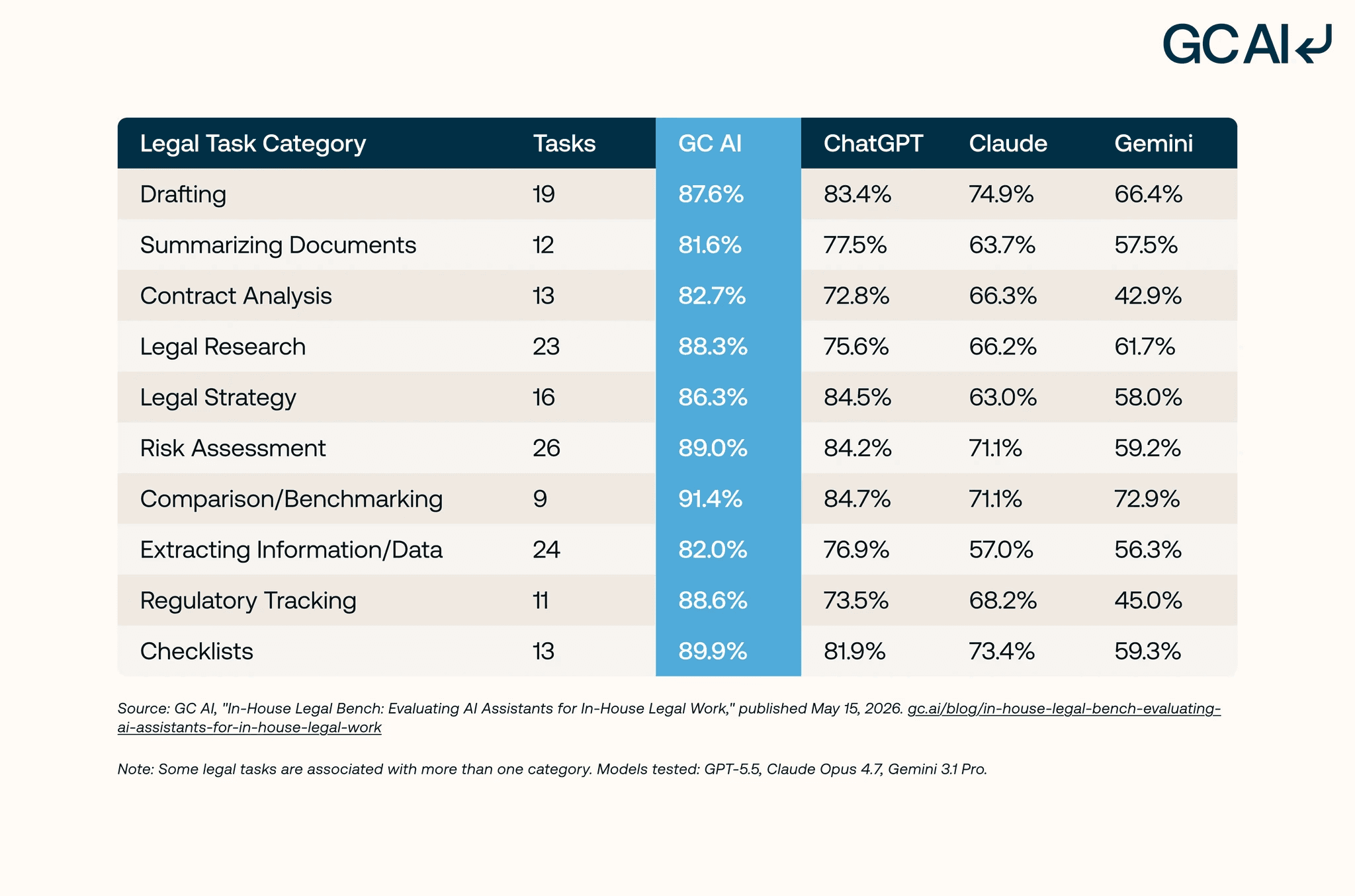
On that last measure, GC AI's In-House Legal Bench (May 2026), a 100-task benchmark scored by attorneys with more than 80 combined years of practice, found GC AI passed 86.8% of in-house legal tasks, ahead of ChatGPT (GPT-5.5) at 79.8%, Claude (Opus 4.7) at 68.4%, and Gemini (3.1 Pro) at 57.5%. The benchmark measures GC AI against general-purpose models.
In the words of in-house lawyers running the workflows:
“I go straight to GC AI for everything from research requests to litigation responses. I've compared against ChatGPT, GC AI gives more comprehensive responses appropriate for a lawyer to use. After six months of use, I'm sure I've saved hundreds of hours.” (Trisha Mauer, VP of Legal at Tonal)
Start With One Contract That Earns the Stack
The contract, the policy refresh, the DPA, or the board memo sitting open on your desk right now is the best evaluation document. Upload it in the trial, run a Playbook, verify the citations with Exact Quote, and forward the output to the business partner who asked for it. If the output ships, the platform earned the seat. If it does not, you learned what you needed to know in an afternoon.