

Dive Deeper
Transcript
Episode Overview
A chief trust officer holds the portfolio of a general counsel, expanded beyond legal into compliance, cybersecurity, and often M&A and business development.
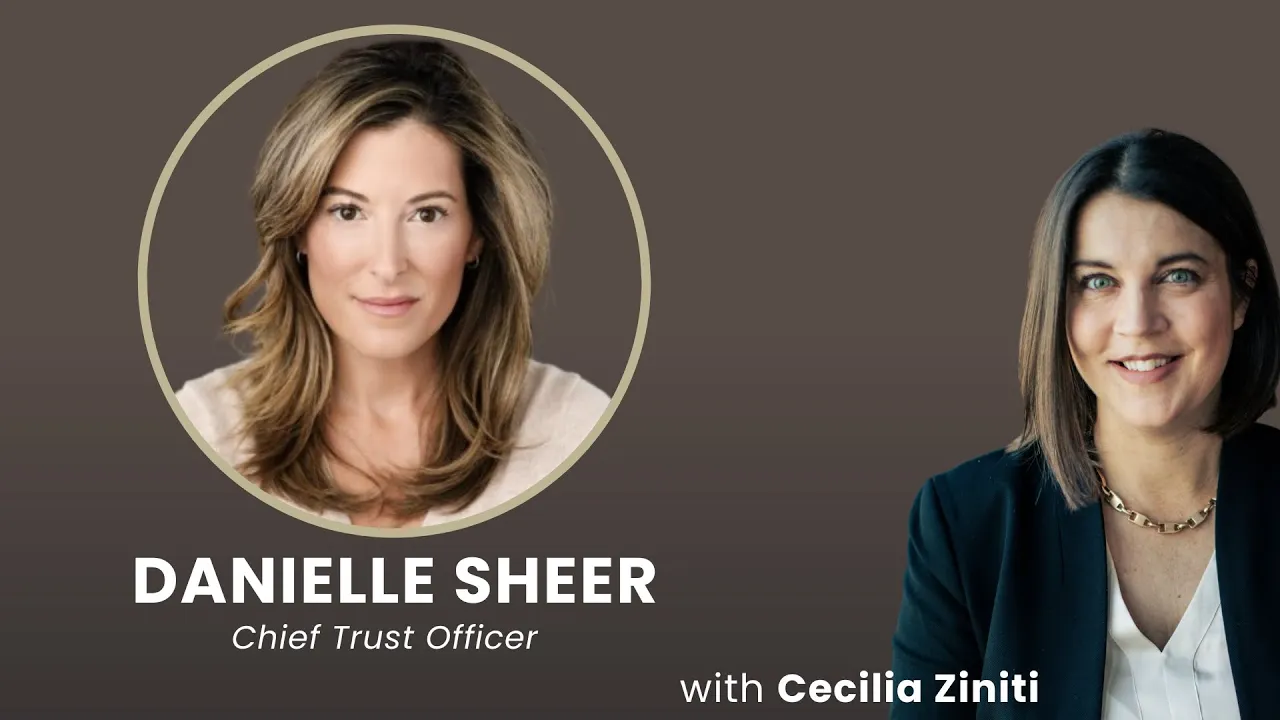
Danielle Sheer holds this title at Commvault, where her leadership philosophy comes down to one question she asks in every crisis. Who does the company want to be on the other side of it?
Sheer is also one of the more relatable AI adoption stories in legal. Eighteen months before this conversation, she stood up at a TechGC (now L Suite) event and said AI was not a thing.
Today, she uses legal AI in her daily work. In this conversation with GC AI co-founder and CEO Cecilia Ziniti, Sheer explains where the trust title came from, what boards want to hear about enterprise risk, and why the lawyers who thrive next will be translators.
About Danielle Sheer
Danielle Sheer is Chief Trust Officer at Commvault, the data protection and cyber resilience company, where her portfolio spans legal, compliance, cybersecurity, M&A, and business development.
Earlier, she was General Counsel at Carbonite, where she led the company through its IPO. She serves on the board of directors of Manhattan Associates, a public supply chain technology company, and on the trustee advisory board of Beth Israel Deaconess Medical Center, a teaching hospital affiliated with Harvard Medical School.
Sheer has become a leading voice on enterprise risk, cybersecurity, and responsible growth, and she travels with much of her legal team: Commvault is the third company where the core group has worked together.
Key Takeaways
The chief trust officer title lets the legal portfolio grow beyond legal. It expands into compliance, cybersecurity, M&A, and business development, the areas that draw on skills lawyers build over time.
Boards want the spare tire answer. Identify the three to five systems that would put the company out of business if they went down, and decide the backup plan before the crisis, not during it.
Ask what problem AI solves, not how to use more of it. "How do we use more AI?" is the wrong question, Sheer says, and it kept her skeptical for years.
Legal advice is no longer paywalled. Anyone can get a legal answer fast, so the in-house lawyer's durable value is translating what the law means for a specific business, audience, and decision.
AI can be right, but only humans can be effective. The time it saves on research goes to relationships, counterarguments, and showing up prepared, the work only a person can do.
What Is the Difference Between a Chief Trust Officer and a General Counsel?
The difference is scope plus perception. A general counsel owns legal. A chief trust officer owns legal and the functions that naturally attach to it, and the title changes how everyone else in the building receives the person holding it. Sheer first encountered the title in an article about Adobe's general counsel, by her recollection close to 15 years ago, and two things struck her immediately.
The first was room for the portfolio to grow. Compliance, security, and other areas of the business tap into skills that lawyers develop over time, and "trust" gives them a shared home in a way "general counsel" never did. At Commvault, Sheer's remit now runs from legal through compliance, cybersecurity, M&A, and business development.
The second was personal. Early in her career, Sheer ran what she describes as a campaign to change how the world felt about lawyers. She lost.
Sheer explains:
"When a lawyer enters a room, a lot of people kind of clench up. It adds a layer of stress into the energy of a place. ... I was able to change how the people in my immediate vicinity felt about me. I was able to build trust. But when somebody brings along their lawyer, it's not something that immediately builds trust with everybody else in the room."
The title turns that perception on its head.
Sheer's test case: Commvault handles security incidents across its supply chain, and each one has to be communicated. Her question to Ziniti on the episode: if I have to communicate an incident to you as a CEO, would you rather hear from the general counsel or the chief trust officer? The role changed her own thinking too.
"Instead of leading with the legal analysis, I lead with the business goal. What are we trying to accomplish? Legal becomes an input into that, but there are so many other inputs, and I no longer think myopically about the legal input. Then it's my job to assess risk and regulations and speed to success."
Ziniti has lived the other side of that lesson. As a CEO, she once added her lawyer to a supplier dispute expecting it to strengthen her position, and the conversation escalated on the spot. The title, Sheer argues, sets expectations before the first word: the in-house lawyer arrived to solve the problem, and everyone in the room can proceed on that basis.
How Does a Chief Trust Officer Show Up in a Crisis?
By owning the destination. Sheer's example is a key leader resigning, though the frame works for security incidents, failed deals, and goals as well. Everyone in the room has a functional lane: HR is planning the exit and the backfill, legal is checking non-competes and non-solicits, the peers are recalculating who they can rely on. Sheer's job is the question nobody else is holding.
"Almost every crisis or goal that we want to achieve, I'm thinking, who do we want to be on the other side of this? And how do we get there together, by strengthening trust and not by breaking trust with each other, with our employees, with our customers, with our board?"
The functional answers still matter. Is there an internal candidate? Should the search go outside? Does the role need a different skill set now? Does the departing leader exit with the company's gratitude? Sheer treats each one as an input, with the intended destination as the output. "Life is a long song," she tells her executive team. People leave and come back. How a company behaves in the hard moment is what it gets known for on the other side.
What Do Boards Want to Know About Enterprise Risk?
Boards want the simple question answered: what are the three to five systems that, if they go down, put the company out of business, and what is the backup plan for each? Sheer credits her board seat at Manhattan Associates with sharpening this more than any executive role did. Board members do not want the checklist, the loaded vocabulary, or a book report on the enterprise risk management program.
"What has to be totally down for you to be out of business? And now tell me, what's your backup plan? What's your spare tire? How do you spin those things up while you're handling the remediation? That's what boards want to know."
She makes it concrete with Manhattan Associates heading into the holiday season: vendors all over the world shipping gifts and electronics through a warehouse management system. If something in that chain goes down, which failures stop the business, and what keeps things running while the team figures out what went wrong? She runs her house in Massachusetts the same way. Storms come. What happens when the electric goes out is a question you answer in October.
The discipline is asking what she calls the Sesame Street simple question, before the crisis, and spending money on a headache that has not become a reality yet. That is why the chief trust officer exists: the backstops live in support, finance, and cybersecurity, but one person asks the question, connects the answers, and carries a comprehensive narrative to the board.
Those same spare tire questions apply to legal AI platforms too, and we turned them into five evaluation questions in our guide to data security in legal AI.
Why Did Sheer Change Her Mind About Legal AI?
Sheer was a skeptic because the industry was asking the wrong question. Her objection was never to the technology. It was to boardrooms asking how to use more AI, sell more AI, and avoid being left behind, before anyone named the problem being solved.
"It was like nails on a chalkboard to me because that is the wrong question to be asking. I needed to sit with people I trusted and hear, repeatedly, what problem are we solving and is AI a new tool that can help us solve it?"
Her analogy is electricity. Dismissing AI would be like saying electricity is not a thing and lighting candles. But the electricity rollout also burned houses down until wiring codes caught up, and that history shapes her posture: go slow to go fast, and build the safeguards in as the technology arrives. What moved her from skeptic to user was sitting with people she trusted, Ziniti among them, and working out what problem the technology solved in her own week.
She had already forced herself to use ChatGPT daily, with guardrails: she turns off the settings that talk to her like a human because she has no interest in having her emotions toyed with. What she wanted was that capability built for her world. She found it in GC AI.
"What I love about it is that it helps me overcome a blank page. And it gives me a heads up on what the customer perspective could be when I am so rooted in my own way of thinking." "It gives me the tone, the tenor, the reliability, the credibility of an LLM that was created by and for lawyers."
Her favorite prompt pattern is adversarial: for somebody who does not agree with this, what would their arguments be? She reads the answer, digests it, and comes back with a plan for the three leaders she needs to influence. The surprise, she says, is what the reclaimed research time became. More time for relationships. Because influence never came from the argument alone; it comes from people trusting you enough to say they disagree and talk it through.
What Skills Will the Modern General Counsel Need?
Translation. Sheer's prediction for the profession is blunt: legal advice has been paywalled for as long as the profession has existed, and the end of those days is here. Anyone can get a legal answer quickly. The in-house lawyers who thrive will be the ones who turn that answer into something a specific audience can act on.
"Nobody can read these regulations, not even the people who write them. So you have to understand them and then translate them into what's the point. And what's the point will be different for who you're talking to. What's the point to you as a CEO? What is the point to the head of engineering? They will mean different things."
Every executive function has its bag of tricks, she notes. The chief revenue officer brings compensation design and customer relationships. Finance has its tools. Legal has to sharpen its own now.
"Anybody can GC AI a question and get a legal answer. How I apply that to this business and these people will be the secret sauce."
Sheer's paywall thesis opens our guide to AI legal advice, which digs into where liability sits when the answer comes from a machine and what in-house teams should do about it.
What Does AI Free Lawyers Up to Do?
Be effective. Years ago, a coach told Sheer she would have to figure out whether she wanted to be right or wanted to be effective. She resented it. She wanted both. The coach's answer: great, but there will be times you have to choose. Sheer now applies the same split to AI.
"For the most part, let's assume that it can be right. What it can't be is effective. So it frees up time for humans to figure out how to be effective. It gets you to water, but it can't force you to drink."
Her growth advice to her team follows the same logic: write down everything you do in a week, stream of consciousness, then find a way to give 80% of it away. That is how you teach the next generation, and it is how you create the space to figure out what value you bring next. AI widens that space. The counterarguments, the framing, the relationship with the leader who trusts you enough to push back: none of it comes from the platform, and all of it is what the platform buys you time to do, the same judgment in-house lawyers are learning to protect as AI takes on more.
Recommended Reading
Why Judgment Is the New Superpower for In-House Lawyers in the Age of AI: the "be effective, not just right" argument from former Unity CLO Anirma Gupta, the natural companion to Sheer's coach story.
AI for General Counsel: One Operating Layer for Solo GCs to Full Departments: how the expanded GC portfolio Sheer describes (legal, compliance, security, M&A) runs on a single operating layer.


