Westlaw is Thomson Reuters' legal research platform, with current offerings that include Westlaw Edge, Westlaw Edge with AI-Assisted Research, and Westlaw Advantage. Those products combine different research coverage and AI capabilities, so the advertised monthly price is only part of the buying decision.
Westlaw pricing depends on your research coverage, users, AI tools, and contract term. Westlaw Edge with AI-Assisted Research starts at $155.35 a month for eligible small law firms on a three-year term. In-house legal teams need a quote for their department.
Before you compare prices, check which sources and AI features each plan includes, who can use them, and what costs extra.
GC AI is an enterprise legal AI platform for in-house legal teams trusted by 2,200+ legal teams including Nestle, News Corp, TIME, Riot Games, and Bass Pro Shops.
Our Research solution investigates legal questions across primary law and authoritative sources and returns structured answers with citations and source links. Counsel can inspect the supporting authorities, then carry that work into document analysis, drafting, contract review, and other in-house workflows.
For this pricing decision, start with the research job itself: which authorities, jurisdictions, and source types does the team need, and how easily can counsel inspect the support for an answer?
At Viant Technology, Chief Legal Officer Ritesh Patel describes using GC AI first for research and issue spotting, including HR and privacy questions, and emphasizes that lawyers can check the sources behind an answer.
Our CEO and co-founder, Cecilia Ziniti, was a general counsel three times (Anki, Bloomtech, and Replit) and an in-house counsel at Amazon and Cruise.
At Replit in 2022, she got early access to large language models before ChatGPT launched and used them for legal work. She built GC AI to solve problems she encountered firsthand as an in-house lawyer. That in-house perspective now shows up in a platform that pairs source-visible legal research with drafting, contract review, document analysis, and other legal work.
How Much Does Westlaw Cost?
These U.S. starting prices apply to new customers at law firms with up to 10 attorneys:
Plan | Single Circuit | All States and Federal | Term |
Westlaw Edge with AI-Assisted Research | $155.35/month | $266.50/month | Three years |
Westlaw Advantage | $256.75/month | $399.75/month | Not specified for these starting prices |
These are advertised starting prices (as of October 2026), not confirmed per-user rates or corporate legal department prices. Existing customers, larger firms, and in-house teams should request a quote.
Single-circuit coverage includes state and federal primary law within one federal circuit. The broader package covers all states and federal primary law, plus legislative history. Ask for the specific databases included in your offer, especially if your team relies on treatises, practice guides, or specialist resources.
Westlaw Advantage also advertises discounts for two- and three-year terms.
Which Westlaw Plans Include AI?
Westlaw's research AI and CoCounsel's document tools come in different packages. Confirm the exact product you need on the order form.
Product | What It Includes | What to Confirm in Your Quote |
Westlaw Edge | Legal research coverage and core Westlaw research tools. | Do not assume AI-Assisted Research is included; confirm the exact research package and databases. |
Westlaw Edge with AI-Assisted Research | AI-Assisted Research and AI Jurisdictional Surveys, with the selected research coverage. | Confirm jurisdiction and source coverage, eligible users, and any usage limits. |
Westlaw Advantage | Research features including Deep Research and Litigation Document Analyzer. | Confirm coverage, user access, and whether the quoted price reflects a term discount. |
Westlaw Advantage with CoCounsel Essentials | Westlaw Advantage plus CoCounsel Essentials' document analysis and drafting tools. | Confirm which CoCounsel tools are included, eligible users, and any usage limits. |
CoCounsel Legal | Westlaw Advantage, Practical Law Dynamic Tool Set, and CoCounsel Essentials. | Confirm bundle components, eligible users, and how any existing subscriptions are handled. |
A quote that says “AI included” leaves too much unclear. Ask which tools each user can access, whether any usage limits apply, and whether the AI answer's cited sources are included in your research subscription.
For a closer look at the document workflows, see our GC AI vs. CoCounsel comparison.
What Can Increase Your Westlaw Bill?
Research Coverage
Start with the work your team handles. A department researching employment questions across several states may need different coverage from one focused on a single jurisdiction.
List the jurisdictions and named resources your lawyers use. A broad label such as “national coverage” can still leave gaps in treatises, practice guides, or specialist sources. Ask the vendor to mark each required source as included, excluded, or available at an additional cost.
Users and Contract Length
A lower monthly price may require a longer commitment, so compare the full contract cost as well as the first year's spend. If you are adding CoCounsel or Practical Law, check for overlap with your department's existing subscriptions.
Confirm how users are counted, what it costs to add or replace seats, whether you can reduce seats, how long the commitment lasts, and whether overlapping subscriptions end or receive a credit.
Out-of-Plan Charges
Retrieving or delivering documents outside your subscription can create additional charges. Review recent invoices and usage reports before renewing; they can show whether your team repeatedly pays for a source that should be included in the next package.
Ask which documents are outside your plan, which rates apply when they are retrieved or delivered, and what account controls are available to help manage unplanned charges.
Renewal and Cancellation Terms
An auto-renewal clause can leave little time to act. Add the notice deadline to your calendar when the agreement is signed.
Confirm the renewal price or increase formula, notice deadline, cancellation method, and whether you can reduce users or coverage at renewal.
What to Record When Comparing Westlaw Quotes
Before comparing monthly prices, put every offer against the same set of fields. This keeps differences in coverage, AI access, user rules, extra charges, and renewal terms from disappearing inside a single number. Keep the proposal, order form, rate schedule, and written vendor answers together.
Product and AI access: Exact product version, included AI tools, eligible users, and usage limits.
Research coverage: Jurisdictions, named databases, secondary sources, and exclusions.
Users: Covered users, added-seat cost, replacement rules, and reduction rights.
Subscription price: Monthly or annual fee, payment schedule, discounts, and taxes.
Other subscriptions: Add-ons, credits, and existing agreements that will continue.
Usage charges: Chargeable activities, rates, warnings, and spending controls.
Contract commitment: Start date, end date, each year's price, and full-term total.
Renewal and exit: Renewal increase, notice deadline, cancellation method, and early-exit terms.
Calculate three amounts separately:
First-year subscription cost: The fees due during the first 12 months, including add-ons and any subscriptions you must retain.
Full-term commitment: All fixed payments required through the end of the contract, accounting for scheduled increases and confirmed credits.
Estimated extra spend: Project variable out-of-plan usage and internal costs such as training and migration separately from fixed contractual payments.
Add applicable taxes, and keep any one-time implementation costs separate from recurring fees. A three-year offer can have a lower first-year price and a higher total commitment than a shorter agreement.
Test the Research, Then Compare the Westlaw Quote
The subscription price matters only if the product covers the research your lawyers do. Before comparing the quote documents side by side, test representative legal questions and compare the sources, coverage, and verification work each option requires.
Test a Representative Research Question
Choose a recurring question your team knows well enough to evaluate. Use the same facts, jurisdictions, and time period for each product you are considering. Our Research can investigate the question across legal and government sources and return structured analysis with citations and source links.
Compare:
Whether the answer addresses the question you asked.
Which primary authorities and other sources support the key conclusions.
Whether counsel can open and verify those sources.
Whether the jurisdictions and source types your team needs are covered.
Which caveats, conflicts, or missing facts the answer identifies.
How much lawyer review is required before the analysis is usable.
A representative test is more useful than asking whether a quote simply includes “AI research.” It shows what the team would receive for the subscription.
Example research prompt
Research [legal question] for [jurisdiction or jurisdictions] using current primary authority. State the conclusion for each jurisdiction, cite the authority supporting each key proposition, link to the source where available, identify any material split or uncertainty, and list facts that could change the analysis. Do not fill gaps with assumptions.
Use an equivalent question and evaluation criteria across the products you are considering. One prompt is not a complete product evaluation, but it can expose meaningful differences in coverage, source visibility, and verification effort.
Compare the Quote Documents
Once you know which research capabilities matter, compare the written terms behind each price. Our document analysis can help identify differences, cite the relevant passages, and flag questions the documents do not answer.
Create a Project for the subscription review. Add the current agreement, renewal proposal, competing quotes, rate schedules, and relevant vendor emails using Files. Include the documents that define coverage and charges alongside the sales proposal, and follow your company's access rules when sharing the Project.
Try This Westlaw Quote-Comparison Prompt
Here is an example prompt to adapt to the proposals and contract documents you have:
Example prompt
Compare the attached subscription offers using the comparison fields above.
For each offer:
Cite the source document and passage for each answer.
Mark missing or conflicting terms as “Needs vendor confirmation.”
Separate first-year subscription cost, full-term fixed commitment, and estimated extra spend.
If a proposal uses a broad label such as “AI research,” list the exact included tools or mark that item for vendor confirmation.
List the questions that still need answers before signing.
Do not infer terms, product access, pricing, or commitments that the documents do not establish.
After GC AI prepares the comparison, open each cited passage, resolve conflicts, and approve the recommendation before sending it to finance or signing.
Check the Sources and Prepare Your Recommendation
Open the cited passages, verify the figures, and recalculate the totals before using the comparison. Exact Quote helps you check quoted language against the source document.
Add the vendor's written answers to the Project, then ask GC AI to update the comparison. Your recommendation can be brief: the preferred option, its cost, the research coverage your team needs, and any unresolved terms. For a broader purchase review, use our guide to evaluating legal AI vendors.
Compare the Full Commitment Before You Sign
The advertised monthly price is only one part of a Westlaw decision. For an in-house team, the better comparison is whether the package covers the work you need at an acceptable full-term cost, with clear answers about AI access, out-of-plan charges, user changes, and renewal exposure.
Our platform can keep that comparison tied to the source documents as proposals change and vendor answers come in. That source-checking point comes back in Patel's explanation of why it matters to his team:
“Having sources and links right there builds trust. You can check the law yourself, and that trust drives adoption across the team.”
Use Exact Quote to open cited language against the source document. This demo shows how the citation workflow works:
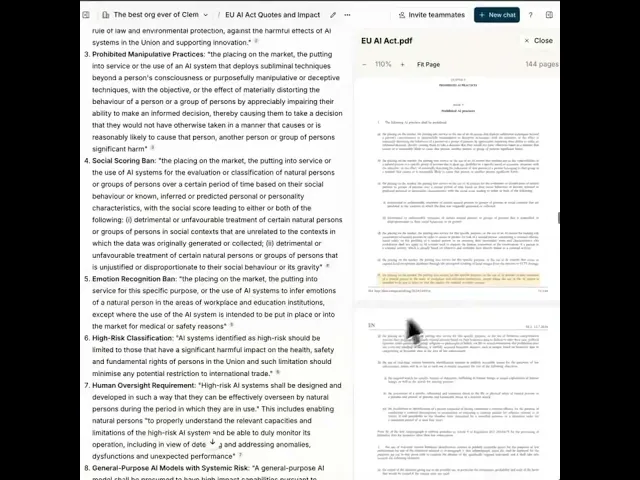
If you want to test the workflow, start with one proposal set and verify every cited term before using the recommendation.
Frequently Asked Questions
How Much Does Westlaw Cost per Year?
At the advertised $155.35 monthly starting rate, 12 months would total $1,864.20 before taxes and extra charges. That rate applies to eligible small law firms buying Westlaw Edge with AI-Assisted Research on a three-year term; it is not an in-house department quote. For a corporate comparison, ask for each year's price and the full contract commitment.
Does Westlaw Still Charge per Search?
No, not every search carries a separate charge. Thomson Reuters says out-of-plan charges can apply when you retrieve or deliver documents outside your subscription. Ask which documents are outside your plan and what rates apply to those retrievals or deliveries.
Is CoCounsel Included With Westlaw?
Sometimes. Westlaw Advantage with CoCounsel Essentials includes CoCounsel Essentials' document tools, while CoCounsel Legal combines Westlaw Advantage, Practical Law Dynamic Tool Set, and CoCounsel Essentials. Check the exact product name and included tools on your order form.
Can You Negotiate Westlaw Pricing?
Yes. You can ask for different pricing or terms based on user count, coverage, and contract length, although savings are not guaranteed. At renewal, compare any proposed increase, available credits, and the full commitment before accepting a lower monthly rate.