For Alexandra Sepulveda, Assistant General Counsel at Trust & Will, a SaaS agreement review means taking the first pass on her company’s vendor paper before anyone else sees it. She describes the moment one turns into real work:
“Imagine a redline comes back asking for unlimited indemnity. I’ll tell GC AI, ‘Here’s the clause and why we can’t accept it. Draft a four-sentence response to sales, collaborative tone, options to move forward.’ It gives me a clear, diplomatic note I can send fast.”
Indemnity earns its place on every SaaS agreement checklist, and it is one of nine clauses where the contract hides its real risk, the kind an AI first pass is built to catch.
After NDAs, the software-as-a-service contract is the one in-house teams see most: a vendor MSA, a subscription order form, a renewal that auto-extends when the notice window passes unnoticed.
The risk sits in the boilerplate, where a liability cap pegged to one month of fees, an indemnity that runs one direction, and a feedback license that assigns your product ideas to the counterparty all read as routine on a fast pass.
A SaaS agreement review is the process of reading that contract for the terms that allocate money, data, and risk, then deciding which to accept, which to push, and which to walk away from.
An AI SaaS agreement review does the first pass in minutes instead of an afternoon: it extracts the clauses, compares them against your standard positions, flags what is off-market, and drafts the redline you would have typed yourself.
The lawyer stays the reviewer; the machine handles the reading.
In GC AI’s Legal AI 101 class, the practice document handed to attorneys is a SaaS agreement for exactly this reason: it is the contract that teaches the workflow.
You can try the SaaS MSA workflow free on a contract your team has already negotiated and compare the output.
The 9-Clause SaaS Agreement Checklist
When you run a SaaS agreement through an AI contract review platform, nine clauses carry most of the legal and commercial risk. They are the nine that surface most often across the vendor paper in-house teams run through GC AI, and they are the same nine whether you sit on the buyer side or the vendor side. What changes is the position you want.
Auto-renewal and notice windows
Limitation of liability and the cap
Indemnification
Data ownership, security, and privacy exhibits
SLA, uptime, and service credits
Termination and transition assistance
Price-escalation caps
IP ownership and the feedback license
Assignment and change of control
Auto-Renewal and Notice Windows
The first thing to check is how the term renews and how much warning you get before it does. Many SaaS agreements renew automatically for successive 12-month terms unless a party gives notice 30, 60, or 90 days before the renewal date. A 90-day non-renewal window on an annual term means you have a three-month gate, once a year, to exit. Miss it and you are locked in for another year.
Buyer-side, you want a short notice window and the right to terminate for convenience. Vendor-side, you want the longer window and the automatic roll. The renewal mechanics and the exact notice period surface in one line, and the deadline lands on your calendar before it closes. A renewal nobody flagged in time is the easiest money a vendor ever makes.
Limitation of Liability and the Cap
The liability cap is where the real money sits, and it is the clause most often written in the vendor’s favor. A common vendor position caps total liability at the fees paid in the prior 12 months and excludes all indirect, consequential, and special damages. For a $40,000 annual subscription, that caps the vendor’s exposure at $40,000 no matter what breaks.
Buyer-side, you push for a super-cap on data-breach and confidentiality claims (often 2x to 5x fees, sometimes uncapped) and you carve indemnity obligations out of the general cap. Vendor-side, you hold the 12-month cap and resist carve-outs. The cap multiplier and the carve-outs come back flagged, including the carve-outs that should be there and went missing. What is missing from a liability clause matters as much as what is in it.
Indemnification
Indemnification is the promise to cover the other side’s losses for defined categories of harm, usually third-party IP infringement claims, data breaches, and gross negligence. The asymmetry is the tell. A vendor-friendly draft indemnifies the customer narrowly for IP claims while asking the customer to indemnify the vendor broadly for its use of the service.
This is the clause behind Sepulveda’s unlimited-indemnity redline. On the first pass, AI catches the one-directional indemnity and drafts the response to sales, which turns the catch into a note the business can use without a from-scratch write-up.
Data Ownership, Security, and Privacy Exhibits
This is the clause set that decides what happens to your data, and it is usually buried in an exhibit or a linked DPA. Check three things: who owns the customer data (the customer should), whether the vendor can use that data to train models or improve the service, and what security and privacy commitments the DPA makes. For a buyer, a vendor right to use your data for “service improvement” can mean your confidential information feeds a model.
For a vendor, the DPA is where GDPR, CCPA, and SOC obligations get pinned down.
AI is strong here precisely because the relevant language sits across the main agreement, the DPA, and the security exhibit at once. It can read all three together and tell you whether the data-ownership language in the body survives the carve-outs in the exhibit. That cross-document reading is where a human pass under time pressure loses the thread.
SLA, Uptime, and Service Credits
The service level agreement promises availability, usually as a monthly uptime percentage, and defines the remedy when the vendor misses it. The remedy is almost always a service credit, and service credits are weaker than they look. A 99.9% uptime commitment with a 10% credit as the sole remedy means a multi-day outage gets you a 10% refund and nothing else.
Buyer-side, you want uptime high, credits meaningful, and a termination right if uptime drops below a floor for consecutive months. Vendor-side, you want credits as the exclusive remedy and generous maintenance-window carve-outs. On a five-figure subscription, the termination floor matters more than the credit math, because a 10% credit comes nowhere near the cost of a multi-day outage.
Termination and Transition Assistance
Two questions matter when the relationship ends: on what grounds can each side terminate, and what does the vendor owe you on the way out. Termination for convenience, termination for uncured breach, and termination for insolvency are standard. The clause buyers forget is transition assistance: the vendor’s obligation to return your data in a usable format and support migration for a defined wind-down period.
Buyer-side, you want a data-export right, a defined transition period, and your data returned in a standard format. Vendor-side, you want termination tightly scoped and post-termination obligations limited. A missing transition clause is as much a finding as a one-sided one, and catching it on the first pass is what saves a data-stranded exit later.
Price-Escalation Caps
SaaS pricing rarely stays flat across renewals. The escalation clause governs how much the vendor can raise the price at renewal, and an uncapped escalation is a slow leak in the budget. A clause that allows increases “at the vendor’s then-current list price” gives the vendor an open-ended lever.
Buyer-side, you cap annual increases at a fixed percentage or a published index like CPI. Vendor-side, you keep escalation tied to list price. The escalation language and any cap get pulled out of the order form, where price terms often live. Catch it once and you stop re-litigating your budget at every renewal.
IP Ownership and the Feedback License
SaaS agreements routinely include a feedback clause: anything you tell the vendor about how to improve the product becomes the vendor’s to use freely. On its own that is reasonable. The problem is breadth. A feedback license written to capture “all suggestions, ideas, and improvements” can reach further than either side intended, especially if your team is sophisticated about the product category.
Buyer-side, you narrow the feedback license to product feedback and confirm you retain ownership of your own pre-existing IP and your data. Vendor-side, you keep the feedback license broad. AI flags the scope of the feedback grant and confirms the customer-IP-ownership language holds, which matters most for buyers who are themselves building in an adjacent space.
Assignment and Change of Control
The last clause to check is what happens to the contract when one party gets acquired. An assignment clause that lets the vendor freely assign on a change of control means your data and your terms can transfer to an acquirer you never vetted, possibly a competitor.
This is a live concern for in-house teams.
In that same Legal AI 101 class, one attorney planning a contract-review project wrote her own prompt on it in real time:
“You are planning a contract review project focused on change of control clauses in your SaaS agreements with customers. What are the important elements of change of control that you should consider?”
Buyer-side, you want consent rights or at least notice on the vendor’s change of control, and your own freedom to assign to an affiliate or acquirer. Vendor-side, you want the reverse. AI flags whether assignment is mutual, whether change of control triggers any consent right, and whether the clause is silent, which is itself a finding.
Buyer-Side vs Vendor-Side: The Same Review, Two Positions
The clauses are constant; the standard positions flip with the side you sit on. Encoding those positions once is what separates a team that reviews 200 SaaS agreements a year cleanly from one that reviews them inconsistently.
Clause | Buyer-Side Position | Vendor-Side Position |
Auto-renewal | Short notice window, termination for convenience | Longer notice window, automatic roll |
Liability cap | Super-cap for data and confidentiality breaches | 12-month fee cap, no carve-outs |
Indemnification | Broad vendor indemnity, narrow customer indemnity | Reciprocal or vendor-favorable |
Data and DPA | Customer owns data, no training use | Service-improvement rights retained |
SLA and credits | Meaningful credits plus termination floor | Credits as sole remedy |
Termination | Data export and transition assistance | Tightly scoped, limited post-term duties |
Price escalation | Capped at fixed % or CPI | Tied to then-current list price |
Feedback license | Narrow, product-only | Broad |
Change of control | Consent or notice rights | Free assignment |
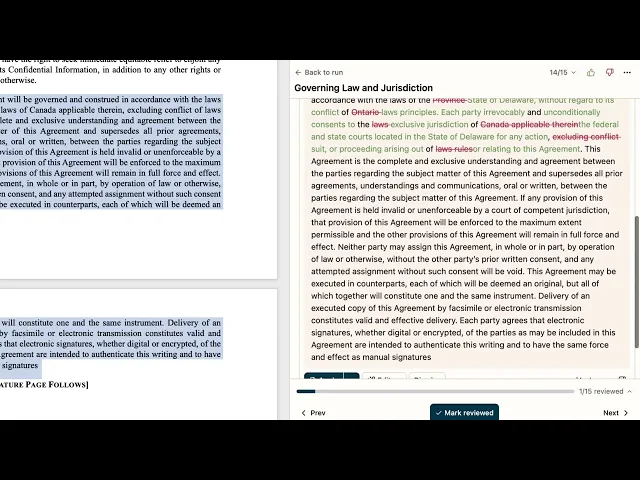
This is what a SaaS MSA playbook encodes. GC AI includes a pre-built Playbooks workflow for MSAs for SaaS, alongside NDAs, DPAs, and MSAs for commercial purchases, so the first pass compares every clause against the position your team already decided on.
Alexis Palmer, Senior Managing Counsel at Snyk, works mostly on other-party paper with enterprise customers and points to the consistency that gives a team:
“Having saved prompts means anyone on my team can run the same review I would. If I’m on PTO, I know they’ll get a similar result and apply their own judgment from there.”
If your team already has standard positions, you can encode them in a Playbook and run your next SaaS agreement against them in one pass.
Where the Lawyer Still Owns the Call
AI does the reading. The lawyer decides which deals are worth the fight. A 12-month liability cap is a hard stop on a contract that touches regulated health data and a perfectly fine concession on a $9,000 tooling subscription.
The platform surfaces the clause and the off-market flag. Whether to spend negotiating capital on it is a judgment about the deal, the counterparty, and the company’s risk appetite, and that judgment is the lawyer’s.
The same holds for citation. When an AI tells you a clause caps liability at one month of fees, you want to see the exact words on the page.
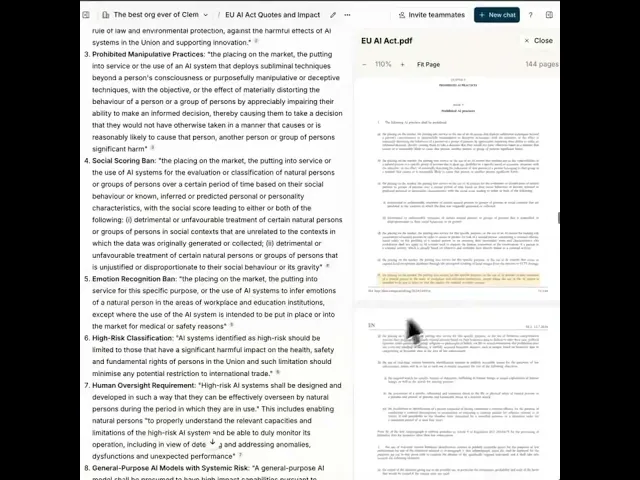
GC AI’s Exact Quote pulls the cited language character for character from the document so verification takes one click. The point of the first pass is to give the lawyer more time for the part only the lawyer can do.
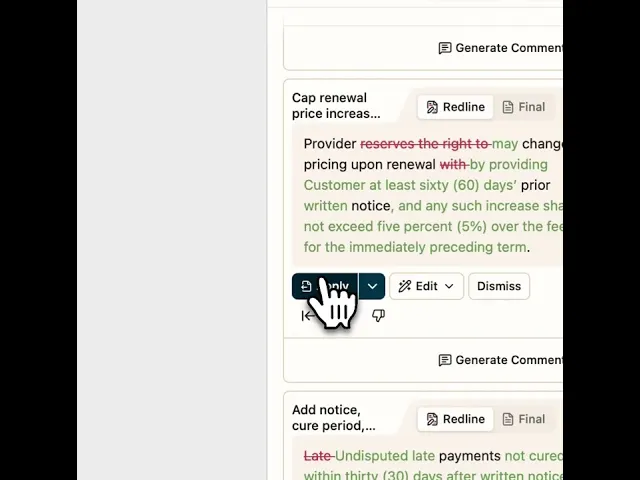
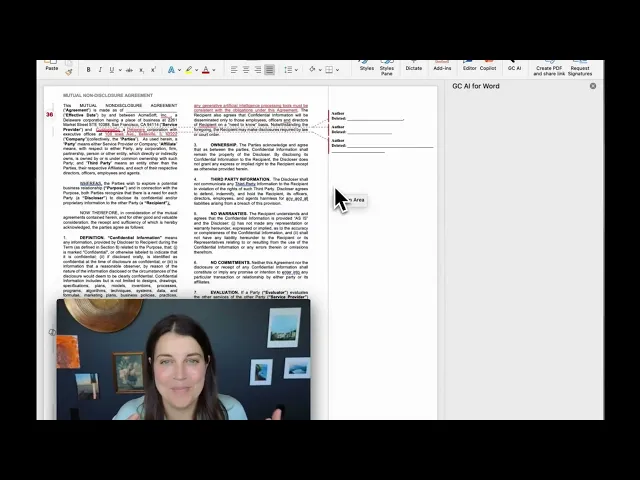
Because most SaaS review happens in Word, you can keep the whole workflow there. GC AI for Word redlines selected clauses or the full contract, spots issues, and drafts replacement language inside the document.
Tiffany Lee, General Counsel and Corporate Secretary at Liquid Death, described the loop:
“If it sees a missing confidentiality clause, I’ll just ask it to draft one I can drop right into the agreement: no leaving the system, no reformatting.”
The teams running this at speed report the time back lands fast. In GC AI’s December 2025 ROI study of more than 100 active customers, in-house lawyers saved an average of 14 hours per week and reported 21% greater perceived accuracy compared to generic AI.
Hayley McAllister, Senior Counsel and Head of Commercial Legal at Jasper, who spends roughly 75% of her time on go-to-market and vendor contracts, put the per-contract version plainly:
“What used to take me an hour now takes me 10 minutes.”
GC AI is purpose-built for in-house counsel, founded by a three-time general counsel, and built for confidential legal work under zero-data-retention terms with OpenAI and Anthropic.
Run Your Next SaaS Review With a Playbook
Pick a SaaS agreement your team has already negotiated, run it through the pre-built SaaS MSA Playbook, and compare the flags against the calls you made by hand. The output shows you what a consistent first pass looks like on a contract you already know the answer to.
No credit card required. Want to build the prompting habit first? GC AI’s free legal AI classes are CLE-eligible in California and use a real SaaS agreement as the practice document.
Frequently Asked Questions
What Should In-House Counsel Check in a SaaS Agreement Review?
A SaaS agreement review should check nine high-risk clauses: auto-renewal and notice windows, limitation of liability and the cap, indemnification, data ownership and the security and privacy exhibits, SLA uptime and service credits, termination and transition assistance, price-escalation caps, IP and the feedback license, and assignment or change of control. These clauses allocate money, data, and risk, and they are where vendor-favorable boilerplate most often hides.
How Does AI SaaS Agreement Review Work?
An AI SaaS agreement review extracts the clauses from the contract, compares them against your standard positions, flags terms that are off-market, and drafts a redline. The lawyer reviews the output and decides which points to negotiate. GC AI includes a pre-built SaaS MSA Playbook for this workflow, and its December 2025 ROI study of 100+ customers found in-house lawyers saved an average of 14 hours per week.
What Is the Difference Between Buyer-Side and Vendor-Side SaaS Agreement Review?
The clauses are the same, but the target positions are opposite. A buyer wants a short renewal-notice window, a liability super-cap for data breaches, broad vendor indemnity, capped price escalation, and consent rights on change of control. A vendor wants the longer notice window, a 12-month fee cap with no carve-outs, reciprocal indemnity, list-price escalation, and free assignment. Encoding your side’s positions in a playbook keeps the review consistent across every contract.
Is It Safe to Use AI to Review Confidential SaaS Contracts?
It is safe when the platform is built for confidential legal work. GC AI is SOC 2 Type II and SOC 3 certified, GDPR compliant, with zero data retention agreements with OpenAI and Anthropic, and AES-256 encryption, so contract data is not used to train third-party models. In-house teams at 2,100+ legal departments across 53 countries, including those at Hitachi, Liquid Death, Snyk, and Columbia, plus 200+ public companies, use GC AI as of September 2026.
Does AI Replace the Lawyer in SaaS Agreement Review?
No. AI does the first-pass reading, clause extraction, and redline drafting, which gives the lawyer more time for the judgment calls. Deciding whether a 12-month liability cap is acceptable depends on the deal, the data involved, and the company’s risk appetite, and that call stays with the lawyer. GC AI’s Exact Quote pulls cited language character for character so counsel can verify every flag against the source in one click.
What Is a Liability Cap in a SaaS Agreement?
A liability cap is the contractual ceiling on what one party can owe the other if something goes wrong, and in SaaS agreements it is usually set to the fees paid in the prior 12 months. Buyers push for a super-cap on data-breach and confidentiality claims, often 2x to 5x fees, and carve indemnity out of the general cap. The cap is where the real money sits, so it is the clause most worth reading closely on any vendor paper.
What Should a SaaS Data Processing Addendum Cover?
A SaaS data processing addendum should cover who owns the customer data, whether the vendor can use that data to train models or improve the service, and the security and privacy commitments the vendor makes under GDPR, CCPA, and SOC. The customer should retain ownership of its data, and a broad vendor right to use data for service improvement is the term to watch, since it can mean confidential information feeds a model. The DPA is often a linked exhibit, so its language has to be read alongside the main agreement.
How Long Does an AI SaaS Agreement Review Take?
An AI SaaS agreement review takes minutes for the first pass, where a manual read can take the better part of an afternoon. The AI extracts the clauses, compares them against your standard positions, flags what is off-market, and drafts the redline. The lawyer then reviews the output and decides which points to negotiate, so the time saved goes to the judgment calls.
What Is Auto-Renewal in a SaaS Contract?
Auto-renewal is a clause that extends the contract for another term automatically unless a party gives notice before a deadline, often 30, 60, or 90 days before the renewal date. A 90-day non-renewal window on an annual term leaves a single three-month gate each year to exit, and a missed deadline locks in another full year. Buyers want a short notice window and a termination-for-convenience right; vendors want the longer window and the automatic roll.