In-house legal teams are tracking six regulatory threads this quarter: the SEC cyber-incident disclosure rule, Colorado’s AI Act, updated SOC 2 trust services criteria, state consumer privacy laws rolling out across California, Virginia, Connecticut, Utah, and Texas, ISO 42001 AI management certification, and the EU AI Act‘s general-purpose model obligations. Manual tracking isn’t ideal, and it does not scale. A four-person legal team can read the filings. It cannot also map each change to the company’s contracts, policies, product features, and vendor agreements.
AI for compliance monitoring is the software that does the mapping. Machine learning pulls regulatory changes from primary sources, natural language processing turns those changes into obligations the team can act on, and retrieval-augmented systems connect the obligations back to the company’s existing legal assets. The work that used to sit in a binder now sits in a live dashboard.
Regulatory change reaches deep into the business. A new rule touches contracts, policies, product features, and vendor agreements, and each document needs a fresh read against the new language. AI for compliance monitoring compresses that review cycle. GC AI does it for in-house legal.
The Six Lanes of AI Compliance Monitoring
The phrase “AI compliance monitoring” maps to six software categories. Each has its own buyer, its own framework set, and its own vendors. Reading the full landscape first tells you which lane fits your team.
Lane | Primary Buyer | Framework Set |
|---|---|---|
Regulatory change and AI governance | In-house legal, CCO | EU AI Act, ISO 42001, NIST AI RMF, state AI laws, GDPR |
GRC and security frameworks | CISO, IT compliance | SOC 2, ISO 27001, HIPAA, PCI-DSS |
Financial crime and AML | Banking compliance, BSA officer | BSA, OFAC, AML directives |
Healthcare and clinical compliance | Life sciences compliance | HIPAA, GxP, FDA 21 CFR Part 11 |
Communications and marketing compliance | Marketing compliance, broker-dealer ops | FINRA 2210, FTC Act, pharma DTC rules |
Physical safety and PPE | EHS, operations | OSHA, ANSI standards |
For in-house counsel, the first lane carries the bulk of the legal work. The other five lanes typically report into Security, Risk, Compliance, or Operations. The general counsel signs the policy but does not run the monitor. When an article online promises “AI compliance monitoring tools” and then benchmarks Sprinto against Drata, it is answering the CISO and IT buyer rather than the legal buyer.
The in-house team partners closely with two adjacent lanes: IT compliance monitoring (the second lane) and AI compliance monitoring tools for banking (the third lane). The legal team sets the policy; the platform in that lane runs the continuous check. Vision AI for real-time compliance monitoring sits in the sixth lane, where a computer vision model reviews CCTV feeds for OSHA gear compliance. None of these adjacent lanes read a contract, a DPA, or a regulatory filing the way a lawyer reads it.
How AI Works for Compliance Monitoring
AI for compliance monitoring uses machine learning, natural language processing, and predictive models to track regulatory change, collect evidence against compliance frameworks, score risk, and flag gaps between policy and practice. It ingests structured data (logs, spreadsheets, ticket systems) and unstructured data (regulator feeds, contracts, policies, communications) and returns an ordered list of where the business sits relative to its obligations.
AI-powered compliance monitoring differs from traditional GRC in three ways. AI reads unstructured documents that rule-based systems skip. AI ranks risks by pattern-matching against historical enforcement and internal incidents, instead of treating all control gaps as equally urgent. AI updates its own monitoring rules as regulations change, instead of waiting for a human analyst to write a new rule.
Four core capabilities drive the category:
Regulatory change detection
Evidence collection and control mapping
Risk scoring
Policy and contract alignment
Strong platforms do all four. Thin platforms do one and call it the category.
Regulatory Change Detection
NLP models scan regulator feeds, legislative trackers, standards bodies, and bar association alerts. The model filters by the company’s jurisdictions, product lines, and risk areas, then returns a short list ranked by effective date and business impact. Strong platforms cite the source document at the paragraph level.
Evidence Collection and Control Mapping
The system connects to cloud infrastructure, identity systems, HR platforms, and document stores. It maps each control (access review, encryption at rest, vendor risk assessment) to a framework requirement. When an auditor asks for evidence, the system produces it.
Risk Scoring
The model ranks where the company is at highest risk. The ranking uses historical enforcement patterns, peer-group incidents, and internal violation data. Without risk scoring, a compliance monitoring platform returns 400 open findings and no sense of which five matter. AI compliance tools for risk monitoring live or die on the quality of this ranking.
Policy and Contract Alignment
The newest capability. When a regulation changes, the system reviews existing contracts and policies against the new rule and surfaces clauses that need updates. This is where AI-driven compliance monitoring starts to look like legal work. It reads a DPA the way a lawyer reads it, then says: “Section 4.2 does not meet the new cross-border transfer rule.”
Capability 4 is the one where in-house legal teams see the biggest lift. Capabilities 1 through 3 already have tooling in established GRC stacks. Capability 4 has been manual until the current generation of legal AI platforms shipped.
For a broader look at AI-powered compliance work for in-house teams, see AI for Legal Compliance: The In-House Guide (2026).
Where AI Compliance Monitoring Breaks for In-House Legal
Three failure modes recur.
Generic GRC tools do not read a contract. Drata, Sprinto, and Vanta excel at pulling evidence from cloud infrastructure. They do not read a DPA, spot a missing data-transfer clause, or redline a new SaaS agreement against the company standard. That work is legal work, and GRC platforms do not do it.
Financial crime, advertising, and safety platforms monitor one data stream. A payments AML engine monitors transactions. A marketing compliance platform monitors ad copy. A vision AI platform monitors a factory floor. These are narrow streams. They do not cover the regulations that reach the whole enterprise through commercial contracts, product terms, and public statements.
Horizontal AI catches a change but does not cite primary law the way lawyers cite. ChatGPT can summarize a regulation. It does not cite character-level back to the source, and it will confidently paraphrase a rule that it has not read. For anything that becomes a legal memo, that gap is disqualifying.
Accuracy is one limit of general-purpose AI. Data governance is another. :Elana Freeman, Head of Legal and Compliance at Swing Education, frames the data rule directly on CZ and Friends
“If it is already publicly accessible or you don’t care if it is publicly accessible, go wild.”
Public information is fair game. Confidential contracts, client data, and team playbooks belong on a legal AI platform with zero data retention and character-level citation.
The missing category is a legal AI platform that reads regulations and contracts the way an in-house lawyer reads them, cites primary law with character-level accuracy, and lives inside the documents where in-house teams already work. That is the lane GC AI owns.
What Changed in the Regulatory Calendar: July 2026 Update
Two of the regulatory threads this guide opened with moved in the past eight weeks. Both moves reward teams that monitor the primary sources.
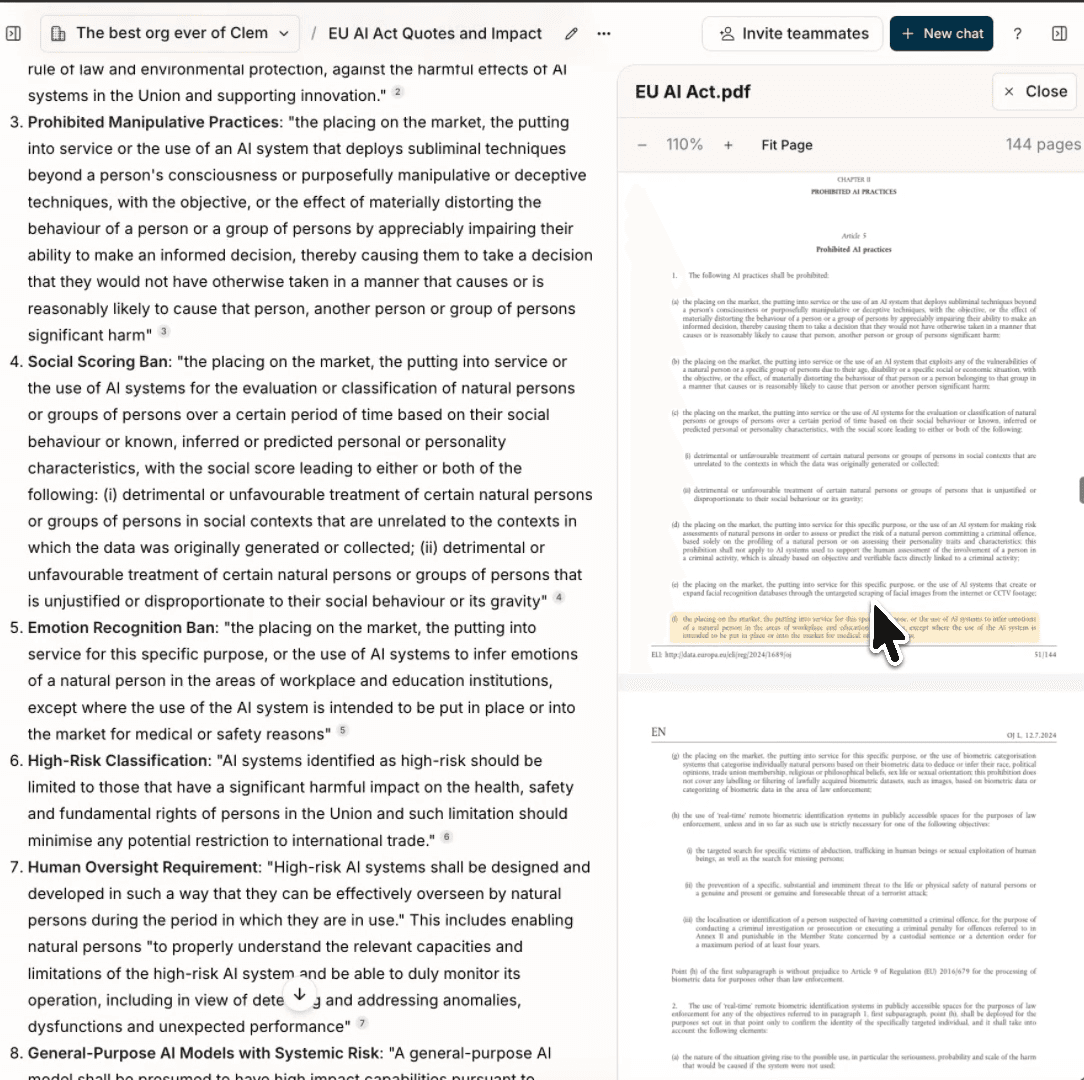
The EU AI Act’s high-risk deadlines shifted. The Digital Omnibus package, endorsed by the European Parliament on June 16, 2026, and given final approval by the Council on June 29, 2026, defers the high-risk obligations for stand-alone Annex III systems from August 2, 2026, to December 2, 2027, and for AI embedded in regulated products to August 2, 2028. The Article 50 transparency obligations still take effect on August 2, 2026, and the general-purpose model obligations in force since August 2025 stay in place, per Gibson Dunn’s omnibus analysis.
Colorado rewrote its AI Act. SB 26-189, signed May 14, 2026, delays the effective date from June 30, 2026, to January 1, 2027, and replaces the original risk-based framework, including the duty of care and deployer impact assessments, with a narrower disclosure and transparency regime for automated decision-making technologies.
Every date in this section moved at least once inside twelve months. A compliance calendar built in March went stale by July. That churn is the operating case for AI for compliance monitoring: Research pulls the current text of the rule with linked primary sources, so your team tracks the law as it stands today.
How To Evaluate AI for Compliance Monitoring
For in-house legal, the evaluation runs on six questions. Fail any one and the platform is the wrong fit.
Regulatory coverage. Does the platform track the frameworks your business touches? EU AI Act, state AI bills, SEC cyber-incident rule, GDPR, sector-specific. Ask for the source list.
Citation integrity. Does the platform cite primary law at the character level, or paraphrase? Paraphrase falls apart under a regulator response. GC AI’s Exact Quote returns the character-level source from the underlying document, which generalist AI does not.
Workflow fit. Does the platform live inside Microsoft Word, email, and the existing CLM? In-house teams edit policies and review contracts in Word. A platform that forces a separate app loses daily use.
Enterprise security. GC AI is SOC 2 Type II and SOC 3 certified, GDPR compliant, with zero data retention agreements with OpenAI and Anthropic, and AES-256 encryption. Ask each vendor for the same list.
Policy and contract alignment. Can the platform review your contracts and policies against a regulation, or only log events? This is capability 4 from the previous section. It is the capability that saves legal hours directly.
Adoption program. Does the platform ship with a curriculum for the legal team? GC AI Classes covers 101 (AI prompting), 106 (using Playbooks), 107 (building Playbooks), and more. The 101 and 201 classes count for California CLE credit. A platform without training sits underused.
Human oversight and explainability. Ask each vendor to show how a flagged item moves from AI output to human sign-off, and how a lawyer traces each answer back to source text. The EU AI Act and the NIST AI RMF both treat human oversight as a core control, and buyer guides across the GRC category now rank auditability of AI-generated recommendations as a first-order criterion. A monitoring platform whose reasoning a lawyer can check earns a place in the legal workflow.
How Compliance Monitoring Works in GC AI
:Danielle Sheer, Chief Trust Officer and CLO at Commvault, named the gap directly on the CZ and Friends podcast
“What would be really helpful is if there was an entire universe that was like ChatGPT, but built for and made for the legal world and the compliance world.”
GC AI is the legal AI platform purpose-built for in-house counsel.
We read contracts against primary law, cite at the character level, and track regulatory change with linked primary sources. 1,900+ legal teams use GC AI as of July 2026, including tech companies (Vercel, Snyk, Zscaler), finance platforms (Tipalti, Gusto, Acorns), manufacturing leaders (Hitachi, Logitech, Tonal), and retail brands (Arc’teryx, SKIMS, Columbia, Bass Pro Shops), across 200+ public companies and 25 unicorns.
GC AI’s CEO and co-founder, Cecilia Ziniti, was a general counsel three times (Anki, Bloomtech, and Replit), and an in-house counsel at Amazon and Cruise. Ziniti built GC AI to solve the problems she encountered firsthand as an in-house lawyer. That experience is embedded directly into GC AI’s system prompt, tone, and workflows.
For compliance monitoring work, six features carry the load:
Research pulls primary law in real time, with citations. Ask “what changed in the EU AI Act general-purpose model obligations” and Research returns the answer with linked primary sources. Research biases toward authoritative databases, legal sources, and government sites.
Exact Quote returns character-level citations from uploaded documents. Upload a DPA, ask which clause governs cross-border transfers, and Exact Quote returns the specific sentence and page.
Playbooks runs automated contract review using agents. Pre-built playbooks ship for NDAs, DPAs, MSAs for SaaS, and MSAs for commercial purchases. Custom playbooks encode your team’s regulatory redlines. When a regulation shifts, the playbook shifts with it.
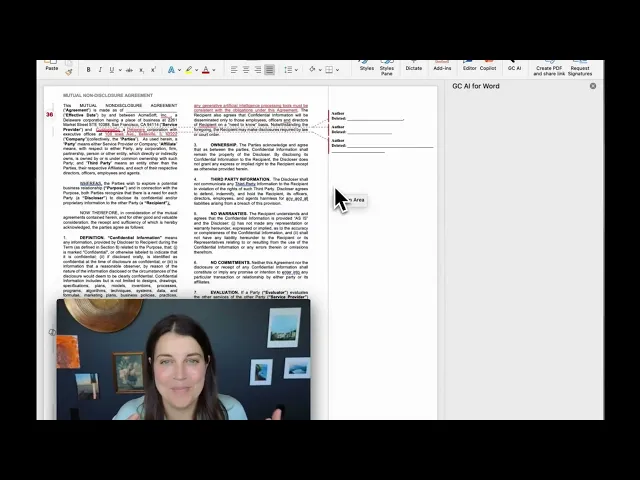
GC AI for Word lives inside Microsoft Word. Redlining, issue spotting, drafting, and Chat2 research happen in the document the team already uses. Playbooks, Easy Prompt, saved prompts, and Projects work inside Word.
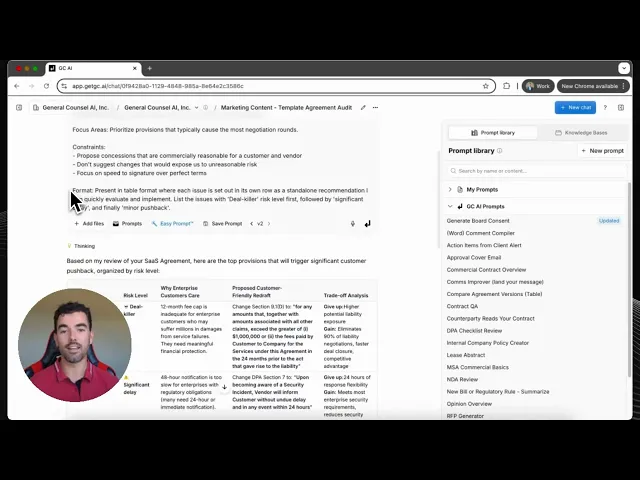
Skill Library stores the team’s reusable prompting work as callable skills. A regulatory-memo pattern, a DPA review prompt, a cross-border transfer check, all live in one place, and anyone on the team can run the senior lawyer’s review with a click. New: the Regulatory Monitoring Skill Creator turns this into a standing agent. Set your jurisdictions, risk areas, and a materiality threshold, and it scans regulatory sources on a schedule, verifies flagged items against primary sources, and returns a prioritized action-items table with Critical/High/Medium/Low tiers.
Files analyze up to 1,500 pages of policies, contracts, or regulatory filings in a single collection. Ask a question across the collection and GC AI returns the answer grounded in the documents.
Getting started takes three steps:
Research pulls the primary text
Exact Quote maps it against the contracts and policies in your Files collection
A Playbook or Skill Library entry encodes the pattern so the team can re-run the review at scale.
Watch the full demo:
How GC AI Fits Into an In-House Compliance Stack
In-house compliance monitoring usually runs on a three-layer stack. GC AI sits in the third layer.
Operational layer. A CLM platform (Ironclad, Agiloft, SpotDraft) stores contracts, routes approvals, and tracks renewals.
Evidence layer. A GRC platform (Drata, Sprinto, Vanta, Secureframe, or an enterprise system like Archer) pulls evidence from cloud and identity systems to prove framework compliance for SOC 2, ISO 27001, or HIPAA.
Legal analysis layer. GC AI reads the contracts, cites the primary law, reviews policies against regulatory changes, and generates the legal memos.
The GRC stack proves that the company has controls. GC AI proves that the controls and contracts meet the law as written today. In-house teams typically run both.
Kacie Zanassi, Director of Employment, Litigation and Legal Ops at Eventbrite, describes the research-as-first-step habit:
“When facing litigation in unfamiliar jurisdictions, I use GC AI as my first step to quickly understand procedural requirements, causes of action, and local court rules.”
Joys Choi, VP of Legal at Tipalti, frames the ongoing monitoring angle:
“GC AI has become a daily partner for our lean legal team. It gives us fast, reliable analysis across multiple jurisdictions and keeps us ahead of regulatory change. It’s transformed how we operate.”
Tipalti operates across multiple jurisdictions. A lean legal team that tracks compliance changes across several countries is the kind of team that breaks under manual tracking and rebuilds around a legal AI platform.
What In-House Teams Measure After Adopting AI for Compliance Monitoring
Four metrics carry the business case. Each maps to a finance-visible line item.
Hours returned to the team. GC AI customers save an average of 14 hours per week per lawyer. For a four-lawyer team, that is 2,912 hours a year, or roughly a full extra headcount of productive time.
Outside counsel spend reduced. Customers reported a 14% reduction in outside counsel spend. For a company in the $1B-$5B revenue range with ACC-benchmark outside counsel spend around $1.8M, a 14% reduction is about $252,000 in annual savings.
Time from regulation published to policy updated. This metric the team owns internally. Before AI, midmarket legal teams would take weeks to update an internal policy after a regulation changes. With Research pulling the primary text and Playbooks reviewing existing policies against the new text, the cycle compresses to days.
Time-to-value. 97.5% of GC AI customers see value before month one, and the returns compound as the team builds out Playbooks and Skill Library templates.
Trisha Mauer, VP of Legal at Tonal, ties the time savings to daily practice:
“I go straight to GC AI for everything from research requests to litigation responses. I’ve compared against ChatGPT, GC AI gives more comprehensive responses appropriate for a lawyer to use. After six months of use, I’m sure I’ve saved hundreds of hours.”
The In-House Implementation Playbook
A compliance monitoring rollout does not take a year. These are the milestones in-house teams hit on GC AI.
Week 1
Upload core contracts (standard NDA, MSA, DPA templates) and the current company AI policy into a Files collection.
Connect GC AI for Word on the team’s machines.
Run one live regulatory memo through Research. Compare the output to the team’s baseline draft.
Month 1
Build three Playbooks for recurring contract review work: inbound NDA, vendor DPA, and one sector-specific template.
Draft 10 reusable prompts in Skill Library for common compliance asks (cross-border transfer check, AI-use clause review, regulatory memo first draft).
Enroll the team in the free 101 class for CLE credit.
Month 3
Expand Playbooks to cover the regulation-specific redlines the team handles regularly: EU AI Act DPA language, state privacy notice updates, SOC 2 vendor questionnaire responses.
Add Files collections for each major regulation, so the team can ask “what changed” queries without re-uploading.
Measure hours returned per lawyer against the week-zero baseline.
Month 6
Connect GC AI output into the team’s reporting cadence with Operations, Finance, or Security.
Measure outside counsel spend trend quarter-over-quarter.
Build the next layer: AI governance memos for the product team, regulatory change summaries for the board, and contract benchmarks across the counterparty set.
For a practical framework for screening and routing new AI tools, see AI Governance Intake: 7 Questions That Trigger Review.
Start With One Regulatory Memo
The cleanest way to test AI for compliance monitoring at your company is to run one live work item through the platform and compare the output against your team’s baseline. Pick a regulation your team is already tracking this quarter. Ask Research to summarize what changed, with primary-source citations. Upload a contract or policy the regulation touches. Ask GC AI to mark the clauses that need updating. Compare the output to your team’s own read.
GC AI is enterprise-ready for regulated work. It runs in production at 2,100+ legal teams, including 200+ public companies and 25 unicorns, and is SOC 2 Type II and SOC 3 certified, GDPR compliant, and built on zero data retention agreements with OpenAI and Anthropic, so it clears the audit and security review a regulated company requires.
Frequently Asked Questions
What Is AI for Compliance Monitoring?
AI for compliance monitoring is software that uses machine learning, natural language processing, and predictive models to track regulatory change, collect evidence against compliance frameworks, score risk, and flag gaps between policy and practice. The software ingests both structured data and unstructured documents and returns a ranked list of where the business sits relative to its obligations.
What Is the Best AI for Compliance Monitoring for In-House Counsel?
For in-house legal teams, the strongest fit is a legal AI platform with character-level citation, regulatory research, contract review, and Microsoft Word integration. GC AI targets this lane exactly: 2,100+ legal teams across 200+ public companies and 25 unicorns use it today, with an average of 14 hours per lawyer saved each week.
How Does AI Compliance Monitoring Compare to Traditional GRC Tools?
GRC platforms (Sprinto, Drata, Vanta, Secureframe) excel at pulling evidence from cloud and identity systems to prove SOC 2, ISO 27001, or HIPAA compliance. They do not review commercial contracts, read regulations, or produce legal memos. In-house teams typically pair a GRC platform with a legal AI platform: the GRC stack owns evidence collection, the legal AI platform owns legal analysis and contract review.
What Is the Best Legal AI for Legal Compliance?
For legal compliance work specifically, the strongest fit is a legal AI platform, not a generic GRC or AI-monitoring tool. GRC platforms prove that security and privacy controls are in place; they do not read a contract, spot a missing data-transfer clause, or cite primary law the way a lawyer needs to. GC AI is built for that legal-analysis layer: character-level citation, multi-agent regulatory research, and Microsoft Word integration, used by 2,100+ legal teams across 200+ public companies and 25 unicorns as of September 2026.
Is AI Compliance Monitoring Secure Enough for Regulated Industries?
Enterprise-grade legal AI platforms meet the security bar for regulated industries. GC AI is SOC 2 Type II and SOC 3 certified, GDPR compliant, with zero data retention agreements with OpenAI and Anthropic, and AES-256 encryption.
Does AI Compliance Monitoring Replace Legal Review?
No. AI compliance monitoring speeds the first pass: finding the change, mapping it to obligations, flagging affected documents. The legal judgment stays with the lawyer. The value is in returning legal hours to strategic work.
How Fast Do In-House Teams See Value From an AI Compliance Monitoring Platform?
Across more than 100 active GC AI customers, 97.5% saw value before month one. Month-one value usually shows up as hours returned on regulatory research and contract review, then compounds as the team builds out Playbooks and Skill Library templates.
Which Regulations Can an AI Compliance Monitoring Platform Track?
Coverage varies by platform. A legal AI platform with strong research capability tracks the EU AI Act, ISO 42001, NIST AI RMF, state AI laws (Colorado SB24-205, California SB 942), GDPR, CCPA, SEC cyber-incident rules, and sector-specific frameworks. GC AI Research pulls from authoritative legal and government sources in real time.
How Does AI Compliance Monitoring Handle the EU AI Act?
A strong legal AI platform tracks the EU AI Act at the article level, pulls the specific obligations that apply to providers and deployers of high-risk AI, and reviews contracts and company AI policies against those obligations. GC AI Research returns linked primary-source citations from the official EU text, and Playbooks encode the team’s standard redline for each recurring clause gap.
Can a Lean Legal Team Run Compliance Monitoring for a Public Company?
Yes, with the right platform. A lean team running Research for regulatory reading, Playbooks for recurring contract review, and Skill Library for reusable prompt templates can cover SEC cyber disclosure, EU AI Act obligations, SOC 2, and state privacy laws simultaneously, while a senior lawyer keeps judgment on the outputs. The ROI for small legal departments shows up as hours returned to strategic work and a steady outside counsel spend trend.
Recurring compliance reviews run as scheduled Skills, and how to build Skills in GC AI shows how to define one, including the intake questions and always/never rules.
What Does AI for Compliance Monitoring Cost?
Pricing varies by platform and scope. GC AI’s standard plan is $500 per seat per month and includes all features. Start a 14-day free trial with no credit card required.
What Are AI Regulatory Compliance Monitoring Agents?
AI regulatory compliance monitoring agents are AI systems that run recurring regulatory monitoring on a schedule. A standing agent scans regulator feeds across the jurisdictions you set, verifies flagged changes against primary sources, and returns a prioritized list of action items. The lawyer keeps the judgment: the agent flags and drafts, the team decides. In GC AI, the Regulatory Monitoring Skill Creator builds this kind of standing agent from your jurisdictions, risk areas, and materiality threshold.