Privacy counsel spend a lot of time telling employees what’s safe to put into an AI tool. Courts are already ruling on whether that use can waive privilege, and they don’t agree: the Heppner ruling found one company’s consumer-AI use broke privilege, while other courts have gone the other way on similar facts.
AI for privacy counsel means turning that same scrutiny on their own work. Ariana Goodell, Senior Counsel for Privacy and Policy at Verkada, had to fight her way into the meetings where consent and data-handling get decided. She told CZ and Friends, where GC AI’s CEO Cecilia Ziniti interviews senior legal leaders, which ones mattered:
“Some of the more critical meetings that I feel like you can be in is actually the product planning and roadmap planning meetings because there you’re kind of understanding… what’s a P zero, what’s a P one and why. Those were meetings that I had to kind of really advocate to get at the table… They didn’t really have legal integrated into their design process.”
That’s the work: answer the questions before the feature ships. And the job keeps growing. Every feature, every vendor, every jurisdiction adds another privacy question, and usually one privacy counsel is answering them all.
Goodell has watched the heavy-handed version fail:
“If you try to kind of shove this like privacy by design program with all these shiny decks and like I’m going to be in every meeting, it just doesn’t always work. You kind of really have to understand how each product team works.”
GC AI is the enterprise legal AI platform a three-time general counsel (Anki, Bloomtech, and Replit) built for in-house teams, including 200+ public companies and security-first teams like Snyk, as of August 2026. Three GC AI features carry the privacy counsel workload:
Playbooks include a DPA review for the vendor queue
Research answers multi-jurisdiction consent questions from primary law with citations
Files holds your policy corpus, so answers start from your own documents
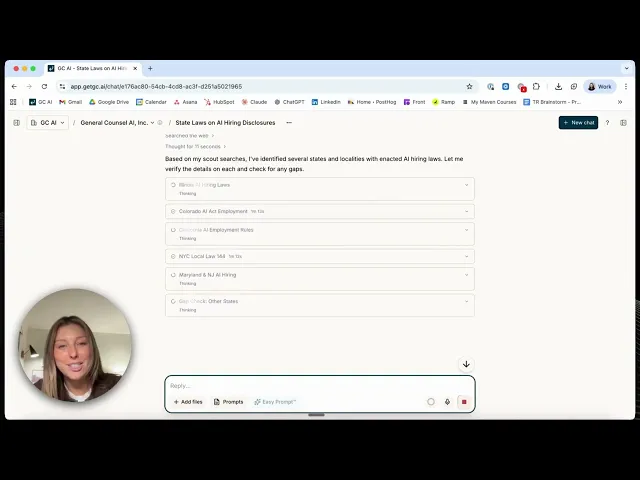
That’s the Playbook running on a live agreement: sorting each clause into pass, fallback, or flag against your positions, then drafting the redline in Word for anything off-standard. For the full GDPR Article 28 checklist it runs against, see AI DPA Review.
KT Farley, Chief Privacy Officer and Associate General Counsel at Helix, runs that exact workflow on her own privacy team:
“Junior teammates now run the checklist prompt first and bring me the output as the predicate for my review.”
What a Privacy Counsel Owns In-House
In-house privacy counsel own privacy: consent flows, data mapping, DPAs with each vendor, incident posture, and the gap between what the privacy policy says and what the product does.
Rachel Harris, GC and AI Governance and Privacy Officer at Suzy, got the job description on her first day from her predecessor:
“You’re the privacy counsel, you own privacy. Your clients at Suzy are the product and engineering teams, and also our head of security. Go become best friends with them.”
Harris draws a sharper distinction:
“there’s knowing privacy and cybersecurity in private practice when you’re the outside counsel advising it. And it’s very different when you’re in-house.”
The in-house version means living with a roadmap that moves fast.
Privacy by Design, Team by Team
Privacy by design works when the guidance arrives shaped for each product team, and Ariana Goodell of Verkada calls her method federation:
“It’s imperative for you to kind of federate out your guidance. What’s relevant to one product team… is going to be different from another one.”
AI makes federation sustainable for one privacy counsel: the consent standard lives once in a playbook, the per-team guidance drafts from it, and the jurisdiction questions each team raises get cited answers the same day. One privacy counsel can carry several product teams, and the guidance still arrives within the sprint.
The Work Privacy Counsel Hand to AI First
The same five tasks come up first:
DPA review: each vendor arrives with one, and the pre-built DPA playbook checks each against your required positions.
Multi-jurisdiction consent questions: age thresholds, EU vs. US treatment, and sector rules answered from primary law with Research.
Policy-to-product alignment: reading the privacy policy against what the feature does, with your own documents loaded in Files.
Vendor diligence: security terms and subprocessor lists read at portfolio scale before the DPA gets signed.
Guidance drafting: the per-team privacy briefs Goodell federates, drafted from the standard instead of from scratch.
The judgment stays with the counsel: which risks ship, which stop the launch, and what gets escalated. AI does the reading, so judgment arrives on roadmap time.
Best Practices for Privacy Counsel’s Own AI Use
Privacy counsel usually write the AI-use policy everyone else follows. Their own AI use has to clear the same bar. Four practices hold up:
Run privacy work through enterprise terms, never a personal or consumer account: a consumer account sits outside any contract the company negotiated, and it’s the fact pattern behind the Heppner ruling.
Confirm the retention commitment covers the whole stack: ask whether every model provider behind the tool, not just the interface, has agreed not to train on inputs.
Keep counsel visibly directing the work: courts weighing privilege look at who controlled the tool and how, so a documented, attorney-directed workflow holds up better than an ad hoc one.
Put the policy in writing: ABA Formal Opinion 512 frames competence, confidentiality, and supervision as the duties a written AI-use policy has to cover, and a memo beats a Slack message if the use ever gets challenged.
These are the same diligence questions privacy counsel already run on every vendor. Running them on the AI tool too keeps the rest of the job on schedule, the same accountability instinct Clay’s company-wide AI writing policy is now applying outside legal too.
What to Ask Before Choosing a Legal AI Tool
Privacy counsel read subprocessor lists for a living, so start with GC AI’s: the live subprocessor list names each vendor that touches customer content.
GC AI is SOC 2 Type II and SOC 3 certified, GDPR compliant, and AES-256 encrypted, and every AI provider in its stack processes customer content on a zero data retention basis.
Security-first companies like Snyk trust GC AI with that same work.
Four questions test whether a platform clears that bar:
Retention, verified across the stack: does the zero-data-retention commitment name every model provider, or just the one in the interface?
Segregated data: is your content isolated from other customers’, or pooled into shared infrastructure?
A subprocessor list you can read today: named vendors, not a promise to provide one on request.
Change control: does the platform log who changed a model or retention setting, and when?
Privacy operations platforms manage the records: consent logs, DSAR queues, assessment workflows. A legal AI platform carries the judgment work beside them: the DPA review, the jurisdiction call, the policy read.
Privacy counsel usually run both.
Answer early, and privacy helps shape the product.
Frequently Asked Questions
What Is the Difference Between Privacy Counsel and a Data Protection Officer?
Privacy counsel is a legal role: advising the business on privacy law, reviewing DPAs, and shaping product decisions, with duties running to the company. A Data Protection Officer is a defined statutory role under GDPR with independence requirements and duties that include monitoring compliance itself. One person sometimes wears both titles, and the DPO’s statutory independence is the line to watch when they do.
Can AI Review a DPA?
Yes: GC AI includes a pre-built DPA playbook that checks each agreement against standard positions and flags each clause sitting off them, with the privacy counsel reviewing the flags and making the calls. Teams run vendor DPAs through the playbook before negotiation, so the first human read starts from the exceptions. The counsel still owns the judgment on what to accept.
Is AI Safe for Privacy Counsel Work?
Yes, on a platform with enterprise controls: GC AI keeps customer data in a segregated database, maintains zero data retention agreements across its AI providers, and publishes its full subprocessor list. Run privacy work through enterprise terms your team has reviewed, the same diligence standard you apply to any vendor processing personal data.
Does Using AI Waive Attorney-Client Privilege?
Not automatically, and the case law is still developing: courts have reached different results on similar facts. What separates the outcomes is simple: enterprise terms, counsel-directed use, and a documented policy protect privilege far better than an ad hoc consumer account, and the Heppner ruling is the clearest cautionary example of what happens without them.