AI for General Counsel: One Operating Layer for Solo GCs to Full Departments
Josh Bertini, Head of GrowthPublished Updated
Joys Choi spent years reporting her own bandwidth in one color. The Senior Director of Legal at Tipalti put it this way:
Before GC AI, no one even asked about my bandwidth because it was always red. Now I'm yellow more often, and trying to get to green.
That is the whole job of a general counsel in three colors. Red means the queue owns you: every contract, every “quick legal question,” every outside-counsel invoice arrives faster than you can clear it, and the business stops asking what you think because it knows you have no room to think it.
Green means you run the function instead of drowning in it.
Here at GC AI, the legal AI built for in-house counsel by a three-time general counsel, we run across all five of those workflows, not just the contract on your screen. Cecilia Ziniti, who has sat in the GC seat at Anki, Bloomtech, and Replit and was in-house before that at Amazon and Cruise, built the platform around the operating layer she had to run: how matters enter, move, get staffed, and get measured. That is the reason the same product handles intake, throughput, outside-counsel spend, knowledge, and the report you hand the CFO.
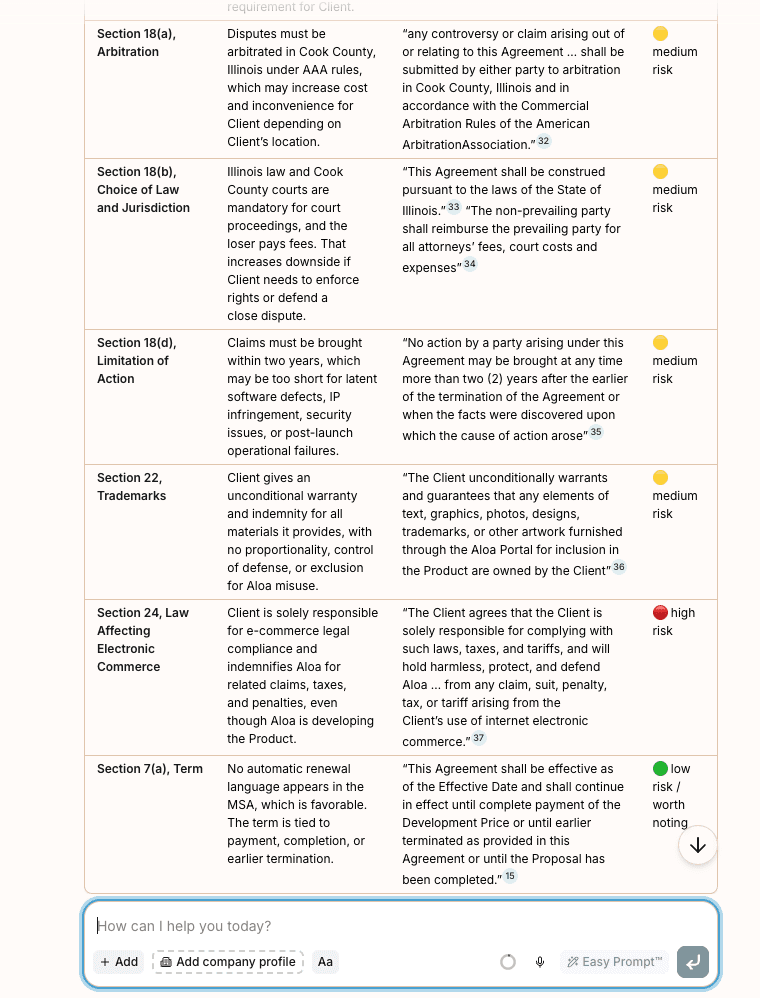
AI for general counsel operations is the use of legal AI across the five workflows a GC owns: intake and triage, contract throughput, outside-counsel spend, knowledge management, and reporting to the business. It works one layer up from a single redline. A tool reviews a contract; an operating layer changes how matters enter, move, get staffed, and get measured. Legal AI fits inside each of the five.
The shift is no longer theoretical. AI adoption inside corporate legal departments nearly doubled in a year, from 44% of general counsel reporting active use to 87%, according to FTI Consulting's General Counsel Report (a survey of 207 GCs and chief legal officers at companies above $100M in revenue). The GCs who got to green treated AI as an operating layer across the whole function, beyond a single feature bolted onto contract review.
This is not a tool hoping to land its first in-house customer. As of September 2026, 2,100+ legal teams run on GC AI, ranging from a solo general counsel to departments inside 300+ public companies and 25+ unicorns, with an NPS of 80. Named departments include Tipalti, Liquid Death, Snyk, Arc'teryx, Columbia Sportswear, Jasper, and Interface. That is what a buyer at any team size should weigh, far more than a funding round.
Start with the workflow that takes the most time of your week.
What Is AI for General Counsel Operations?
AI for general counsel operations covers the five operational workflows a GC owns: intake and triage of incoming work, contract throughput, outside-counsel spend management, knowledge management, and reporting to the business. The defining feature is scope. It reaches how matters enter, move, get staffed, and get measured, beyond the speed of any single review.
This matters because the GC's job is operational at its core. A GC gets judged on whether the function clears its queue, whether the outside-counsel budget holds, whether the business trusts legal's answers, and whether the CEO can get a one-page read on legal's load any week of the year. Those are operations questions, and AI now reaches all of them.
This is also where “AI for general counsel operations” differs from “AI in legal operations.” Legal operations, as a discipline, is a team function: technology stack, vendor management, process design, often run by a dedicated legal ops professional. The general counsel's operations are the running of the legal function itself, the part that stays the GC's responsibility whether or not a legal ops hire exists. Most in-house teams running these workflows do not have a legal ops department; the GC is the operator.
The GC's operational reality: the function is the deliverable, and AI now reaches every part of how it runs.
How a Matter Moves Through a Legal Function
To see where AI fits, follow a single request through the department. A sales rep sends the most common message in any in-house lawyer's inbox: “Quick approval on this contract?” In a red-queue department, that message lands in a shared inbox, sits until someone triages it, gets read cold by whichever lawyer is free, bounces to outside counsel if it touches an unfamiliar jurisdiction, and produces an answer with no record of how long it took or what it cost. Multiply by every function that touches legal, and the GC spends the week as a router instead of a counselor.
An AI-native function moves the same request differently. Intake gets classified the moment it arrives. The contract gets a first-pass review against the team's own standards before a human opens it. The unfamiliar-jurisdiction question gets researched in-house before anyone dials outside counsel. The knowledge from that matter gets captured so the next identical request resolves faster. And the whole flow leaves a trail the GC can report on. The tracking runs as scaffolding behind the work, so the team feeds one workflow instead of a second system.
That operating model is what the rest of this guide builds out, one workflow at a time.
Intake and Triage: Controlling What Enters the Queue
Intake and triage is the workflow that decides what legal works on and in what order, and it is where most in-house overload begins. Every function in the company treats legal as on-demand: sales wants a contract reviewed, HR wants a policy checked, finance wants a vendor agreement cleared. Without a triage layer, the loudest requester wins and the GC loses control of the calendar.
AI changes triage in two ways. First, it classifies and routes incoming work, so a request gets sorted by type, risk, and urgency before a lawyer spends judgment on it. Cindy Prabhakar, who leads legal at Marvell, described the payoff at scale on the CZ and Friends podcast:
We've auto-triaged about 40%, and a global team triages the rest. Things are assigned almost within 24 business hours.
That is a function deciding what it works on, instead of reacting to whoever emails last.
Second, AI lets legal push routine legal-adjacent work back to the business with guardrails, so it never enters the queue at all. A standard NDA or low-risk vendor form does not need a lawyer if the requesting team has a playbook and a self-serve answer.
GC AI's Playbooks encode the team's standard positions into repeatable review workflows for this high-volume, judgment-light work, and its Skill Library ships ready-to-run skills for common requests like NDAs, DPAs, and board consents. The queue that never forms is the cheapest queue to clear.
Triage well and the GC sets the agenda; triage poorly and the inbox sets it. Make intake a deliberate decision the function controls.
Contract Throughput: The Volume That Defines the Week
Contract throughput is the highest-volume operational workflow a legal function runs, and the one AI changes most directly. Tiffany Lee, GC and Corporate Secretary at Liquid Death, named the stakes plainly:
The bread and butter of any in-house lawyer is contract review. Every agreement has to be read, flagged, and summarized, it's repetitive work that eats into the time you should be spending on strategy.
Throughput is a team-level metric, one redline up from the per-document view: how many agreements the team can move per week at a consistent standard while the backlog shrinks. AI raises it by running the first pass on every agreement, checking against the team's standard positions, flagging deviations, surfacing the clauses that need human judgment, and summarizing what changed. This is the heart of contract management with AI: the work moves at a consistent standard while the backlog shrinks.
The lawyer arrives at a structured starting point instead of a blank document. Inside Microsoft Word, where most contract work already happens, GC AI for Word handles redlining, issue-spotting, and drafting without a context switch.
The gain compounds across a team. Cameron Clark, Head of Legal at Arc'teryx, ran the first year as the company's only lawyer:
With GC AI, we've handled the workload of a full legal team with just one or two lawyers.
That is throughput as a staffing decision: the team clears more work at the same headcount.
Contract throughput is the metric the business feels first. When agreements clear in days instead of weeks, sales stops routing around legal.
Outside-Counsel Spend: The Budget Line Every CFO Watches
Outside-counsel spend is the operational workflow with the most direct financial stakes, and the one a GC gets asked about in every budget review. Outside counsel consumes roughly half of corporate legal budgets, with median outside-counsel spend around $1.8M per department, per the ACC's Law Department Management Benchmarking report. Every dollar of work the team can do in-house is a dollar that does not leave the budget.
AI reduces outside-counsel spend by raising the threshold at which a question has to leave the building. Ritesh Patel, Chief Legal Officer at Viant Technology, described the new decision point:
Before, I'd call outside counsel and pay by the hour for a generic answer. Now, I can analyze it myself, see where it gets me, and call outside counsel if I'm truly out of depth.
The referral now happens only on the matters that earn it.
GC AI's own ROI study quantifies the effect. In a December 2025 study of more than 100 active GC AI customers, teams reported reducing outside counsel spend by 14%, roughly $252,000 in annual savings for the median company against that $1.8M benchmark.
The mechanism is the in-house first pass: matters that once started at a firm now start with GC AI Research, which pulls from primary law with citations, so the GC reaches the “out of depth” line later and pays outside counsel for less.
The invoices that do arrive get the same first-pass treatment. GC AI's Skill Library ships an External Counsel Invoice Review skill (July 2026): attach the invoice and it flags block billing, vague time entries, rate overages, and duplicate entries against your outside counsel guidelines and fee schedules, then drafts the correction email to the billing partner.
The 14% line is the one that survives the budget review. Every matter resolved in-house is a number the GC can show the CFO.
Knowledge Management: The Institutional Memory That Stops Walking Out
Knowledge management is the operational workflow that determines whether a legal function gets smarter over time or re-solves the same problem every quarter. In most in-house teams, the institutional memory lives in individual lawyers' heads and inboxes: the fallback position on indemnity, the reason a clause got rejected last year, the playbook for a recurring vendor. When a lawyer leaves, the knowledge leaves with them.
AI turns scattered knowledge into a shared, queryable layer. GC AI Files lets a team build permanent collections of its own documents, templates, and precedents, accessible across every chat and able to analyze up to 1,500 pages at once, so the team's standards live in the platform instead of someone's drive. Projects, GC AI's matter-level memory, carries context across chats so a complex deal does not restart from zero each session. And Custom Company Profile encodes the team's voice, templates, and standard positions, so outputs arrive calibrated to how the team writes.
The operational payoff is faster, more consistent answers and a function that does not lose ground when staff turns over. Andrea Peters, Senior Counsel and Global Head of Compliance at Interface, described how shared prompting compounds across a team:
Instead of re-doing research or writing long explanations, I can just share the prompt I used. It saves all of us time and gets us aligned quickly.
Knowledge management is how a two-person team starts to operate like a four-person one.
Captured knowledge is leverage; uncaptured knowledge is risk that walks out the door. Build the institutional memory into the platform so it stays when people move on.
Reporting to the Business: Making Legal's Work Legible
Reporting is the operational workflow that turns legal's output into something the rest of the business can see, and it is the one GCs most often neglect until a budget cycle forces it. A legal function that cannot show its load, its throughput, and its spend gets treated as a cost center with no visible return. The colors Joys Choi used, red and yellow and green, only work as management if the GC can put them in front of a CFO.
AI helps in two directions. It generates the reporting itself: matter summaries, status updates, and the plain-English briefings that translate legal work for non-lawyer stakeholders. The same Viant CLO we met on outside-counsel spend uses GC AI for this handoff too:
I describe the setup, get an answer with citations, and use that to brief my team or our business partners.
The deeper shift is positional. Reporting is how legal moves from the department of no to a business partner, the role Molly Abraham of Coinbase described as being “the dot connector across legal, policy, compliance, and the business.” A GC who can show throughput, spend reduction, and capacity in numbers is a GC the CEO brings into the room earlier. For the metrics worth tracking, see corporate legal department metrics.
Legal that cannot be measured gets managed as overhead. Reporting is how the GC turns the function's work into a number the business respects.
Where GC AI Fits Across the Operating Layer
GC AI is the legal AI built for in-house counsel, which is what lets it run the whole operating layer where other tools cover a single workflow. The same platform that runs first-pass contract review through Playbooks also handles in-house research that keeps matters off the outside-counsel invoice, stores institutional knowledge in Files, and produces the briefings that go to the CFO. One platform across the five workflows, instead of five tools to integrate.
Case law is now one more workflow on that same layer. GC AI includes US Case Law directly in chat, so a precedent check no longer means leaving the platform: ask a question in plain English and GC AI searches a dedicated database of 14M+ US federal and state court opinions, reads the full text, flags whether each case is still good law, and writes a cited analysis grounded in your own contracts and context, with every citation linked to the full opinion in a built-in reader. Where a general-purpose AI can invent citations, GC AI checks treatment data, flagging whether a case was overruled, reversed, questioned, or affirmed, so the GC knows the law is still standing before relying on it. GC AI also offers International Law, with case law and legislation from 30+ jurisdictions across Europe, Asia-Pacific, and Latin America.
Team and Enterprise plans include one legal database of the organization's choice: US Case Law or International Law (add-on of both databases available). For Individual seats, US Case Law and International Law are available as add-ons.
That breadth is the point, and it is measurable. On the In-House Legal Bench, GC AI's evaluation of AI assistants across 100 in-house tasks scored against 1,200+ attorney-developed criteria, the results were:
-
GC AI: 86.8%
-
ChatGPT (GPT-5.5): 79.8%
-
Claude (Opus 4.7): 68.4%
-
Gemini (3.1 Pro): 57.5%
The largest GC AI advantages were in regulatory tracking, legal research, and checklists, the operational work a GC runs daily.
The enterprise procurement and security review is the other threshold a platform clears before it touches privileged work. GC AI is SOC 2 Type II and SOC 3 certified, GDPR compliant, and AES-256 encryption. We maintain zero-data-retention agreements with our LLM providers wherever feasible, with the access controls and audit trails an enterprise IT review expects.
Pricing is published at $500 per seat per month, with a 14-day free trial and no credit card. For a structured read on what to buy and what to skip, see in-house counsel AI software and the best legal AI tools for in-house counsel.
Test it against a matter you already know the answer to: drop in a contract your team has reviewed, or a question you would have sent to a firm.
The Role of Team Adoption
An operating layer only works if the team runs on it, which makes adoption the workflow under the workflows. A platform that two lawyers use and the rest ignore does not move the function's metrics. The GCs who get to green build fluency across the whole team, from junior staff to the top.
The fastest path is to start where the value is obvious and let usage compound. Junior staff can run the first pass and bring the output as the predicate for senior review, the pattern KT Farley, Chief Privacy Officer and Associate GC at Helix, described:
Junior teammates now run the checklist prompt first and bring me the output as the predicate for my review.
Treating AI like a new hire who needs context and feedback, the way you would coach any new team member, is the mindset that separates teams who get leverage from teams who get frustrated.
GC AI's free, CLE-eligible classes, taught by former general counsels, build this fluency, and Easy Prompt turns plain-language requests into optimized legal prompts, so a lawyer does not need prompt-engineering skill to get a strong first draft.
Adoption is the multiplier on every other workflow. A platform the whole team runs on is what turns five AI workflows into one operating function.
Start With the Workflow Costing You the Most Right Now
The move from red to green does not start with a platform rollout across all five workflows at once. It starts with the one costing you the most this week. If the contract backlog is the bottleneck, run the next ten agreements through a first-pass review and measure how much faster they clear.
If outside-counsel spend is the budget problem, take the next question you would have sent to a firm and see how far an in-house first pass gets you. If reporting is the gap, generate one matter summary your CFO can read.
The general counsels who built operating leverage with AI did not wait for a perfect deployment. They picked one workflow, proved the return, and let the result fund the next. The function gets to green one workflow at a time, and the first one is the one already keeping you in red.
Every week you stay in red is a week the business routes around legal and the backlog compounds. Pick the workflow that hurts most and prove the return this week: the trial runs 14 days with no card and no sales call, and the demo puts a solutions attorney on your own playbook.
Frequently Asked Questions
What In-House Teams Measure After Adopting AI
The operating layer pays off in numbers a GC can put on a slide. In GC AI's December 2025 ROI study of more than 100 active customers, teams reported saving an average of 14 hours per week per lawyer, and 97.5% saw value before month one. Fourteen hours is the difference between a lawyer who routes requests and one who counsels the business.
Run your own numbers with the GC AI ROI calculator: enter team size, hours spent on contracts, and annual outside-counsel spend, and it returns the annual dollar impact. That output turns an operations story into a budget conversation, with throughput, spend reduction, and capacity already quantified.
What Is the Best Legal AI for a Solo General Counsel or Small In-House Team?
GC AI is built for exactly this range: a solo general counsel or a one- to two-lawyer in-house team runs intake and triage, contract throughput, outside-counsel spend, knowledge management, and reporting on one platform instead of stitching together five point tools a small team has no bandwidth to manage. Arc'teryx ran its first year on one lawyer using GC AI's first-pass contract review and research, and GC AI's knowledge-management layer is what lets a two-person team operate like a four-person one. Pricing is published at $500 per seat per month with a 14-day free trial, so a solo GC can test it against real matters before adding headcount.
How Does AI Help a General Counsel Reduce Outside-Counsel Spend?
AI reduces outside-counsel spend by raising the threshold at which a question has to leave the building, letting the GC run a first pass in-house before paying for an hourly answer. In GC AI's December 2025 ROI study of more than 100 customers, teams reported reducing outside counsel spend by 14%, roughly $252,000 in annual savings for the median company against the ACC benchmark of $1.8M in median outside-counsel spend. The mechanism is in-house research with citations that handles the routine questions, so firms get the matters that genuinely require them.
What Is the Difference Between AI for General Counsel Operations and AI in Legal Operations?
AI for general counsel operations is the running of the legal function itself, intake, throughput, spend, knowledge, and reporting, which stays the GC's responsibility whether or not a dedicated legal ops hire exists. AI in legal operations is broader and refers to the legal ops discipline: technology stack, vendor management, and process design, often run by a legal operations professional. Most in-house teams running these workflows do not have a legal ops department, so the general counsel is the operator.
How Much Time Does AI Save an In-House Legal Team?
AI saves in-house legal teams an average of 14 hours per week per lawyer, according to GC AI's December 2025 ROI study of more than 100 active customers. The same study found 97.5% of teams saw value before month one and a 14% reduction in outside-counsel spend. The hours-back figure is the operational difference between a lawyer who routes requests and one who counsels the business.
Can AI Handle Intake and Triage for a Legal Department?
Yes, AI handles intake and triage by classifying and routing incoming requests by type, risk, and urgency before a lawyer spends judgment on them, and by enabling self-serve workflows that keep routine work out of the queue entirely. One in-house team reported auto-triaging about 40% of incoming matters and assigning the rest within 24 business hours. GC AI's Playbooks and Skill Library encode the team's standard positions so high-volume, judgment-light requests resolve without a lawyer touching each one.
How Do General Counsel Report Legal's Value to the Business With AI?
General counsel use AI to generate matter summaries, status updates, and plain-English briefings that translate legal work for non-lawyer stakeholders, and to produce a measurable record of time saved. As one in-house lawyer put it, you can see the time saved in GC AI directly, and that lands when you report to a CFO. Reporting is how legal moves from a cost center to a business partner the CEO brings into the room earlier.
Is GC AI Secure Enough for Privileged In-House Work?
Yes, GC AI is SOC 2 Type II and SOC 3 certified, GDPR compliant, and AES-256 encryption. We maintain zero-data-retention agreements with our LLM providers wherever feasible. These are the security thresholds any platform handling privileged in-house legal work has to clear before it touches sensitive matters. GC AI is built for in-house counsel, with access controls, audit trails, and confidentiality safeguards designed for the security and IT diligence an enterprise runs, and it is trusted by 200+ public companies as of August 2026.
How Should a General Counsel Start Using AI Across Operations?
A general counsel should start with the single operational workflow causing the most pain this week, prove the return, and let the result fund the next one. If contract backlog is the bottleneck, run the next ten agreements through a first-pass review; if outside-counsel spend is the problem, take the next question you would send to a firm and run it in-house first. GC AI offers a 14-day free trial with no credit card so a team can test one workflow before rolling out across the function.