

Dive Deeper
Transcript
Episode Overview
In-house counsel calibrate legal risk by learning the company’s risk appetite as deeply as possible and re-checking it as the company changes, then matching each decision to the stage the company is in today, according to David Schellhase, former General Counsel of Salesforce, Groupon, and Slack.
Schellhase built that discipline across 35 years in Silicon Valley, taking all three companies public along the way. He calls it “always be calibrating.”
That discipline extends to blunt conversations with a CEO. When Slack’s Stewart Butterfield called from Dublin a year before GDPR took effect, unable to sleep after reading the regulation cover to cover, Schellhase told him flatly that he had not read it yet, because sharks closer to shore needed his attention first.
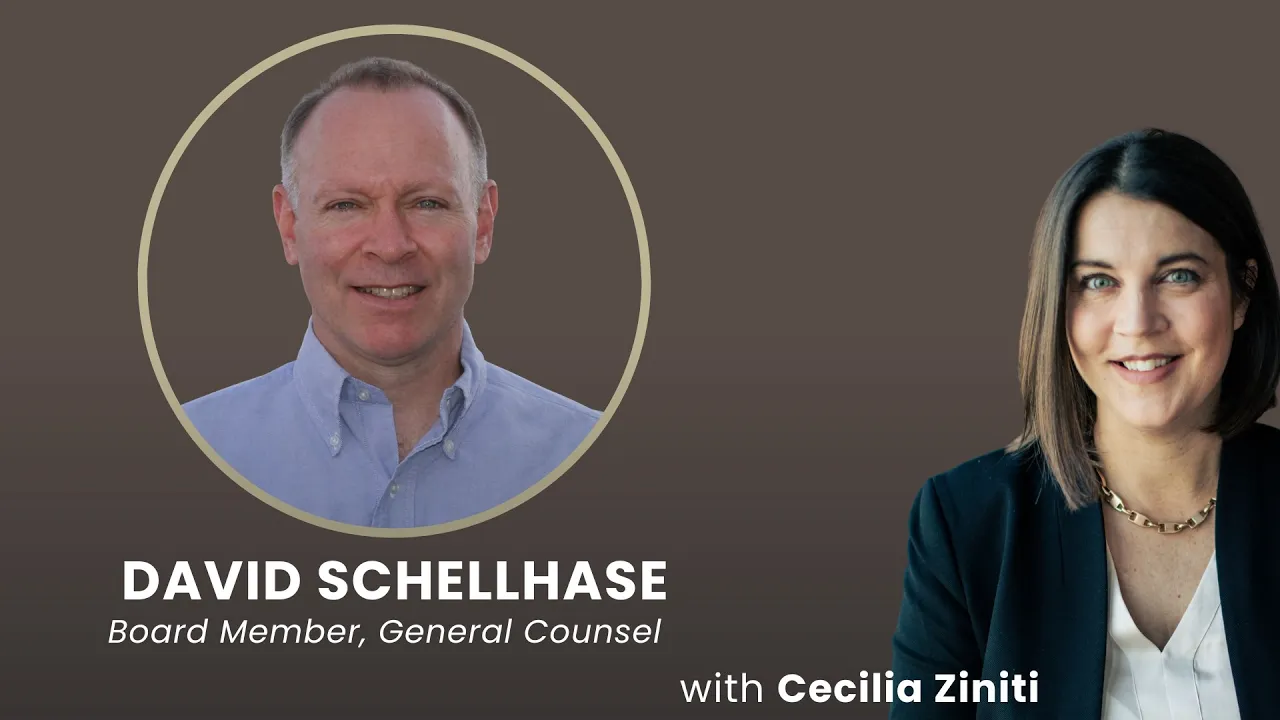
In this conversation with GC AI co-founder and CEO Cecilia Ziniti, Schellhase walks through how that same calibration shows up in prioritization, the Overton window that lets innovation outrun the law, and what legal AI means for the billable hour.
About David Schellhase
David Schellhase is a former General Counsel of Salesforce (9 years), Groupon, and Slack, and he has taken three companies public.
Today he is an Entrepreneur in Residence at the cybersecurity fund Ballistic Ventures and serves on the boards of Okta, and Next Chapter, a nonprofit that helps formerly incarcerated people find work in technology.
Key Takeaways
Risk calibration means matching judgment to risk appetite in the moment. Schellhase calls it "always be calibrating," rechecking the company's risk appetite as it changes over time.
Prioritize ruthlessly, even with the CEO. Schellhase told Slack's Stewart Butterfield he had not read GDPR yet, a year before it took effect, because more urgent work sat in front of him.
"Strong opinions, loosely held" and "disagree and commit" are one discipline. Take a clear legal position, drop it when the evidence proves you wrong, and commit to the company's direction even when the call goes against you.
The Overton window shifts fast on regulated topics. Ride-sharing, marijuana, and prediction markets all moved from legal gray zones toward accepted business within a decade, and AI-generated content is shifting now.
Schellhase would vote for one AI law: label everything AI-generated. That keeps trustworthy, branded sources valuable as the volume of convincing fake content goes off the charts.
What Does "Always Be Calibrating" Mean for In-House Counsel?
"Always be calibrating" is Schellhase's framework for in-house risk judgment. It means knowing your one client's risk profile and risk appetite as deeply as possible, and re-checking both as the company changes.
The method is over-communication. Sit with executives, colleagues, and anyone at the company who understands risk, so the picture in your head matches the company that exists today.
Schellhase explained:
"Always be calibrating is really understanding your client's risk profile and risk appetite and trying to understand that as deeply as possible. ... Every company has a slightly different way of looking at risk and a slightly different appetite for risk. And that changes over time."
Calibration matters because the decisions that reach a GC's desk live in the gray zone. If the answer were clear, the business would not need a lawyer to opine; they would go.
A good decision in a legal gray zone requires knowing where the company is, what it is trying to accomplish, and how much risk it will absorb to get there.
How Company Risk Appetite Changes as the Company Grows
Schellhase has taken three companies public, and each time he watched the same shift. The bigger and more scrutinized a company gets, the less risk it will take on, and scrutiny peaks around a public offering.
A GC who keeps giving startup advice to a pre-IPO company is calibrated for a company that no longer exists.
Schellhase put the early-stage end of the spectrum bluntly:
"If you say, hey, we're at the beginning of our company's life and we have almost no revenue and we're up against these massive competitors, guess what? If you don't take a ton of risk at that stage, you're never going to get anywhere as a company. That's when you're at your most risk-taking."
How Should In-House Counsel Prioritize Legal Work?
Ruthlessly, and by consequence. Schellhase asks which items on the CEO's worry list need attention right now, and which can wait.
That judgment is a different skill from knowing the law, and it is the in-house lawyer's core contribution, because a CEO's job is to worry about everything at once.
His favorite example is a call from Dublin. A year before GDPR took effect, Slack CEO Stewart Butterfield could not sleep in his hotel, had been reading the regulation itself, and called his GC to talk it through.
Schellhase had not read it, and he said so.
"I said, Stewart, this law doesn't even take effect for a year. I haven't read it, to be totally honest, because I haven't needed to read it yet. The EU may change it. The EU may break apart. ... There are sharks at my feet that I'm trying to get done. ... You've got to trust me enough to prioritize what's important for the company."
Butterfield laughed and accepted it, and the exchange became a template for the relationship.
Ziniti had nearly the same GDPR conversation at a former employer. She told her CEO the EU would be busy with Facebook for a couple of years, and taking three extra weeks to finish the register of processing activities would not sink the company.
That kind of candor with a CEO takes years to build, and it outvalues any single piece of legal analysis.
Schellhase summed up the skill:
"One of the skill sets that I think you've got to have as a general counsel is the ability to convince your boss that you are right and he is right, but you're righter."
Why Does Innovation Outrun the Law? Groupon and the Overton Window
Schellhase's thesis, the book he says he would write with more time, is that "innovation is crime." Innovations from the past decade began life in deep legal gray zones. Uber launched against taxi regulations, short-term Airbnb rentals remain a crime in Manhattan by his account, prediction markets press against state gambling laws, and recreational marijuana remains a federal crime in 2026 even where states have legalized it.
What resolves the conflict is society deciding it wants what the innovation provides.
Groupon gave him his sharpest example. The company went from a startup to operating in 80 countries almost overnight, he says, and ran into laws it did not know existed.
As Schellhase tells it, New York prohibits varying the price of liquor within a single day, a post-Prohibition rule that made Groupon's discounted drink voucher illegal.
Schellhase remembered the trip it forced:
"A Groupon for discounted liquor was illegal. I had to fly to Albany and appear before the New York State Liquor Board. We wound up settling and making the Groupon only applicable to food. ... There is no such thing as a bar in New York City. There are restaurants that serve liquor."
The concept underneath is the Overton window, the range of positions society will accept. It moved on ride-sharing almost overnight, on marijuana over the past 10 years, and it is moving now on prediction markets and AI-generated content.
In-house lawyers at technology companies sit inside that shift and help steer it.
"Technology pushes that Overton window so rapidly and without regard to state boundaries, country boundaries, religion, ethics, anything. It makes things available cheaply and easily, ubiquitously. ... And so that's why technology, especially right now, and will be for the next 25 years, is a super exciting place to be."
What Three Founders Taught Schellhase About Practicing Law
Schellhase names three founders who shaped how he practices. Marc Benioff at Salesforce taught him repetition, marketing, and stamina, the discipline of returning the email and taking the call.
Andrew Mason at Groupon taught him humor, play, and giving people a genuine sense of accomplishment. Stewart Butterfield at Slack taught him craft, caring enough about the work that matters, the capital-B brief, to make it genuinely good.
He rolls the three influences into one term, the productive narcissist, and he means it as a compliment:
"In order to make something out of nothing, you have to be a narcissist a bit. You have to really believe in yourself because so many people are going to tell you no every step of the way. ... But you have to balance that with high, high amounts of productivity."
His hiring advice for in-house lawyers follows directly. Find your flavor of the productive narcissist and go work for her, because she is going to drive the world forward.
What Does "Strong Opinions, Loosely Held" Mean for In-House Lawyers?
It means take a clear position on how to do the thing in the most legal manner possible, hold that position loosely enough to abandon it when the market or the evidence proves you wrong, and commit to the company's direction even when the call went against you. Schellhase treats the phrase and its cousin, "disagree and commit," as one discipline, and he grounds it in proportion.
"Almost all of us, the technology companies we work for, are neither curing cancer nor saving souls. The damages that you cause mostly are healable or repairable with dollars. With that knowledge, coupled with the notion that you're calibrating the risk appetite of your company, ... you're better able to operate and provide good advice to your one client, the company, because you see the big picture."
That perspective, proportionate and committed, is what separates a genuinely useful in-house lawyer from a technically correct one. You will not win 100 percent of the time. Be prepared to compromise, and roll with it.
How Will Legal AI Change the Billable Hour?
Schellhase expects AI to pressure legal pricing toward differentiated rates. The billable hour prices each hour identically, whether the work is complex and urgent or routine, which makes it hard for outside lawyers to say no, turn off, or signal what matters.
Clients already feed outside counsel's briefs into AI and ask for improvements, and eventually they ask why they are paying for the first draft at all. Teams rethinking that spend can start with the guide to reducing outside counsel spend with AI.
On AI itself, Schellhase is direct:
"I'm a daily user of chatbots for sure. If anything, it's underhyped."
His one regulatory ask is a law requiring all AI-generated content to be labeled as such. Truth has been a precious commodity in society, he argues, and the volume of convincing fake content is about to go off the charts, which makes branded, trustworthy sources more valuable.
Ziniti adds that lawyers, who have long been filters of truth, are well positioned to play that role as AI reshapes how information gets verified.
Recommended Reading
Why Judgment Is the New Superpower for In-House Lawyers in the Age of AI: the judgment layer Schellhase says AI cannot replace.
How Great GCs Think About Growth, Risk, and Crisis Management: the risk-appetite arc that sits under "always be calibrating."
Be Columbo, Not Sherlock: Ron Bell of Collective Health on Judgment, Adaptability, and Curiosity: another GC on staying calibrated as the company changes.


