

Dive Deeper
Transcript
Episode Overview
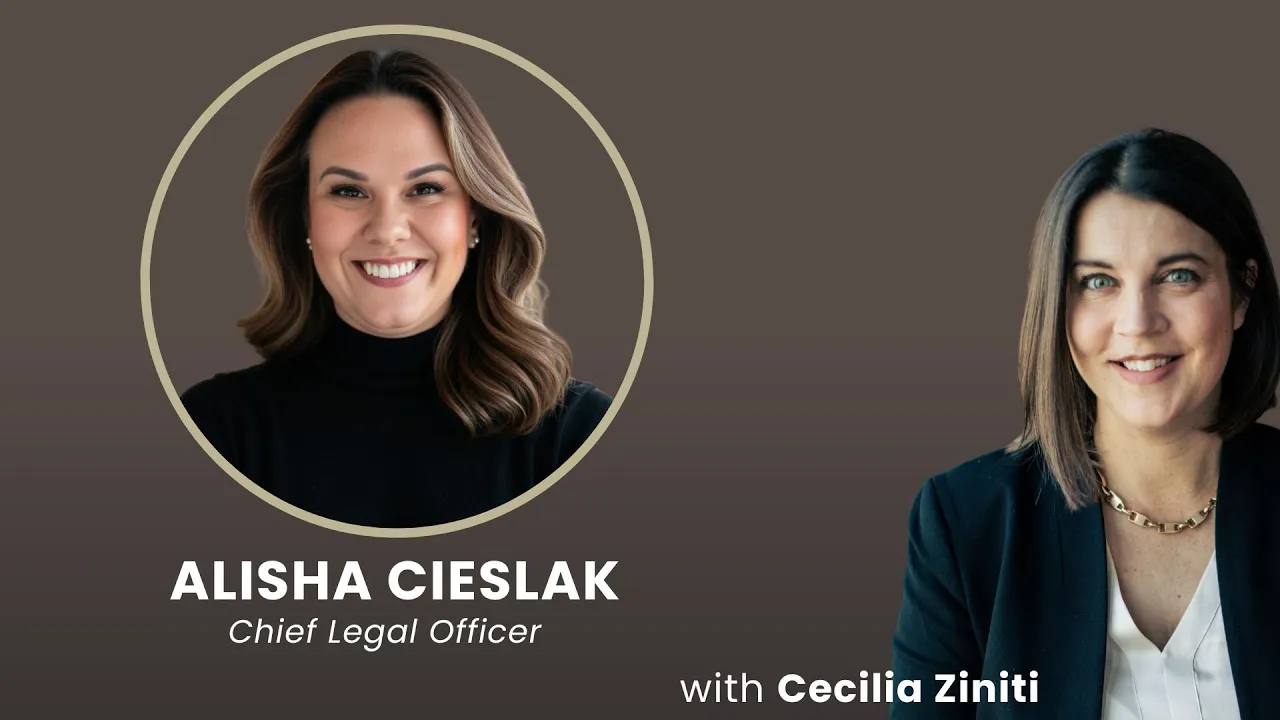
When Alisha Cieslak joined Gordon Food Service in 2014, she was employee number one in the legal department, at a company that was already doing $10 billion in revenue across a dozen states and Canada. There was no active-matters list. No board legal reports. No files.
She built the answer into a framework she now calls Greenfield to Gold Standard: assess what the company's legal needs actually are, pressure test the culture and the board's real risk tolerance, then design a strategy that fits that specific company rather than importing one from somewhere else.
A decade later she had scaled that greenfield start into a 150-plus-person enterprise team spanning legal, risk, IT, and food safety and quality, at a company that had grown to $20 billion in revenue.
Alisha Cieslak
Alisha Cieslak is the former Chief Legal and Risk Officer of Gordon Food Service, the North American food service distributor operating since 1897. Before Gordon Food Service, she was Director of Legal Affairs, North America, at Benteler Group. She holds a JD from Wayne State University Law School, a BA in political science and corporate communications from the University of Michigan-Dearborn, and a Graduate Certificate in Board Governance from the University of Michigan Ross School of Business.
In 2026, Michigan governor Gretchen Whitmer appointed her to an eight-year term on Oakland University's Board of Trustees, effective August 12, 2026; she has also served on the executive committee of the Grand Rapids Chamber of Commerce Board and the Board of Special Olympics Michigan.
Key Takeaways
A first general counsel's job is to build the infrastructure, not just give advice. Cieslak walked into a $10 billion company with no outside counsel guidelines, no contract templates, and no filing system, and had to engineer that infrastructure from scratch before she could do anything else.
A good culture is the best risk mitigation strategy. Cieslak went on a listening tour, riding delivery trucks and working in stores, and found that most people weren't skipping good process because they didn't want to comply. They didn't know what excellent looked like, or didn't have the time.
Trading a pre-approval mandate for trust paid off. Cieslak made a deal with the family that she would never require anyone to get her sign-off before making a business decision. In exchange, she had to build a department people wanted to come to voluntarily.
Private, family-owned companies can make better long-term decisions, not just different ones. Without a quarterly earnings call to answer to, Cieslak argues the decision-making trade-off often lands in a more ethical place, not just a slower one.
The law firms that win the AI era will be the ones that stop billing by the hour. Cieslak's read on the current gap between how companies and how law firms are adopting AI: the two sides are optimizing for opposite incentives, and only value-based billing closes that gap.
What Does It Actually Mean to Build a Legal Department From Scratch?
Cieslak's Greenfield to Gold Standard framework breaks the job into three moves: assess what the company's legal needs actually are, pressure test the cultural and board risk tolerance, then design a strategy for that specific company, not a copy-paste of what worked somewhere else.
Walking into Gordon Food Service in 2014, she found long-standing, trusted outside counsel relationships but no internal infrastructure at all: no policies, no procedures, no billing systems, no filing systems, no way to select outside counsel consistently. She had to build the basics, like outside counsel guidelines and templated agreements, while being careful not to look like she was disintermediating the outside firms the company already trusted.
"There is no playbook for when you're the first general counsel or when you're a general counsel for the first time."
The answer, she says, was replacing a playbook with a repeatable process for reading any new environment.
Why Is a Good Culture the Best Risk Mitigation Strategy?
Cieslak's listening tour doubled as a diagnostic. She rode with a delivery driver, worked a shift in a retail store, and talked to sales reps to understand where the real risk and the real opportunity sat, rather than assuming she already knew.
What she found was a company whose values, mostly around integrity and long-term relationships, were already strong enough to anchor a legal strategy on.
"I often say that the best risk mitigation strategy is having a good culture."
She made one explicit trade with the family to test that culture: no policy would require anyone to get her approval before making a business decision. She would earn the habit of people coming to her instead of mandating it, one relationship at a time.
How Do You Scale From Employee Number One to an Enterprise Leader?
Cieslak's path from a department of one to leading 150-plus people came from repeatedly raising her hand for problems that had no owner yet: no department, no function, no playbook.
That pattern, solving the unsolvable, built enough trust that when COVID hit and later when food recalls needed a steady, composed response, leadership already knew who to call.
"I started becoming that person who could solve the unsolvable."
The hardest part of that growth, she says, wasn't managing individual contributors. It was learning to lead other leaders, and to build leaders under them in turn.
Why Do Private, Family-Owned Companies Approach Risk Differently?
Cieslak has worked inside two privately held, family-run companies, Benteler and Gordon Food Service, and argues the absence of a quarterly earnings call changes the quality of decisions, not just their pace.
When a family's own name is on every box or every engraved part, she says, there's a personal accountability that tends to produce better outcomes even without a regulator mandating it.
"Honorable people who take that responsibility very seriously will almost always do the right thing."
That doesn't mean private companies skip regulation. Cieslak points to food safety specifically as one of the most scrutinized areas of the business regardless of ownership structure, from temperature control at pickup to labeling and allergen disclosure.
Why Will Law Firms That Win the AI Era Move to Value-Based Billing?
Cieslak's read on the current moment: companies and law firms are adopting AI to optimize for opposite things, and neither side is talking to the other about it.
"Every incentive they've had is not to go faster... in house, they're incentivized to go faster. So if we're all incentivized to go faster together to achieve better outcomes for the company and you're incentivized based on that, I think we all win."
Gordon Food Service started preparing 48 months before generative AI accelerated, working with a CIO who brought in outside expertise to educate the enterprise risk committee and the board before the technology was mainstream inside the company, which let the legal team move faster once it was. That kind of head start is what GC AI's operating layer for general counsel is built to shorten, and teams starting from further behind can catch up with GC AI's free legal AI classes.
The Health Story Behind the Advice
For two decades, Cieslak operated as though her health, time, and relationships were subordinate to delivering flawless work. In January 2021, in the middle of leading Gordon Food Service's COVID-19 response, she was diagnosed with an early-stage cancer.
She chose a conservative treatment path so she wouldn't have to step away from work. The cancer returned at the end of 2022, and this time she took the treatment she needed. She is now cancer-free.
Then, in late 2024 or early 2025, her mother was diagnosed with a similar cancer. Cieslak became her mother's full-time caregiver for the final months of her life.
"I couldn't see it when it was me, but I saw it when it was her."
That experience is what she credits with resetting how she thinks about the next decade of her career: work that has real impact, without abandoning her health or her identity to get it.


