

Dive Deeper
Transcript
Episode Overview
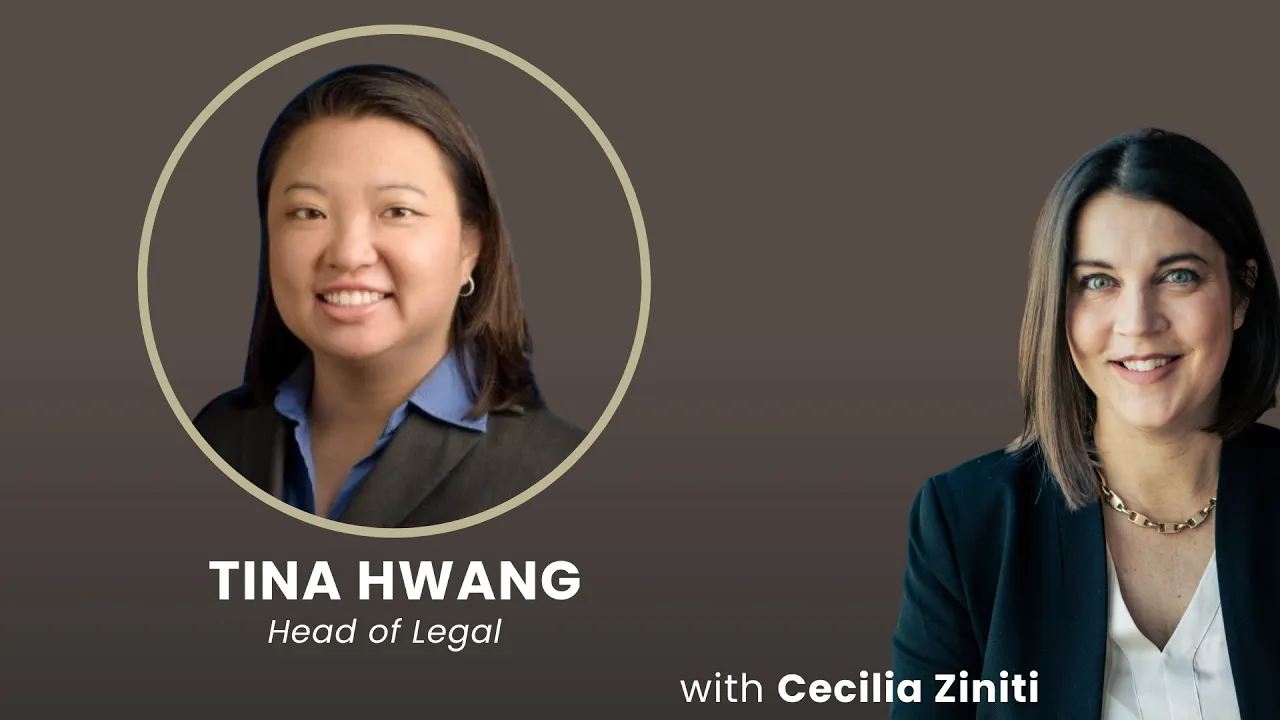
Tina Hwang doesn't start with the law. As head of legal at ClassDojo, an app connecting teachers, parents, and kids, she treats legal compliance as table stakes, not the goal, when her team designs a new feature.
Her standard is simple. Would this hold up if you pictured your own teenager using it, not an abstract compliance category? That question, more than any statute, is what she asks her product and engineering teams before anything ships.
Hwang built this instinct across more than a decade at Google, Twitter, WhatsApp, and Meta, building product counsel teams of up to 35 lawyers, before bringing it to ClassDojo.
Tina Hwang
Tina Hwang is head of legal at ClassDojo, the classroom communication platform connecting teachers, parents, and kids worldwide. She started her career as a software developer, a background that still shapes how she thinks about product design and trust. Before ClassDojo, she spent over a decade at Google, Twitter, WhatsApp, and Meta, building product counsel teams of up to 35 lawyers.
Key Takeaways
Legal compliance is the floor, not the design goal. Hwang calls it "a really spicy take for a lawyer," but she pushes product teams past the compliance bar toward a harder question: does this feature earn the kind of trust that keeps someone coming back, even through a price increase or a cheaper competitor.
Age-appropriate design means picturing a real teenager, not a legal category. Instead of stopping at "COPPA only applies to kids under 13," Hwang asks her engineers whether they'd want their own 14, 15, or 16-year-old using the feature, and what control they'd want as a parent.
User empathy has to survive contact with real users, not just the design process. When location-sharing features shipped, Hwang's team heard from domestic violence survivors who wanted the feature off by default, and from families abroad who wanted it on. The fix came from a CX team that could surface the pattern fast.
The "product counsel" model works because the lawyer becomes part of the product team. Hwang learned the role from its originators at Google and now says the best in-house lawyers are the ones product and engineering teams treat as a single window into legal, not an outside gate.
In-house lawyers should get comfortable delivering a confident 80% answer. Hwang tells her team a well-calibrated 80% answer, given fast, is usually more valuable to the business than a slower search for total certainty.
Why Doesn't Legal Compliance Alone Build User Trust?
Hwang's central argument is that meeting the legal bar and earning user trust are two different jobs, and treating them as the same one is a mistake.
"It's not about the law," she says, calling it a spicy take for a lawyer. The law is the foundation, but building trust means recreating something closer to a human relationship: transparency, consistency, and a real answer to why someone should rely on you.
That framing shapes how she shows up in a feature review. Rather than starting from what's legally required, she starts from what a user would expect from someone they trust, then works backward to the legal requirements that support it.
"The legal compliance component is just one factor of that entire equation."
The payoff, she argues, is retention that survives a price increase or a cheaper competitor, because users are staying for the relationship, not just the feature set.
How Do You Design for Age-Appropriate Trust Beyond COPPA?
Hwang's go-to move in a design meeting is a direct question to her engineers: do you have a 14-year-old? A 16-year-old? Now forget the law for a second. What can that kid actually understand about what this technology is doing and how to control it?
She extends the exercise globally. A user in Latin America, Asia, or Europe may have different expectations of the same feature, so she pushes teams to design for more than one default user.
"What level of control would you want as a parent for any of this, regardless of the legal ramifications and the legal bar?"
The goal isn't a stricter product. It's a design process anchored in a specific, real user instead of an abstract compliance threshold.
How Does User Empathy Shape Legal and Product Decisions?
Hwang points to location-sharing features as the clearest example of empathy that only shows up after launch, not during design. Once location sharing turned on, feedback split immediately: domestic violence survivors wanted it off by default, while families abroad said the same feature made them feel safer knowing where everyone was.
Smaller companies without a dedicated UX research team, she says, should hire product managers and engineers who have that instinct built in, then lean on a strong customer support team to catch the trends a design process can't predict.
"You're not gonna be able to think of every different scenario before you launch," she says. What matters is the ability to pivot once real feedback comes in.
What Does a Product Counsel Actually Do?
Hwang learned the "product counsel" model early in her career at Google, crediting Alex Mangler and Alex McGilvery, along with O Wan, as the people who defined the role for her. A product counsel sits embedded inside a business line rather than serving it from a functional legal team, close enough to the product to calibrate risk trade-offs the way outside counsel never could.
She sees the role becoming more important, not less, in the AI era, pointing to new "Frontier Council" job postings as the same product-counsel concept applied to frontier model development.
"In-house is moving quickly, you have to transition quickly and you have to really, really understand the products to advise the business in a risk calibrated way."
Building and Mentoring a 35-Person Legal Team
Asked what she's most proud of, Hwang doesn't point to a title or a launch. She points to the relationships that outlast the org chart: people who reach out years later for a gut check even after she's no longer their manager.
That's the return on building legal frameworks from scratch at multiple companies, she says. The scale and the projects fade. What stays is whether the people she led still trust her judgment.
Why Curiosity Matters More Than Pedigree When Hiring Lawyers
Hwang's hiring bar has changed. She used to look for a specific background and prior training. Now she looks for baseline curiosity, especially with AI tooling reshaping legal work, a shift other legal leaders are making too.
"I don't need the lawyer necessarily that can recite the treatise to me," she says. She wants the lawyer willing to sit down with a new tool, build a workflow, and let it surface ten percent of the day's priorities automatically.
She also builds in the habit deliberately, carving out an hour or two most Friday afternoons just to experiment with a new AI skill or connector rather than working through her to-do list.
Why Should In-House Lawyers Get Comfortable With an 80 Percent Answer?
Hwang names the instinct that holds many lawyers back from executive roles: the need to be a hundred percent certain before giving an answer. Her advice is to let that go once judgment is established.
"Your 80% is probably better than most folks out there," she tells lawyers who've been through enough real decisions to have earned the instinct. The business often needs a fast, well-calibrated answer more than it needs a slower, fully certain one. It's the same case other legal leaders are making for why judgment, not just speed, is what sets in-house counsel apart in the AI era.
Launching WhatsApp Payments in India Mid-COVID
Hwang's clearest story about operating at global scale is the WhatsApp Pay launch in India. With no offices open during COVID, she had a notary come to her house to sign a government document as part of a 24-hour political window to get the pilot approved with Indian regulators and banks.
Her takeaway: launching globally is as much about politics as it is about law. Companies that only build for the US, she says, often underestimate how much local custom and political timing shape a successful global launch.
Where Does AI Fit Into Legal Work Three Years From Now?
Hwang predicts no legal workflow will exist without AI within three years, from intake through research to output, while human judgment stays essential to whether a lawyer is comfortable standing behind the final work product. That's the same shift GC AI built its operating layer for in-house legal teams around.
She compares the shift to the move from BlackBerry to smartphone: not a replaceable tool bolted onto the job, but something so integrated into the legal workflow that working without it stops making sense. That's the line this episode's title comes from.
Tina Hwang's Advice for New In-House Lawyers
Hwang's closing advice: know the law and stay curious about the tools reshaping how it gets practiced. She calls this the golden age of legal tech and tells new lawyers to explore it rather than wait for it to become mandatory.
Recommended Reading
Burn the Boats by Matt Higgins: referenced by Cecilia Ziniti on the risk-versus-opportunity mindset shift from general counsel to CEO


