Spellbook was built for the transactional lawyer. Harvey was built for the Big Law partner. GC AI was built for the in-house GC who runs both jobs and a dozen more.
If you are comparing Spellbook vs Harvey, here is what matters most: in-house work spans both of those lanes and goes well beyond either. You triage contracts that came in over the weekend. You give the CEO a regulatory read by 9 AM Monday. You explain “indemnification” to a new PM before Tuesday’s vendor call. You send the Board four bullets and the auditor a one-line answer. You triage all of it before lunch.
This page compares Spellbook and Harvey on the things that matter for in-house counsel: who each product was built for, where each one hits its limits, and how either one stacks up against a legal AI platform built specifically for the in-house GC.
Spellbook vs Harvey: The Quick Side-by-Side
Spellbook and Harvey share a category but split on who they serve, product center of gravity, and pricing transparency. The view at a glance, with all competitor capability data verified directly against Spellbook’s and Harvey’s own product pages as of June 2026:
Category | Spellbook | Harvey |
Built for | Transactional lawyers across law firms and in-house | Am Law 100 firms expanding into enterprise in-house |
Best for in-house | Commercial contract review and drafting in Microsoft Word | Enterprise M&A diligence and workflow automation |
Pricing | No public pricing as of June 2026 | “Seat-based pricing with an option for consumption pricing”; some customers are moving to consumption-based pricing. Some prospects report hearing about token-based pricing. Confirm included usage, overage rates, budget controls, and trial terms in your proposal. |
Free trial | 7 days | Not publicly listed; confirm trial terms in your proposal. |
Word integration | Word-native, the entire product runs inside Word | Yes, alongside Outlook, SharePoint, and Drive, plus Microsoft 365 Copilot and Cowork |
Research depth | Contract benchmarks against a proprietary contract corpus | Knowledge product for legal, regulatory, and tax research |
Document analysis | Ask feature with citations on uploaded contracts | Vault for bulk document review, up to 100,000 docs per vault |
Multi-document agent | Associate, recently launched | Vault Review and Deep Analysis modes |
Workflow automation | Playbooks for negotiation strategy | Workflow Agents with no-code builder |
Security | SOC 2 Type II, GDPR, PIPEDA, ZDR with OpenAI and Anthropic | SOC 2 Type II, ISO 27001, GDPR, CCPA |
In-house design priority | Shared with law firm customers from day one | 500+ in-house teams added since 2025; Am Law remains the anchor |
Published NPS | Not published | Not published |
What Spellbook Is Built For
Spellbook is a legal AI platform headquartered in Toronto, founded by Scott Stevenson. The product runs primarily inside Microsoft Word as an add-in. A web app called Associate handles multi-document workflows. Spellbook serves both law firms and in-house teams, with the product’s center of gravity on the transactional commercial contract.
The Spellbook suite includes the following surfaces as of June 2026:
Review. AI redlining inside Word with risk identification, playbook deviation flagging, and alternative clause suggestions. Uses Word’s native Track Changes.
Draft. Clause and document generation from precedent and past work, with Smart Clause Drafting pulling from prior engagements.
Ask. Legal Q&A about contracts with citations, in natural language.
Benchmarks. Comparison against more than 2,000 industry standards drawn from 10 million contracts. Answers “what is market” with proprietary data.
Playbooks. Negotiation strategy with pre-approved clauses, approval workflows, and KPIs that the AI enforces during review.
Clause Library. A standard boilerplate repository that users can upload to.
Associate. A multi-document agent for transactional workflows like data room reviews, financing documents, and disclosure schedules.
Spellbook does its best work on commercial contracts that live in Microsoft Word. The combination of in-Word redlining, Benchmarks for market-standard clauses, and Playbooks enforcing company negotiation standards is a strong package for the transactional commercial lawyer.
Where Spellbook Serves In-House Teams Well
If your in-house team’s primary daily work is commercial contract review and you want a Word-native product, Spellbook is fast to get started with. The 7-day free trial is shorter than the window most in-house teams want for a real evaluation, but it is enough to see the core workflow on your own paper.
Where the In-House Gap Shows Up
Spellbook serves both law firms and in-house teams from the same product. The primary customer is the transactional commercial lawyer, and Spellbook’s published product surfaces (Review, Draft, Ask, Benchmarks, Playbooks, Clause Library, Associate) cover that scope. Buyers should evaluate whether the in-house workstreams beyond it (regulatory monitoring across jurisdictions, employment matters, executive-facing communications, board materials, and the multi-stakeholder triage that fills most of an in-house calendar) sit within their daily use case.
Pricing also stays behind a sales conversation: Spellbook does not publish a price as of June 2026, so you cannot model cost before the demo cycle.
Is Spellbook Right for You?
Spellbook is the right pick if your daily work is commercial contract review and drafting in Microsoft Word, and you want market-benchmark data on clauses against a proprietary contract corpus. If you don’t think it’s a good fit, read through our Spellbook alternatives guide.
If your scope is broader (contracts plus research plus regulatory plus stakeholder communication), try GC AI free for 14 days.
What Harvey Is Built For
Harvey is an enterprise legal AI platform headquartered in San Francisco. Co-founded in 2022 by Winston Weinberg (formerly a securities and antitrust litigator at O’Melveny) and Gabriel Pereyra (formerly a research scientist at Google DeepMind), Harvey serves Am Law 100 firms as its primary customer base and has expanded into enterprise in-house teams over the past twelve months.
The Harvey suite includes the following surfaces as of June 2026:
Assistant. The core chat and drafting interface for research questions, document analysis, and memo work. Output is structured for firm-style review.
Vault. Secure document storage and bulk analysis across up to 100,000 documents per vault. Runs in Review mode (tabular per-file answers), Ask mode (consolidated cross-document answers), and Deep Analysis (comprehensive cited reports). Syncs with iManage, SharePoint, and Google Drive.
Knowledge. Research across legal, regulatory, and tax domains, with citation-backed answers to complex cross-domain queries.
Workflow Agents. A no-code workflow builder for multi-step automated processes, with conditionals, classification, role-based permissions, and external partner sharing. Launched June 2025.
Ecosystem. Integrations with Microsoft Word, Outlook, SharePoint, and Drive, plus Microsoft 365 Copilot and Copilot Cowork as of June 2026.
Mobile App. Launched September 2025, with voice-to-prompt, document scanning, and audio transcription.
Shared Spaces. Secure document and workflow sharing with clients and external partners. Launched December 2025.
Harvey does its best work where in-house work resembles Big Law practice: M&A diligence across data rooms, large-scale regulatory document review, and workflow automation for legal operations teams with the capacity to build and maintain those workflows.
Where Harvey Serves In-House Teams Well
If your in-house team runs frequent M&A and needs bulk document review at volume, Vault is genuinely compelling. Multinational teams with data residency requirements in the US, EU/Switzerland, or Australia get those options. Teams already operating inside iManage or SharePoint will find Harvey’s integration layer fits the existing stack.
Where the In-House Gap Shows Up
Harvey launched with Am Law 100 firms as the primary customer, and the output style still carries that origin. The default is a long-form memo formatted for partner-to-associate review and for a firm sending work to a client.
Harvey’s pricing model is not a single published per-seat figure. In a September 17, 2026, Legal IT Insider interview with COO Katie Burke, Harvey said it offers seat-based pricing with an option for consumption pricing, and that some customers are already moving to that model. Some prospects report hearing about token-based pricing. Confirm the billing basis, included usage, overage rates, and spending controls with Harvey before the budget conversation.
Is Harvey Right for You?
Harvey is the right pick if your in-house team runs frequent enterprise M&A transactions, has procurement capacity for an enterprise sales cycle, and wants a platform your outside-counsel firm partners also use. Enterprise M&A velocity is a real use case, and it is a narrow one. If your team handles regulatory monitoring, employment matters, and executive communication alongside contracts, the Harvey procurement cycle is a heavy starting point for a platform you may use less than half the week.
If Harvey isn’t right for you, read our Harvey alternatives guide.
Try GC AI free for 14 days on the full scope before either sales call.
Dive deeper: Best Legal AI Tools for In-House Counsel, and In-House Counsel AI Software.
What’s Missing for In-House Teams
Spellbook is designed around the transactional commercial contract. Harvey launched with Am Law 100 firms as its primary customer base. Buyers evaluating either platform for in-house work should map their daily scope against each product’s primary customer. Five concrete places show where the fit decisions land.
Output format. Spellbook produces redlined Word contracts. Harvey produces firm-style memos. Both are correct for their primary customer. An in-house GC forwarding an analysis to a non-lawyer executive needs a four-bullet summary the CEO will read in the elevator. A memo with footnotes and a Word document marked with track changes are designed for a different reader.
Scope of daily work. The in-house calendar runs across many workstreams: regulatory monitoring across jurisdictions, employment questions, board materials, executive correspondence, stakeholder negotiation, and the triage work where the GC’s job is to decide what to set aside. A platform built around one workstream covers a slice of that calendar. The rest sits in tabs you keep open and tools you switch between.
Procurement friction. Spellbook and Harvey both require a sales conversation before sharing pricing. For a lean in-house team without a procurement function, the demo cycle is a cost in itself: scheduling, NDAs, security review, a champion call, internal alignment. Published pricing and a real free trial collapse weeks of that into days.
Output tone. Law firm memos and clause redlines have a register. The work product an in-house GC sends to non-lawyer stakeholders has a different one. Concise outputs that lead with the decision are how precision shows up inside a company. Long-form firm memo style answers the partner’s question; the in-house GC is answering the CEO’s.
Training depth. Harvey Academy is an on-demand training catalog whose CLE eligibility is not listed publicly as of June 2026. Spellbook’s Learning Hub of written guides also does not list CLE eligibility as of June 2026. For in-house teams building AI fluency across a department, the depth gap shows.
Alexandra Sepulveda, Assistant General Counsel at Trust and Will, put the in-house buyer’s decision rule directly:
“If you only have a budget for one tool, choose the one fine-tuned for in-house legal.”
That is the in-house buying instinct in one line. When a lean team has one budget line for legal AI, the question is which product was built around the work the team does. The mapping below shows how Spellbook, Harvey, and GC AI line up against the five gaps.
How Spellbook, Harvey, and GC AI Map to the Five Gaps
Gap | Spellbook | Harvey | GC AI |
Output format | Word redlines | Firm-style memos | Character-level citations, business-readable summaries |
Scope of daily work | Commercial contracts | M&A diligence and enterprise workflow | Full in-house scope: contracts, research, regulatory, executive communication |
Procurement | Demo + 7-day trial, no public pricing | Demo cycle, no public pricing | $500/seat/mo published, 14-day free trial |
Output tone | Transactional precision | Partner-track register | Business-readable, decision-ready |
Training depth | Learning Hub guides, CLE not listed | Harvey Academy, CLE not listed | Free CLE-eligible classes, 6,000+ lawyers trained |
What GC AI Does for In-House Teams
Cecilia Ziniti was a general counsel three times (Anki, Bloomtech, Replit) before co-founding GC AI. She had been the one calling outside counsel for a 50-state survey, the one redlining a vendor MSA after midnight, the one summarizing a regulator letter for a CEO who wanted four bullets.
GC AI exists because the in-house work she did inside those legal departments had no software built around it. The legal AI products on the market served law firms running partner-track memos or transactional lawyers redlining commercial deals inside Microsoft Word. The question she walked into every Monday morning sat unanswered: how do I run legal as a business unit?
More than 1,900 legal teams use GC AI as of July 2026, across 53 countries and more than 200 public companies, including the in-house teams at Tipalti, Arc’teryx, Snyk, Vercel, Liquid Death, Tonal, Hitachi, and Columbia Sportswear. More than 6,000 lawyers have trained on the platform through GC AI’s CLE-eligible classes.
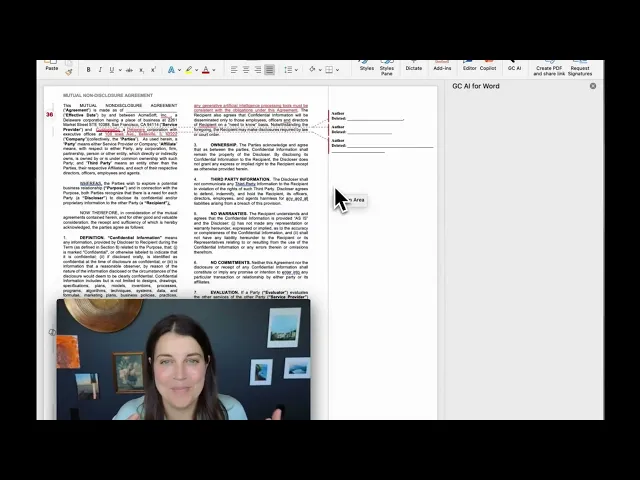
Watch a demo of GC AI:
Hayley McAllister, Senior Counsel at Jasper, captured the design constraint in one line:
“The biggest advantage of GC AI is it understands that you are trying to be more of a business person.”
The product surfaces in-house counsel use daily:
Exact Quote. Character-level citation from uploaded documents. Every answer is traceable to precise language in the source. For work product forwarded to a CEO or CFO, verifiability is the bar that matters.
Playbooks. Automated contract review against company standards, with pre-built playbooks shipping for NDAs, DPAs, MSAs, and commercial purchases.
Skill Library. Ready-to-use prompt templates for in-house workflows: NDA review, regulatory summaries, board consents, executive briefings.
GC AI for Word. Web research and contract review inside Microsoft Word. Web chats sync with one click. The context switch between web app and Word is no longer required.
Research. Multi-agent legal research from primary law sources, with citations.
Easy Prompt. Turns plain-language questions into structured legal prompts. Trademarked.
Files. Permanent document collections accessible across every chat, analyzing up to 1,500 pages at once.
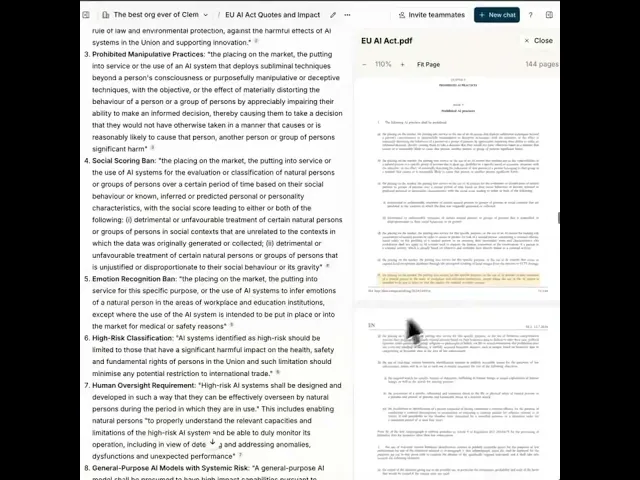
Exact Quote: verbatim, character-level citations
GC AI has transparent pricing at $500 per seat per month with a 14-day free trial and no credit card required. Pricing transparency means the evaluation runs on the in-house team’s timeline.
GC AI also publishes the In-House Legal Bench, the legal AI category’s head-to-head benchmark of AI assistants on in-house tasks, scored against 1,200+ attorney-developed criteria across 100 in-house legal scenarios in May 2026.
Measured against general-purpose AI:
GC AI: 86.8%
ChatGPT (GPT-5.5): 79.8%
Claude (Opus 4.7): 68.4%
Gemini (3.1 Pro): 57.5%

In a December 2025 study of more than 100 GC AI customers, in-house teams reduced outside counsel spend by 14%, the equivalent of roughly $252,000 in annual savings at the median company (14% of the ACC Law Department Management Benchmarking Report median outside counsel spend of $1.8M).
The platform is SOC 2 Type II and SOC 3 certified, GDPR compliant, with zero data retention agreements with OpenAI and Anthropic, and AES-256 encryption.
GC AI’s published NPS is 77 (April 2026 customer survey), the kind of satisfaction signal in-house procurement teams use to validate a purchase before the budget conversation.
Trust, Precision, and Craft for the In-House GC
There is one test for legal AI in an in-house seat: does the work product forward to the CEO without the GC rereading every clause.
Trust, precision, and craft are the right bar for legal AI. Applied to the in-house vertical, that bar means concise outputs the executive team can act on, character-level citations the regulator can verify, and design decisions made by someone who has done the job.
GC AI’s system prompt runs more than 20,000 lines, tuned for in-house workflows from the first instruction down. The first instruction tells the model it is a lawyer; the next, that it is an in-house lawyer. That second sentence is the design difference.
Spellbook is a strong fit for transactional lawyers whose daily work lives inside Microsoft Word. Harvey is a strong fit for enterprise in-house teams running M&A diligence at volume inside an Am Law 100 ecosystem.
GC AI is the platform the in-house GC reaches for when the question is the full scope of in-house work, run as a business unit. GC AI’s answer comes back ready to forward to your CEO.
Frequently Asked Questions
What Is the Main Difference Between Spellbook and Harvey?
The main difference between Spellbook and Harvey is the workload each was designed around. Spellbook is a Word-native contract review and drafting platform serving both law firms and in-house teams, with a transactional commercial focus. Harvey is an enterprise legal AI platform that launched with Am Law 100 firms in 2022 and has expanded into enterprise in-house in the past twelve months. Spellbook optimizes for the contract on the screen. Harvey optimizes for the firm-style memo and large-scale document review across deal data rooms. In-house counsel comparing both typically evaluate GC AI alongside them as the platform purpose-built for in-house work.
Is Spellbook or Harvey Built for In-House Counsel?
Among the three platforms most often compared by in-house buyers, GC AI is the one built around in-house counsel as the primary customer. Spellbook serves both law firms and in-house teams from the same product surface, with a transactional commercial contract focus. Harvey launched with Am Law 100 firms as its primary customer base and has expanded into enterprise in-house in the past twelve months. GC AI was designed by founder Cecilia Ziniti, a three-time GC, around the daily scope of in-house work: contracts, regulatory work, employment matters, and executive communication.
Can an In-House Team Use Both Spellbook and Harvey?
Yes, although in-house teams running both is uncommon outside of large enterprises with M&A volume that justifies Harvey alongside Spellbook for commercial contract work. For lean in-house teams operating with one budget line, GC AI is the platform purpose-built to cover the full in-house daily scope on a single license.
How Much Do Spellbook and Harvey Cost?
Harvey offers seat-based pricing with an option for consumption pricing, and some customers are already moving to that model, according to a September 17, 2026, Legal IT Insider interview with COO Katie Burke. Some prospects report hearing that Harvey has begun discussing token-based pricing in sales conversations. If cost predictability matters, ask for normal-month and peak-quarter forecasts, included usage, overage rates, and spending controls in writing. Spellbook offers a 7-day free trial. GC AI publishes $500 per seat per month with a 14-day trial and no credit card required.
What Is the Best Legal AI Alternative for In-House Counsel?
For in-house counsel evaluating Spellbook and Harvey, the most directly comparable alternative is GC AI. GC AI is purpose-built for in-house legal teams, with published pricing, a 14-day free trial, character-level citations through Exact Quote, in-house Playbooks for NDAs and DPAs, and free CLE-eligible classes taught by former general counsels. More than 1,900 in-house legal teams use the platform.
Is Spellbook or Harvey Better for Contract Review?
Spellbook is the stronger contract review platform between the two for commercial transactional work in Microsoft Word. Harvey’s primary contract use case is bulk document review through Vault, built for M&A diligence at the data-room level. Line-by-line redlining of a single commercial agreement is closer to Spellbook’s core use case. For in-house teams whose contract work spans commercial agreements, NDAs, MSAs, and DPAs alongside the rest of the in-house scope, GC AI’s Playbooks ship for those workflows on day one.
What Should In-House Counsel Ask in a Spellbook or Harvey Demo?
Four demo questions surface in-house fit. (1) “Can I run a free trial on our contracts and matters before signing anything?” (2) “What is the total annual cost for a team our size, including any seat minimums or implementation fees?” (3) “Can you show an output formatted for a non-lawyer executive audience?” (4) “How does the platform handle workstreams beyond contracts, including regulatory monitoring, employment matters, and board materials?” GC AI answers each in the affirmative: a 14-day free trial on real work, $500 per seat per month published pricing, executive-ready outputs with character-level citations through Exact Quote, and the full in-house scope covered by Playbooks and the Skill Library. Buyers should also confirm the platform meets the duties laid out in ABA Formal Opinion 512 on generative AI tools, including confidentiality and independent verification.