Harvey serves the AmLaw 100 partner. CoCounsel serves the Westlaw-grounded litigation researcher. GC AI serves the in-house GC who runs both jobs and a dozen more.
In-house work spans both of those lanes and goes well beyond either. Most weeks the calendar mixes a commercial MSA review with a privacy question from product, an employment matter from the head of people, and a board summary the CEO wants in two paragraphs. The platform that fits is the one calibrated for the full mix.
What Is Harvey?
Harvey is an enterprise legal AI platform for legal and professional services teams, used by many of the AmLaw 100 and a growing in-house roster. A former O’Melveny lawyer (Winston Weinberg, CEO) and a former DeepMind researcher (Gabriel Pereyra) founded it in 2022 and built the platform around firm-side legal workflows: modular document analysis, clause extraction, and research at scale. The customer base, product surface, and marketing all reflect that origin.
The current product suite includes seven named surfaces per Harvey’s site:
Assistant: document Q&A and drafting
Vault: bulk document analysis and storage
Knowledge: cross-domain research over legal, regulatory, and tax content
Workflow Agents: configurable multi-step processes for repeatable firm tasks
Harvey Mobile: work from anywhere
Ecosystem: integration with iManage, Microsoft, Outlook, SharePoint, plus Microsoft 365 Copilot and Copilot Cowork — Harvey runs as an agent in Copilot and a plugin in Copilot Cowork (launched June 16, 2026)
Harvey Agents: end-to-end agentic execution
In January 2026, Harvey acquired Hexus, a platform for creating product demos, videos, and guides. Hexus founder Sakshi Pratap and the Hexus engineering team joined Harvey to support its expanding work with in-house legal departments.
Harvey serves global law firms and large enterprises, covering contract analysis, due diligence, compliance, and litigation workflows. The in-house customers Harvey lists publicly are large global enterprises with significant procurement budgets.
What Is CoCounsel?
CoCounsel is the legal AI platform from Thomson Reuters, built on the 2023 Casetext acquisition and now sitting as the AI layer over the broader Westlaw and Practical Law research stack. Thomson Reuters originally designed CoCounsel for law firms doing litigation-grade research, brief drafting, and contract analysis grounded in primary law. In 2024, Thomson Reuters integrated CoCounsel with Westlaw and Practical Law content, moving the platform from standalone AI outputs to connected end-to-end legal workflows.
The current product surface:
CoCounsel Legal: the agentic flagship, launched August 2025 with Deep Research and guided agentic workflows
CoCounsel Drafting for Word: a Microsoft Word add-in for transactional drafting, verified on Microsoft AppSource
Bundled Westlaw and Practical Law research integrations
For teams whose work centers on primary law research, CoCounsel’s live Westlaw connection and KeyCite signal verification on every cited case is the feature that earns the seat.
CoCounsel serves the law firm and broader professional-services market. Customer stories Thomson Reuters publishes include AmLaw firms, mid-sized firms, and corporate legal departments inside the broader Thomson Reuters ecosystem (legal, tax, accounting).
Harvey vs CoCounsel: The Side-by-Side
The table below covers the dimensions that decide enterprise legal AI procurement in 2026.
Capability | Harvey | CoCounsel (Thomson Reuters) | GC AI |
|---|---|---|---|
Built For | AmLaw 100 law firms and enterprise in-house | Law firms and the broader Thomson Reuters professional services stack across legal, tax, accounting | In-house counsel |
Anchor Workflow | Document analysis at scale, M&A diligence, cross-jurisdictional advisory | Deep legal research grounded in Westlaw and Practical Law, litigation-grade drafting | The daily in-house workload: commercial contracts, research, drafting, regulatory tracking, stakeholder communication |
Pricing (as of June 2026) | Seat-based pricing with an option for consumption pricing; some customers are moving to consumption-based pricing. Some prospects report hearing about token-based pricing. Confirm included usage, overage rates, budget controls, and trial terms in your proposal. | Configurator-based, roughly $104 to $639/user/month for firms up to 10 attorneys. A solo on Westlaw Advantage with CoCounsel Essentials with full coverage pays $639.20/user/month on a 1-year term ($519.35 on a 3-year term). CoCounsel Legal, the agentic flagship, is sales-quoted. | $500/user/month |
Free Trial | Demo-only via sales | Available by request through Thomson Reuters sales | |
Self-Serve Sign-Up | No | No | Yes |
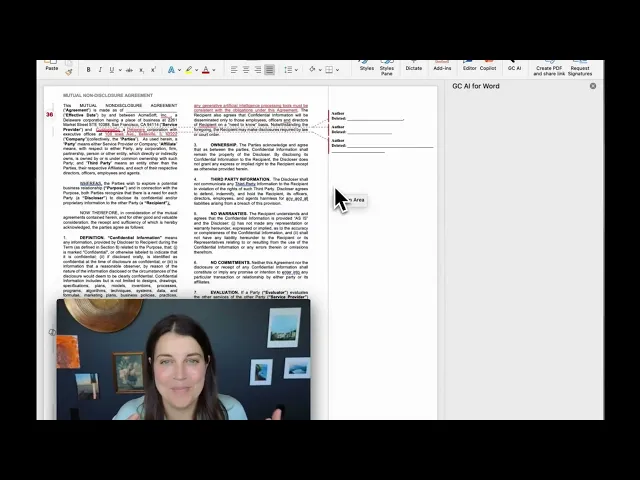
Microsoft Word Integration | Integration alongside Outlook, SharePoint, iManage; Harvey runs as an agent in Microsoft 365 Copilot and a plugin in Copilot Cowork (launched June 16, 2026) | CoCounsel Drafting for Word: search Practical Law, SEC agreements, and firm precedents inside Word | GC AI for Word: Chat2 web research, Easy Prompt, Skill Library, Playbooks, Projects inside the document |
Contract Review | Workflow Agents: configurable multi-step processes for repeatable tasks | Document review and contract analysis across term, date, and amount extraction | Playbooks: agentic multi-step contract review against the team’s NDA, DPA, and MSA standards with persistent matter memory |
Legal Research | Knowledge product with firm-specific data | Deep research grounded in Westlaw and Practical Law with citation-backed answers | Research: multi-agent retrieval from primary law and authoritative sources with citations |
Document Vault | Vault: bulk document analysis and storage | CoCounsel Files, bulk document upload and analysis | Files: analyze up to 1,500 pages at once in a single chat |
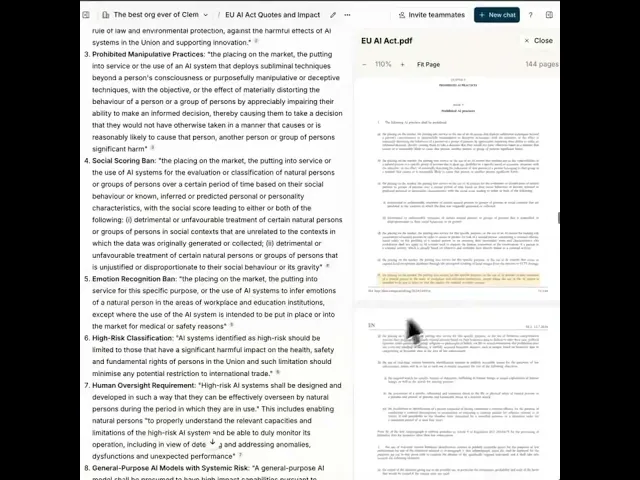
Citation | Citations within firm-uploaded documents and the broader knowledge corpus | Citations within Westlaw and Practical Law sources with KeyCite signal verification | Exact Quote: character-level verification from documents you upload |
Agentic Capabilities | Harvey Agents and Workflow Agents | CoCounsel Legal Deep Research and agentic guided workflows | Web research agents, email integration, diagramming, Wizard prompting, document creation, Playbooks |
Security | SOC 2 Type II, ISO 27001, GDPR, CCPA | SOC 2 Type II, ISO 27001 | SOC 2 Type II, SOC 3, GDPR, ZDR with OpenAI and Anthropic, AES-256 |
LLM Providers | Custom models built with OpenAI, plus Anthropic and Google integrations | Built on OpenAI GPT models trained on legal materials and Casetext Research data | OpenAI, Anthropic, Cohere, Reducto, Google |
Education | Harvey Academy, free with account registration and an academic program with law schools | Thomson Reuters resource library, customer training, Practical Law guidance | GC AI Classes: free, California CLE-eligible, taught by former general counsels, 6,000+ lawyers taught |
NPS | Not published | Not published | 77 published, comparable to Apple and Netflix |
Best For | AmLaw 100 litigation, M&A diligence, cross-jurisdictional advisory | Litigation-heavy teams and firms already standardized on Westlaw and Practical Law | In-house legal teams of any size running the full daily mix of contracts, research, drafting, and stakeholder communication |
All capability facts in the table are verified as of June 2026 against each vendor’s public product pages. Re-verify pricing, certifications, and feature claims with each vendor before procurement, since pricing models are sales-led and change.
Which One Fits: A 3-Question Decision
Three questions settle most in-house shortlists.
Is your primary user an AmLaw associate or partner running M&A, litigation, or cross-jurisdictional advisory at firm scale? Harvey is built for that seat.
Is your work half or more case-law research and litigation-grade drafting, with Westlaw already your research surface? CoCounsel inherits Westlaw’s authority and KeyCite signals.
Is your week the full in-house mix, contracts plus research, regulatory, employment, drafting, and stakeholder communication, run by a lean team that wants published pricing and a self-serve trial? That is the seat GC AI is built for.
What’s Missing for In-House Teams
Harvey expanded with AmLaw 100 firms as its primary customer base. Thomson Reuters designed CoCounsel around Westlaw-grounded litigation research. Buyers evaluating either platform for in-house work should map their daily scope against each product’s primary customer. Five concrete places show where the fit decisions land.
Output format. Harvey produces firm-style memos for partner-track review. CoCounsel produces litigation-grade briefs and memos grounded in primary law. Both serve their primary customer. An in-house GC forwarding an analysis to a non-lawyer executive needs a four-bullet summary the CEO will read between meetings.
Scope of daily work. The in-house calendar runs across many workstreams: regulatory monitoring across jurisdictions, employment questions, board materials, executive correspondence, stakeholder negotiation, and the triage where the GC’s job is to decide what to set aside. Harvey covers M&A diligence and bulk document review. CoCounsel covers Westlaw research and litigation drafting. A platform built around one or two workstreams covers a slice of the in-house calendar. The rest sits in tabs you keep open.
For a lean in-house team without a procurement function, the demo cycle is a cost in itself: scheduling, NDAs, security review, a champion call, and internal alignment. Harvey has said it offers seat-based pricing with an option for consumption pricing, and that some customers are already moving to that model, according to a September 17, 2026, Legal IT Insider interview with COO Katie Burke. A consumption option adds another budget question: what happens to monthly spend as document volume, workflow runs, or research activity increases? Ask for included usage, overage rates, usage monitoring, and spending controls before signing.
Output tone. Firm memos and litigation briefs have a register. The work product an in-house GC sends to non-lawyer stakeholders has a different one. Concise outputs that lead with the decision are how precision shows up inside a company. Long-form firm memo style answers the partner’s question; the in-house GC is answering the CEO’s.
Training depth. Harvey Academy is an on-demand training catalog. The Academy does not list CLE eligibility publicly as of May 2026. Thomson Reuters offers a resource library and Practical Law guidance, also without listed CLE eligibility as of May 2026. For in-house teams building AI fluency across a department, the depth gap shows.
Alexandra Sepulveda, Assistant General Counsel at Trust and Will, put the in-house buyer’s decision rule directly:
“If you only have a budget for one tool, choose the one fine-tuned for in-house legal.”
That is the in-house buying instinct in one line. When a lean team has one budget line for legal AI, the question is which product is built around the work the team does.
Where Harvey Wins
Harvey earns its seat in three specific places.
Large law firm litigation and M&A. Matter scale, document volume, and partner-supervised associate review define the daily work. Vault and Workflow Agents match the repeatable, supervised structure of firm-side practice.
Cross-jurisdictional advisory for global firms. Harvey’s in-house roster spans the UK, EU, US, and APAC, supporting multi-jurisdictional regulatory and M&A workflows at enterprise scale.
Large enterprises with multi-quarter procurement runway. Harvey’s pricing may be seat-based or consumption-based, so ask for normal- and peak-workload forecasts, included usage, overage rates, and spending controls before approving a custom deployment.
Harvey is right for you if you are an AmLaw 100 firm or a global enterprise legal department with significant M&A, litigation, or cross-jurisdictional advisory volume, and you have the budget and procurement runway for an enterprise sales cycle. If your in-house team needs published pricing, a self-serve trial, and an output style calibrated for the CEO, the CFO, and the head of sales, start a 14-day free trial of GC AI.
Compare Harvey deeper at GC AI vs Harvey or browse the Harvey alternatives guide.
Where CoCounsel Wins
CoCounsel earns its seat where Westlaw is already the primary research surface. The fit shows up in three specific lanes.
Deep legal research with case-law citations. CoCounsel pipes Westlaw, Practical Law, KeyCite signals, and the broader Thomson Reuters research corpus directly into the AI layer. That pipeline is hard to replicate without Westlaw access.
Litigation-grade brief and memo drafting. CoCounsel Drafting for Word is tuned for precedent-heavy work.
Regulatory research at scale. The wider Thomson Reuters professional ecosystem (legal, tax, accounting) matters for cross-functional regulatory teams in financial services, healthcare, and life sciences.
CoCounsel is right for you if your team is already on Westlaw, your work is 50% or more case-law research and litigation-grade drafting, and you want the AI layer to inherit Westlaw’s authority and KeyCite signals. If your in-house workload is the full mix (contract review, multi-jurisdictional research, drafting for non-lawyers, regulatory tracking, stakeholder communication) and only some of it is research-intensive, test GC AI on the broader workload before committing to a Westlaw-bundled contract.
If your shortlist has narrowed to GC AI and CoCounsel, our GC AI vs CoCounsel comparison explores how the two platforms differ across research, contract review, Microsoft Word workflows, pricing, and the day-to-day needs of in-house legal teams.
For an in-house workflow fit, see the best legal AI tools for in-house counsel guide. That covers the firm-side case for Harvey and CoCounsel. The in-house buyer reading this same comparison runs a different evaluation, taken up next.
What GC AI Does for In-House Teams
Cecilia Ziniti was a General Counsel three times (Anki, Bloomtech, Replit) before co-founding GC AI in November 2023. She had been the one calling outside counsel for a 50-state survey, the one redlining a vendor MSA after midnight, the one summarizing a regulator letter for a CEO who wanted four bullets.
GC AI exists because the in-house work she did inside those legal departments had no software built around it. The legal AI products on the market served law firms running partner-track memos or transactional lawyers redlining commercial deals inside Microsoft Word. Harvey was scaling its AmLaw 100 footprint. CoCounsel was a research engine bundled with Westlaw. The question Cecilia walked into every Monday morning sat unanswered: how do I run legal as a business unit?
GC AI is the answer. The 20,000-line legal system prompt is calibrated around contracts, research, drafting for non-lawyer audiences, regulatory tracking, and stakeholder communication, with in-house Playbooks shipping for the workflows in-house teams run every week.
Hayley McAllister, Senior Counsel at Jasper, captured the design constraint in one line:
“The biggest advantage of GC AI is it understands that you are trying to be more of a business person.”
2,100+ legal teams across 53 countries run on GC AI as of September 2026, including the legal departments at Liquid Death, Arc’teryx, Tipalti, and Vercel, among 200+ public companies and 25 unicorns.
The features that match the workload: agentic Playbooks for repeatable contract review, Exact Quote for character-level citations on your own documents, GC AI for Word for the full platform inside the document, and Research for multi-agent legal intelligence with primary-law citations.
Trisha Mauer, VP of Legal at Tonal, ran her own comparison against ChatGPT before adopting GC AI:
“I go straight to GC AI for everything from research requests to litigation responses. I’ve compared against ChatGPT. GC AI gives more comprehensive responses appropriate for a lawyer to use. After six months of use, I’m sure I’ve saved hundreds of hours.”
That is the daily decision for an in-house counsel: which platform produces the answer good enough to send before the close of business.
The numbers in-house teams reported in GC AI’s December 2025 ROI study of more than 100 active customers:
14 hours saved per lawyer per week
14% reduction in outside counsel spend
21% greater accuracy than generic AI platforms like ChatGPT
97.5% of teams see value before month one (Time to Value Study, February 2026)
Approximately $252,000 in annual savings for the median company (14% of the $1.8M median outside counsel spend per the ACC Law Department Management Benchmarking Report)
Take a free legal AI class or book a demo to see GC AI on your own documents this week.
How GC AI Scores Against General-Purpose AI
GC AI built the In-House Legal Bench, a head-to-head benchmark of AI assistants on real in-house legal work, scored on 100 in-house tasks against 1,200+ attorney-developed criteria across drafting, contract analysis, legal research, regulatory tracking, and risk assessment. Measured against general-purpose AI as of May 2026:
GC AI: 86.8%
ChatGPT (GPT-5.5): 79.8%
Claude (Opus 4.7): 68.4%
Gemini (3.1 Pro): 57.5%
GC AI’s largest margins land on the research-intensive work in-house teams run most: regulatory tracking, legal research, and checklists.
Trust, Precision, and Craft for In-House Counsel
There is one test for legal AI in an in-house seat: does the work product forward to the CEO without the GC rereading every clause.
Trust, precision, and craft are the right bar for legal AI. Applied to the in-house vertical, that bar means concise outputs the executive team can act on, character-level citations the regulator can verify, and design decisions made by someone who has done the job.
GC AI’s system prompt runs more than 20,000 lines, tuned for in-house workflows from the first instruction down. The first instruction tells the model it is a lawyer; the next, that it is an in-house lawyer. That second sentence is the design difference.
GC AI is the platform the in-house GC reaches for when the question is the full scope of in-house work, run as a business unit. GC AI’s answer comes back ready to forward to your CEO.
Frequently Asked Questions
Is Harvey or CoCounsel Better for In-House Counsel?
For an in-house legal team running the full workload mix of contracts, employment, privacy, regulatory tracking, board prep, and stakeholder communication, a platform purpose-built for that workload such as GC AI typically fits better than Harvey or CoCounsel. Harvey was first built for AmLaw 100 law firms and now serves large enterprise in-house departments. CoCounsel was first built for law firms doing litigation-grade research, with Thomson Reuters since expanding the positioning to include in-house teams. For an in-house team where Westlaw is the primary research surface or where M&A and litigation volume is firm-scale, Harvey or CoCounsel can earn the seat.
Does Harvey or CoCounsel Offer a Free Trial?
Harvey is demo-only and requires a sales conversation before access. CoCounsel offers a free trial by request through Thomson Reuters sales. Neither offers self-serve sign-up. GC AI offers a 14-day free trial with no credit card and self-serve sign-up.
Does Harvey Integrate with Microsoft Word?
Yes. Harvey’s Ecosystem product provides integration with Microsoft Word alongside Outlook, SharePoint, and iManage. As of June 16, 2026, Harvey is also available as an agent inside Microsoft 365 Copilot and a plugin inside Copilot Cowork. CoCounsel ships CoCounsel Drafting for Word, a Microsoft Word add-in that searches Practical Law standard documents, SEC agreements, and firm precedents inside the document. GC AI for Word brings Chat2 web research, Easy Prompt, Skill Library, and Projects into Word with one-click sync between web and document.
How Do Citations Work in Harvey vs CoCounsel?
CoCounsel’s citation strength is research-grounded: the platform cites within Westlaw, Practical Law, and KeyCite signal verification, which fits litigation-grade brief and memo drafting tuned to primary law. Harvey’s Vault and Knowledge products surface citations within firm-uploaded documents and the broader knowledge corpus. GC AI’s Exact Quote pulls character-level verification from documents you upload, so the answer that lands in front of the CEO cites the exact clause, line, and characters within that line.
What Security Certifications Do Harvey and CoCounsel Have?
Harvey holds SOC 2 Type II, ISO 27001, GDPR, and CCPA compliance. CoCounsel holds SOC 2 Type II and ISO 27001, with encryption in transit and at rest through Thomson Reuters infrastructure. GC AI is SOC 2 Type II and SOC 3 certified, GDPR compliant, with zero data retention agreements with OpenAI and Anthropic, and AES-256 encryption. Re-verify all certifications against each vendor’s current security page before procurement.
Can an In-House Team Use Both Harvey and CoCounsel?
Yes, at large enterprises with significant outside counsel relationships and meaningful Westlaw spend. The clean split: outside counsel uses Harvey for litigation, M&A, and cross-jurisdictional advisory work, the in-house team uses CoCounsel for Westlaw-grounded research, and a platform such as GC AI handles the daily commercial contracts, drafting, and stakeholder communication. For lean in-house teams under 20 lawyers, running both Harvey and CoCounsel is structurally unnecessary in most cases.
What Is the Best Alternative to Harvey and CoCounsel for In-House Counsel?
GC AI is the legal AI platform purpose-built for in-house counsel, used by 2,100+ legal teams across 53 countries, including 200+ public companies and 25 unicorns. The 20,000-line legal system prompt was written by a three-time General Counsel for the in-house workload. Pricing is published at $500 per user per month with a 14-day free trial and no credit card required. The full landscape of alternatives is in the best legal AI tools for in-house counsel guide.
Which Platform Is Best for AmLaw Firms Doing M&A and Litigation?
Harvey was first built for AmLaw associates doing M&A diligence, cross-jurisdictional advisory work, and litigation-grade document analysis at scale. CoCounsel is the strongest fit for firms standardized on Westlaw and Practical Law for research-grounded brief and memo drafting. For firms evaluating both, the choice often comes down to whether the firm wants Westlaw-grounded research (CoCounsel) or matter-scale document workflow (Harvey).
Are There Other Legal AI Platforms an In-House Team Should Evaluate?
For firm-side transactional drafting in Word, Spellbook is a direct alternative to Harvey on the contract drafting axis. For European firms and multi-jurisdictional EU practices, Legora is a regional alternative. For in-house teams, GC AI is purpose-built for the daily workload. The broader landscape is in the legal AI tools guide and the best legal AI tools for in-house counsel pillar.