

Dive Deeper
Transcript
Episode Overview
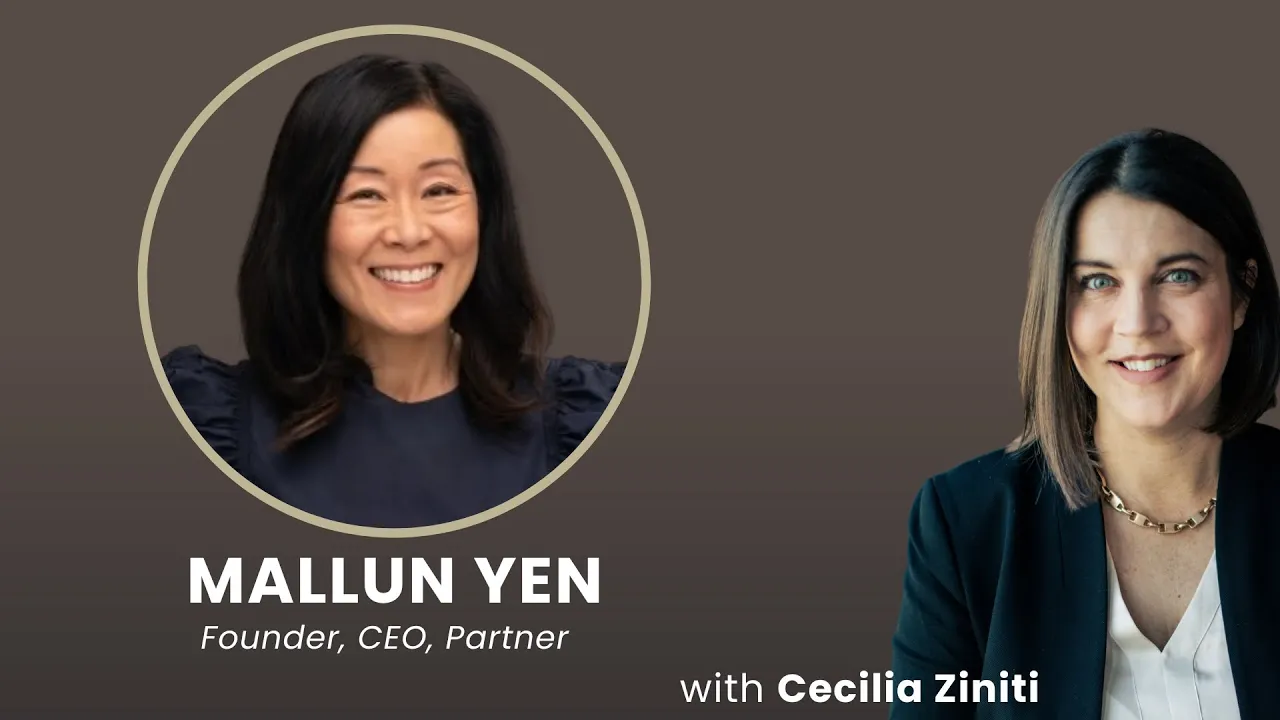
Mallun Yen has been nearly every kind of lawyer there is: district attorney's office intern, federal law clerk, patent litigator, tech transactions attorney, in-house counsel, and deputy general counsel and chief IP counsel at Cisco.
For years she hid the lawyer part when she became a founder and investor. Then she changed her mind.
Lawyers make great founders because legal training doubles as founder training. Both mean dissecting ideas to their essential claims, obsessing over what could go wrong, catching what someone else might pick at, and sitting with engineers to understand a product in detail.
In this episode, Yen tells GC AI co-founder and CEO Cecilia Ziniti why the outsider advantage beats pattern recognition, how she built a venture fund everyone said was unmanageable, and why every lawyer has a superpower worth building around. Along the way, Ziniti tells the story of how GC AI itself was founded.
About Mallun Yen
Mallun Yen is the founder and CEO of Operator Collective, a venture fund backed by more than 250 operator LPs who built and scaled companies like Salesforce, Stripe, and Google.
Before venture, she was Cisco's chief IP counsel and deputy general counsel, then a founder of RPX Corporation, the patent risk management company that went from zero to \$100 million in revenue and a public listing in three years, and was acquired by HGGC in 2018 for approximately \$555 million.
In 2005 she co-founded ChIPs, the nonprofit advancing women in tech, law, and policy, which she says now counts 30 chapters and 7,500 members worldwide.
Key Takeaways
Legal training doubles as founder training. Yen hid being a lawyer for years, then realized that dissecting ideas, anticipating objections, and refusing to let details slip are the exact skills that build a company.
Not knowing the unwritten rules is an advantage. Every major move in Yen's career, from patent litigation to structuring Operator Collective's 250-LP model, went against advice from people who knew the old model too well.
Being informed is table stakes; having an opinion is the job. Yen tells her team what she once told her own lawyers: do not just list the risks, say what you would do.
Collective intelligence beats individual brilliance. Operator Collective runs on more than 250 operator LPs instead of one partner's network, which Yen sums up as "one plus one equals a thousand."
Solve the problem you know more deeply than anyone else. Yen built RPX out of living inside Cisco's patent troll problem, and Ziniti says GC AI exists because she was obsessed with AI while serving as Replit's general counsel.
Why Do Lawyers Make Great Founders?
Legal training teaches founders their core skills long before they know they need them, the instincts to dissect an idea to its essential claims, catalog everything that could go wrong, and hold onto details that cannot fall through the cracks. Yen, an IP attorney by training, spent years talking to engineers about what made their inventions different. That is customer discovery and product diligence by another name.
For a long time, Yen did not want anyone in her investor circles to know she had been a lawyer. She wanted to be known as a founder. Legal felt like a signal that sent people's minds in the wrong direction.
Yen explains what changed:
"As a lawyer, we are taught to dissect everything. What are all the things that could possibly go wrong, which is what you need to do as a founder, right? And you have to obsess about the details. You can't let things fall through the cracks. What is somebody else gonna pick at?... I actually think it's great training."
How Do You Stop Being "Just the Lawyer"?
Learn the fundamentals first, then use your voice. Yen holds lawyers and investors to the same rule. Your job is not to list the risks and stop. Your job is to be informed enough to have an opinion, then give it. A decision has to be made, and the "on the one hand, on the other hand" memo is only table stakes.
Yen credits blunt mentors. At Cisco, general counsel Mark Chandler's harshest feedback was blunt: "You sound like a lawyer." Ziniti heard the same message at Amazon, where Melissa Chaw, then VP and deputy general counsel, told her, "You are a business person with a legal skill set."
Yen said:
"Your job is not to tell me what the risks are.... Your job is to have an opinion. But to be informed enough to have an opinion."
That's the same discipline great GCs use to turn risk analysis into an actual decision.
What Is the Outsider Advantage?
The outsider advantage is knowing a field well enough to work in it without knowing it so well that the existing way feels like the only way. Every major move Yen made was one people advised against, from leaving patent litigation at its heyday for a small tech transactions group, to leaving the chief IP counsel role at Cisco, to structuring a venture fund around 250 operator LPs when conventional wisdom said that was unmanageable.
The people saying no knew more about how things had always been done than she did. That was the point.
"Had I been in venture, I might have said, oh yeah, that's not gonna work. And I just wouldn't have done it.... I knew enough about venture to know you've got to comply with the regulations, you know what the structure is, et cetera. But then I could rebuild it from the ground up to optimize for operators."
ChIPs is her favorite proof. In 2005, a reporter's article pointed out there were only seven women serving as chief IP counsel at major tech companies. The seven had lunch, then decided to plan a conference. None of them had ever planned one. The organization now spans 30 chapters and 7,500 members.
"Sometimes it's good not to know, because if we knew how much work it was, we might not have done it."
How Does Collective Intelligence Beat Individual Brilliance?
Operator Collective runs on distributed expertise from more than 250 operator LPs, many of them women over 40 juggling full-time executive roles. Yen built the fund so they could take part without leaving those day jobs.
No single partner hunting deals alone can match what that collective knows across enterprise software, which is how most venture firms still operate.
The model traces straight back to her Cisco years, when patent troll litigation pushed her and her peers at other tech companies to band together rather than fight alone, the insight that became RPX.
"The collective is always stronger than the individual.... It's not just one plus one equals two. It's one plus one equals a thousand."
It also fits who Yen is. She is not on X, does not want to be the face of a brand, and would rather point at the extraordinary people around her. Her advice to investors: "you miss the people who don't look like the usual suspects... who can bring something amazing to the table because they're an outsider.... look beyond the usual suspects."
How Do Lawyers Find Their Superpower?
Figure out what you know more deeply than anyone else, then build around it instead of spending energy fixing what does not come naturally. That is Yen's advice to every lawyer eyeing entrepreneurship, and she notes you do not have to quit your job to follow it. Keep the salary, pay the loans, and build on the side around something you cannot stop thinking about.
Her own answer is rooted in family history. Her father was an immigrant engineer who etched circuit boards in the garage, held patents, and once pitched Sequoia; she found the rejection letter only after he died. She worked in the family's businesses from age 12 and hated it. Only years later did she connect the dots, tracing her path as a patent attorney, a founder, and a compulsive builder back to him.
"Everyone out there has a superpower. Own it, know that you do, and lean into it. There is something that you know and you love and really understand more deeply than anyone else. Just find out what that is, because you all have it.
Recommended Reading
Why "Outsiders" Make Great Founders: Mallun Yen on Collective Intelligence and Owning Your Power: the companion blog write-up of this same conversation.
How Great GCs Think About Growth, Risk, and Crisis Management: a natural next read on turning risk analysis into decisions and having an opinion, the through-line of Yen's advice.
AI for General Counsel: One Operating Layer for Solo GCs to Full Departments: how legal AI gives lawyers back the time for the judgment-heavy, high-leverage work Yen describes.


