

Dive Deeper
Transcript
Episode Overview
What makes an effective general counsel? Joseph Schohl breaks it into eight essentials across two sides, personal and organizational: the GoPro mindset, decision-making and judgment, communication skills, breadth and depth, partnering with the business, and protecting the organization.
Schohl built that framework the hard way. His first year as a general counsel meant closing a company-doubling acquisition and surviving what was then the longest FTC approval process to date, flying to Washington, D.C. every Sunday for 10 months.
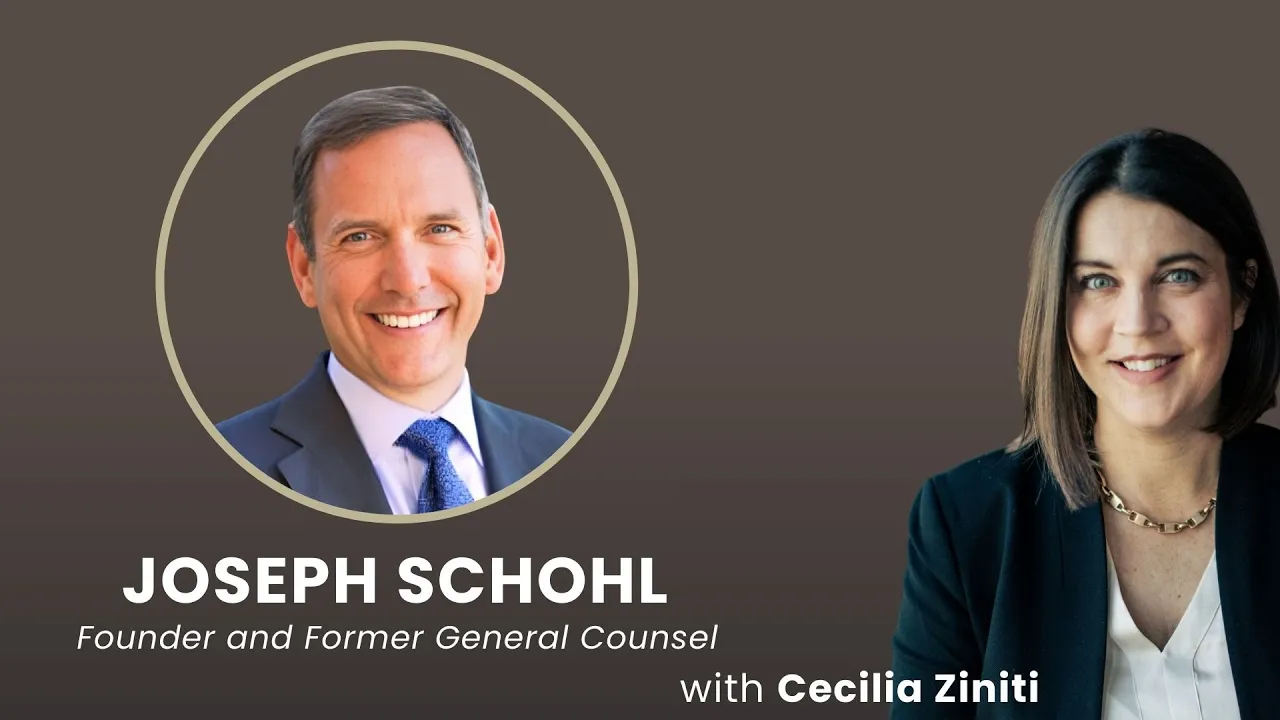
In this conversation with GC AI co-founder and CEO Cecilia Ziniti, Schohl walks through six of the eight essentials, how he uses AI as the sixth step in his daily routine, and why there is no single career path to the GC chair.
About Joseph Schohl
Joseph Schohl is Co-Founder of Inside Counsel Academy and Founder of GeneralCounselWest. He was General Counsel at DaVita and has served as GC or CLO five times across his career.
Key Takeaways
Confidence comes from surviving situations you weren't sure you could handle. Schohl's first year as GC meant closing a company-doubling acquisition and flying to Washington, D.C. every Sunday for ten months through what was then the longest FTC approval process on record.
Cross-functional communication moves your career further than subject expertise. Schohl says the coaching advice he trusts most is that getting five percent better at a legal specialty helps far less than getting ten percent better at communicating across the business.
A GC can never say "that's not my area of expertise." Schohl says you make unfamiliar territory your area quickly if the company needs it, a lesson he confirmed across dozens of interviews with other GCs who each took a different path to the chair.
A blunt CEO conversation is a real test of the role. Told shortly before a deal closed that he might not lead the combined company, Schohl put a stake in the ground, telling his CEO he would keep acting as GC until someone told him otherwise.
A GC's daily routine now ends with an AI check-in. Schohl closes each workday with a five-step checklist, then added a sixth step in late 2025, asking his AI platforms what they can help him prepare, research, or draft, after demoing every tool a podcast guest recommended and keeping the four that stuck.
What Is the First Year as a New General Counsel Really Like?
For Schohl, the first year meant closing a company-doubling acquisition, surviving what was then the longest FTC approval process to date, flying to Washington, D.C. each Sunday for 10 months, and building a legal team, all while learning a business he had joined 24 hours before the deal started.
Schohl on what that first year taught him:
"In a job like that, you're really going to find out what you're capable of in terms of breadth and depth ... Everything that's come since has seemed much easier because of that." "Confidence is built by being put in situations where you don't know if you're going to be successful and you figure out a way to do it and you learn from that ... It's not really a fake it till you make it."
How Do You Handle a CEO Who Says You Might Not Keep the GC Job?
Schohl named the tension out loud, slept on it, then committed fully. Shortly before the deal closed, his CEO told him the target company had its own general counsel, and Schohl might not lead the combined entity.
Here is how he responded, first in the room and then the next morning:
"We'll see how things work out, and if they don't work out for me here, I assume you'll treat me fairly on the way out. I sort of put a stake in the ground." "I'm the GC now, so I'm going to be the GC until somebody tells me I'm not ... I'm not going to sit here with every decision plagued with doubt ... I'm going to go all in."
Is There One Career Path to the GC Chair?
No. Schohl assumed his own route was the standard, then started interviewing general counsels on his Becoming the GC podcast and found the opposite. No two paths matched.
Dozens of interviews later, his takeaway was blunt:
"Everybody has their own path and they're wildly different. You can make it to the GC chair if you're a litigation associate, you can be a regulatory lawyer, you can be doing something that seemingly has no relation when you're at the law firm." "You can never be a GC and say that's not in my area of expertise ... You better make it your area quickly if that's what the company needs."
What Are the 8 Essentials of an Effective General Counsel?
Inside Counsel Academy organizes the qualities of an effective general counsel into eight essentials, four personal and four organizational. On the show, Schohl named six of the eight. He covered all four personal essentials, plus organizational essentials six and seven.
The Four Personal Effectiveness Essentials
1. A GoPro mindset: Schohl means treating in-house law the way an NBA player or a world-class musician treats their craft, a chosen profession worth performing at your highest level, backed by self-care, sleep, and continual learning.
2. Decision-making and judgment: Ask CEOs what they want most in a GC and they will say judgment, and Schohl rejects the idea it cannot be taught, arguing frameworks and after-action reviews accelerate it.
3. Communication skills, written, verbal, and cross-functional: As Schohl told Cecilia, "If you're going to move up as an executive, it's communication and judgment."
4. Breadth and depth: A GC is expected to know something about everything, and Schohl points to legal AI as today's accelerant for building that breadth.
The Organizational Effectiveness Essentials
Schohl named the two that anchor this side. Essential six is partner with your business, and essential seven is protect the organization, which he maps to the partner-guardian tension Ben W. Heineman Jr. describes in The Inside Counsel Revolution.
That same balance runs through how great GCs approach growth, risk, and crisis.
How Does an Effective GC Use AI Every Day?
Schohl closes each workday with what he calls his Big Five (inbox zero, review calendar, update task list, enter time, pick tomorrow's top three), and in late 2025 he added a sixth step. He now asks his AI partners what they can help him prepare, research, or draft.
He got there by researching the best legal AI tools for in-house counsel the way he researches anything else. He heard Sterling Miller discuss AI adoption on The Legal Department podcast, demoed every tool Miller mentioned, and kept the four that stuck.
He now uses those four platforms daily and told Cecilia on air: "I know it's not a promotion, but GC AI is the number one most powerful one that I use."
He also took GC AI's legal AI classes, which he credits with accelerating his understanding of AI across his practice.


