


Dive Deeper
Transcript
Episode Overview
Bill Berry banned the legal memo at Verkada. His team skips the M&A jargon, joins product conversations from day one, and sounds less like lawyers and more like business partners.
Berry has grown Verkada's legal team from three lawyers to about 20 since 2022, the same stretch in which the company grew from under 1,000 employees to more than 2,300. Ariana Goodell joined as senior counsel for privacy and policy, choosing Verkada over a VP of Legal title at her last company because the work fit her curiosity better.
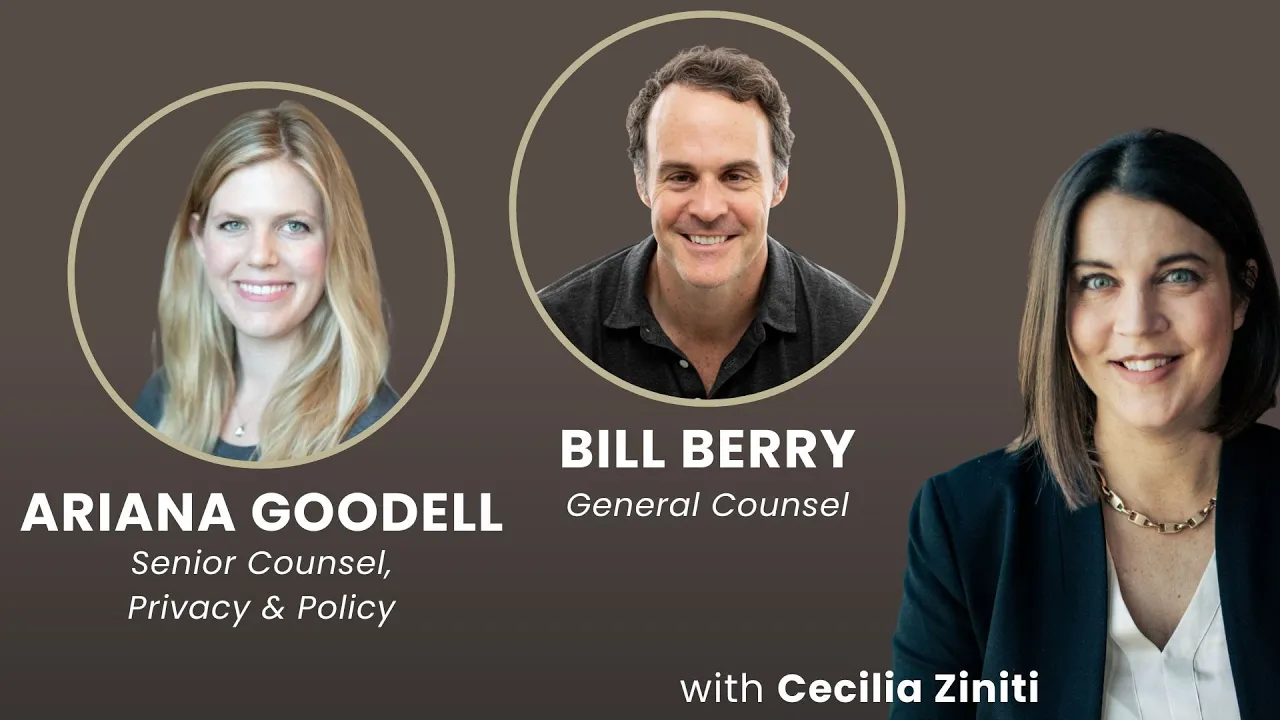
How do you build an in-house legal team the business trusts? On this episode of CZ and Friends, Berry and Goodell walk GC AI co-founder and CEO Cecilia Ziniti through their formula. Hire for chaos tolerance over big egos, cut the legalese, put legal in the room while products are still being built, and treat AI literacy as table stakes.
Legal shows up as a business partner from the first conversation, not just the closing signature.
About Bill Berry and Ariana Goodell
Bill Berry is General Counsel at Verkada, a cloud-based physical security and smart building company whose products span cameras, access control, alarms, guest management, and air quality sensors for schools, government agencies, and enterprises. Berry joined in 2022, when Verkada had fewer than 1,000 employees.
The company has since grown to 2,300 employees across 17 offices worldwide, and his legal team has grown from roughly three lawyers to about 20. Before Verkada, Berry held legal roles at Google, where he ran a litigation team managing roughly 1,000 active cases, and at Tesla.
His path to the law was anything but linear: an electrical engineering degree, the Navy, business school, and then a law degree he pursued because his identical twin brother was doing the joint program.
Ariana Goodell is Senior Counsel for Privacy and Policy at Verkada, where she advises on products at the intersection of AI, biometrics, and physical security, including cameras with facial recognition and biometric access control. She began her career as a litigation associate at Reed Smith, where she sought out extra work from partners with tech clients, and was Cecilia's outside counsel associate on privacy before GDPR had come out.
She later spent five years in-house at Branch as VP of Legal, then moved to Verkada because the work in privacy and AI mattered more to her than the title.
Key Takeaways
Ego is not a prerequisite for ambition. Berry built Verkada's legal team on that conviction after watching Google's hire-the-big-personality playbook up close; a hint of ego in an interview moves a candidate down a notch.
Kill the legalese. No legal memos, no M&A lingo in stakeholder emails, because clear communication is survival at a company that more than doubled headcount in three years.
Be in the boat. Legal joins product conversations at the start and says the business objective out loud, so product managers can represent legal's considerations even when no lawyer is in the room.
Federate your advice. Verkada's product suite runs from air quality sensors to facial recognition, so Goodell meets each product team individually, at its own maturity level.
Use AI to learn AI. Then start with the low-hanging fruit: Goodell built her technical literacy by asking an LLM baseline questions, and Berry's working group started with contract review and first drafting.
How Do You Build a Legal Career Without a Linear Path?
Neither guest planned their way here. Berry will tell you he is not a model for career planning; he followed opportunities from engineering to the Navy to business school to law school. What the jagged path taught him is the kind of environment where he does his best work.
Berry put it this way:
"I thrived more when I had a lot of balls up in the air juggling rather than one big thing to work on. ... I am drawn to that chaos."
Every company he has landed at, Google, Tesla, and Verkada among them, shared that quality. A thousand things happen at once, and all of it requires judgment and speed.
He also punctures a myth about the giants. The Google litigation team he ran tracked its roughly 1,000 active cases on a spreadsheet because the homegrown tool did not work well.
Big companies are not the well-oiled machines outsiders imagine, and tolerance for that operational mess is a personality trait worth hiring for.
Goodell's version of the same through line is curiosity. As a Reed Smith litigation associate she stacked extra projects from partners with tech clients on top of her regular workload just to stay close to the work that excited her, then kept following that work in-house, even when it meant giving up a bigger title.
"I've always wanted to feed my curiosity about being a better lawyer, a better thinker, a better problem solver. Sometimes your linear career path from a role perspective doesn't line up with your personal fulfillment."
How Do You Hire In-House Lawyers Without Big Egos?
Berry's hiring philosophy was shaped by watching what he did not want to replicate. At Google, the prevailing wisdom favored the big personality who would get things done through force of will.
It produced results, and it produced a culture Berry chose not to carry forward. Tesla reinforced the lesson from the other direction: a famously outsized personality at the top, and almost no room for ego below it.
When Berry started building Verkada's legal team, the anti-ego filter became deliberate. A hint of ego in an interview moves a candidate down a notch, whatever the resume says.
"I don't think you need an ego to be ambitious. I don't think you need an ego to be driven. I don't think you need an ego to drive things to completion. You can do all that without an ego."
Instead, he screens for an authentic conversation.
Goodell's interview is his favorite example. He and Verkada's Chief Privacy Officer walked out in near-unanimous agreement before finishing the candidate slate.
"You won't feel like you're talking to a lawyer. You'll feel like you're talking to a person that's in the boat with them, making business decisions."
The screening ran both ways. Goodell asked Berry what kind of legal team he wanted to build ten years out, and talked to as many people on the team as she could, because the people a leader has already hired are the proof.
Her own hiring heuristic matches. The candidates who impressed her most asked questions that got to motivations, because understanding what moves people is what makes a lawyer effective inside a business.
How Should In-House Legal Partner With Product Teams?
The phrase that anchors the episode is Berry's. Legal should be in the boat with the business. In practice that means legal joins product conversations while features are being designed, because a compliance consideration heard early gets built in, while one heard late gets bolted on.
Berry's cautionary tale is the product name he learned about by happenstance that closely resembled a government agency's, which sent him sprinting down the hall before boxes got printed.
Goodell runs the day-to-day version of that philosophy. Her playbook:
Start every new stakeholder relationship with a non-work question, so the first interaction feels human.
Say the business objective out loud before raising a single legal consideration.
Educate product managers on legal's main considerations so they can represent legal in rooms where she is not present.
Get into roadmap and product planning meetings, because that is where you learn what is keeping teams up at night and why a P0 is a P0.
Know the difference between conference ready and launch ready, and flex accordingly.
Goodell summed up the mindset:
"When you verbalize the business objective for your internal client, it reminds them you're not just there to be a lawyer or provide advice that's not meaningful. You're doing it to help solve their problem."
Because Verkada's product suite is so wide, Goodell federates her advice. An air quality sensor and a facial recognition camera collecting biometric vectors do not carry the same sensitivity, and the product teams behind them run on separate roadmaps and separate back-end microservices.
So she meets each team where it is, rather than arriving with one privacy-by-design program and a deck.
Why Do In-House Lawyers Need AI Literacy?
Verkada was building on machine learning and computer vision before generative AI became a household phrase, so Goodell could not treat model training as someone else's domain. Her solution was to use AI to learn AI.
"I can't imagine trying to wrap my head around all the steps engineers go through to prepare data to train a model without having an LLM where I can just ask these baseline questions and go through the reasoning process myself."
She calls it a godsend, and she frames the larger point as a professional floor for any lawyer:
"If you want to do lawyering, there's a baseline AI literacy you're going to have to have. This is true for everybody at the company, but for lawyers especially, we're at a time right now where AI literacy is going to fill the gap where you can extend your skill set."
On the team side, Berry was deliberate about not boiling the ocean. His team, with 600 to 800 salespeople generating NDAs, reseller agreements, and vendor agreements upstream of it, formed a working group to find the low-hanging fruit first.
The use cases that stood out: legal research gut checks and first drafting, plus contract review, the workflow nearest to the team's daily load.
Berry's proof point was personal. Facing a secondary transaction policy with no template anywhere, he described what he wanted in a prompt and got a workable first draft that saved him a couple of hours of drafting time.
Goodell's verdict on where this leads is more time for creative lawyering, with outside counsel no longer supplying the first draft.
Recommended Reading
Performance Without Ego: How Verkada's Legal Team Earns the Trust of the Company: GC AI's own long-form profile of Bill Berry and Ariana Goodell (live companion piece to this episode page).
How Great GCs Think About Growth, Risk, and Crisis Management: Tricia Kinney on building a high-performance legal team, a natural next read after Berry and Goodell on team culture.
AI for Startup Legal Operations: How Lean Legal Teams Scale: the operational counterpart to Berry's low-hanging-fruit approach to AI adoption.


