You closed a new round of funding six months ago. Sales onboarded eleven new reps and the pipeline grew 4x. Procurement is sending vendor security addenda twice a week. The Head of People wants a 50-state contractor classification memo by Friday. You need more help. The CEO needs a board pre-read by Tuesday on the FTC’s new endorsement guides. Your inbox has 38 unread Slack threads tagged “legal,” and you are one lawyer. Maybe two, if you count the paralegal who started in March and is still ramping.
This is the inflection. The company outgrew the legal team you have. The question is whether AI gives the existing team the leverage to keep up, or whether you go to your CEO and ask for headcount.
AI for startup legal operations is how a lean in-house team carries the work of a function two or three times its size. The category covers legal AI platforms, AI-powered contract review, and the prompting practices that let one or two lawyers absorb the workload that used to require a hire.
Matthew Campobasso, Chief Legal Officer at Zone & Co., put the math plainly on the CZ and Friends podcast
“AI has become a force multiplier for us. My team of three lawyers, I would say in any given week, it’s probably between the work of five or six lawyers. And that is because of AI.”
The hire you defer at this inflection is real money. A Senior Counsel hire is a six-figure all-in commitment. GC AI at $500 per seat per month, and $5,000 a year per seat. Even at four seats, the platform pays for itself the first time it absorbs a workload that would have driven a hire.
When Growth Outruns Lean Legal Operations
The wall is predictable. The legal team that fit at 50 employees does not fit at 200. The contracts that were a manageable trickle become a daily torrent. Compliance asks that used to land once a quarter arrive every other week. The work has not become harder. It has become more, and there are still only two of you.
Sophie McNaught, Managing Director at Silicon Valley Bank and AI Risk Advisor at Primary Venture Partners, frames the founder’s risk plainly:
“The biggest risk is that you don’t exist in a year because you couldn’t figure out how to sell to your customers.”
The in-house lawyer’s parallel risk is the bottleneck version. The company sells, the contracts pile, the security questionnaires sit, and the strategic-counsel role you were hired for becomes a help desk you cannot leave.
Sarah Binder, General Counsel at BetterUp and former GC at Lime, sees this every quarter she advises in-house lawyers:
“AI is literally tipping every almost every business model, every operating model upside down. It’s a huge opportunity, but it also is risk if you don’t move smart enough.”

The trap for a lean legal team is to absorb the risk personally. To stay late, work weekends, ship lower-quality work, and tell yourself the headcount conversation has to wait for the next raise.
There is a faster path. AI extends the legal team you already have. Real leverage on the lawyers in the room, so the team can carry two-to-three times the throughput before the conversation about Counsel #2 even starts. Hiring stays on the table for when it is the right answer. AI buys the runway to know when that is, and gives the team data on what the next hire should specialize in.
Want to pilot on real work before the next budget cycle?
The Math: Why AI Comes Before Counsel #2
Hiring is the right answer at the right inflection. The question for any in-house lawyer running a lean team at a scaling company is whether that inflection is now or six months from now. AI buys the runway to find out.
Tricia Kinney, Chief Legal Officer at Consilio and a CZ and Friends guest, ran the same productivity math:
“A study from Harvard showed that on average it’s giving law firm lawyers about four hours back per week. If you’re billing a 40-hour week, that’s 10% of your time. Getting a 10% FTE on my team, that’s a massive, massive boost.”
On a three-person team, a 10% boost per lawyer is roughly a third of a fourth lawyer reclaimed. On GC AI’s December 2025 ROI study of 100+ customers, the average came in at 14 hours per lawyer per week, closer to a 35% FTE recovery per person.
Anirma Gupta, former Chief Legal Officer at Unity and a CZ and Friends guest, sees the ten-year arc of the in-house function:
“I think legal departments are going to be smaller, but for those who are willing to put in the effort to develop those judgment skills, I think there’s a lot of opportunity.”
The teams that build judgment plus AI leverage stay lean and grow influence. The teams that try to scale through headcount alone get squeezed.
The split between what AI carries and what the lawyer carries is the operating model. AI is reliable in 2026 on first-pass sales paper review (NDAs, MSAs, DPAs, vendor agreements, customer addenda), employment and HR pattern questions (multi-state contractor classification, PTO carryover, equity-grant edge cases, leave-policy details), vendor security and DPA negotiations, multi-jurisdiction surveys, first-pass “what’s market” research, and board-ready executive summaries.
The lawyer stays in the loop on every output, but the first pass is no longer the lawyer’s hours.
The lawyer drives the answer on judgment calls under uncertainty (whether to settle, whether to walk, whether to escalate to the CEO), stakeholder relationships and trust, novel regulatory questions the regulator has not yet ruled on, irrecoverable-cost calls (M&A indemnity caps, privacy breach disclosures, termination decisions), and cross-functional negotiation at 11pm with the deal closing the next morning. Move the first set to AI.
Keep the second set at the lawyer. The hours that come back are the hours you used to spend on the first list.
Five AI Applications in Legal Operations That Carry the Week
A legal AI platform earns its keep on the workloads that compound week-over-week. The five below are where lean in-house teams report the biggest measurable lift:
Sales paper review: NDAs, MSAs, DPAs, and vendor addenda
Employment and HR questions
Vendor security addenda and DPA negotiations
First-pass research and “what’s market” answers
Board prep, executive summaries, and regulatory translation
Sales Paper Review: NDAs, MSAs, DPAs, and Vendor Addenda
Sales paper is where the lean team’s week disappears. A scaling company closing four-to-six new customers a month is generating 20-40 contracts a month between MSAs, order forms, NDAs, and addenda. Multiply by the number of vendors procurement is bringing in, and a one-to-two-lawyer team is staring at 60-100 documents a month before any of the strategic work begins.
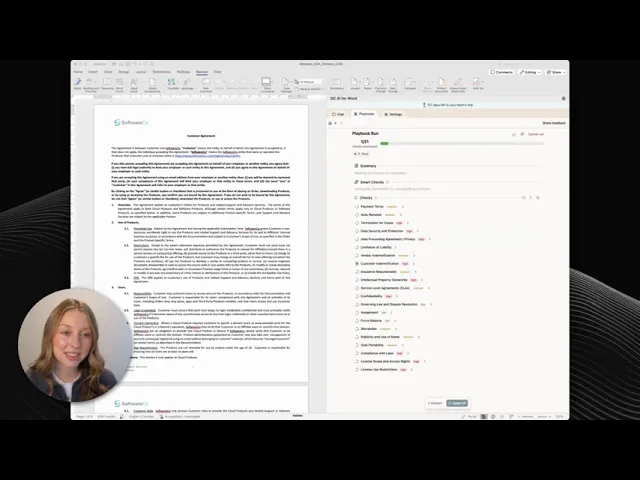
Contract AI for legal operations targets this workload directly. The pattern: upload the team’s playbook, train the platform on the standard positions, and let AI draft the first-pass redline. The lawyer reviews, calibrates the playbook over time, and the AI gets sharper run by run.
David Morris, Senior Counsel at Snyk, on the team’s response after a GC AI trial:
“This was the first time that after a trial, the team came to me and said, so we can’t live without this. Having rolled out electronic billing, contract management tools, no one ever was this excited about any legal technology ever.”
Adoption matters at lean-team scale because there is no slack budget for shelfware. If the team will not use it, it does not work.
The same first-pass review pattern applies at funding milestones. A startup GC working through a Series A or B closing is reviewing SAFEs, convertible note conversions, equity grant agreements, and IP assignments in a compressed window. AI-assisted first-pass markup compresses what used to be a multi-day outside counsel engagement into an internal review, with targeted outside counsel time reserved for the judgment calls: cap table edge cases, indemnification structure, reps and warranties. The volume is milestone-driven rather than weekly, but the leverage is identical.
Employment and HR Questions
Employment is the workload that compounds fastest as a startup grows. A 50-person company with one HR generalist is sending the GC three-to-five employment questions a week: PTO accrual in California vs Texas, contractor classification under California AB 5, equity acceleration triggers, leave-policy edge cases, performance-management documentation.
Most are pattern questions with answers in primary law and the team’s existing precedent.
Maury Bricks, General Counsel at ARKO Corp, on his shift from AI skeptic to power user:
“I was not using AI, proudly staying away from ChatGPT and everything, saying, you know, not needed. I’m smart. I can do my work. And Michelle showed me. I love how I type in like ‘please redline this document’ and then press easy prompt and it’s like, did you mean you wanted to know these 40 things? And I’m like, yes, that’s exactly what I wanted to do.”
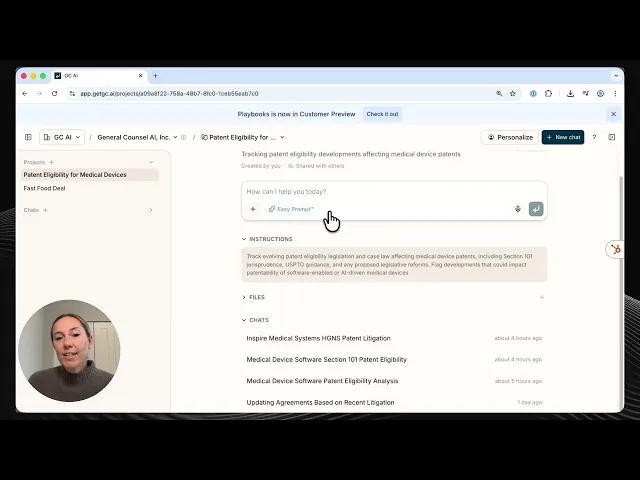
The Easy Prompt pattern (plain-language input, AI returns the structured forty-point answer) is exactly the leverage that lets a solo GC handle five employment questions in the time it used to take to handle one.
The pattern repeats across class transcripts. Bryan Ludwig, an attendee who walked through a procurement question on Executive Order 14275, broke it into four steps: define the regulatory exposure, summarize the rule, map it to the team’s contract clauses, draft a stakeholder response. AI carried the first three. The lawyer carried the fourth. For more on the drafting side of the workload, see our AI for legal document drafting guide.
Vendor Security Addenda and DPA Negotiations
Security and privacy lands the moment the company signs its first enterprise customer, and it scales with every customer after. Each new deal brings a security questionnaire, a DPA, sometimes a custom infosec addendum, and a back-and-forth with the customer’s security team that the in-house GC ends up mediating.
Ali Hartley, Chief Legal Officer at SimplePractice, on operationalizing the workload with AI:
“My security team has now built this really awesome prompt for vendor reviews. They’re using AI as sort of that first step in a vendor review. Previously, it used to take over like between three to six hours per vendor review. And now it’s down to less than 30 minutes.”
Three-to-six hours down to under 30 minutes is roughly 6-12x throughput on the same headcount. That is the math that lets a lean legal team defer a privacy counsel hire for another two quarters.
The pattern is identical across teams. Build a vendor review skill with the team’s standards baked in, run vendor paper through it, surface deviations, lawyer reviews and sends. The work compounds because each new prompt iteration encodes more of the team’s institutional knowledge.
First-Pass Research and “What’s Market” Answers
In-house lawyers spend a non-trivial share of the week on questions that start with “is this term standard” or “how does this play in another state.” AI technologies for scaling legal operations are well-suited to this work because the answer is research-shaped rather than judgment-shaped.
Eric Robinson, a banker who took the GC AI 101 class, used the platform to draft a crypto loan program memo with citations in a single sitting. His comparison to the pre-AI version:
“Could be December, I’d still be researching that stuff.”
The lift was not 50%. It was orders of magnitude.
The output is a research foundation. The lawyer verifies, edits, and ships in a fraction of the time and outside-counsel spend the project would have taken otherwise. For more on this workload, see our AI for Legal Research guide and our roundup of the Best AI Tools for Legal Research in 2026.
Board Prep, Executive Summaries, and Regulatory Translation
The hardest part of the in-house GC role at a scaling company is the translation layer. The CEO, the CFO, and the board do not need the torts-exam answer. They need a one-page narrative that captures the position, the risk, and the recommended action.
Jenna Hunt, Head of Legal Operations at Tipalti:
“We’ve built a prompt in our team that they then run through GCAI and it kind of gives an executive summary on the dumbed-down version of, hey, business owner of this new piece of technology, FYI, these are the things that you should be aware of.”
The Tipalti pattern (a saved prompt that consistently produces business-owner-facing summaries) is reproducible by any team. Build the prompt once, run it on every regulatory update, every contract risk, every litigation position. The GC’s executive translation layer scales without additional hours.
Consilio Chief Legal Officer Tricia Kinney‘s lens on the same problem:
“If you give them the torts exam answer where you’re just flagging all the parade of horribles that can happen, you’re going to lose them. You’ve got to speak in the language they understand.”
AI improves productivity in legal operations partly through hours saved, partly through the quality lift on the work that reaches executives.
Most contracts live in Microsoft Word. Try GC AI for Word on your next contract or executive summary.
The AI Stack for Startup Legal Operations
Most enterprise legal operations checklists assume a Director of Legal Ops, a CLM, an e-billing platform, a matter management system, a contract repository, GRC tooling, and a privacy platform. For a 50-300 person scaling company with one-to-five lawyers, that checklist is the wrong shape. The lean stack is shorter.
The reasoning layer
This is the most leveraged piece of the stack. A legal AI platform built for in-house counsel runs every response through a system prompt designed for legal work, and ships with a Word integration, a document repository, and a prompt library. It does the work of the next four enterprise tools.
GC AI is the recommended choice for in-house teams. Built by a 3x GC, every response runs through a 20,000+ line legal system prompt. 2,100+ in-house teams across 53 countries use it, including 200+ public companies and 25 unicorns, with an NPS of 77. Pricing is $500 per seat per month, no seat minimum, with a 14-day free trial and no credit card required.
The Word integration
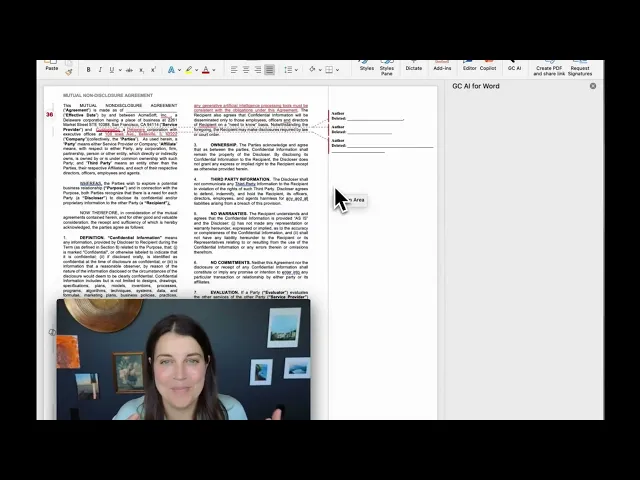
Most contracts live in Microsoft Word. GC AI for Word ships with Chat2 (web research from inside Word), Easy Prompt, the Skill Library, and Projects, so the team does not switch tools mid-document.
The document repository
A lean team needs one home for the team’s playbooks, standard agreements, security addenda, and prior memos. Files inside GC AI handles this: upload up to 1,500 pages at once into permanent collections accessible across every chat.
The prompt library
The repeatable workflows the team runs again and again, like NDA review, DPA redline, multi-state employment surveys, and vendor security questionnaires, live as named, version-controlled prompts. The Skill Library is the home for them. Teams that have not standardized this layer end up rewriting the same prompt twenty times.
What to skip until 5+ lawyers and 200+ contracts a year
Full CLM (Ironclad, Agiloft, Conga). A real implementation, with months of rollout, a dedicated admin, real change-management investment, and a material annual cost. The ROI lands at 5+ lawyers, 200+ contracts a year, or a procurement function mature enough to enforce intake. Below that bar, a CLM is overhead. The team is faster with a Files repository plus the AI platform.
E-billing platforms (Brightflag, Onit, SimpleLegal). Earn their keep when outside counsel spend is high and the team is managing more than five firms. Below that bar, a spreadsheet plus quarterly invoicing review is faster.
Standalone GRC tools (LogicGate, OneTrust GRC). Earn their keep when compliance is a dedicated function, which at scaling stage it usually is not.
What to pair the reasoning layer with
Lightweight intake (Streamline AI, Checkbox). If intake volume is high (10+ requests a week from sales, procurement, and people teams), an intake platform routes work and creates an audit trail.
Privacy and security (OneTrust, Vanta). If the company is selling enterprise (SOC 2, ISO 27001, GDPR), a privacy or security platform handles the audit and certification workflow. The legal AI platform does the analytical work. The privacy platform does the operational work. The two coexist.
Jeremy Siegel, General Counsel at LegalMize, on running this stack on the CZ and Friends podcast:
“I am a power user of GC AI. I love that I can create different profiles and it knows the risks I’m looking at fairly well now. My end product is just done much faster, much more efficiently than if I was doing it myself.”
The “different profiles” pattern (a separate Project per matter, with its own context and standards) is what lets a solo GC keep ten parallel matters straight without a full CLM.
Every vendor pitches “purpose-built.” It’s the legal AI version of “time is of the essence.” The way to test the claim is to run a real workload through the platform during the trial. Tools built primarily for law firms and startup attorneys, like Harvey and Spellbook, serve a different buyer than an in-house team. See GC AI vs Harvey, GC AI vs Spellbook, GC AI vs Legora, and GC AI vs LegalOn if evaluating the full field.
For a startup carrying $500K to $1M in outside counsel spend, the same 14% reduction reclaims $70K to $140K a year.
On a three-lawyer team, the 14 hours per lawyer per week reclaimed adds up to one full FTE of work absorbed without a hire. That is the runway you buy yourself between funding rounds, or between annual budget cycles, without adding Counsel #2.
The 52% adoption number from the October 2025 ACC and Everlaw GenAI Survey, where in-house counsel using generative AI more than doubled from 23% in 2024, tells the wider story: this is no longer a frontier experiment for in-house teams. It is the default. The competitive pressure is on the teams that have not made the move yet.
Hiring Signals AI Cannot Cover
Sooner or later, the right answer is to hire. The question is who, when, and how, and AI gives a lean team better data on all three than the function had a year ago.
Workload specialization. Privacy at 200 employees and enterprise sales. IP at a patent-heavy company shipping product. Securities at a pre-IPO process. The pattern is a single workstream consuming 30%+ of one lawyer’s week, with a depth of expertise past what AI plus a generalist can carry.
Cross-jurisdictional complexity. International entity formation. Multi-state employment with active litigation exposure. Cross-border data flows under GDPR, the EU AI Act, and a patchwork of state privacy laws. AI can summarize the landscape. A specialist holds the relationships with local counsel and makes the judgment calls.
Regulatory scrutiny. An FTC inquiry. An FDA pre-submission. EU AI Act exposure on a customer-facing model. A litigation hold from a state attorney general. When the regulator is in the room, the team needs depth that AI cannot provide.
Litigation. Active litigation is its own workload, with discovery management, deposition prep, and settlement strategy, and pulls a generalist GC out of the strategic-counsel role for months. A litigation counsel hire or a long-term firm relationship covers this.
The fifth signal is the diagnostic one. If outside counsel spend is up year-over-year despite the team using a legal AI platform, that means AI is not covering the work that is driving the spend. Look at where the bills are coming from. That is the role description for the next hire.
What AI helps you decide is the rest of the hiring conversation. By tracking which workloads consume the team’s week and which AI cannot carry, the team builds a real role description from data instead of guessing what a senior counsel might be useful for. The 14 hours per lawyer per week reclaimed is the buffer that lets the conversation happen on the team’s terms, with budget secured. And on day one of the new hire, the prompt library, the Files repository with two years of precedent, and the playbooks compress what used to be a quarter of training into weeks.
Diane Honda, Chief Administrative Officer at Redis and a CZ and Friends guest, on the in-house GC’s evolving role:
“In-house counsel is going to have to make the rules that don’t exist on the outside yet. That’s how our role is evolving in this new AI world. It’s a great opportunity to lead and not wait.”
The function the company hired you to be is one that uses AI to handle the workload mass and uses that bandwidth to lead. The hire reinforces that role when the data says it is time.
How GC AI Powers Startup Legal Operations
GC AI’s CEO and co-founder, Cecilia Ziniti, was a general counsel three times (Anki, Bloomtech, and Replit), and an in-house counsel at Amazon and Cruise. Ziniti built GC AI to solve the problems she encountered firsthand as an in-house lawyer. That experience is embedded directly into GC AI’s system prompt, tone, and workflows.
The day-to-day surface for a lean team is a chat interface next to a document workspace, plus the Word add-in. Five features carry most of the week:
Playbooks standardize contract review: upload the team’s standard positions once, and every NDA, DPA, or MSA runs through the same workflow, with deviations surfaced automatically.
Easy Prompt converts plain-language input into structured AI output: type “redline this document,” get back the forty-point answer the team actually needed.
Exact Quote pulls character-level verbatim citations from uploaded documents, making every research output defensible when a CFO or board member asks for the source.
Projects holds context and chat history per matter, so a two-lawyer team runs a dozen parallel contracts and negotiations without losing thread between sessions.
GC AI for Word puts the full stack inside Microsoft Word, with the Skill Library, Chat2 web research, and Easy Prompt accessible without leaving the document.
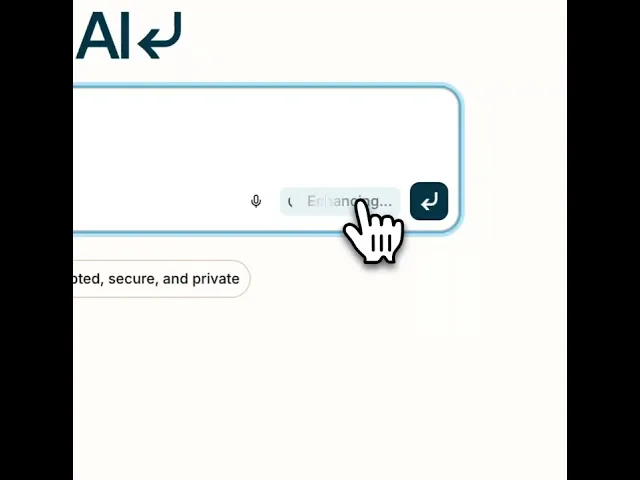
For a lean team starting a trial: spend day one running two or three real NDAs through the pre-built Playbook.
Build the first custom employment Q&A Skill in week two, trained on the questions that landed in Slack this month.
By month one, the vendor review workflow should be running on real DPAs and calibrating to the team’s positions with each pass. The Skill Library compounds: each prompt the team builds captures institutional knowledge in a version-controlled home that is there the day a new lawyer joins, or when a vendor sends paper at 11pm.
GC AI is SOC 2 Type II and SOC 3 certified, GDPR compliant, with zero data retention agreements with OpenAI and Anthropic, and AES-256 encryption. See the full security overview. Education comes with the platform: free, California CLE-eligible classes (101, 105, 106, 107, 201) taught by former general counsels at GC AI Classes, with 6,000+ lawyers having completed the courses to date.
Want to run GC AI on your own work?
Frequently Asked Questions
What is AI for startup legal operations?
AI for startup legal operations is the bundle of legal AI platforms, AI-powered review tools, and AI prompting practices that lets a lean in-house legal team move faster, ship better work, and scale as the company grows without proportional headcount growth. The category covers contract review, employment and HR Q&A, vendor security and DPA work, multi-jurisdictional research, and executive summarization. According to the December 2025 GC AI ROI study of 100+ active customers, in-house lawyers using a purpose-built legal AI platform save 14 hours per week, reduce outside counsel spend by 14%, and report 21% greater perceived accuracy than generic AI.
When Does AI Make Sense for a Startup Legal Team?
AI makes sense for a startup legal team when the volume of pattern work (contract review, vendor DPAs, employment Q&A, research) is outpacing what the team can carry, but the company is not yet at the scale where full CLM or additional headcount is justified. For most venture-backed teams, that inflection lands at Series A or B, when the contract trickle becomes a weekly torrent. The practical signal: if two or more lawyers are regularly working nights and weekends on work that is not judgment-shaped, AI is the right answer before a hire.
What Workloads Should a Lean Legal Team Give to AI First?
The highest-leverage starting point is the contract review workload: NDAs, MSAs, DPAs, vendor addenda, and employment agreements. These are high-frequency, pattern-shaped, and time-consuming, and a legal AI platform can run first-pass review against a saved Playbook in minutes. After contracts, the next best workloads are vendor security and DPA negotiation (SimplePractice CLO Ali Hartley cut vendor review from three-to-six hours to under 30 minutes), employment and HR Q&A, and first-pass research. Board prep and executive summaries deliver the highest-leverage output for the team’s internal relationships.
How Much Time Can AI Actually Return to an In-House Lawyer?
Per the December 2025 GC AI ROI study of 100+ active customers, the average is 14 hours per lawyer per week, with 97.5% of teams seeing value before month one. At three lawyers, that is 42 hours a week reclaimed, close to one full additional FTE. The Harvard study Consilio CLO Tricia Kinney cited found four hours per week for law firm lawyers; in-house teams on purpose-built platforms consistently report higher numbers because the platform is tuned to in-house workflows rather than litigation and deal work.
What Does a Lean AI Stack Actually Look Like for a 1-5 Lawyer Team?
The lean in-house AI stack has four layers. The reasoning layer is a legal AI platform built for in-house work: GC AI includes a chat interface, Word integration, document repository, and Skill Library in one platform. The Word integration (GC AI for Word) puts the full stack inside Microsoft Word with redlining, Chat2 web research, and Easy Prompt. The document repository holds playbooks, precedent, and standard agreements. The prompt library standardizes repeatable workflows as named, version-controlled Skills. Skip full CLM, e-billing, and standalone GRC platforms until the team grows past five lawyers and 200+ contracts a year.
How do AI-powered legal operations platforms compare to general-purpose AI like ChatGPT?
In the GC AI In-House Legal Bench (May 2026), GC AI scored 86.8% across 100 in-house legal tasks, ahead of ChatGPT (79.8%), Claude (68.4%), and Gemini (57.5%). Purpose-built legal AI platforms are tuned on in-house workflows, score 21% higher on perceived accuracy than general-purpose AI in customer testing, and ship features (Exact Quote citations, Playbooks, Skill Library, Word integration) that general-purpose AI does not have. General-purpose AI is a useful bridge for non-privileged horizontal work but is not a replacement for a legal AI platform on contract review, regulatory research, or anything client-confidential.
Does contract AI for legal operations work for vendor DPAs and security addenda?
Yes. Vendor DPA and security addendum review is one of the highest-leverage contract AI workloads for lean in-house teams. SimplePractice CLO Ali Hartley reported the team’s vendor review time dropped from three-to-six hours to under 30 minutes after building a vendor review prompt inside GC AI. The pattern: build a skill with the team’s security and privacy standards baked in, run vendor paper through it, surface deviations, lawyer reviews and sends.
What Are the Benefits of AI in Legal Operations in 2026?
The benefits of AI in legal operations in 2026 are quantitative and qualitative. Quantitative: 14 hours per lawyer per week saved, 14% reduction in outside counsel spend, and $70,000 to $140,000 in annual savings for a startup carrying $500K to $1M in outside counsel spend. Qualitative: better executive translation work, more strategic counsel time, and a clearer signal about what the next hire should specialize in.
What Legal Tasks Should a Startup In-House Lawyer Never Hand Off to AI?
A lean legal team should keep five categories at the lawyer level: settlement calls and litigation strategy, novel regulatory questions the regulator has not yet ruled on, cross-functional negotiations where trust and relationship matter (deal closes, board conversations), irrecoverable-cost decisions (M&A indemnity caps, privacy breach disclosures, termination decisions), and any output going to a regulator, court, or opposing counsel without attorney review. AI is reliable on first-pass and research-shaped work. The lawyer carries judgment, relationships, and accountability.
How Does AI Affect the Decision to Hire Another Lawyer?
AI shifts the hiring decision from time pressure to signal clarity. Without AI, a lean team hires Counsel #2 when the inbox is unmanageable, which is often the wrong reason and the wrong role. With AI absorbing high-frequency pattern work, the team can track which workloads are not being absorbed, and those workloads become the role description for the next hire. AI does not replace the hire; it changes when the hire happens and what the hire should be.
What Are the Clear Signals That It Is Time to Hire Instead of Relying on AI?
Five signals indicate it is time to hire rather than extend AI: a single workstream (privacy, IP, securities) consuming 30% or more of one lawyer’s week; cross-jurisdictional complexity requiring local counsel judgment calls; regulatory scrutiny (FTC, FDA, EU AI Act, state AG); active litigation pulling a generalist GC out of the strategic role; or outside counsel spend growing year-over-year despite AI use. If outside counsel spend is up despite AI, AI is not covering the work driving the spend.
What Security Standards Does GC AI Meet?
GC AI is SOC 2 Type II and SOC 3 certified, GDPR compliant, with zero data retention agreements with OpenAI and Anthropic, and AES-256 encryption. The platform is used by 2,100+ legal teams across 53 countries, including 200+ public companies and 25 unicorns, with an NPS of 77. Enterprise teams can access GC AI under SSO and managed procurement. See gc.ai/security for the full compliance and data-handling overview.
How Is GC AI Priced for a Startup Legal Team?
GC AI is priced at $500 per seat per month, with no seat minimum and a 14-day free trial (no credit card required). Annual billing is $5,000 per seat per year. The platform includes the full feature set at every tier: Playbooks, Easy Prompt, Exact Quote, Projects, Files, Skill Library, GC AI for Word, and CLE-eligible classes. An Enterprise tier is available for teams needing SSO and managed procurement. See gc.ai/pricing for current details.