

Dive Deeper
Transcript
Episode Overview
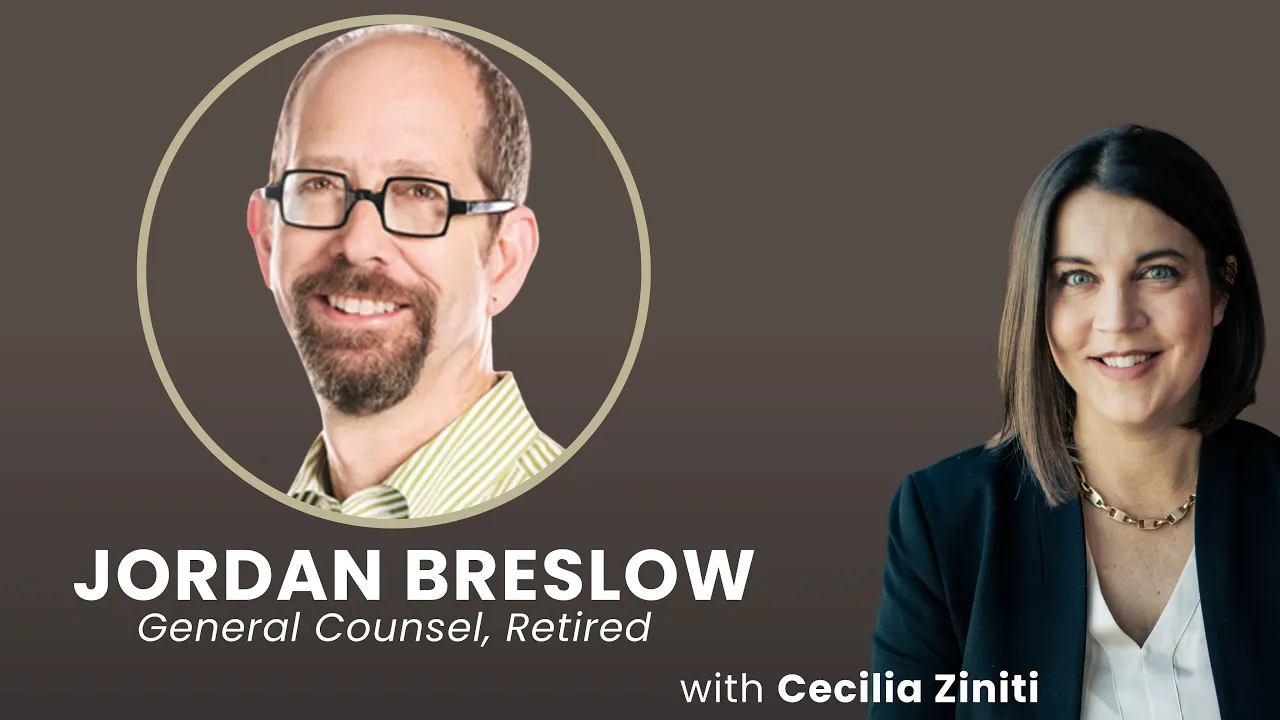
An essay on hiring a general counsel published by a16z tells the story of a GC whose “resounding no” saved Ben Horowitz and Opsware “from a massive legal headache and a potential jail sentence.” On this episode, Jordan Breslow tells his side of it.
Breslow’s answer to how a general counsel says no to the CEO starts with years spent finding ways to say yes. When a common practice finally sets off your gut, study it until you understand it, then say no plainly, even if the priciest law firms in Silicon Valley disagree.
Breslow and GC AI co-founder and CEO Cecilia Ziniti cover four IPOs, the stock option backdating scandal, plain English lawyering, and whether AI companies owe the creators whose work trains their models.
About Jordan Breslow
Jordan Breslow spent four decades in-house at some of the defining technology companies of the internet era. He graduated from Hastings Law School in 1980, built his own technology practice in Walnut Creek, and became Geoworks' first in-house counsel.
As general counsel of Opsware, he guided the company from its Loudcloud origins through its \$1.6 billion sale to Hewlett-Packard. After serving as general counsel at Silver Spring Networks and working at New Island Capital, an impact investment firm, he joined Etsy as general counsel and led its 2015 IPO, the largest certified B corporation to go public at the time.
He taught as an adjunct at UC Berkeley and NYU Law while practicing, and the American Bar Association's Landslide magazine profiled his career in 2017. Now retired on Lake Tahoe's North Shore, he plays in a band called Down the Rabbit Hole and mentors young lawyers who find him on LinkedIn.
Key Takeaways
Handling unfamiliar legal work starts with confessing what you don't know. Facing a bridge loan on day two of his career, Breslow called a friend to ask what one was, then built his career on the same method: call someone who knows, study hard, and never copy a document he doesn't fully understand.
A rare no carries more weight after a long record of yes. Breslow says Ben Horowitz trusted his call on stock option pricing because Breslow had spent years finding ways to say yes first.
Trust your gut even when the priciest law firms disagree. Prominent Silicon Valley firms said backdating stock option grants was acceptable, but Breslow said no anyway, and Opsware stayed out of the SEC's sweep that later sent executives to jail.
Plain English is part of a company's brand, not just a courtesy. During Etsy's IPO, Breslow sent every document back to outside counsel until it read in plain language, since legalese would have contradicted a company built around small creators.
Legal and technically correct aren't always the same as right. Breslow wants an ASCAP-style licensing system that compensates the writers and artists whose work trains AI models, even though he agrees current copyright law does not require it.
How Do You Handle Legal Work You Have Never Done Before?
Breslow's method for handling unfamiliar work leans on strong outside counsel, hard study of each new area before touching it, real relationships instead of a reliance on title, and a refusal to copy and paste a document he does not fully understand. He built it on day two at Geoworks, when the company president asked him to handle a bridge loan and he had to phone a friend to ask what one was.
Breslow had left firm life because he dreaded it. "I don't like time sheets. I don't like billing," he said on the episode. "It's boring. It's tedious. It's thankless."
When Geoworks, a Berkeley startup looking for its first in-house counsel, called, he turned them down. Six months later he called back and said he would be there Monday.
Then came the bridge loan. He smiled, said of course, waited for the door to close, and called a friend.
Breslow put it this way:
"There's just no way one can be prepared for all the things that get thrown at you as a general counsel. The word general fits. You've got to do IP and technology and human resources and so many different things."
That experience became the prototype for four IPOs. In his first, at Geoworks, Breslow played a small role, mostly connecting bankers and lawyers with the people inside the company who knew the facts.
By his fourth, at Etsy, he was running the process. His point for newer GCs is that you cannot walk into a complex transaction assuming you will add a ton of value.
Find where you can contribute, then grow into the lead, the same arc great GCs describe when they think about growth, risk, and crisis management.
How Does a General Counsel Say No to the CEO?
Build a long track record of yes first. Breslow's rule, the one he repeats to the lawyers he mentors, is to find a way to say yes as many times as possible, so that a no carries weight.
Then, when your gut flags something, do the research, take advice, and deliver the no plainly, without hedging.
The test came at Opsware after the company went public. A new CFO arrived with a practice from a previous employer, pricing stock option grants at the lowest point the stock had traded in the previous 30 days.
Nobody called it backdating yet. Horowitz asked Breslow what he thought.
Breslow researched it, talked to other GCs, and consulted outside counsel.
Prominent Silicon Valley law firms said it was acceptable, and everybody was doing it.
"It still didn't feel right to me, and I guess what my gut was saying is just because everybody's doing something doesn't make it right."
Breslow told Horowitz he was not comfortable with it and did not think they should do it. Horowitz trusted him, and Opsware passed.
Shortly after, the SEC launched a sweeping investigation into option backdating. Companies paid large fines, people went to jail, and some general counsels lost their jobs.
The a16z essay on hiring a general counsel credits that "resounding no" with saving Horowitz and Opsware from "a massive legal headache and a potential jail sentence."
Why did the no land? Breslow explained:
"I was in the habit of finding a way to say yes as many times as I possibly could."
He is candid that this takes time. A first-year lawyer cannot start a career vetoing the CEO.
Trust in yourself, and others' trust in you, compound over years of being the ally who looks for a way to yes. And the best no comes with an alternative already in hand, something else that still gets the other person the result they want. It is the same judgment that no AI tool can replace for in-house counsel.
Why Should IPO Documents Be Written in Plain English?
Because the people reading them, employees, shareholders, customers, and merchants, deserve documents they can understand, and because a company's legal voice is part of its brand. At the Etsy IPO, Breslow and his CFO decided the outside lawyers and bankers would not dictate the process, and plain English became the standing order.
The army of IPO lawyers arrives with vetted documents they are terrified to change. Breslow sent them back anyway.
"I sent back to our outside counsel every single document that they sent to me and said, rewrite it. I want it redone in English."
Etsy's entire identity was built around small creators and human connection. Legalese would have been a brand contradiction.
"Whether it's the employees, the shareholders, or the customers, the merchants, I didn't want to hit them with incomprehensible documents," Breslow said.
He won most of those battles. The ones he lost were the ones where outside counsel said, credibly, that changing the language would create liability exposure the company could not afford.
The Etsy IPO carried a second first. Etsy went public as the largest certified B corporation at the time, and Breslow wove that status into the prospectus and worked the questions directly with the SEC.
He pushed further, meeting with Delaware officials about reincorporating Etsy as a public benefit corporation, a status that gives directors legal obligations to stakeholders beyond shareholders.
Delaware's rules did not change in time for the IPO, and the shareholder vote threshold made conversion close to impossible afterward. Etsy listed on April 16, 2015 at \$16 a share.
Should AI Companies Pay the Creators Whose Work Trains Their Models?
Breslow does not think the law requires it, but he believes the right answer is a licensing system modeled on music. ASCAP and BMI let venues and performers use copyrighted songs commercially while routing compensation back to the people who wrote them.
Nothing comparable exists for the authors and artists whose work trains commercial AI models, and Breslow thinks it should.
He comes at the question from both sides. He was Etsy's general counsel, where brand and IP protection filled his days, and he is a working musician who plays cover songs every summer on Tahoe's North Shore.
When his band plays someone else's song, a mechanism exists to pay the writer. Not much, he jokes about his tens of dollars a year in music income, but it functions.
"If you're using all the works of all these authors to train your AI model, you don't have to pay them for it, at least under copyright law. That seems like the right, technically correct answer, but it feels wrong... It bothers me that they're going to profit off the labor of all of these authors."
Breslow referenced the reasoning in the Anthropic copyright case, where Judge William Alsup held in June 2025 that training a model on lawfully acquired books was "exceedingly transformative" fair use, an analogy to a person who reads a book and learns from it.
Breslow accepts the logic as far as it goes, as long as the model is not regurgitating copies. But for him, the moral question settled in the same place his gut settled on option pricing two decades earlier, where technically permissible and genuinely right point in different directions.
That instinct, sitting with an unsettled area of law and making good judgments anyway, is exactly what he thinks companies need from a GC in the AI era.
What Advice Does a Four-IPO General Counsel Give Young Lawyers?
Breslow's advice for young lawyers has three parts, leading with praise, choosing your battles, and being yourself. Breslow credits the first to Chuck Katz, his predecessor at Loudcloud:
"I don't think you inspire great work out of anybody through fear and intimidation."
The second and third come from his own record of doing the job against type.
Horowitz once wrote in Breslow's annual review that he was doing everything right and getting all the results, and that his one piece of advice was to show more bravado. Breslow still laughs about it.
He was never the loudest person in the boardroom, never the shoulder-punching jock the review seemed to want, and he became the GC Horowitz trusted with the company's hardest call anyway.
"I think a lot of us grow up seeing lawyers on television and trials, and we have this whole image of how lawyers are supposed to behave... I'm not full of bravado, and yet I was very successful in what I needed to do. Because I was myself."
The personality you bring to the work is what makes the judgment yours. That judgment is the job.
Recommended Reading
Why Judgment Is the New Superpower for In-House Lawyers in the Age of AI: why judgment becomes the differentiator as AI absorbs routine work, the same instinct Breslow trusted on the backdating call.
How Great GCs Think About Growth, Risk, and Crisis Management: reframing risk from a parade of horribles into likely scenarios, a companion to Breslow's say-yes-then-say-no method.


